Real Jardín Botánico de Madrid: What to Expect Before You Visit
One of Europe's oldest royal botanical gardens, the Real Jardín Botánico de Madrid sits beside the Prado Museum along the Paseo del Prado. Founded in 1755 and part of a UNESCO World Heritage landscape since 2021, it holds around 5,500 living plant species across terraced grounds that reward slow, deliberate exploration.
Quick Facts
- Location
- Plaza de Murillo 2, 28014 Madrid (Retiro district, beside the Prado Museum)
- Getting There
- Metro Line 1 – Atocha; Metro Lines 1/2 – Banco de España (10-min walk). Multiple EMT bus lines along Paseo del Prado.
- Time Needed
- 1 to 2 hours for a relaxed visit; up to 3 hours if an exhibition is on at Pabellón Villanueva
- Cost
- General admission: €4. Reduced (students 18–25, 65+, large families): €1. Groups (10+): €2. Some temporary exhibitions add €2–5. Free entry Tuesdays 10:00–13:30 for under-18s.
- Best for
- Plant lovers, architecture enthusiasts, museum-circuit breaks, spring blossom walks, quiet afternoon escapes
- Official website
- rjb.csic.es
What the Real Jardín Botánico Actually Is
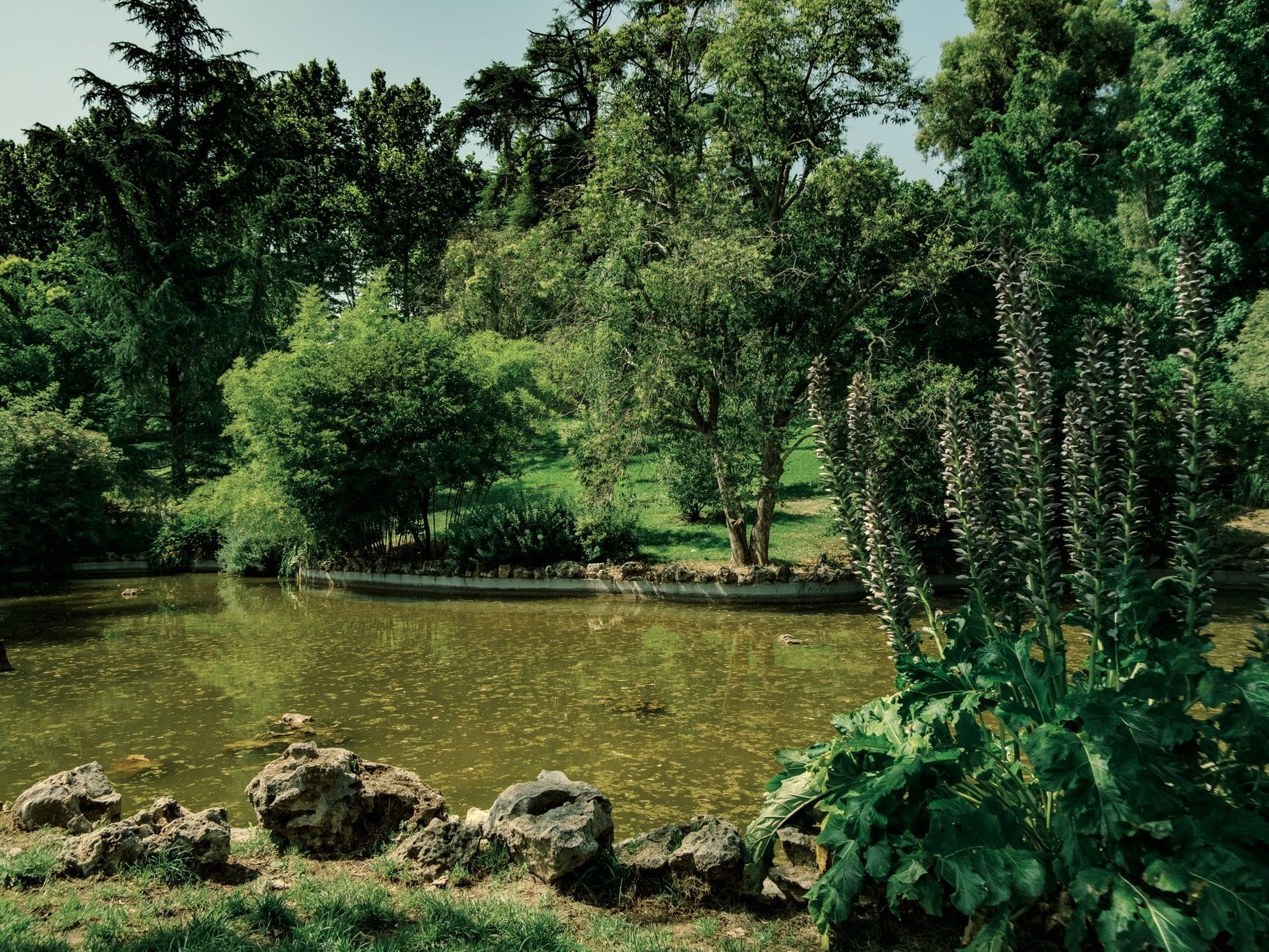
The Real Jardín Botánico de Madrid, or Royal Botanical Garden of Madrid, is a working scientific institution as much as it is a public garden. Managed by the Consejo Superior de Investigaciones Científicas (CSIC), Spain's national research council, it functions as a living plant library and active herbarium. For visitors, that dual identity matters: the grounds are maintained with a precision you don't find in ornamental city parks, and the labeling of species throughout the garden gives the place a quiet, instructive quality.
The garden covers roughly 8 hectares and is organized across three terraced levels. The lowest terrace contains the formal botanical school parterre, where plants are arranged by taxonomic classification. The middle terrace holds the historic quadrant gardens with medicinal and aromatic plants, trees, and ornamental beds. The upper level, the terrace of trees, is shadier and more park-like in feeling, with large mature specimens that provide real cover on a hot afternoon.
💡 Local tip
Pick up a paper map at the ticket desk. The garden's layout is logical but not immediately obvious from the entrance, and the map identifies the greenhouse sections and exhibition pavilion that first-time visitors often miss.
History: From a Royal Curiosity to a UNESCO Landscape
The garden's origins trace to 1755, when King Ferdinand VI established a botanical garden by royal decree at the Huerta de Migas Calientes, a site near the Manzanares River. Its purpose was scientific: to cultivate and study plants arriving from Spain's overseas territories, making it an instrument of Enlightenment-era natural history.
King Charles III ordered its relocation to the current site on the Paseo del Prado in 1781. The move was part of the broader transformation of the Paseo del Prado into Madrid's so-called Salón del Prado, an urban corridor of scientific institutions that also included the natural history cabinet (now the Prado Museum) and what would become the Reina Sofía. The garden's neoclassical iron gates and the Pabellón Villanueva, its main exhibition building, date from this late 18th-century redesign.
In 1942, the garden was declared an Artistic Garden. More significantly, in July 2021, it became part of Madrid's Paseo del Prado cultural landscape, recognized by UNESCO as a World Heritage Site under the designation "Paisaje de la Luz" (Landscape of Light). That designation covers the entire boulevard corridor from the Prado to the Retiro, placing the botanical garden in one of Europe's most formally recognized urban heritage zones.
Tickets & tours
Hand-picked options from our booking partner. Prices are indicative; availability and final rates are confirmed when you complete your booking.
Flexible time Real Madrid: Bernabeu Stadium & Museum Entry
From 42 €Instant confirmationMonasterio de las Descalzas Reales guided tour
From 13 €Instant confirmationReal Madrid Bernabeu Stadium tour and gourmet tasting
From 79 €Instant confirmationFree cancellationMonasterio de las Descalzas tickets and guided tour
From 19 €Instant confirmationFree cancellation
The Experience: What You See, Smell, and Hear Inside
Walking through the main entrance on Plaza de Murillo, the shift in atmosphere is immediate. The stone and iron gate, the gravel underfoot, and the sudden drop in ambient street noise create a clear threshold between city and garden. On weekday mornings, you share the paths mainly with researchers, older local visitors reading on benches, and a few tourists working methodically through the terraces.
In spring, roughly March through May, the garden is at its most aromatic. The rose collection on the lower terrace produces a concentration of scent that is hard to find in an urban environment. Wisteria runs along some of the walls in April. The bonsai collection, housed in a dedicated area near the upper terrace, draws sustained attention from visitors who might otherwise walk past it.
Summer afternoons are hot, and the garden's limited tree cover on the lower terraces means direct sun exposure. The upper tree terrace becomes the obvious destination after 14:00 in July and August. The greenhouses, which hold tropical and subtropical collections, feel paradoxically cool relative to an August afternoon outside, though the humidity inside is notable. The garden stays open until 20:30 in summer, and the last two hours of the day, with low slanted light crossing the parterre beds, are quite pleasant.
Autumn brings a different quality: the large deciduous trees on the upper terrace produce color from October onward, the crowds thin after mid-September, and the cooler air makes extended walks easier. Winter visits are quieter still. The garden closes at 18:00 from November through February, which means arriving by 15:00 gives comfortable time to cover everything without rushing.
The Pabellón Villanueva and Temporary Exhibitions
The Pabellón Villanueva, named after architect Juan de Villanueva who also designed the Prado, sits at the center of the garden and hosts rotating temporary exhibitions on botanical illustration, natural history, and ecology. These are worth checking before your visit: the program changes several times a year, and past shows have included major collections of 18th-century scientific illustrations from the garden's own archive.
Entry to an active exhibition requires a ticket supplement of €2 to €5 on top of the general admission fee. This can be purchased at the gate or online. If you arrive with a specific exhibition in mind, check the garden's official website in advance, as some shows require timed-entry reservations that fill up on weekends.
ℹ️ Good to know
The garden's own herbarium, one of the largest in Spain with over a million preserved specimens, is a research facility and not open to general visitors. The exhibitions at Pabellón Villanueva are the closest public access point to that collection.
Practical Walkthrough: Getting There and Getting Around
The most direct approach is from the Atocha metro station (Line 1), a 5 to 7-minute walk north along the Paseo del Prado. You pass the back wall of the garden before reaching the main entrance gate on Plaza de Murillo. The entrance faces the east side of the Museo del Prado, which makes this an easy addition to a Prado visit, or a good place to decompress after several hours inside a museum.
The garden opens daily at 10:00 and is closed only on 25 December and 1 January. Closing times vary by season: 18:00 in November through February, 19:00 in March and October, 20:00 in April and September, and 20:30 from May through August. This seasonal schedule matters practically: a winter visit allows only 8 hours of operating time, and the light fades fast in December.
Wheelchairs are available at the entrance free of charge, and the main paths across the terraced areas are accessible. The terrain does involve gentle slopes between levels, but the gravel paths are well-maintained and wide enough for strollers. Baby strollers and wheelchairs can navigate all the primary routes without difficulty, though some narrower secondary paths between beds are not accessible.
⚠️ What to skip
The garden has very limited shade on the lower and middle terraces. In July and August, midday visits between 12:00 and 16:00 can be particularly uncomfortable. Bring water and sun protection, or plan your visit for early morning or the final two hours before closing.
Photography Inside the Garden
The Real Jardín Botánico is one of the more photogenic spots in Madrid for close plant work: macro textures, botanical illustration compositions, and early-morning dew on the lower parterre are all accessible without competing with large crowds. The neoclassical gate at the Plaza de Murillo entrance photographs best in mid-morning, when the light comes from the east and catches the ironwork directly.
Photography for personal use is permitted throughout the garden. Commercial or professional photography typically requires prior authorization from the CSIC administration; check the official website for current policy before any professional shoot.
Fitting It Into a Larger Itinerary
The garden sits at the southern end of the Paseo del Prado cultural corridor. Combining it with the Prado, the Museo Thyssen-Bornemisza, and the Museo Reina Sofía makes for a full-day art and culture circuit, with the garden serving as the natural interlude between museums. If you are doing only one museum that day, the botanical garden makes a more relaxed extension of a Prado visit than walking the full Paseo del Prado in afternoon heat.
From the garden's north exit, Parque del Retiro is a 5-minute walk east. The two green spaces are often visited in sequence: the botanical garden for focused, quiet exploration, and Retiro for more open park behavior. They serve different functions and the contrast between them is actually useful to understand what each space offers.
Travelers thinking through a broader Madrid schedule can check the best museums in Madrid guide to understand how the botanical garden fits alongside the major collections nearby. For spring visits specifically, the garden is covered in the Madrid in spring guide, which includes other seasonal highlights in the Retiro area.
Insider Tips
- Tuesday mornings between 10:00 and 13:30 are free for visitors under 18, which also means they attract school groups. If you want quiet, avoid Tuesday morning and instead visit on a weekday afternoon in October or November.
- The bonsai collection near the upper terrace is genuinely impressive but easy to walk past without the map. Ask at the ticket desk to mark it if the map is unclear.
- The garden's own café is small and can run out of seating quickly at midday on weekends. If you want to eat nearby, walk five minutes north along the Paseo del Prado rather than waiting for a table inside.
- If a temporary exhibition is running at Pabellón Villanueva, buy the combined ticket at the gate rather than online unless timed-entry is required. The queue for tickets is rarely long on weekdays, and the combined ticket is only marginally more expensive.
- The final hour before closing in summer (19:30 to 20:30) is the single best time to visit. Temperatures drop, the light turns golden across the parterre, and most visitors have already left.
Who Is Real Jardín Botánico de Madrid For?
- Travelers who need a quiet pause after several hours inside the Prado or Reina Sofía
- Plant enthusiasts, botanists, or anyone interested in 18th-century scientific history
- Photographers looking for botanical close-up subjects and neoclassical architectural details
- Visitors in spring who want to see Madrid's rose and wisteria season at close range
- Families with young children who want accessible green space near the museum district
Nearby Attractions
Other things to see while in Retiro:
- CaixaForum Madrid
CaixaForum Madrid is a striking cultural centre on Paseo del Prado, housed in a converted early-20th-century power station redesigned by Herzog & de Meuron. Alongside rotating international exhibitions, it features a celebrated vertical garden by botanist Patrick Blanc and sits within walking distance of the city's three great art museums.
- Estanque Grande del Retiro
The Estanque Grande del Retiro is a vast artificial lake at the center of Parque del Retiro, created in the 17th century for royal festivities and now open to everyone for free. Rent a rowboat, watch street performers, or simply sit on the surrounding promenade as the Alfonso XII monument reflects in the water.
- Museo Nacional del Prado
The Museo Nacional del Prado holds one of the most important collections of European art in the world, with around 7,000–8,000 paintings spanning five centuries of Western painting. Located on the Paseo del Prado in the Retiro district, it is the cultural centerpiece of Madrid and the reason many visitors come to the city at all.
- Museo Nacional Centro de Arte Reina Sofía
The Museo Nacional Centro de Arte Reina Sofía is Spain's national museum of 20th-century art, housed in a converted 18th-century hospital near Atocha station. Its permanent collection includes Picasso's Guernica and major works by Dalí and Miró, making it one of the most significant modern art institutions in Europe.