Paseo del Prado: Madrid's UNESCO Boulevard and Cultural Spine
Paseo del Prado is Madrid's most storied urban boulevard, stretching from Plaza de Cibeles south to the Atocha railway station. Lined with fountains, classical architecture, and three of Europe's great art museums, it earned UNESCO World Heritage status in 2021 as part of the 'Paisaje de la Luz' (Landscape of Light). Entry to the boulevard itself is free, and it rewards visitors at every hour of the day.
Quick Facts
- Location
- Between Plaza de Cibeles and Plaza del Emperador Carlos V (Atocha), Retiro district, Madrid
- Getting There
- Banco de España (Line 2) at north end; Estación del Arte (Line 1) at south end
- Time Needed
- 1 hour for the boulevard walk; half a day if combining with museums
- Cost
- Free to walk; individual museums charge separate admission
- Best for
- Architecture lovers, art-museum hopping, morning walkers, first-time Madrid visitors
- Official website
- www.esmadrid.com/en/tourist-information/paseo-prado
What Paseo del Prado Actually Is
Paseo del Prado is not a park and not a museum. It is a broad, tree-lined urban boulevard running roughly 1 kilometre north to south through central Madrid, connecting the Neptune and Cibeles fountains at its upper reaches down to the Glorieta del Emperador Carlos V at Atocha. The word 'paseo' translates simply as 'promenade', and that is the accurate description: this is a public walkway where Madrileños have been strolling, meeting, and watching city life for over four centuries.
What elevates it above most European boulevards is the concentration of institutions on either side. The Museo del Prado, the Museo Thyssen-Bornemisza, and the Museo Reina Sofía all sit within a short walk of the central axis, earning the area the informal label 'Golden Triangle of Art'. In July 2021, the boulevard and the adjacent Retiro Park were jointly inscribed as a UNESCO World Heritage Site under the name Paisaje de la Luz, Landscape of Light, in recognition of the urban planning ideas that shaped this part of the city from the 18th century onward.
ℹ️ Good to know
The boulevard itself is free to walk at any hour. The three major museums alongside it charge separate admissions and have their own opening hours. Plan your day accordingly if you intend to combine the walk with a museum visit.
Four Centuries of Urban Planning in One Walk
The origins of Paseo del Prado go back to the reign of King Philip II in the 16th century, when the area was developed as one of Europe's earliest formal tree-lined promenades. At that point, it served as a leisure ground on the eastern edge of the city, offering shade and social space to Madrid's court-influenced population. The concept was ambitious for its era: a designed public corridor intended as much for display and sociability as for movement.
The boulevard's present appearance owes most to an 18th-century transformation under King Charles III, the reformist Bourbon monarch who also gave Madrid its street lighting and drainage system. Charles commissioned the Salón del Prado project, with landscape work by José de Hermosilla and the iconic fountains by architect Ventura Rodríguez. The Fuente de Neptuno and Fuente de Cibeles date from this period. Charles III's ambition was to give Madrid a monumental public space that could rival Paris or London, and the result is largely what you see today.
Over the following two centuries, major institutions were added along the boulevard's flanks. The Prado museum building, originally conceived as a natural history museum, opened as an art gallery in 1819. The Museo del Prado now holds one of the world's most important collections of European painting, including the largest holdings of Velázquez and Goya in existence. Across the avenue, the Museo Thyssen-Bornemisza occupies the 19th-century Villahermosa Palace. Further south, the Museo Reina Sofía anchors the lower end of the corridor in a converted 18th-century hospital, its steel and glass towers by Jean Nouvel added in 2005.
Tickets & tours
Hand-picked options from our booking partner. Prices are indicative; availability and final rates are confirmed when you complete your booking.
Paseo del Arte pass for Museo Nacional Thyssen-Bornemisza, Reina Sofia Museum and Prado Museum
From 37 €Instant confirmationGuided visit of the Prado and Reina Sofia museums
From 68 €Instant confirmationFree cancellationImperial Madrid walking tour
From 16 €Instant confirmationFree cancellationMadrid Prado Museum Ticket and In-App Audio Tour
From 36 €Instant confirmation
Walking the Boulevard: What You Actually See
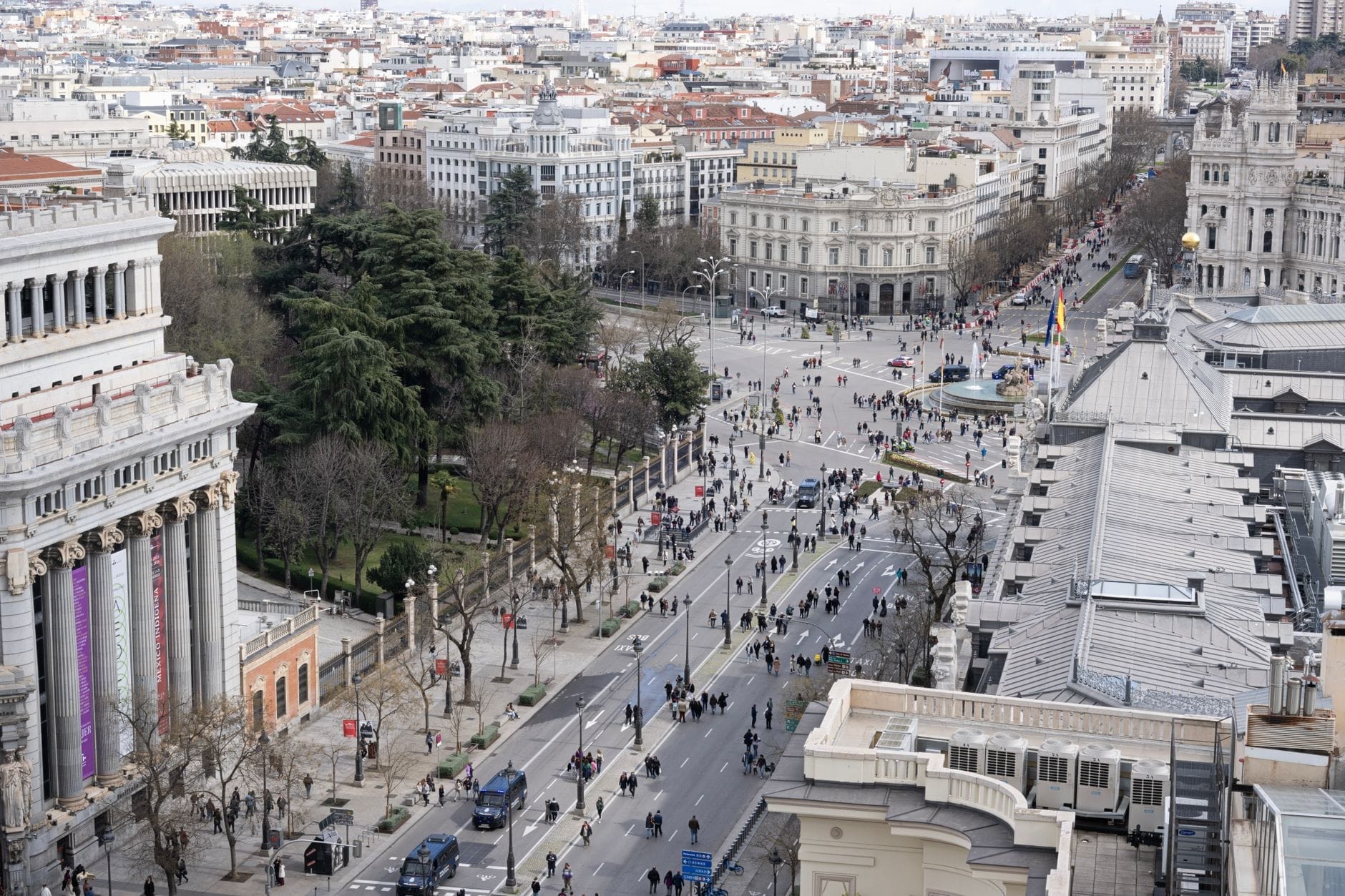
Starting at the northern end, Plaza de Cibeles greets you with the neoclassical Cibeles Fountain at its centre and the Palacio de Cibeles (the city hall, its tower open to the public for panoramic views) on the northwest corner. The visual force of this plaza is considerable: the white stone buildings are framed on clear days against a deep blue Castilian sky, and the fountain itself, depicting the goddess Cybele in a chariot drawn by lions, is one of Madrid's most recognisable images.
Walking south from Cibeles, the boulevard widens into a central pedestrian promenade flanked by double rows of plane trees. The shade they provide is real and welcome in summer, when Madrid regularly exceeds 35°C. Benches appear at regular intervals, and the central walkway is wide enough that even on busy days it does not feel congested. If you are exploring the broader area, the Retiro district stretches east from the boulevard, with the El Retiro Park just a few minutes' walk from the Prado entrance.
Midway along, the Fuente de Neptuno fountain marks the informal heart of the promenade. The Neptune roundabout sits between the Prado and the Thyssen, with the palatial Westin Palace Hotel visible to the west. This junction is where the boulevard's dual identity becomes clearest: it is simultaneously a piece of 18th-century urban design and a functioning city thoroughfare, with taxis, buses, and cyclists moving around its edges while pedestrians occupy the central strip.
The southern stretch toward Atocha passes the botanical garden entrance on the east side, the Real Jardín Botánico, which dates from the same Bourbon reform era as the boulevard itself. The walk ends at the Glorieta del Emperador Carlos V, a large roundabout anchored by the ornate Atocha station building. The old Atocha terminal, while architecturally distinct from the newer high-speed rail section, now famously contains a tropical garden inside its 19th-century iron and glass structure.
How the Experience Changes Through the Day
Early mornings, between roughly 7am and 9am, belong to local residents. Joggers use the central promenade as a running route, dog walkers move in clusters near the tree lines, and the fountains catch the low eastern light without any tourist crowds around them. The stone surfaces are cooler, the traffic is lighter, and the boulevard's proportions are easier to appreciate without other people filling the frame. If you want photographs of the Cibeles fountain without tour groups in the foreground, this is your window.
By mid-morning, museum queues form at the Prado entrance and the first tour groups appear. The central promenade becomes busier but never uncomfortably so on most days. Midday in summer is the one time to exercise caution: the heat radiating from stone pavements can be intense, and the shade from the plane trees, while helpful, covers only the central strip. Carrying water is not optional in July and August.
Late afternoon, from about 5pm onward, is when the boulevard returns to a more relaxed pace. Museum visitors emerge and drift toward the central promenade. Café terraces on the streets adjacent to the boulevard fill up. The light in Madrid in late afternoon takes on a particular quality at this altitude, 667 metres above sea level, turning the stone facades of the Prado and the Villahermosa Palace a warm amber. This is the hour most photographers aim for.
💡 Local tip
The stretch between the Neptune fountain and the Prado entrance is at its best in the hour before sunset in spring and autumn. The light, the moderate temperatures, and the relatively reduced foot traffic combine in a way that mid-morning visits rarely match.
Practical Walkthrough: Getting There and Getting Around
The boulevard has no gates and no opening hours. You can arrive at any time. For transit, Banco de España station on Metro Line 2 deposits you directly at Plaza de Cibeles, the natural starting point for a north-to-south walk. Estación del Arte on Line 1 is a few minutes' walk from the Reina Sofía and the Atocha end. Both stations are marked on Google Maps without ambiguity.
If you are combining the boulevard with the surrounding area, the walk connects naturally to the Parque del Retiro to the east via the Prado's side entrance, and to the Real Jardín Botánico directly adjacent on the south-eastern flank. Both are worth considering if you have time beyond the boulevard itself.
BiciMAD bike-share docking stations are located along and near the boulevard, making it easy to extend a ride toward the Retiro park or south toward Madrid Río. The terrain is flat throughout. Wheelchair access is available along the main promenades, with curb ramps at crossings, though visitors with mobility requirements should check the current status of specific metro station lifts before arrival, as these can vary.
Weather, Seasons, and Realistic Expectations
The best seasons for the boulevard are spring (April to May) and early autumn (September to October). Temperatures are in the range of 18–25°C, the trees carry full foliage, and the light is at its most photogenic. Winter visits are entirely possible and can be atmospheric: the plane trees are bare, the fountains are still, and the fewer tourists mean the neoclassical architecture is easier to read without distraction.
Summer is the main caveat. July and August are hot in Madrid, regularly above 35°C and occasionally above 40°C. The boulevard is an exposed stone environment and becomes uncomfortable between noon and 5pm without shade, water, and a clear plan. That said, a morning walk followed by a few hours inside the air-conditioned Prado or Thyssen is a sensible summer strategy. For a broader view of how the seasons affect the city, see the best time to visit Madrid guide.
Rain is occasional in spring and autumn but rarely persistent. The central promenade has covered sections near the museum entrances. Winter fog, when it occurs, creates an unusual atmosphere along the boulevard that regular visitors sometimes prefer to the tourist-season clarity.
Is It Worth Your Time?
For first-time visitors to Madrid, Paseo del Prado is as close to non-negotiable as a free attraction can be. It is the physical axis around which much of Madrid's most significant architecture and cultural infrastructure is organised. Walking its length takes under 30 minutes at a relaxed pace and provides a clear orientation to the city's scale, its Bourbon-era planning ambitions, and its relationship between public space and major institutions.
That said, the boulevard is primarily a connective and contextual experience rather than a destination in the way a museum is. Visitors expecting dramatic visual spectacle at every step may find the middle sections of the walk somewhat utilitarian. The real payoff is the sequence: arriving at Cibeles from the north, reading the fountain and the palace together, walking south through the tree corridors, and arriving at the Neptune junction with the Prado on your left and the Thyssen on your right. This sequence makes the boulevard's historical ambition legible in a way that no single photograph communicates.
Travellers who want to understand how the boulevard fits into a full itinerary will find the best museums in Madrid guide useful for planning which institutions to prioritise alongside the walk.
Insider Tips
- The Fuente de Neptuno and Fuente de Cibeles are both lit after dark, and the boulevard takes on a different quality in the evening when traffic eases and the central promenade belongs almost entirely to pedestrians. An evening walk from Atocha to Cibeles, starting around 9pm in summer, is a genuine local experience.
- The Prado's main entrance queue on the Paseo can be long in high season. The Goya entrance on Calle de Ruiz de Alarcón, on the museum's western side, often has shorter waits and is used primarily by those who have pre-booked tickets online.
- The Palacio de Cibeles viewpoint (on the roof of the city hall building at the plaza's northwest corner) gives you a north-facing view back down the boulevard. It is one of the less-visited high viewpoints in central Madrid, often overshadowed by the Círculo de Bellas Artes terrace nearby.
- If you are visiting in spring, the Real Jardín Botánico at the boulevard's southern end has rose blooms that peak in May and early June. The garden's entrance is modest in price and the crowds are far smaller than at the major museums.
- Bike-sharing is an underused option for the boulevard. A BiciMAD bike lets you ride the full length in minutes and then continue south toward Madrid Río without needing another metro change.
Who Is Paseo del Prado For?
- First-time visitors who want a free, walkable introduction to Madrid's historical and cultural core
- Architecture and urban history enthusiasts drawn to 18th-century Bourbon city planning
- Art travellers using the boulevard as a logical route connecting the Prado, Thyssen, and Reina Sofía
- Early-morning joggers and walkers looking for a flat, tree-lined urban route in central Madrid
- Photographers seeking neoclassical fountains and long stone perspectives in good natural light
Nearby Attractions
Other things to see while in Retiro:
- CaixaForum Madrid
CaixaForum Madrid is a striking cultural centre on Paseo del Prado, housed in a converted early-20th-century power station redesigned by Herzog & de Meuron. Alongside rotating international exhibitions, it features a celebrated vertical garden by botanist Patrick Blanc and sits within walking distance of the city's three great art museums.
- Estanque Grande del Retiro
The Estanque Grande del Retiro is a vast artificial lake at the center of Parque del Retiro, created in the 17th century for royal festivities and now open to everyone for free. Rent a rowboat, watch street performers, or simply sit on the surrounding promenade as the Alfonso XII monument reflects in the water.
- Museo Nacional del Prado
The Museo Nacional del Prado holds one of the most important collections of European art in the world, with around 7,000–8,000 paintings spanning five centuries of Western painting. Located on the Paseo del Prado in the Retiro district, it is the cultural centerpiece of Madrid and the reason many visitors come to the city at all.
- Museo Nacional Centro de Arte Reina Sofía
The Museo Nacional Centro de Arte Reina Sofía is Spain's national museum of 20th-century art, housed in a converted 18th-century hospital near Atocha station. Its permanent collection includes Picasso's Guernica and major works by Dalí and Miró, making it one of the most significant modern art institutions in Europe.