Parque del Retiro: Madrid's Great Urban Park
Covering 125 hectares in the heart of Madrid, the Parque del Buen Retiro is the city's most beloved green space. A UNESCO World Heritage Site since 2021, entry is free, and the park rewards visitors at nearly any hour.
Quick Facts
- Location
- Retiro district, Madrid. Bounded by Calle de Alcalá (north), Alfonso XII (west), Avenida de Menéndez Pelayo (east), and Plaza de la Independencia / southern access area.
- Getting There
- Metro: Retiro (Line 2). Buses: 1, 2, 19, 20, 27, 28, 52, 74, and E1.
- Time Needed
- 2–4 hours for a leisurely visit; a full half-day if you plan to visit the Palacio de Cristal and Palacio de Velázquez.
- Cost
- Free entry to the park. Individual attractions inside (such as temporary exhibitions) may have separate fees — verify before visiting.
- Best for
- Morning walks, weekend relaxation, architecture, photography, families, and anyone who wants to understand the rhythm of daily Madrid life.
- Official website
- www.esmadrid.com/informacion-turistica/parque-del-retiro
What El Retiro Actually Is
The Parque del Buen Retiro, known universally in Madrid simply as El Retiro, is a 125-hectare public park sitting in the eastern edge of the city centre. With its lake, two 19th-century glass-and-iron pavilions, rose gardens, fountains, and open-air sculpture, it functions more like a small city than a park. On any given Sunday afternoon it holds thousands of people simultaneously without feeling crowded, which says something about its scale.
The park was declared a UNESCO World Heritage Site in July 2021, included within the broader designation of the 'Paisaje de la Luz' (Landscape of Light) alongside the Paseo del Prado and the Barrio de los Jerónimos.
ℹ️ Good to know
Opening hours change by season: October to March, the park is open 06:00–22:00. April to September, it stays open until midnight (00:00). Arrive early on weekends — the main gates fill up quickly by mid-morning.
A Royal Garden Opened to the People
El Retiro's origins trace to the 17th century, when Felipe IV developed the grounds as a recreational estate for the Habsburg court. The name 'Buen Retiro' refers to the idea of a good retreat, a place of withdrawal from public life — the opposite of what it became. For roughly two centuries it was closed to ordinary Madrileños, accessible only to royalty and their guests.
That changed definitively in 1868, when the park passed into municipal ownership following political upheaval and was opened to the public. Within a generation it had become the social centre of Madrid. In 1935 the Spanish government designated it a Historic-Artistic Garden, giving it a high level of heritage protection under Spanish law.
That history is legible in the landscape. The formal geometry of the oldest sections, the ornamental lake at the centre, and the two iron pavilions speak to a very specific vision of what a royal garden should express. If you want to understand how this fits into Madrid's broader architectural story, the Madrid architecture guide places El Retiro in its wider urban context.
Tickets & tours
Hand-picked options from our booking partner. Prices are indicative; availability and final rates are confirmed when you complete your booking.
Imperial Madrid walking tour
From 16 €Instant confirmationFree cancellation2-hour Private Segway Tour of Madrid and Retiro Park
From 45 €Instant confirmationFree cancellationRetiro Park private tour with local guide
From 35 €Instant confirmationFree cancellationTapas and history tour through old Madrid
From 75 €Instant confirmationFree cancellation
The Park by Time of Day
El Retiro reads completely differently depending on when you visit. Early morning, between 07:00 and 09:00, the park belongs almost entirely to runners and dog walkers. The gravel paths are quiet, light filters through the tree canopy in long horizontal lines, and the smell of damp earth and pine needles is noticeable in the shaded corridors near the rose garden. In summer this is also the only tolerable time to be here without shade — daytime temperatures in July and August regularly exceed 35°C.
By mid-morning on weekends, the park transforms. The rowing lake fills with boats, street performers set up near the Alfonso XII monument, and families occupy the benches near the Palacio de Cristal. On Sunday afternoons the atmosphere around the lake becomes festive in a low-key, entirely local way: people eating sandwiches, children chasing pigeons, groups playing cards. It is worth experiencing precisely because it is not staged for tourists.
Late afternoon, roughly 18:00 to 20:00 in spring and autumn, is the most photographically interesting window. The light from the west catches the iron framework of the Palacio de Cristal at an angle that makes the glass glow amber. The lake reflects the Alfonso XII colonnade. By this point many day-trippers have left, and the park feels quieter and more contemplative.
💡 Local tip
Summer midday visits (12:00–16:00) are genuinely uncomfortable due to the heat and intense sun. The park has limited shaded seating near the central lake. If you visit in July or August, plan for early morning or early evening.
Key Landmarks Inside the Park
Estanque Grande (The Great Lake)
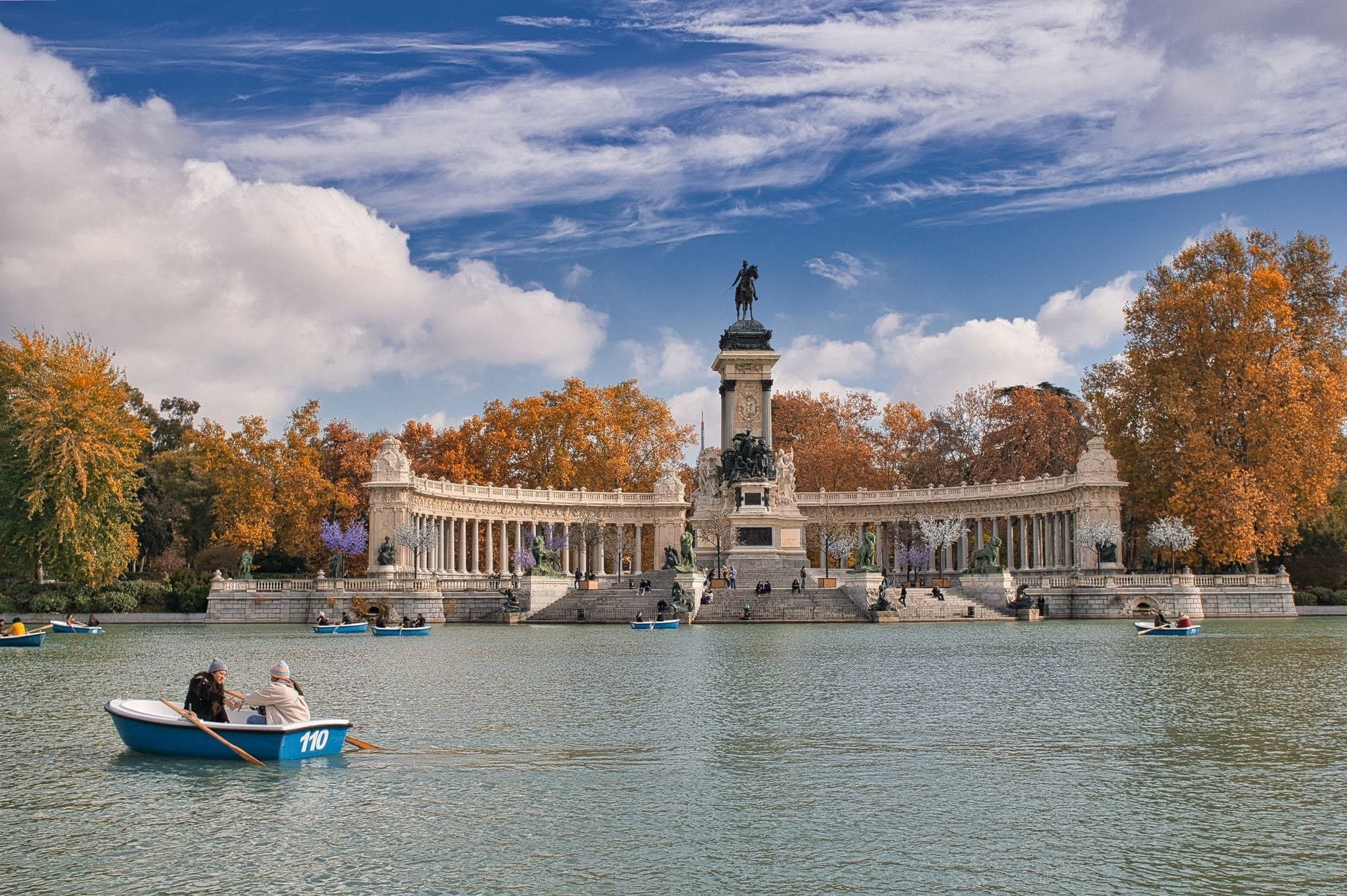
The Estanque Grande is the geographic and social heart of the park. The rectangular artificial lake, dominated on its southern bank by the equestrian monument to Alfonso XII, was constructed in the 17th century as a royal pleasure ground. Today rowboats are available for hire throughout the warmer months — a decidedly low-tech activity that still draws long queues on Sunday afternoons. The monument's curved colonnade creates a backdrop that looks almost theatrical from the water.
Palacio de Cristal and Palacio de Velázquez
These two iron-and-glass pavilions, built in 1887 and 1883 respectively for major exhibitions, are among the finest examples of 19th-century industrial architecture in Spain. The Palacio de Cristal, with its soaring glass dome and ornate tilework base designed by Ricardo Velázquez Bosco, functions today as an exhibition space managed by the Museo Reina Sofía. It usually hosts large-scale installation art. The building itself frequently upstages whatever is inside it.
The Palacio de Velázquez, nearby, operates similarly as an extension of the Reina Sofía's programme. Both are free to enter when open for exhibitions. Check the Museo Reina Sofía website for current exhibition schedules before visiting, as they occasionally close between shows.
Retiro Rose Garden (Rosaleda)
The Retiro Rose Garden sits in the southwestern corner of the park and contains several thousand rose bushes of hundreds of varieties. Peak bloom runs from late April through June, when the scent from the garden drifts noticeably into the surrounding paths. Outside of flowering season it is considerably less interesting, though the formal layout retains its structure year-round.
El Ángel Caído (The Fallen Angel)
This late 19th-century bronze sculpture by Ricardo Bellver depicts Lucifer at the moment of his fall from heaven. It sits on a tiered marble pedestal in the southern section of the park and is sometimes cited as one of the earliest public monuments to the devil.
Practical Walkthrough: How to Navigate the Park
The park has multiple entrance gates. The most convenient for visitors arriving from the Prado museum area is the Puerta de la Independencia on the Alfonso XII side, and visitors coming from Retiro metro station will typically enter via the Puerta de Alcalá side, a short walk from the station exit.
The park's perimeter is approximately 4.5 kilometres. A full circuit on foot takes around 45 minutes without stops. The terrain is mostly flat and the main paths are wide and paved with compacted gravel, making most of the park accessible without significant difficulty. The area is part of the broader Retiro neighbourhood, which borders the Paseo del Prado to the west.
Toilets are available at several points throughout the park but are not always well-signposted. The park has no single map kiosk — pick up an orientation map from the Madrid tourism office on Plaza Mayor before your visit, or use offline navigation, as mobile signal can be patchy under the denser tree canopies.
⚠️ What to skip
Pickpocketing is reported around the main lake on busy weekend afternoons, particularly in the rowboat queue and near street performers. Keep bags zipped and phones in a front pocket in crowded areas.
Photography, Weather, and What to Bring
For photography, the three best locations are the Palacio de Cristal (best in late afternoon light), the Alfonso XII monument from a rowboat or from the far north bank of the lake (best in morning), and the Puerta de la Independencia gate facing the Paseo del Prado (best at golden hour). The park's interior paths under the mature tree canopy shoot well in overcast light, which suppresses harsh shadows.
Bring water in summer regardless of how long you plan to stay. There are a few kiosks selling drinks but they can have queues. Comfortable shoes are worth the effort — the gravel paths are manageable, but uneven in some of the older sections near the southern end. In spring, light layers are sensible since morning temperatures can be cool even when the afternoon reaches 20°C.
If you are planning a wider day around this area, the park connects naturally to the Paseo del Prado cultural corridor. The Museo del Prado entrance is a 10-minute walk from the Alfonso XII gate, and the Real Jardín Botánico is immediately adjacent to the south. The Paseo del Prado itself, now part of the same UNESCO World Heritage designation, links these spaces into a coherent half-day or full-day itinerary.
Who Should Reconsider
El Retiro is exceptional for what it is: a large, free, historically significant urban park. But visitors expecting manicured formal gardens on the scale of Versailles or the precision of London's Kew Gardens may find some sections underwhelming. Parts of the interior, away from the main lake and pavilions, are simply woodland paths without dramatic focal points. The park is also not quiet on weekends between 11:00 and 18:00 — if solitude is the goal, a weekday morning is a different experience entirely.
Travellers with very limited time in Madrid (a single day, for instance) might weigh whether two to three hours here competes well against time in the Prado or Reina Sofía. The answer depends on the traveller: if green space and outdoor time matter to you, El Retiro earns its place easily. If you are primarily in Madrid for art museums, the park works better as a morning warm-up than a centrepiece.
Insider Tips
- The rowboats on the Estanque Grande can only be hired from the kiosk on the north bank. On summer weekends, queues form by 11:00. Arrive before 10:30 or come back after 17:00 when the crowds thin slightly.
- The Palacio de Cristal hosts free art installations managed by the Museo Reina Sofía. The schedule is not heavily advertised — check the Reina Sofía website's calendar a few days before your visit to see if an exhibition is running.
- The park's quieter entrance during peak weekends is often on the southeastern side near Avenida de Menéndez Pelayo. Most visitors concentrate around the Alfonso XII and Retiro metro entrances.
- A free Sunday puppet show for children (Títeres de Cachiporra) runs in the park on many weekends near the Puerta de la Independencia area. Schedules vary by season — check the Madrid city events calendar.
- The perimeter path along the inside of the eastern wall, near the Ángel Caído, is significantly less trafficked than the central lake circuit. It runs through denser tree cover and is noticeably cooler in summer.
Who Is Parque de El Retiro For?
- Families with children who need open space between museum visits
- Early-morning runners and walkers who want a scenic and safe circuit
- Architecture and photography enthusiasts targeting the Palacio de Cristal
- Travellers who want to observe authentic everyday Madrid life rather than tourist-facing experiences
- Anyone visiting the Paseo del Prado museums who wants to extend the day outdoors
Nearby Attractions
Other things to see while in Retiro:
- CaixaForum Madrid
CaixaForum Madrid is a striking cultural centre on Paseo del Prado, housed in a converted early-20th-century power station redesigned by Herzog & de Meuron. Alongside rotating international exhibitions, it features a celebrated vertical garden by botanist Patrick Blanc and sits within walking distance of the city's three great art museums.
- Estanque Grande del Retiro
The Estanque Grande del Retiro is a vast artificial lake at the center of Parque del Retiro, created in the 17th century for royal festivities and now open to everyone for free. Rent a rowboat, watch street performers, or simply sit on the surrounding promenade as the Alfonso XII monument reflects in the water.
- Museo Nacional del Prado
The Museo Nacional del Prado holds one of the most important collections of European art in the world, with around 7,000–8,000 paintings spanning five centuries of Western painting. Located on the Paseo del Prado in the Retiro district, it is the cultural centerpiece of Madrid and the reason many visitors come to the city at all.
- Museo Nacional Centro de Arte Reina Sofía
The Museo Nacional Centro de Arte Reina Sofía is Spain's national museum of 20th-century art, housed in a converted 18th-century hospital near Atocha station. Its permanent collection includes Picasso's Guernica and major works by Dalí and Miró, making it one of the most significant modern art institutions in Europe.