CaixaForum Madrid: The Cultural Centre That Defies Gravity
CaixaForum Madrid is a striking cultural centre on Paseo del Prado, housed in a converted early-20th-century power station redesigned by Herzog & de Meuron. Alongside rotating international exhibitions, it features a celebrated vertical garden by botanist Patrick Blanc and sits within walking distance of the city's three great art museums.
Quick Facts
- Location
- Paseo del Prado 36, 28014 Madrid (Cortes neighbourhood)
- Getting There
- Atocha station (~4-min walk); Antón Martín metro (~7-min walk)
- Time Needed
- 1.5 to 2.5 hours
- Cost
- €6 per exhibition; free for CaixaBank customers, children under 16, and European Youth Card holders
- Best for
- Architecture lovers, art enthusiasts, families, budget travellers
- Official website
- www.esmadrid.com/en/tourist-information/caixaforum-madrid
Why CaixaForum Madrid Stands Out
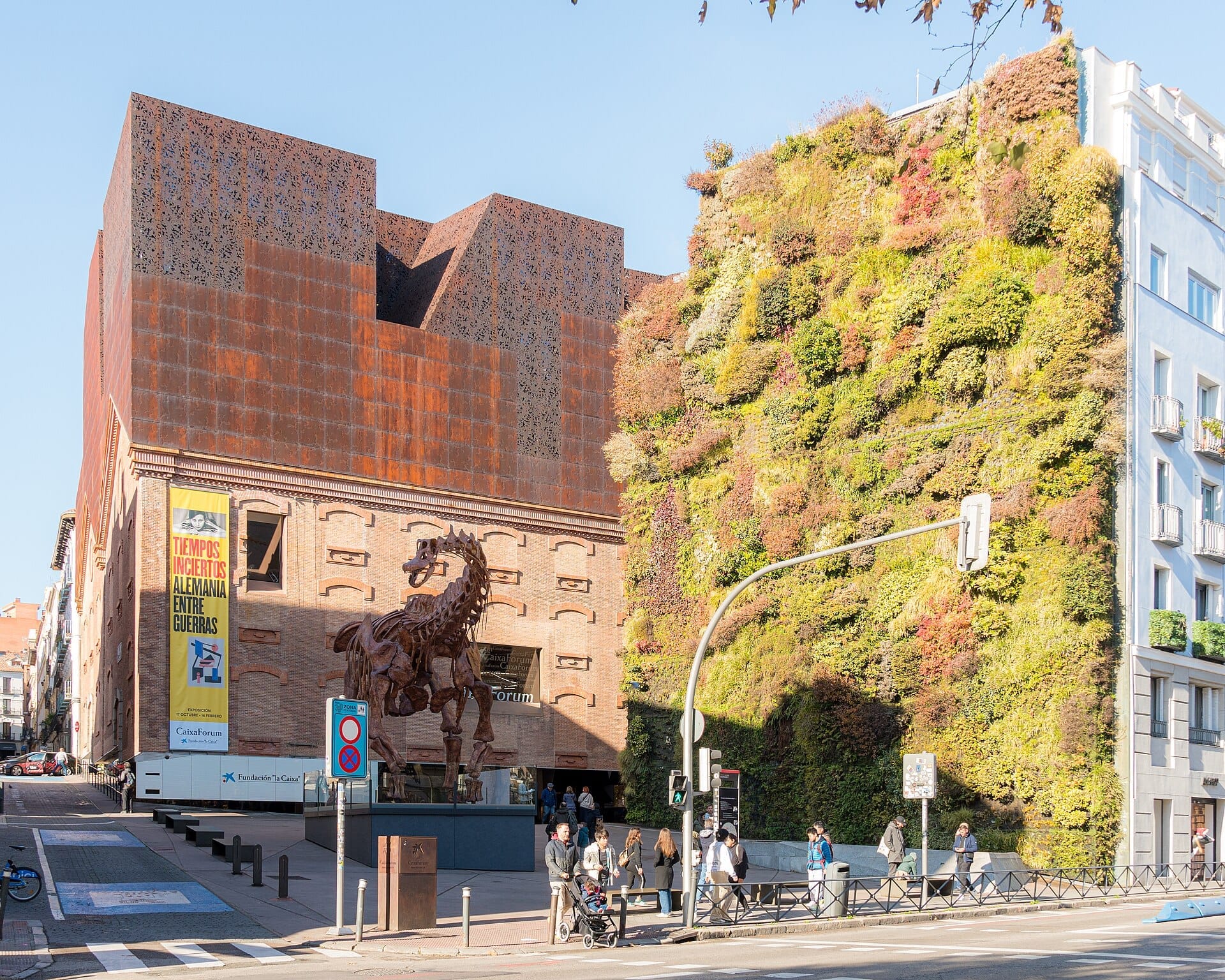
CaixaForum Madrid occupies one of the most architecturally arresting buildings in a city that does not lack for striking facades. From the street, the building appears to hover: its rusted-iron upper storeys seem to float above the ground with no visible support, a deliberate illusion achieved by Swiss architects Herzog & de Meuron when they stripped away the old power station's brick base during their 2003-2008 conversion. The result is a building that stops pedestrians mid-stride, even those who have passed it dozens of times.
The cultural centre is run by the Fundación 'la Caixa', the philanthropic arm of Spain's CaixaBank, and its programming reflects serious institutional ambition. Rather than a single permanent collection, it rotates major international loan exhibitions through its galleries, meaning what you see on one visit will be completely different six months later. That keeps the audience returning, and it keeps standards high: past shows have drawn from the Louvre, the British Museum, and private collections across Europe.
💡 Local tip
Admission is free on 15 May (San Isidro), 18 May (International Day of Museums), and 9 November (Our Lady of Almudena). If your dates align, plan around one of these.
The Architecture: A Power Station Turned Upside Down
The original structure, known as the Central del Mediodía, was built in the early 1900s as an electrical power plant. By the time the 'la Caixa' foundation acquired it, the building had been decommissioned for decades. Herzog & de Meuron's transformation was radical: they demolished the base walls but preserved and restored the upper brick shell, creating a cantilevered volume supported internally by a steel structure. The architects then clad the new additions in perforated corten steel panels, which have oxidised to a deep amber-brown that reads almost like hammered leather in afternoon light.
At ground level, where walls once met the pavement, there is now open space. You walk beneath the building before you enter it. This is not just a visual trick; it creates a genuine public plaza under shelter, which Madrid's climate makes surprisingly practical. On summer afternoons, when temperatures frequently exceed 33 degrees Celsius on the Paseo del Prado, the shade beneath the overhang is welcome. The building's gross floor area reaches around 10,000 square metres across a height of about 25 metres, but it reads as compact and precise rather than monumental.
The conversion is widely cited in architectural writing on adaptive reuse, and it sits naturally within the broader conversation about Madrid's architectural ambitions. If you want wider context on the city's built heritage, the Madrid architecture guide covers the key landmarks along this stretch of the city.
Tickets & tours
Hand-picked options from our booking partner. Prices are indicative; availability and final rates are confirmed when you complete your booking.
Royal Monastery of El Escorial and the Valley of the Fallen trip from Madrid
From 64 €Instant confirmationFree cancellationFlexible time Real Madrid: Bernabeu Stadium & Museum Entry
From 42 €Instant confirmationMuseum of Senses Madrid entrance ticket
From 19 €Instant confirmationAvila and Segovia full-day tour from Madrid
From 50 €Instant confirmationFree cancellation
The Vertical Garden: Patrick Blanc's Living Wall
Immediately beside the main entrance, an entire building wall has been covered in living plants. This is the work of French botanist Patrick Blanc, who pioneered the modern vertical garden technique and installed this version when the centre opened in 2008. The wall measures approximately 460 square metres and contains more than 15,000 plants from over 250 species, all of them growing without soil, their roots embedded in a felt substrate watered through an automatic irrigation system.
The visual effect is dense and layered, with ferns, grasses, flowering plants, and climbing species arranged in loose botanical zones that shift with the seasons. In spring, sections burst into colour. In winter, the composition becomes more textural, dominated by evergreen forms. Early in the morning, when delivery traffic is still moving on Paseo del Prado and the light is low and directional, the wall catches shadows in ways that make it look almost three-dimensional. It is worth pausing here before you go inside, rather than rushing past it.
💡 Local tip
For photography, the vertical garden is best shot in the morning when soft directional light hits its surface from the east. By midday, the facade falls into flat shadow.
Inside: Exhibitions, Spaces, and What to Expect
CaixaForum Madrid typically runs two to three simultaneous temporary exhibitions across its gallery floors. The programming skews toward major international surveys, science and society themes, and contemporary art, though historical exhibitions on ancient civilisations and photography also feature regularly. Each exhibition requires a separate ticket purchase (€6 per show), so your total cost depends on how many you want to see. If you arrive without checking the current programme, you may find yourself choosing between shows with little in common thematically.
The internal circulation is vertical, with lifts and stairs connecting the gallery levels, the auditorium, a cafeteria-restaurant, and the bookshop. The building's interior finishes are polished and modern: poured concrete, glass, and dark steel contrast with the warmth of the exterior ironwork. Acoustics in the upper galleries are good, and the space does not feel overlit in the way that some contemporary museum conversions do. Natural light is limited by design, which suits the works shown.
The bookshop is worth a dedicated stop. It stocks a well-chosen selection of art and architecture titles, exhibition catalogues, and design objects. Hours extend slightly on weekends (10:00 to 20:30 on Saturdays and Sundays). The cafeteria operates daily from 10:00 to 20:00 and is a reasonable mid-visit stop, though it is not a destination in itself.
ℹ️ Good to know
Spanish Sign Language (SL) guided tours are available with advance registration by phone (+34 91 787 96 06) or email (rcaixaforummadrid@magmacultura.net). Book early as capacity is limited.
Practical Walkthrough: Getting There and Getting the Most Out of It
The centre's address is Paseo del Prado 36, and arriving on foot is the most natural option given its location. From Atocha station, the walk takes around four minutes north along Paseo del Prado. From the Antón Martín metro stop (Line 1), allow about seven minutes on foot. BiciMAD public bike docking stations are available nearby at Calle Almadén 38 and Cuesta de Claudio Moyano 5 if you are cycling.
CaixaForum sits at the southern end of the Paseo del Prado cultural corridor, placing it within a short walk of the Museo del Prado, the Museo Reina Sofía, and the Museo Thyssen-Bornemisza. Pairing a CaixaForum visit with one of the major museums on the same day is entirely feasible, though combining all four in a single outing will leave you exhausted.
Opening hours are Monday to Sunday and on public holidays from 10:00 to 20:00. On 24 December, 31 December, and 5 January, closing time moves to 18:00. The centre is closed on 25 December and 1 and 6 January. These hours are verified but are subject to change, so check the official site before visiting.
⚠️ What to skip
CaixaForum does not have a permanent collection. If you arrive without checking what is currently showing, you may find the subject matter does not interest you. Spend two minutes on their website before you go.
When to Visit and Who Should Think Twice
The centre is rarely as crowded as the Prado or Reina Sofía, which makes weekday mornings between 10:00 and 12:00 pleasantly calm. Weekend afternoons, particularly in spring and autumn when tourist numbers on the Paseo del Prado are highest, bring longer queues at the ticket desk and more congestion in the galleries. If you are visiting with children under 16, bear in mind admission is free for them, so it draws family groups particularly on weekend mornings.
Travellers looking for a permanent encyclopedic collection, or those with no particular interest in the current exhibition programme, may find the visit less rewarding than a morning at the Prado. The €6 admission is fair for what is offered, but it is not a free cultural experience unless you qualify for one of the complimentary categories. That said, the architecture and vertical garden alone are worth the walk past the building, even without going inside.
If you are planning a fuller day in this part of the city, the adjacent Real Jardín Botánico and the broad promenade of the Paseo del Prado extend the itinerary without adding much travel time. The area rewards slow walking.
Insider Tips
- Check the Fundación 'la Caixa' website for the exhibition calendar before you visit. The quality and subject matter of shows varies significantly, and knowing what is on lets you decide whether to buy a ticket or just visit the exterior and garden.
- CaixaBank account holders enter for free with their bank card. If you or anyone in your group is a customer, bring the card. European Youth Card holders and children under 16 also get free entry, which is worth knowing if you are travelling on a budget.
- The underside of the building, where the cantilever creates a shaded public space, is an underrated spot to pause on a hot afternoon. There are no chairs, but it functions as an informal gathering point away from the direct sun.
- The bookshop stocks exhibition catalogues from past shows at reduced prices. If you are interested in any historical CaixaForum exhibitions you missed, this is a good place to look.
- On free admission days (15 May, 18 May, 9 November), arrive at or just before 10:00. Lines form quickly and the galleries fill up faster than on a standard weekday.
Who Is CaixaForum Madrid For?
- Architecture enthusiasts wanting to study one of Europe's most discussed adaptive reuse projects in person
- Travellers combining the Paseo del Prado cultural corridor in a single day and looking for a shorter, lower-cost complement to the big three museums
- Families with children under 16, who enter free and benefit from the centre's accessible, well-designed interiors
- Photography-minded visitors drawn by the vertical garden's seasonal changes and the building's photogenic ironwork exterior
- Culture seekers whose interests follow the rotating programme: from ancient civilisations to contemporary photography and science exhibitions
Nearby Attractions
Other things to see while in Retiro:
- Estanque Grande del Retiro
The Estanque Grande del Retiro is a vast artificial lake at the center of Parque del Retiro, created in the 17th century for royal festivities and now open to everyone for free. Rent a rowboat, watch street performers, or simply sit on the surrounding promenade as the Alfonso XII monument reflects in the water.
- Museo Nacional del Prado
The Museo Nacional del Prado holds one of the most important collections of European art in the world, with around 7,000–8,000 paintings spanning five centuries of Western painting. Located on the Paseo del Prado in the Retiro district, it is the cultural centerpiece of Madrid and the reason many visitors come to the city at all.
- Museo Nacional Centro de Arte Reina Sofía
The Museo Nacional Centro de Arte Reina Sofía is Spain's national museum of 20th-century art, housed in a converted 18th-century hospital near Atocha station. Its permanent collection includes Picasso's Guernica and major works by Dalí and Miró, making it one of the most significant modern art institutions in Europe.
- Museo Thyssen-Bornemisza
Housed in the neoclassical Palacio de Villahermosa on Paseo del Prado, the Museo Nacional Thyssen-Bornemisza spans eight centuries of Western art in one of the world's most cohesive private collections. It completes Madrid's legendary Art Triangle alongside the Prado and Reina Sofía, but offers something neither rival does: a single chronological sweep from medieval panel paintings to 20th-century American abstraction.