Parque del Oeste: A Historic Early 20th‑Century Park in Western Madrid, Explained
Opened in 1906, Parque del Oeste is one of Madrid's first large, purpose‑designed public parks, stretching across more than 70 hectares on the city's western edge. It combines a celebrated rose garden, an authentic Egyptian temple, and sweeping views toward the Sierra de Guadarrama, all without an entrance fee.
Quick Facts
- Location
- Paseo de Camoens y Valero, 4, 28008 Madrid (Moncloa-Argüelles)
- Getting There
- Metro: Moncloa (L6, L3), Plaza de España (L3, L10), Príncipe Pío (L6, L10, R); Cercanías: Príncipe Pío
- Time Needed
- 1.5 to 3 hours for a relaxed visit; longer if you add the rose garden and temple
- Cost
- Free entry. The Teleférico cable car charges a separate fee.
- Best for
- Morning walkers, rose enthusiasts (late May to June), families, and anyone wanting open sky without a ticket
What Is Parque del Oeste?
Parque del Oeste sits on the northwestern flank of central Madrid, between the Moncloa transport hub and the steep drop toward the Manzanares River. Initiated in 1906, it holds the distinction of being one of Madrid's first purpose-designed public parks, conceived in the early 20th century by municipal park designers at a time when the city was beginning to think seriously about green space for its citizens. The official surface area is given as more than 70 hectares by the Madrid City Council, making it significantly smaller than the Retiro but far less crowded on an average Tuesday afternoon.
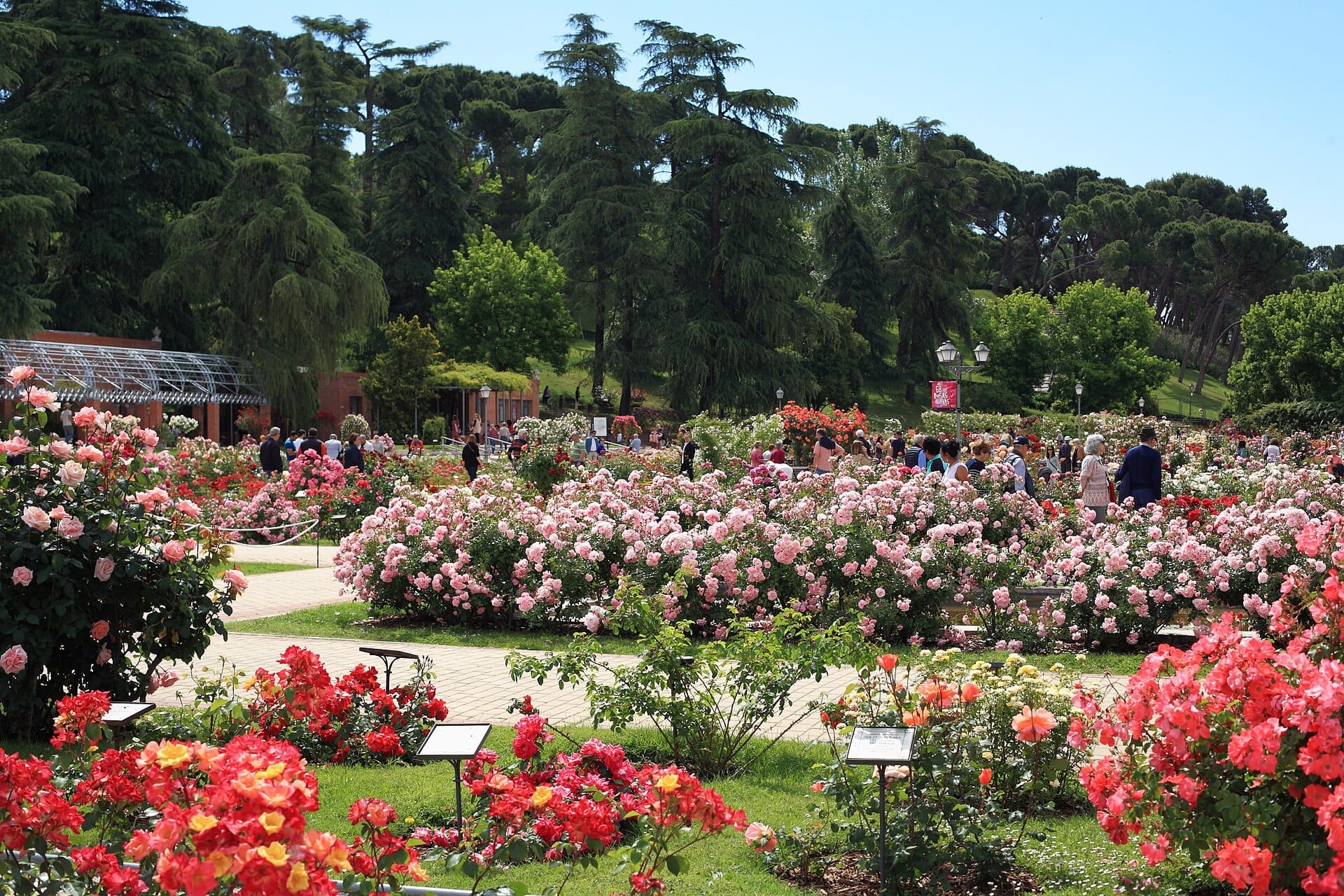
The park is not one flat lawn. It rolls across a series of slopes and terraced areas, with pine, cedar, and cypress trees providing thick shade in summer. At the northern end, the Rosaleda de Ramón Ortiz rose garden concentrates most of the horticultural prestige. At the southern end, near the Príncipe Pío exit, an authentic ancient Egyptian temple sits in open air, relocated here from the banks of the Nile in the late 20th century. Between those two anchors, there are shaded paths, fountains, a cable car station, and the kind of quiet that is genuinely hard to find this close to the city center.
💡 Local tip
The park has no entrance gates and its general paths remain open at all hours under normal conditions. The rose garden does operate on seasonal hours (see section below). If you arrive via metro, the Moncloa exit deposits you directly at the northern entrance near the rose garden.
The Rosaleda de Ramón Ortiz: When and Why It Matters
The Rosaleda is one of the finest rose gardens in Spain, and it enters its peak between late May and mid-June when thousands of rose varieties bloom simultaneously. The scent on a warm morning, when the air is still and the light is low, is one of those Madrid sensory moments that doesn't cost anything and isn't particularly well-publicized. Visiting at midday in high summer is a different story: direct sun, no shade inside the formal garden beds, and heat radiating from the gravel paths.
The garden also hosts the annual Concurso Internacional de Rosa Nueva de Madrid, a competition for new rose varieties. Winning roses are planted and labeled with plaques, which means the collection evolves year by year. The labeled specimens make for particularly interesting reading if you take the time to wander systematically rather than cutting straight through.
Seasonal opening hours for the Rosaleda are as follows: 1 November to 1 March, 10:00 to 18:00; 1 March to 15 April, 10:00 to 19:00; 16 April to 15 September, 10:00 to 21:00; 16 September to 31 October, 10:00 to 19:00. Arrive within the first hour of opening for the best light and quietest atmosphere.
⚠️ What to skip
Outside the rose season (roughly October to April), the Rosaleda is significantly less impressive. If roses are your main reason for visiting, plan around late May to mid-June.
Tickets & tours
Hand-picked options from our booking partner. Prices are indicative; availability and final rates are confirmed when you complete your booking.
Imperial Madrid walking tour
From 16 €Instant confirmationFree cancellationTapas and history tour through old Madrid
From 75 €Instant confirmationFree cancellationRibera del Duero wine tour and tasting from Madrid
From 170 €Instant confirmationGuided tapas adventure in Madrid
From 99 €Instant confirmationFree cancellation
The Templo de Debod: An Egyptian Temple in the Middle of Madrid
At the southern edge of the park stands the Templo de Debod, a 2nd-century BC Egyptian temple that was gifted to Spain by Egypt in 1968 as a gesture of gratitude for Spanish help in salvaging Nubian monuments before the Aswan High Dam flooded the region. It was reconstructed here stone by stone and opened to visitors in 1972. The temple is free to enter (timed tickets are required; check current availability in advance), and it sits in a shallow reflecting pool that, at sunset, creates one of the more photographed scenes in the city.
The western edge of the Templo de Debod platform overlooks the Manzanares valley and offers a long view toward the Casa de Campo and, on clear days, the Sierra de Guadarrama. This is one of Madrid's better sunset viewpoints, which means it fills up in the 30 to 60 minutes before and after sundown. If you want the view without the crowd, arrive either in the late morning or well after dark.
For a broader sense of Madrid's viewpoint culture, the best views in Madrid guide covers how Debod compares to other elevated spots across the city.
How the Park Changes Through the Day
Early mornings in Parque del Oeste belong to runners and dog walkers. The pine-lined paths in the central section are cool until well past 9:00 in summer, making this easily one of the more pleasant places to move around during July and August when the rest of the city bakes. The grass areas near the upper terraces are often damp with dew until mid-morning.
By midday in warmer months, the park quiets down except near the Teleférico cable car station on the eastern side, where families queue for the ride across to Casa de Campo. The cable car is a separate paid service and offers a bird's-eye view of the park's canopy. It is worth checking current operating hours and prices directly with the operator before planning around it.
Late afternoons see students from the nearby Complutense University campus filtering through, and the benches near the rose garden fill with locals enjoying the shade. By early evening in spring and autumn, the park has a noticeably social energy: picnics, couples, older residents on their daily circuit. This is when the park feels most like a neighborhood space rather than a tourist destination.
Getting There and Getting Around
The most practical entry point depends on what you want to see first. For the Rosaleda, exit at Moncloa on Metro lines 3 or 6. For the Templo de Debod, the Plaza de España metro station (lines 2, 3 and 10) puts you about a five-minute walk away. For the Teleférico station and the park's lower southern paths, Príncipe Pío (Metro lines 6 and 10, plus the Ramal R and Cercanías) is the most direct option.
Bus lines 21, 46, 74, 160, 161, and line A all serve stops adjacent to the park. If you are already in the Moncloa-Argüelles neighborhood or walking from the city center, the park connects naturally with the Jardines de Sabatini and the Campo del Moro as part of a longer western Madrid green route.
The park is described as partially accessible for people with reduced mobility, with most main routes and areas being manageable. That said, the terrain does slope significantly in places, and some paths have uneven surfaces. If accessibility is a priority, the flatter areas near the northern entrance and the Rosaleda are the easiest to navigate.
ℹ️ Good to know
Photography note: the Templo de Debod at sunset is popular with photographers. The best angle for the reflecting pool with warm light is from the western walkway around the pool. Bring a wide lens if you want the full temple and sky in frame.
Historical Context and What Else the Park Contains
Parque del Oeste was not an ancient royal garden. Unlike the Retiro, which began as a private royal retreat in the 17th century, the Oeste was laid out as a public park in the early 20th century as part of urban planning efforts to expand green space as Madrid grew westward. The Moncloa area was then at the city's edge, and the park's creation helped anchor development in the direction of what is now the university district.
The park suffered serious damage during the Spanish Civil War (1936 to 1939), when the front line ran directly through this part of the city. Many of the original trees were lost. The park was substantially rebuilt and replanted in the postwar decades, which explains why many of the larger trees, while mature, are not as old as the park's 1905 foundation date might suggest.
Beyond the rose garden and the Egyptian temple, the park contains a children's play area, drinking fountains, and several shaded seating zones. It borders the Moncloa-Argüelles neighborhood to the north and east, a residential district with good café options for before or after a walk.
Who Might Not Enjoy This Park
Parque del Oeste is not the place for visitors who want a packed itinerary of ticketed sights. There is no museum, no pavilion with rotating exhibitions, and no food stalls inside the park itself. If your Madrid visit is limited to two or three days focused on the Prado triangle or the city's historic center, there are stronger claims on your time.
Visitors coming purely for the rose garden outside of the May to June peak will find a pleasant but ordinary urban park. Similarly, those expecting a space on the scale of the Parque del Retiro may be surprised by how quickly you can traverse the Oeste. The Retiro is larger, more central, and offers more structured visitor services.
Insider Tips
- The northwestern corner of the park, above the rose garden, has a cluster of stone benches shaded by tall cedars. This is where locals go on hot afternoons. It doesn't appear on most tourist maps but is findable by following the upper path from the Rosaleda entrance north and uphill.
- The Teleférico cable car to Casa de Campo is fun with children but closes in bad weather and has seasonal hours. Check the operator's current schedule before building plans around it.
- If you visit the Templo de Debod at sunset, arrive at least 20 minutes early to secure a spot on the western platform walkway. The reflecting pool only creates a clean mirror image when there is no wind, which is more common in the mornings than in the evenings.
- The rose competition plaques inside the Rosaleda list the country of origin for each winning variety. Walking the full circuit with this in mind gives the garden a structured interest even outside peak bloom.
- From the park's southern edge near the Teleférico station, you can see the roofline of the Palacio Real to the southeast. This angle, with trees in the foreground, is less photographed than the standard views from Plaza de Oriente.
Who Is Parque del Oeste For?
- Travelers visiting Madrid in late May or June who want to see the Rosaleda at full bloom
- Families looking for open space and a cable car ride without paying museum prices
- Photographers targeting the Templo de Debod at sunrise or sunset
- Runners and walkers who want shaded paths during Madrid's hot summers
- Anyone building a western Madrid walking route connecting the Palacio Real, Campo del Moro, and the park in a single afternoon
Nearby Attractions
Other things to see while in Moncloa & Argüelles:
- Casa de Campo
Once a royal hunting ground reserved for Spanish kings, Casa de Campo is now Madrid's largest public park, covering 1,535.52 hectares west of the Royal Palace. Free to enter year-round, it offers a lake, forest trails, a cable car connection, and two family attractions, all within reach of the city centre.
- Ermita de San Antonio de la Florida
A small neoclassical hermitage beside the Manzanares River holds one of the most extraordinary ceiling fresco cycles in Spain, painted by Francisco de Goya in 1798. Entry is free, crowds are light, and the painter himself is buried beneath the dome he decorated.
- Madrid Río
Madrid Río is a roughly 150-hectare linear park stretching about 7 kilometres along the Manzanares River, built on top of the buried M-30 motorway. Free to enter and open around the clock, it offers cycling paths, playgrounds, riverside promenades, and views of the Royal Palace — all within walking distance of central Madrid.
- Faro de Moncloa
At 92 metres above street level, the Faro de Moncloa observation deck delivers sweeping 360-degree views of Madrid for as little as €4. Built in 1992, this slender 110-metre tower is one of the most affordable viewpoints in the city, and one of the least crowded.