Campo del Moro Gardens: Madrid's Overlooked Royal Park
The Jardines del Campo del Moro spread across more than 20 hectares directly behind the Royal Palace, offering one of the most dramatic views of the Palacio Real in Madrid. Admission is free, crowds are thin compared to the palace itself, and the romantic English-style landscape feels worlds away from the city streets above.
Quick Facts
- Location
- Paseo de la Virgen del Puerto 1, 28013 Madrid (below the Royal Palace)
- Getting There
- EMT buses along Paseo de la Virgen del Puerto (including lines such as 25 and 39); BiciMAD docks at Paseo de la Florida 8 & 37 and Calle Segovia 45
- Time Needed
- 45–90 minutes
- Cost
- Free admission
- Best for
- Garden lovers, photography, a quiet escape near the palace
- Official website
- www.patrimonionacional.es/en/visita/campo-del-moro-gardens
What Is the Campo del Moro?
The Jardines del Campo del Moro occupy a long, sloping valley that drops away from the western façade of the Royal Palace toward the Manzanares River. The name dates to the 12th century, when a Moorish military encampment is said to have occupied this ground during an attempted reconquest of the city, though the gardens themselves have nothing medieval about them today.
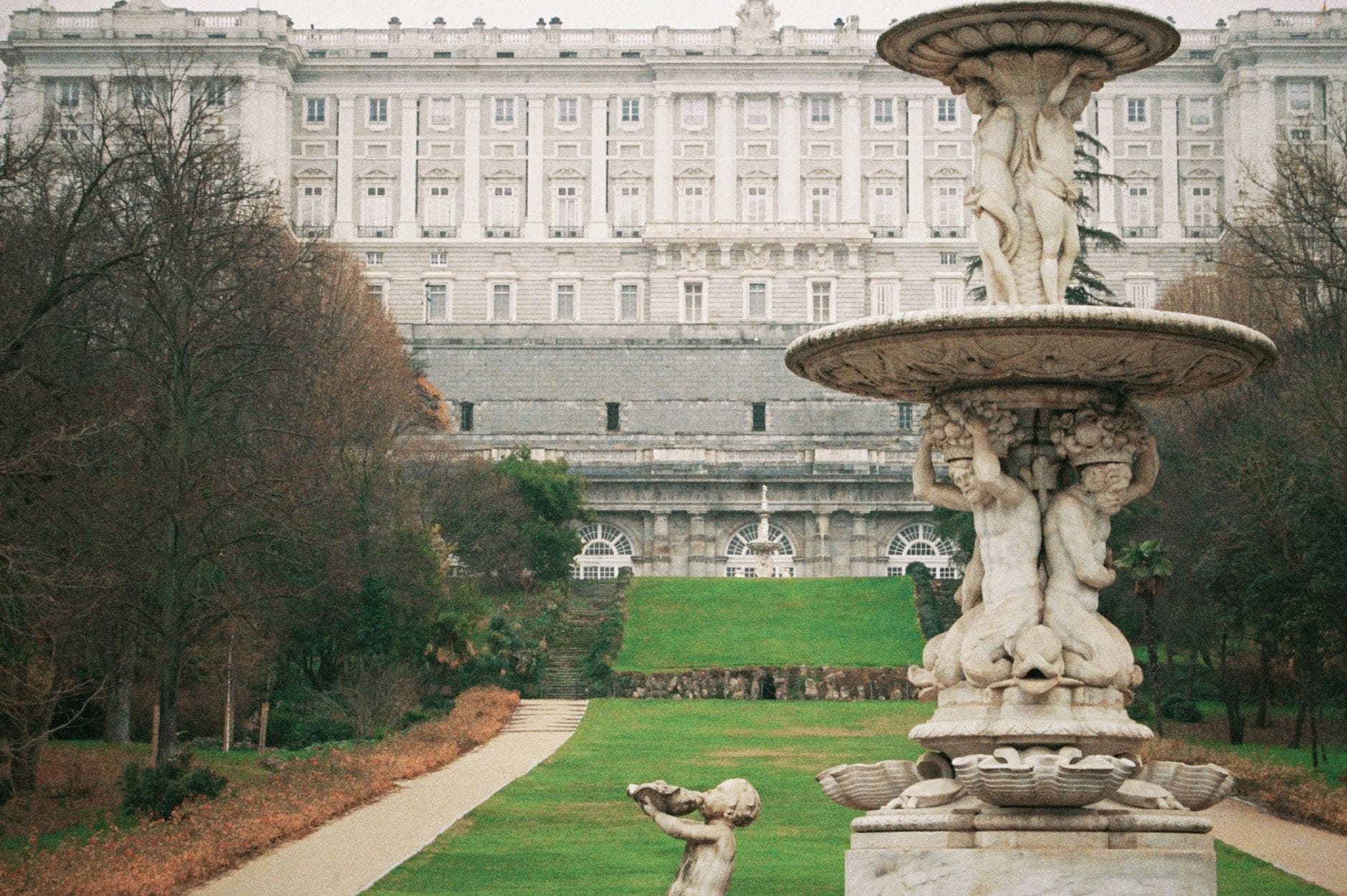
What you find instead is one of Madrid's most graceful green spaces: more than 20 hectares of romantic English-style landscape, arranged in the 19th century under Queen María Cristina and designed by architect Narciso Pascual y Colomer in the mid-1840s. The layout replaced earlier formal gardens with sweeping lawns, dense woodland walks, peacocks, fountains, and long gravel paths that frame a perfect axial view of the palace rising at the top of the hill.
The gardens were declared a Historic-Artistic Monument in 1931, placing them under national heritage protection. They are managed today by Patrimonio Nacional, the body that oversees Spain's royal sites, and admission is free year-round.
ℹ️ Good to know
Gates may close without notice for bad weather, state events, or official ceremonies. Check esmadrid.com or call ahead before making a special journey, especially if visiting on or around national holidays.
Getting There: Which Entrance to Use
The gardens have three pedestrian entrances, and the one you choose significantly affects your experience. The north entrance on Cuesta de San Vicente is the most common arrival point for visitors coming from the city centre or from Opera metro area. It deposits you near the top of the park, close to the fountain and within a short walk of the main view corridor toward the palace.
The south entrance on Cuesta de la Vega sits near the Almudena Cathedral and is convenient if you are already visiting the cathedral or the lower part of the old city. This gate is open year-round from 10:00 to 20:00, making it useful for later afternoon arrivals.
The west entrance on Paseo de la Virgen del Puerto is the one to use if you are arriving from Madrid Río or cycling along the river. This gate has the longest opening hours in summer, staying open until 22:00 from May through August. It also puts you at the lowest point of the park, where the lawns are most open and the palace view is most theatrical.
💡 Local tip
The Cuesta de San Vicente entrance is open 10:00–20:00 from April to September and 10:00–18:00 from October to March, while the Cuesta de la Vega gate is open 10:00–20:00 year-round and the Paseo de la Virgen del Puerto gate opens 10:00–21:00 in April and September, 10:00–22:00 from May through August, and has shorter hours in winter. Plan your exit accordingly.
Tickets & tours
Hand-picked options from our booking partner. Prices are indicative; availability and final rates are confirmed when you complete your booking.
Imperial Madrid walking tour
From 16 €Instant confirmationFree cancellationTapas and history tour through old Madrid
From 75 €Instant confirmationFree cancellation2-hour Private Segway tour of Casa de Campo
From 50 €Instant confirmationFree cancellationRibera del Duero wine tour and tasting from Madrid
From 170 €Instant confirmation
The Experience: Walking the Gardens
The first thing you notice on entering from the west is the sheer scale. The park does not reveal itself quickly. The path climbs gently through dense bands of oak, elm, and horse chestnut, the canopy filtering the light to something cooler and greener than the streets outside. The gravel underfoot is fine and pale, the kind that crunches quietly with each step. In spring the grass on either side runs a deep, almost northern European green, irrigated carefully in a city that turns bone dry by July.
The centrepiece of the park is its main axial walk, a wide gravel avenue that leads your eye up the slope straight toward the Royal Palace. The palace's grey stone bulk, sitting prominently above the valley floor, appears and disappears between the trees as you climb. At certain points along this avenue, the framing is so precise that the building looks almost like a stage set. This is one of the best free views of the Palacio Real available anywhere in Madrid, and relatively few visitors find their way here for it.
The gardens contain two notable fountains and several statues, as well as resident peacocks that wander the lawns without much concern for foot traffic. There is also a small carriage museum housed in a pavilion near the palace end of the park. For the broader palace complex, see the guide to the Royal Palace of Madrid.
The terrain is uneven. The park sits on a genuine hillside, and some stretches are steep enough to require effort. Visitors with pushchairs or mobility limitations will find sections challenging, particularly the upper paths closer to the palace. The lower, western end near Paseo de la Virgen del Puerto is flatter and easier to navigate.
How the Park Changes by Time of Day
Morning visits, particularly on weekdays, are the quietest. At 10:00 the gates open and for the first couple of hours you are likely to have long stretches of path almost to yourself. The light in the morning falls directly on the eastern face of the palace above you, picking out the stone detail cleanly. Birdlife is audible throughout, a contrast with the traffic noise that punctuates nearly everywhere else in central Madrid.
Midday in summer is the most challenging time. Madrid's altitude (667 metres) keeps temperatures a touch lower than coastal cities, but the Campo del Moro offers limited shade in its open lawn sections, and heat coming off the pale gravel paths can be intense from June through August. If you are visiting in summer, the morning window or the extended evening hours, which run from 10:00 until 22:00 from May through August via the Paseo de la Virgen del Puerto entrance, are far more comfortable.
Late afternoon light in spring and autumn is the most photogenic. From around 17:00 onward the sun drops behind the hills to the west and the palace on the hill catches a warm, oblique light. Shadows lengthen across the lawns and the park takes on a quieter, more contemplative character. This is also when locals with dogs and families with children use it most, giving the space a lived-in feeling rather than a tourist-attraction atmosphere.
⚠️ What to skip
The gardens close on 1 January, 1 May, and 25 December. They can also close for state events at the Royal Palace on short notice. If you are making a special trip, check the Patrimonio Nacional website in advance.
Historical and Cultural Context
The land was developed as a garden by King Philip II in the 16th century as a pleasure ground for the royal court, and the area has been associated with the palace complex ever since. The English-style romantic landscape you see today, however, is a 19th-century project. Queen María Cristina commissioned the redesign in the 1840s, and Narciso Pascual y Colomer, one of the leading architects of the period in Spain, shaped the park into its current form, replacing earlier, more formal arrangements with organic paths, irregular planting, and open lawns.
This shift in style reflects a broader European fashion of the time. The romantic English garden, with its studied naturalism, was a deliberate contrast to the symmetrical formality of French-influenced baroque gardens. At the Campo del Moro the result is a park that feels more like a country estate than an urban green space, which partly explains its atmosphere of calm disconnection from the city above.
The gardens are closely linked spatially and historically to the Jardines de Sabatini, the formal gardens on the northern side of the Royal Palace. The two parks represent opposite ends of garden philosophy: Sabatini is geometric and urban, Campo del Moro is informal and rural in spirit. Together they ring the palace on two sides and form part of the wider Paseo del Prado and Buen Retiro World Heritage landscape that UNESCO recognised in 2021.
Photography and Practical Tips
The main view of the Royal Palace from the lower lawn is the signature shot. To capture the palace without trees cutting through it, position yourself on the central gravel axis roughly halfway up the park, toward the western end. A standard lens or a slight telephoto compression works better here than a wide angle, which distorts the palace's proportions and makes the distance between you and the building feel exaggerated.
In spring, the grass is at its greenest and wildflowers appear along the margins of the lawns. In autumn the deciduous trees in the park turn amber and gold, and the combination of warm leaf colour against the grey stone of the palace makes for striking images. Overcast days, which Madrid gets more often in November and March, actually produce softer, more even light for garden photography than the harsh high-contrast sun of July.
Wear comfortable shoes with grip. The gravel paths are stable but the slopes can be slippery after rain. Bring water if visiting in summer, as there are no cafés inside the gardens. The nearest places to eat or drink are on Calle Mayor or along Paseo de la Virgen del Puerto outside the gates.
If you are combining a visit with nearby sights, the Almudena Cathedral is a five-minute walk from the Cuesta de la Vega entrance, and the Plaza de Oriente is directly above the north side of the palace. A loop combining all three sites takes about half a day at a comfortable pace.
Who This Park Is Not For
The Campo del Moro is a garden, not a social event. There are no food stands, no street performers, no evening illuminations, and no interactive installations. If you are looking for the energetic, experience-dense atmosphere of central Madrid, this is the wrong choice. Visitors who find quiet gardens dull, or who need the stimulation of crowds and activity, will exhaust what the park offers in under fifteen minutes.
Similarly, visitors with significant mobility limitations should approach with caution. The slopes are real and some paths are unpaved. For a flatter, more accessible royal garden experience, the Jardines de Sabatini on the north side of the palace is a better option.
Families with very young children in pushchairs will find the lower, western section of the park manageable, but the upper paths toward the palace are difficult with wheeled transport.
Insider Tips
- The park view of the Royal Palace's western facade is actually more dramatic than what you see from Plaza de Oriente, and far fewer people discover it. Save this angle for your best palace photograph.
- Enter from Paseo de la Virgen del Puerto in summer to take advantage of the 10:00–22:00 opening hours and visit during the cooler evening hours. The park is rarely busy after 19:00.
- The resident peacocks tend to congregate near the upper lawns in the morning hours before visitor numbers pick up. Patience and quiet movement will get you much closer to them.
- If the Cuesta de San Vicente entrance is closed for an event at the palace, the Cuesta de la Vega gate (open year-round from 10:00 to 20:00) is almost always accessible as an alternative.
- Combine this park with the Ermita de San Antonio de la Florida, a 10-minute walk north along the river. The Goya frescoes inside the hermitage are extraordinary and equally uncrowded.
Who Is Campo del Moro Gardens For?
- Travellers who want a free, quiet alternative to Madrid's busier parks
- Photography enthusiasts looking for the best long view of the Royal Palace
- Spring and autumn visitors who appreciate seasonal garden landscapes
- Couples wanting a calm walk without tourist-trail crowds
- Anyone combining a morning visit to the Royal Palace with outdoor time afterward
Nearby Attractions
Other things to see while in Sol & Centro:
- Catedral de la Almudena
The Almudena Cathedral took more than a century from the laying of its foundation stone to its consecration in 1993, making it one of Europe's newest major cathedrals. Free to enter and directly opposite the Royal Palace, it rewards visitors who look beyond its mismatched facade to discover a surprisingly bold and colorful interior.
- Círculo de Bellas Artes
Few buildings in central Madrid earn attention on multiple levels at once. The Círculo de Bellas Artes delivers: a landmark Palacios-designed tower within the Paisaje de la Luz UNESCO World Heritage area with a rooftop terrace above the Gran Vía skyline, rotating art exhibitions, and one of the city's most atmospheric cafés. Entry to the building and La Pecera café is free; the rooftop, exhibitions, and combined tickets have separate fees starting from around €6.
- Edificio Metrópolis
Standing at the junction of Calle de Alcalá and Gran Vía, the Edificio Metrópolis is Madrid's most iconic piece of Belle Époque architecture. Its slate dome, gilded detailing, and winged Victory statue make it a landmark that rewards careful observation, even though the building itself is not a public museum. Here is everything you need to know before you go.
- Espacio Fundación Telefónica
Occupying four floors of the iconic Telefónica building on Gran Vía, Espacio Fundación Telefónica is one of Madrid's most rewarding free cultural spaces. Opened in 2012, it presents rotating exhibitions on art, digital culture, and the history of telecommunications across 6,000 square metres of gallery space inside a 1920s architectural landmark.