Plaza de Oriente: Madrid's Most Elegant Royal Square
Plaza de Oriente is a formal public square framed by the Royal Palace, the Teatro Real, and dozens of stone statues of Spanish monarchs. Entry is free, the gardens cover 1.6 hectares, and the setting rewards visitors at almost any hour of day.
Quick Facts
- Location
- Plaza de Oriente, 28013 Madrid (Centro district, Palacio/Austrias area)
- Getting There
- Metro Ópera (Lines 2 & 5); Bus 25, 39
- Time Needed
- 30–60 minutes for the square; longer if combining with nearby palaces
- Cost
- Free entry
- Best for
- Architecture lovers, photography, quiet morning walks, history enthusiasts
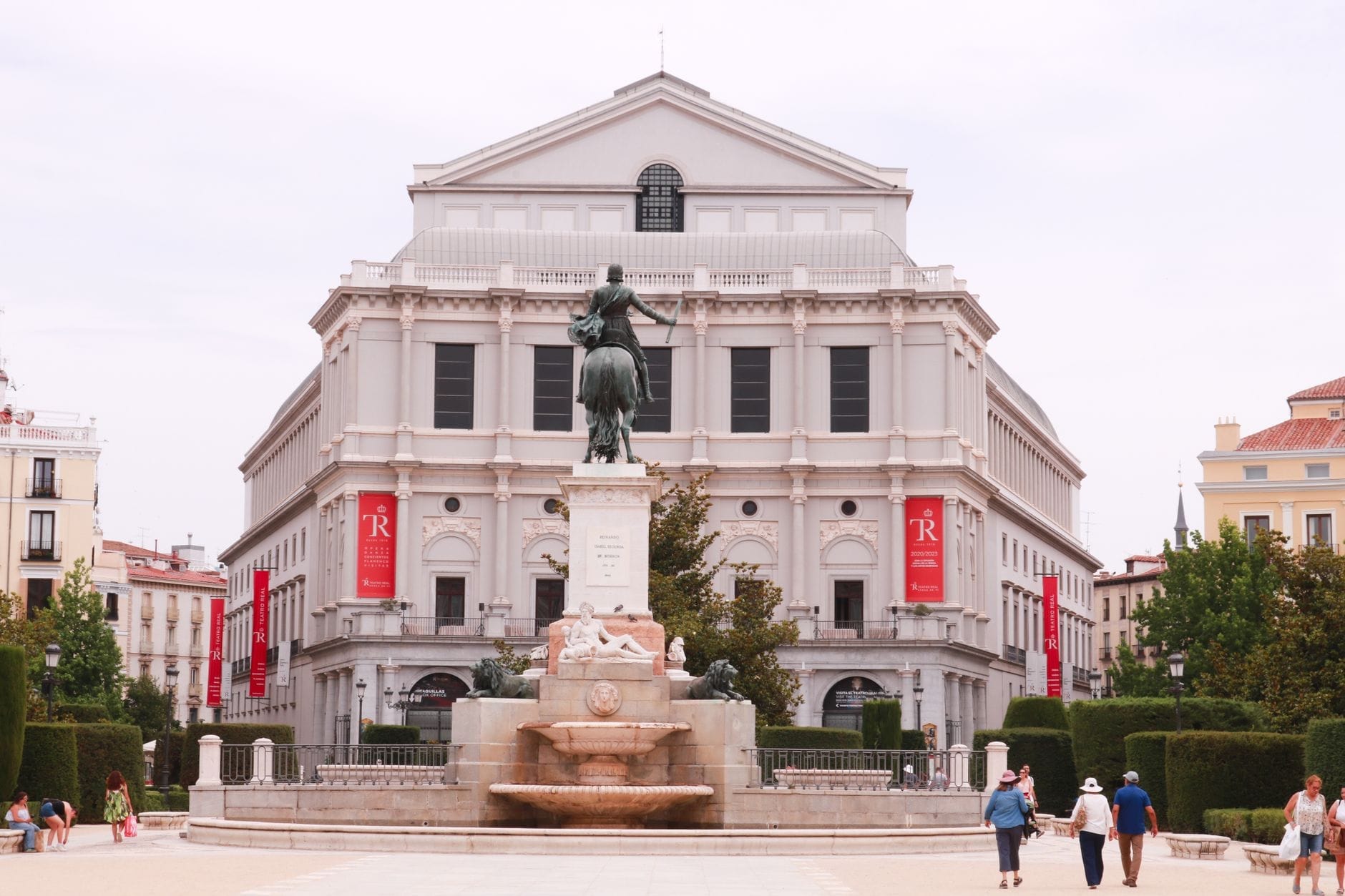
What Is Plaza de Oriente?
Plaza de Oriente is a formal neoclassical square in the heart of Madrid, positioned directly between the Royal Palace and the Teatro Real opera house. Covering approximately 1.6 hectares of sculpted gardens and paved promenades, it serves as both a civic breathing space and one of the most architecturally coherent set pieces in the Spanish capital. Entry is free, with no gates or ticketing of any kind.
The square takes its name from its position: to the east (oriente) of the Royal Palace. That relationship with the palace is everything here. Every path, hedge, and statue is oriented to amplify the palace facade. Standing at the center of the garden, the scale of the Palacio Real becomes fully apparent in a way you cannot appreciate from the street.
💡 Local tip
The nearest metro stop is Ópera (Lines 2 and 5), a two-minute walk from the square's eastern edge. This is a far more scenic arrival than approaching on foot from Puerta del Sol.
History: From Medieval Demolition to Royal Garden
The site was not always open space. During the medieval period, a dense cluster of houses and religious buildings occupied the land adjacent to the royal residence. It was Joseph Bonaparte, who ruled Spain as José I from 1808 to 1813, who ordered the demolition of these structures to clear the view in front of the palace, laying the groundwork for the future square. The plan was partly aesthetic and partly political, projecting an image of royal grandeur.
The definitive design of the square was completed in 1844 under architect Narciso Pascual y Colomer, who gave Plaza de Oriente its geometric garden layout, later complemented by restoration work such as that directed by Miguel de Oriol in 1997.
The square sits at the western edge of the old city center. If you want to understand how this area connects to the wider historic core, the Royal Palace of Madrid directly to the west and the Almudena Cathedral a short walk south together form one of Madrid's most concentrated clusters of landmark architecture.
Tickets & tours
Hand-picked options from our booking partner. Prices are indicative; availability and final rates are confirmed when you complete your booking.
Royal Monastery of El Escorial and the Valley of the Fallen trip from Madrid
From 64 €Instant confirmationFree cancellationFlexible time Real Madrid: Bernabeu Stadium & Museum Entry
From 42 €Instant confirmationMuseum of Senses Madrid entrance ticket
From 19 €Instant confirmationAvila and Segovia full-day tour from Madrid
From 50 €Instant confirmationFree cancellation
The Statues: A Parliament of Stone Kings
Lining the perimeter and scattered through the gardens are statues of Spanish monarchs from the medieval period, representing rulers of Castile, León, Aragon, and other Iberian kingdoms. There are dozens of them, rendered in a consistent classical style, which gives the square a somewhat ceremonial, almost processional feeling.
The centerpiece is the equestrian statue of Philip IV, positioned at the garden's heart. What makes this sculpture remarkable is its engineering: the horse is balanced entirely on its hind legs, a technical challenge that stumped sculptors of the era. The Florentine artist Pietro Tacca created the statue in the 17th century, completing it around 1640, following calculations provided by Galileo Galilei, and it predates the formal garden layout by about two centuries.
ℹ️ Good to know
Look closely at the horse's hindquarters: the statue’s internal weight distribution follows Galileo's counterweight calculations to keep the rearing pose stable, making it one of the earliest equestrian statues in Europe to use such engineering.
How the Square Changes Through the Day
Early mornings, roughly between 7:30 and 9:30, are the quietest. The light comes in low from the east, casting long shadows across the formal hedgerows and warming the pale stone of the Royal Palace facade. Dog walkers and joggers from nearby streets cut through the paths, and the few tourists present tend to be the serious photographers who planned for this exact light.
By mid-morning, the tour groups arrive. The area around the Philip IV statue fills with guided crowds moving between the palace entrance and the Teatro Real. The noise level rises quickly. This is still perfectly pleasant for wandering the outer paths, but any attempt at quiet contemplation near the central statue will be interrupted.
Late afternoon into early evening is arguably the second-best window. The summer heat has usually peaked and started to ease by 6 or 7pm, and the palace facade catches the golden hour light from the west. Couples and locals begin to populate the benches. In summer, cafes on the square's edge stay open well into the evening, and the whole space takes on a more relaxed, residential character.
⚠️ What to skip
In July and August, midday temperatures regularly exceed 35°C. The square has limited shade; avoid visiting between 12pm and 4pm in summer unless you have no other option. Bring water regardless of season.
Photography and the Best Viewpoints
The central garden axis, looking west toward the Royal Palace, is the defining shot. Position yourself near the Philip IV statue and shoot toward the palace in morning or late afternoon light. For an elevated perspective over the square and toward the palace, the Círculo de Bellas Artes rooftop terrace (a short walk east) offers a completely different angle on this part of the city, though it requires a small fee.
The gardens themselves reward detail photography: close-up work on the carved stone statues, the geometric patterns of the clipped hedgerows from above, and the ornate Teatro Real facade that frames the square to the east. The contrast between the grey-white stone buildings and the dark green of the formal gardens is particularly striking in overcast light, which softens harsh shadows.
If you are planning a dedicated photography itinerary around Madrid's monumental core, the best views in Madrid guide covers complementary vantage points across the city.
Practical Walkthrough: Getting There and Around
Exit Ópera metro station toward Calle de Arrieta and you will see the Teatro Real directly ahead. The square opens to your right as you approach the opera house. The entire garden perimeter can be walked in under 15 minutes at a leisurely pace; most visitors spend 30 to 45 minutes combining the statue circuit with time on the benches.
The square is a natural starting or ending point for a broader walk through the historic center. To the south, a five-minute walk leads to Plaza Mayor and beyond that to La Latina. To the north, the Jardines de Sabatini run along the northern wall of the Royal Palace and offer a quieter, more shaded alternative garden experience.
Accessibility is generally good for a public open space of this age. The main paths are paved and level, making the central garden circuit manageable for wheelchairs and strollers. There are no official accessible toilet facilities within the square itself; the nearest public facilities are inside the Teatro Real or nearby cafes.
BiciMAD, Madrid's public bike-share system, has docking stations at Palacio de Oriente on Calle Santa Clara and at Plaza de la Encarnación, both within a two-minute walk.
Is It Worth Visiting?
Plaza de Oriente is not a destination you visit for a single wow moment. Unlike, say, the Prado or the Reina Sofia, there is nothing here that demands hours of attention. What it offers instead is architectural coherence and a genuine sense of royal Madrid at human scale. You can sit on a bench, look up at the palace, and understand why this city was a European capital of consequence.
The square does attract heavy tourist traffic between late morning and early afternoon, particularly in summer and on weekends. If that is when you visit, the experience is serviceable but crowded. Come early or late and it shifts into something considerably more atmospheric.
Visitors expecting a large park with cafes, events, or interactive elements may be underwhelmed. The garden is formal and quiet, maintained as a visual frame for the palace rather than a social hub. If you want a park with more going on, Parque del Retiro is a better choice. But if you want to understand the spatial logic of royal Madrid, Plaza de Oriente is exactly the right place to spend 45 minutes.
Insider Tips
- Arrive before 9am on weekdays to photograph the palace facade and Philip IV statue without tour groups in frame. The low morning light from the east hits the palace stone at a flattering angle that disappears by 10am.
- The benches facing the Royal Palace facade are a useful orientation point: sit here first, get your bearings, then walk the statue circuit clockwise. This puts the best-lit statues in front of you in morning light.
- The Teatro Real (Royal Theatre) faces the square from the east. If opera or concert tickets are out of budget, note that the building's main entrance steps are technically public and provide a slightly elevated view across the gardens toward the palace.
- Bus lines 25 and 39 stop directly adjacent to the square. If you are combining this with a visit to the Templo de Debod or Jardines de Sabatini, bus connections are faster than walking around the palace perimeter.
- On weekday lunchtimes, local office workers from the surrounding government and cultural institutions bring food and eat on the square's benches. This is one of the few times the space feels genuinely local rather than tourist-oriented.
Who Is Plaza de Oriente For?
- Architecture and history enthusiasts who want to read the spatial logic of royal Madrid
- Photographers working the early morning or golden hour window
- Travelers doing a self-guided walking tour of the historic center who want a logical linking point between the Royal Palace and the city core
- Couples looking for a scenic, unhurried spot for an evening stroll
- Families with children who need a free, open space with easy walking paths near the main sights
Nearby Attractions
Other things to see while in Sol & Centro:
- Catedral de la Almudena
The Almudena Cathedral took more than a century from the laying of its foundation stone to its consecration in 1993, making it one of Europe's newest major cathedrals. Free to enter and directly opposite the Royal Palace, it rewards visitors who look beyond its mismatched facade to discover a surprisingly bold and colorful interior.
- Campo del Moro Gardens
The Jardines del Campo del Moro spread across more than 20 hectares directly behind the Royal Palace, offering one of the most dramatic views of the Palacio Real in Madrid. Admission is free, crowds are thin compared to the palace itself, and the romantic English-style landscape feels worlds away from the city streets above.
- Círculo de Bellas Artes
Few buildings in central Madrid earn attention on multiple levels at once. The Círculo de Bellas Artes delivers: a landmark Palacios-designed tower within the Paisaje de la Luz UNESCO World Heritage area with a rooftop terrace above the Gran Vía skyline, rotating art exhibitions, and one of the city's most atmospheric cafés. Entry to the building and La Pecera café is free; the rooftop, exhibitions, and combined tickets have separate fees starting from around €6.
- Edificio Metrópolis
Standing at the junction of Calle de Alcalá and Gran Vía, the Edificio Metrópolis is Madrid's most iconic piece of Belle Époque architecture. Its slate dome, gilded detailing, and winged Victory statue make it a landmark that rewards careful observation, even though the building itself is not a public museum. Here is everything you need to know before you go.