Plaza Mayor, Madrid: The Complete Visitor's Guide
A rectangular 17th-century square in the heart of Madrid, Plaza Mayor is free to enter, open around the clock, and packed with architectural detail. This guide tells you exactly when to visit, what to expect at different hours, and how to make the most of your time here.
Quick Facts
- Location
- Plaza Mayor, 28012 Madrid (Sol neighborhood, Centro district, just west of Puerta del Sol)
- Getting There
- Metro Sol (Lines 1, 2, 3) — about a 5-minute walk west
- Time Needed
- 30–60 minutes to explore the square; longer if dining or shopping
- Cost
- Free entry. Cafés and restaurants charge standard Madrid prices — expect to pay a premium for terrace seating.
- Best for
- Architecture lovers, first-time visitors to Madrid, evening strollers, Christmas market season
- Official website
- www.esmadrid.com/en/tourist-information/plaza-mayor-madrid
What Is Plaza Mayor?
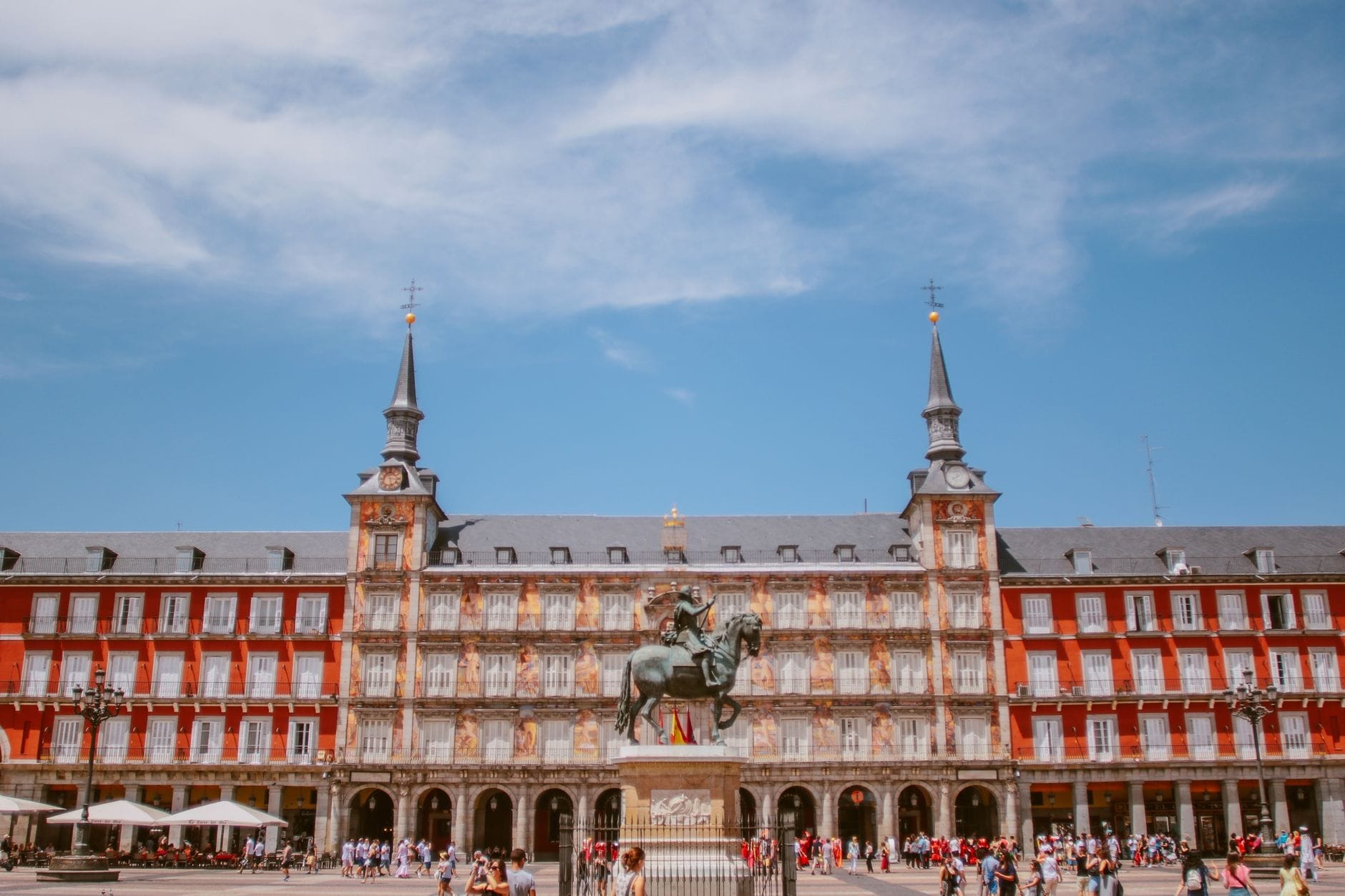
Plaza Mayor de Madrid is a 129-metre by 94-metre rectangular public square entirely enclosed by uniform, ochre-red buildings with slate spires and continuous arcaded walkways at street level. It is one of the largest and best-preserved examples of Castilian baroque civic architecture in Spain, and it sits at the symbolic centre of the city’s historic core. The square is free to enter, open 24 hours a day as a public space, and serves simultaneously as an outdoor living room, a tourist landmark, and — for locals — a place you mostly walk through rather than linger in.
If you are visiting Madrid for the first time, you will almost certainly pass through Plaza Mayor. That is not a problem. The architecture justifies the stop. But it helps to arrive knowing what the square offers and what it does not, so you can calibrate your expectations and spend your time accordingly.
💡 Local tip
Approach from the Arco de Cuchilleros (the southwest arch, accessible from Calle de Cuchilleros) for the most dramatic first view of the square opening up in front of you. Note: this approach involves a sloped, cobbled street. For step-free access, enter from the Calle Mayor side or from the Plaza de la Provincia arch.
The Architecture and History
The square was built on the site of the former Plaza del Arrabal, a medieval market area outside the city walls. The current planned square was laid out during the reign of Philip III in the early 17th century, with construction beginning around 1617 and completion and inauguration in 1620, making this one of Madrid's oldest planned civic spaces. The equestrian bronze statue of Philip III at the centre of the square was cast in 1616 by Giambologna and Pietro Tacca and is one of the oldest monumental sculptures in Madrid.
What you see today is not quite the original. The square suffered three major fires over its first two centuries. After the worst, in 1790, the architect Juan de Villanueva rebuilt the surrounding buildings in a more austere neoclassical style, adding the characteristic sloping slate roofs and reducing the building height slightly to improve ventilation. That rebuilding is responsible for the square's current, cohesive appearance: 237 balconies facing inward, nine arched entrances, and continuous ground-floor arcades running the full perimeter.
Historically, the square served as a public stage for executions, bullfights, royal proclamations, and theatre performances. The Casa de la Panadería — the ornate building with allegorical frescoes on the north side — was originally the city's royal bakery and today serves as a cultural centre. The frescoes on its facade, painted in vivid blues, reds, and golds, are among the most photographed features in the square and were added in their current form in 1992.
Understanding that layered history makes the square considerably more interesting than it appears at first glance. For broader context on Madrid's built heritage, the Madrid architecture guide covers the city's key periods and styles in depth.
Tickets & tours
Hand-picked options from our booking partner. Prices are indicative; availability and final rates are confirmed when you complete your booking.
Royal Monastery of El Escorial and the Valley of the Fallen trip from Madrid
From 64 €Instant confirmationFree cancellationFlexible time Real Madrid: Bernabeu Stadium & Museum Entry
From 42 €Instant confirmationMuseum of Senses Madrid entrance ticket
From 19 €Instant confirmationAvila and Segovia full-day tour from Madrid
From 50 €Instant confirmationFree cancellation
What It Feels Like at Different Times of Day
Early morning, before 9 a.m., Plaza Mayor is one of the quieter corners of central Madrid. Street cleaners move across the cobblestones, café tables are being set out under the arcades, and the low sunlight catches the frescoes on the Casa de la Panadería with particular clarity. This is the best hour for photography: the square is almost empty, the light is warm, and the geometry of the space is easy to see without crowds obscuring it.
By mid-morning, tour groups begin arriving in earnest. The square fills steadily from around 10 a.m. onward, and by midday in peak season it can feel very crowded. The arcades provide shade, but the open centre of the square has no cover, and in July and August the stone reflects considerable heat by early afternoon. If you visit in summer, the noon hours are uncomfortable unless you stay under the arcade columns.
Evening, from around 7 p.m. to 10 p.m., brings a different atmosphere. The tour groups thin out, the light softens, and the square takes on more of the role it plays for residents: a meeting point, a place to have a beer before moving on to dinner. The café terraces fill up, and the ambient sound shifts from camera clicks and tour guide amplifiers to conversation and the low hum of the city. This is probably the most comfortable time to sit and absorb the square.
⚠️ What to skip
Terrace prices in Plaza Mayor are among the highest in central Madrid. A coffee or beer under the arcades can cost two to three times what you would pay a few streets away. You are paying for the location, which is your choice to make — just go in knowing.
Getting There and Getting Around the Square
The most straightforward approach is from Metro Sol (Lines 1, 2, and 3), one of Madrid's central interchange stations. From the Sol exit, walk west along Calle Mayor for about three minutes until you reach the Plaza de la Provincia arch. BiciMAD bike-share docking stations are located at Calle Mayor 6 and 16 and at Plaza de San Miguel, if you are cycling.
The square itself is a large, level, paved surface with no significant steps inside, making it accessible for wheelchair users across most of its area. The nine arched entrances vary in approach: the Arco de Cuchilleros on the southwest side involves a sloped and cobbled descent from Calle de Cuchilleros, while the approaches from Calle Mayor and the Plaza de la Provincia side are flat and straightforward.
Plaza Mayor sits within a dense cluster of historic attractions. The Puerta del Sol is a five-minute walk east. The Mercado de San Miguel — one of Madrid's covered food markets — is immediately adjacent to the northwest corner of the square, which makes it an easy and logical pairing.
What to Do In and Around the Square
Within the square itself, the main activity is looking: at the architecture, at the frescoes, at the statue of Philip III, and at the balconies above. Stamp and coin dealers have operated under the southwest arcades on Sundays for decades, drawing collectors and curious onlookers alike. The market is modest but genuine, and it gives the square a different, more local character on Sunday mornings than it has the rest of the week.
The arcades around the perimeter house a mix of souvenir shops, cafés, and a handful of older specialty stores selling items like Spanish capes and traditional hats. These shops are aimed primarily at tourists, and the quality varies widely. If you are shopping for crafts or food, the Mercado de San Miguel next door offers considerably more interesting options.
South of Plaza Mayor, the streets of La Latina contain some of the city's best tapas bars, particularly along Cava Baja. If you are planning an evening that starts at Plaza Mayor, heading south into La Latina afterward is a straightforward and rewarding sequence. The Cava Baja strip is roughly a ten-minute walk from the square's south side.
During the Christmas season, Plaza Mayor hosts one of Madrid's oldest and largest Christmas markets, with wooden stalls selling decorations, figurines for nativity scenes (a strong Madrid tradition), costumes, and seasonal sweets. The market runs from late November through early January and significantly changes the feel of the square, drawing large local crowds as well as visitors.
If you are planning a visit specifically for the Christmas period, the Madrid Christmas guide covers the market calendar and other seasonal events across the city.
Photography and Practical Notes
The square photographs best from the ground level with a wide-angle lens that can capture the full enclosure of the space. The Casa de la Panadería frescoes are best lit in the morning when the sun hits the north side of the square. If you want a clean shot of the Philip III statue with the full square behind it, arrive before 9 a.m. in summer or on a weekday morning in shoulder season.
There is no particular dress code to enter the square, as it is a public outdoor space. In summer, wear sunscreen and bring water if you plan to spend time in the open centre of the square. The stone reflects heat significantly in July and August. In winter, the square can be cold and windy, and the open centre offers no shelter from rain.
ℹ️ Good to know
Events including outdoor concerts and cultural performances are sometimes held in the square, particularly in summer and during festival periods. These events may require separate tickets depending on the organizer. Check the esMADRID official portal for current programming before your visit.
Is Plaza Mayor Worth Your Time?
For most visitors to Madrid, yes — but with realistic expectations. The square is architecturally significant and historically layered. It photographs well, it is free, and it is central enough that you will likely pass close to it anyway. The thirty minutes it takes to walk through the arcades, look at the frescoes, and absorb the geometry of the space is time well spent.
What it is not: a dining destination, a shopping destination, or a place to spend a long afternoon without a particular purpose. The cafés are overpriced and not especially good. The souvenir shops are generic. If you are looking for the most authentic slice of Madrid street life, the neighborhoods immediately surrounding the square — La Latina to the south, Sol and the streets around it to the east — will serve you better for that purpose.
First-time visitors planning their full itinerary should also look at the things to do in Madrid overview, which puts Plaza Mayor in the context of the city's broader range of experiences and helps prioritize time across different neighborhoods and attraction types.
Insider Tips
- Visit on a Sunday morning to catch the stamp and coin market under the southwest arcades — it has operated here for decades and gives the square a genuinely local atmosphere that weekday visits rarely provide.
- The Arco de Cuchilleros entrance on the southwest side leads directly to one of the oldest streets in central Madrid, lined with mesones (traditional taverns) that have been operating since the 17th century. It is worth ducking into even if you do not eat.
- If you want a coffee without paying terrace prices, walk one block to any café on Calle de Toledo or Calle de Postas — you will pay roughly half what the arcades charge for the same drink.
- The Casa de la Panadería frescoes are easy to miss if you enter from the south side and keep your eyes at street level. Look up at the full facade of the building on the north side of the square — the painted allegorical figures are the most colorful element in an otherwise uniformly ochre space.
- During the Christmas market (late November to early January), arrive on a weekday afternoon rather than a weekend to avoid the densest crowds. The nativity figurine stalls (for the traditional pesebres) are particularly interesting even if you have no intention of buying.
Who Is Plaza Mayor For?
- First-time visitors to Madrid who want to understand the city's historic centre
- Architecture and history enthusiasts interested in Habsburg and Bourbon-era Madrid
- Evening walkers looking for an atmospheric starting point before heading to La Latina for tapas
- Visitors in December who want to experience the traditional Christmas market and nativity figurine stalls
- Photographers who can arrive before 9 a.m. for clean, crowd-free shots of the arcades and frescoes
Nearby Attractions
Other things to see while in Sol & Centro:
- Catedral de la Almudena
The Almudena Cathedral took more than a century from the laying of its foundation stone to its consecration in 1993, making it one of Europe's newest major cathedrals. Free to enter and directly opposite the Royal Palace, it rewards visitors who look beyond its mismatched facade to discover a surprisingly bold and colorful interior.
- Campo del Moro Gardens
The Jardines del Campo del Moro spread across more than 20 hectares directly behind the Royal Palace, offering one of the most dramatic views of the Palacio Real in Madrid. Admission is free, crowds are thin compared to the palace itself, and the romantic English-style landscape feels worlds away from the city streets above.
- Círculo de Bellas Artes
Few buildings in central Madrid earn attention on multiple levels at once. The Círculo de Bellas Artes delivers: a landmark Palacios-designed tower within the Paisaje de la Luz UNESCO World Heritage area with a rooftop terrace above the Gran Vía skyline, rotating art exhibitions, and one of the city's most atmospheric cafés. Entry to the building and La Pecera café is free; the rooftop, exhibitions, and combined tickets have separate fees starting from around €6.
- Edificio Metrópolis
Standing at the junction of Calle de Alcalá and Gran Vía, the Edificio Metrópolis is Madrid's most iconic piece of Belle Époque architecture. Its slate dome, gilded detailing, and winged Victory statue make it a landmark that rewards careful observation, even though the building itself is not a public museum. Here is everything you need to know before you go.