Puerta del Sol: Madrid's Centre of Everything
Puerta del Sol is Madrid's most central public square, marking Kilometre Zero of Spain's road network and hosting the country's most-watched New Year's Eve tradition. Free to enter around the clock, it anchors the historic Sol-Centro neighbourhood and connects to virtually every corner of the city.
Quick Facts
- Location
- Puerta del Sol, 28013 Madrid (Sol neighbourhood, Centro district)
- Getting There
- Metro Sol (Lines 1, 2, 3); Cercanías C-3 and C-4
- Time Needed
- 30–60 minutes to take it in; many visitors pass through several times
- Cost
- Free, open 24 hours
- Best for
- First-time visitors, orientation, New Year's Eve, photography
- Official website
- www.esmadrid.com/en/tourist-information/puerta-del-sol
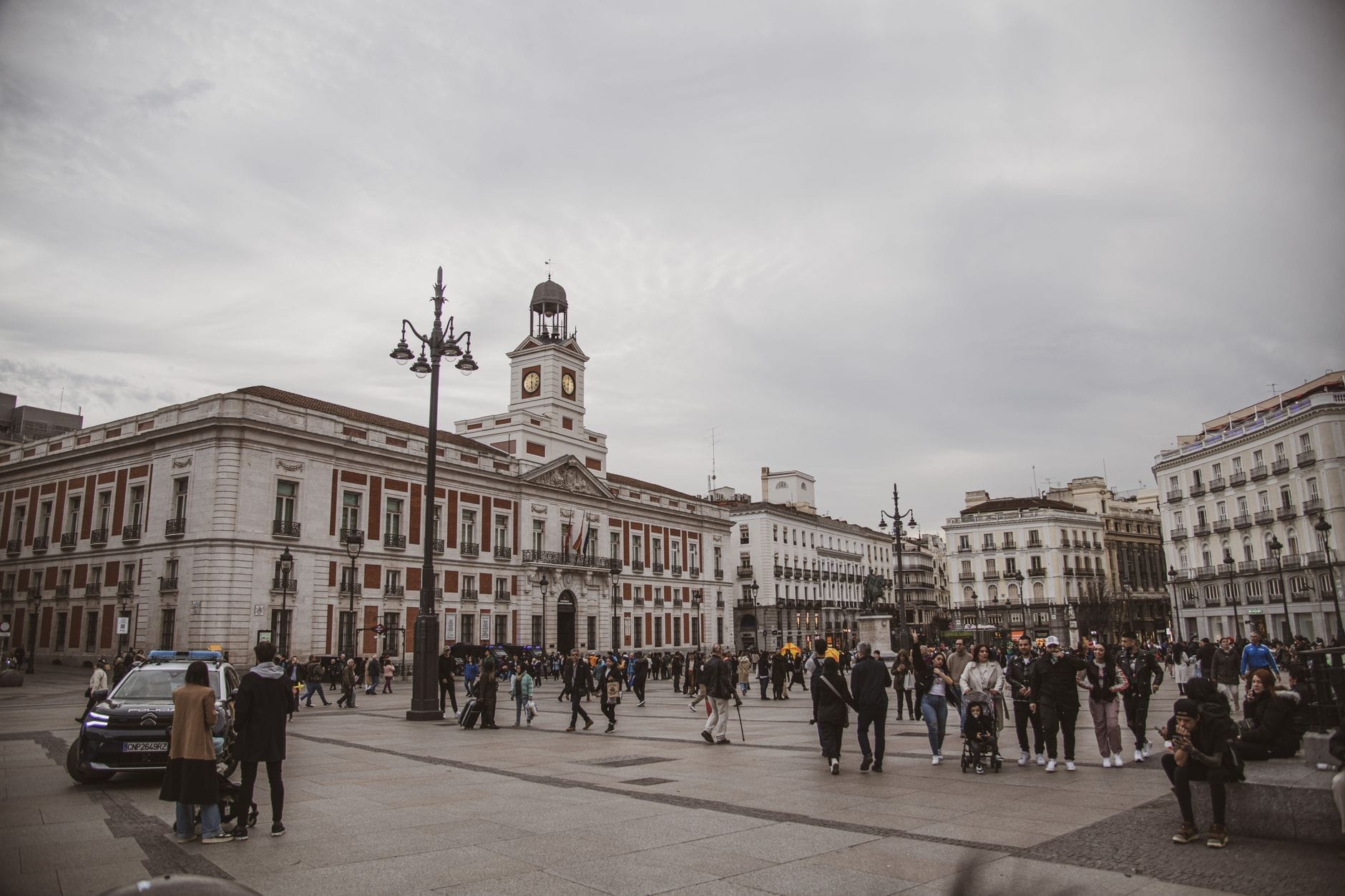
What Puerta del Sol Actually Is
Puerta del Sol is a semicircular public square at the geographic and symbolic heart of Madrid. Its name translates as Gate of the Sun, a reference to the east-facing gate that stood in the city wall here during the 15th century, decorated with a rising sun. That gate is long gone, but the name stuck, and the square has grown into something far more significant than its medieval origins suggest.
Embedded in the pavement outside the Casa de Correos on the south side of the square is a small brass plaque: Kilómetro Cero, the point from which all of Spain's radial roads are measured. It is also the symbolic centre of Madrid itself. Every major radial Spanish national road was historically designated to originate here, at least in name, and most visitors to the city will pass through the square multiple times without planning to.
The square is fully pedestrianized and flat, which makes it naturally accessible for visitors with reduced mobility. It connects directly to the main Gran Vía shopping corridor to the northwest and opens onto the routes leading to Plaza Mayor a short walk to the southwest. Functionally, Puerta del Sol is less a destination in isolation and more a central node that orients the entire city.
💡 Local tip
Find the Km 0 plaque on the pavement in front of the main entrance to the Casa de Correos building. It is often missed by visitors who stand in the square without looking down. Technically, standing on it puts you at the centre of Spain's road network.
The Architecture Anchoring the Square
The dominant structure is the Casa de Correos, the grand neoclassical building on the southern edge of the square. Constructed between 1766 and 1768, it was originally Madrid's main post office, hence its name, House of the Post Office. Today it serves as the seat of the Presidency of the Community (Comunidad) of Madrid. The clock tower on its facade is arguably more famous than the building itself: each New Year's Eve, all of Spain watches its bells count down the final twelve seconds of the year.
The clock tradition dates to the broadcast of 31 December 1962, when it was first televised nationally. The custom is to eat one grape with each of the twelve chimes at midnight, a practice meant to bring good luck in the coming year. The square fills with enormous crowds on that night, and the television broadcast remains a fixture of the Spanish calendar, making the Casa de Correos clock one of the most recognized images in the country.
The square also contains the Statue of the Bear and the Strawberry Tree (El Oso y el Madroño), a bronze sculpture that has served as the official symbol of Madrid since the medieval period. The image of a bear rearing against a strawberry tree appears on the city's coat of arms, and the statue is the default meeting point for locals and tourists alike. If you are exploring the broader Sol-Centro neighbourhood, this statue marks the starting point.
Tickets & tours
Hand-picked options from our booking partner. Prices are indicative; availability and final rates are confirmed when you complete your booking.
Imperial Madrid walking tour
From 16 €Instant confirmationFree cancellationTapas and history tour through old Madrid
From 75 €Instant confirmationFree cancellationGuided tapas adventure in Madrid
From 99 €Instant confirmationFree cancellationHabsburgs Madrid private tour with a local guide
From 35 €Instant confirmationFree cancellation
How the Square Changes by Time of Day
Early morning, before 9am, Puerta del Sol is a different place. Delivery workers move through the surrounding streets, pigeons take over the open paving, and the handful of people crossing the square are mostly commuters heading to the Metro. The light comes in low from the east at this hour, and the Casa de Correos facade catches it well. It is the closest this square ever comes to feeling quiet.
From mid-morning through the afternoon, the crowd builds steadily. Street performers, tour group leaders with raised umbrellas, people queuing at the tourist information kiosks, and cyclists passing through on Madrid's bike-share network all converge here. The sound is an unbroken mix of Spanish, English, and a dozen other languages layered over the background hum of the Metro vents. In summer, the exposed paving radiates heat back up at you. Bringing water and wearing sunscreen is not optional from June through August.
Evenings shift the atmosphere again. As the shopping streets quiet down, the square fills with people heading to dinner, bars, and the areas around Calle de las Huertas and La Latina. Around 9 or 10pm in summer, the square is at its most atmospheric, lit artificially against a still-warm sky, with the surrounding cafe terraces full. In winter, when Madrid's Christmas lights are up, the whole square is covered in illuminations and the seasonal market stalls draw large numbers of visitors.
⚠️ What to skip
Pickpocketing is a genuine concern in Puerta del Sol, particularly in the densest crowds during midday and on New Year's Eve. Keep bags zipped and in front of you. The square is safe in the ordinary sense, but it is one of the highest-footfall spots in Madrid and opportunistic theft is common at busy hours.
Historical Context Worth Knowing
Puerta del Sol has been a site of political significance as much as civic life. In May 1808, fighting near the square marked the beginning of Madrid's uprising against Napoleonic occupation, an event commemorated in Francisco Goya's painting The Second of May 1808 (now in the Prado). The square has since served as the gathering point for protests, celebrations, and public demonstrations throughout Spanish history.
In 2011, it became internationally known as the focal point of the 15-M movement (also called the Indignados movement), when tens of thousands of protesters camped in the square for weeks in a demonstration against austerity and political corruption. The square's role as a place of popular assembly is baked into its design and its central position. For those interested in exploring Madrid's political and cultural layers more deeply, the Madrid architecture guide provides useful context on how the city's major public spaces evolved.
Getting There and Getting Around
The Sol Metro station sits directly beneath the square and is served by Lines 1 (light blue), 2 (red), and 3 (yellow), making it one of the most connected stations in the network. Cercanías commuter rail lines C-3 and C-4 also stop at Sol, which means you can reach the square directly from both Atocha and Chamartín railway stations without changing trains. City buses 3, 50, and 51 also serve the surrounding streets around the square.
Because the square is pedestrianized, taxis and ride-hailing vehicles drop off on the surrounding streets rather than at the square itself. If arriving by car, the nearest parking garages are on adjacent streets, but driving into this part of central Madrid is generally not recommended due to restricted access zones and the efficiency of the Metro.
Puerta del Sol functions as the natural starting point for walking tours of central Madrid. From here, it is roughly a 10-minute walk east along Carrera de San Jerónimo to the Museo del Prado, and a 5-minute walk west to Plaza Mayor. The guide to getting around Madrid covers the Metro fare structure and zone system in detail.
Photography and Practical Notes
For photography, the best light falls on the Casa de Correos in the early morning when the sun is at a low angle from the east and the square is relatively empty. The statue of the Bear and the Strawberry Tree can be difficult to photograph cleanly in the afternoon due to the constant flow of people wanting their photo taken next to it. A wider lens is useful given the scale of the space.
The square is large enough that you rarely feel truly trapped in a crowd outside of peak tourist hours or major events, but the surrounding streets are narrow and can feel congested quickly. Calle del Arenal, Calle Mayor, and Calle Montera all radiate outward from the square and become notably less crowded within two or three blocks.
Accessibility is straightforward. The square is flat, pedestrianized, and free of steps. The Sol Metro station has lift access from street level to the platforms. Bike-share docking stations are located near the square's perimeter.
ℹ️ Good to know
New Year's Eve at Puerta del Sol requires planning well in advance. The square is closed off by security perimeters hours before midnight, and access is controlled. Arriving early is essential. Many locals watch the chimes from nearby bars on television rather than fighting the crowds in the square itself.
Insider Tips
- The Km 0 plaque on the pavement in front of the Casa de Correos is almost always surrounded by people photographing it in tourist season. Visit in the early morning if you want a clear shot or simply to read it in peace.
- The Bear and the Strawberry Tree statue is the default meeting point for the entire city. If you are waiting for someone in Sol, this is where to stand. Note that it is at the eastern end of the square, not the geometric centre.
- The underground Sol station concourse has an arched ceramic mural depicting the historical development of Madrid from the 15th century onward. Almost everyone walks past it without stopping. It is worth a minute of attention.
- Avoid the tourist-facing cafes immediately adjacent to the square. Prices are higher and quality is inconsistent. Walk two blocks in any direction and you will find better coffee at lower prices without the surcharge for the view.
- For New Year's Eve, Spanish supermarkets sell pre-packaged grapes in portions of twelve specifically for the chimes tradition. They are sold out by the afternoon of the 31st, so buy yours in the morning.
Who Is Puerta del Sol For?
- First-time visitors who need to orient themselves in central Madrid
- History and architecture enthusiasts interested in 18th and 19th-century Madrid
- Photographers looking for early-morning shots of monumental neoclassical buildings
- Travellers on a budget who want to explore Madrid's centre without paying admission anywhere
- Anyone visiting Madrid around New Year's Eve for the iconic twelve-grapes countdown
Nearby Attractions
Other things to see while in Sol & Centro:
- Catedral de la Almudena
The Almudena Cathedral took more than a century from the laying of its foundation stone to its consecration in 1993, making it one of Europe's newest major cathedrals. Free to enter and directly opposite the Royal Palace, it rewards visitors who look beyond its mismatched facade to discover a surprisingly bold and colorful interior.
- Campo del Moro Gardens
The Jardines del Campo del Moro spread across more than 20 hectares directly behind the Royal Palace, offering one of the most dramatic views of the Palacio Real in Madrid. Admission is free, crowds are thin compared to the palace itself, and the romantic English-style landscape feels worlds away from the city streets above.
- Círculo de Bellas Artes
Few buildings in central Madrid earn attention on multiple levels at once. The Círculo de Bellas Artes delivers: a landmark Palacios-designed tower within the Paisaje de la Luz UNESCO World Heritage area with a rooftop terrace above the Gran Vía skyline, rotating art exhibitions, and one of the city's most atmospheric cafés. Entry to the building and La Pecera café is free; the rooftop, exhibitions, and combined tickets have separate fees starting from around €6.
- Edificio Metrópolis
Standing at the junction of Calle de Alcalá and Gran Vía, the Edificio Metrópolis is Madrid's most iconic piece of Belle Époque architecture. Its slate dome, gilded detailing, and winged Victory statue make it a landmark that rewards careful observation, even though the building itself is not a public museum. Here is everything you need to know before you go.