Gran Vía Madrid: Architecture, Energy, and Everything In Between
Gran Vía is Madrid's signature boulevard, a 1.3-kilometre stretch of early 20th-century architecture, flagship stores, historic theatres, and rooftop bars cutting through the heart of the city. Free to walk, and endlessly photogenic at every hour.
Quick Facts
- Location
- Gran Vía, 28013 Madrid — from Calle de Alcalá to Plaza de España
- Getting There
- Metro: Gran Vía (Lines 1, 5), Callao (Lines 3, 5); Bus lines 1, 2, 46, 74, 146
- Time Needed
- 1–3 hours for a full walk with stops; accessible 24 hours
- Cost
- Free to walk; individual shops, theatres, and rooftop bars have their own prices
- Best for
- Architecture lovers, shoppers, theatre-goers, first-time visitors to Madrid
- Official website
- www.esmadrid.com/en/gran-via-compras
What Gran Vía Actually Is
Gran Vía is not a park or a museum. It is a working city boulevard, about 1.3 kilometres long, that runs diagonally across central Madrid from the junction with Calle de Alcalá near Plaza de Cibeles all the way to Plaza de España. What makes it remarkable is the near-unbroken row of early 20th-century buildings lining both sides, each one competing for height and decorative ambition, constructed in phases between 1910 and 1929 at enormous cost — over 300 buildings were demolished to make way for it.
The street functions as Madrid's commercial spine: flagship fashion chains, historic cinemas, live-music theatres, department stores, and hotel terraces all coexist on the same pavement. It can feel overwhelming on a Saturday afternoon when foot traffic peaks, but the architecture above the shop fronts rewards anyone who resists the pull of the windows and looks upward.
💡 Local tip
Look up regularly as you walk. The most interesting details on Gran Vía — sculpted cornices, allegorical figures, copper domes — are above the second floor, well out of the sightline of most crowds.
A Short History of a Very Long Project
The idea of slicing a modern boulevard through the cramped medieval street plan of central Madrid dates to 1862, but the final design was only approved in 1899. Ground was broken on 4 April 1910, when King Alfonso XIII symbolically dug the first earth, and the project proceeded in three distinct sections over the next two decades. The first section, from Calle de Alcalá to Red de San Luis, opened in 1910. The second reached Callao in 1917. The third and final stretch to Plaza de España was completed in 1931, with the entire boulevard officially named Gran Vía in 1981.
During the Spanish Civil War, Gran Vía was heavily damaged by artillery fire from the Casa de Campo. Several buildings still bear traces of that period, though casual visitors rarely pause to notice. The name Gran Vía itself was only made its official, permanent designation in 1981, having previously cycled through several names with political associations.
Understanding this timeline helps you read the street architecturally. The buildings vary in style from Beaux-Arts classicism through to Art Deco, reflecting the evolving tastes of three different construction eras. For a broader look at how this kind of ambitious urban planning shaped Madrid, the Madrid architecture guide puts Gran Vía in context alongside the city's other landmark buildings.
Tickets & tours
Hand-picked options from our booking partner. Prices are indicative; availability and final rates are confirmed when you complete your booking.
Avila and Segovia full-day tour from Madrid
From 50 €Instant confirmationFree cancellationSegovia Guided Tour from Madrid with Lunch Option
From 55 €Instant confirmationFree cancellationToledo and Segovia guided tour from Madrid
From 69 €Instant confirmationFree cancellationSegovia hot-air balloon flight with transfer from Madrid
From 245 €Instant confirmationFree cancellation
The Architecture: Section by Section
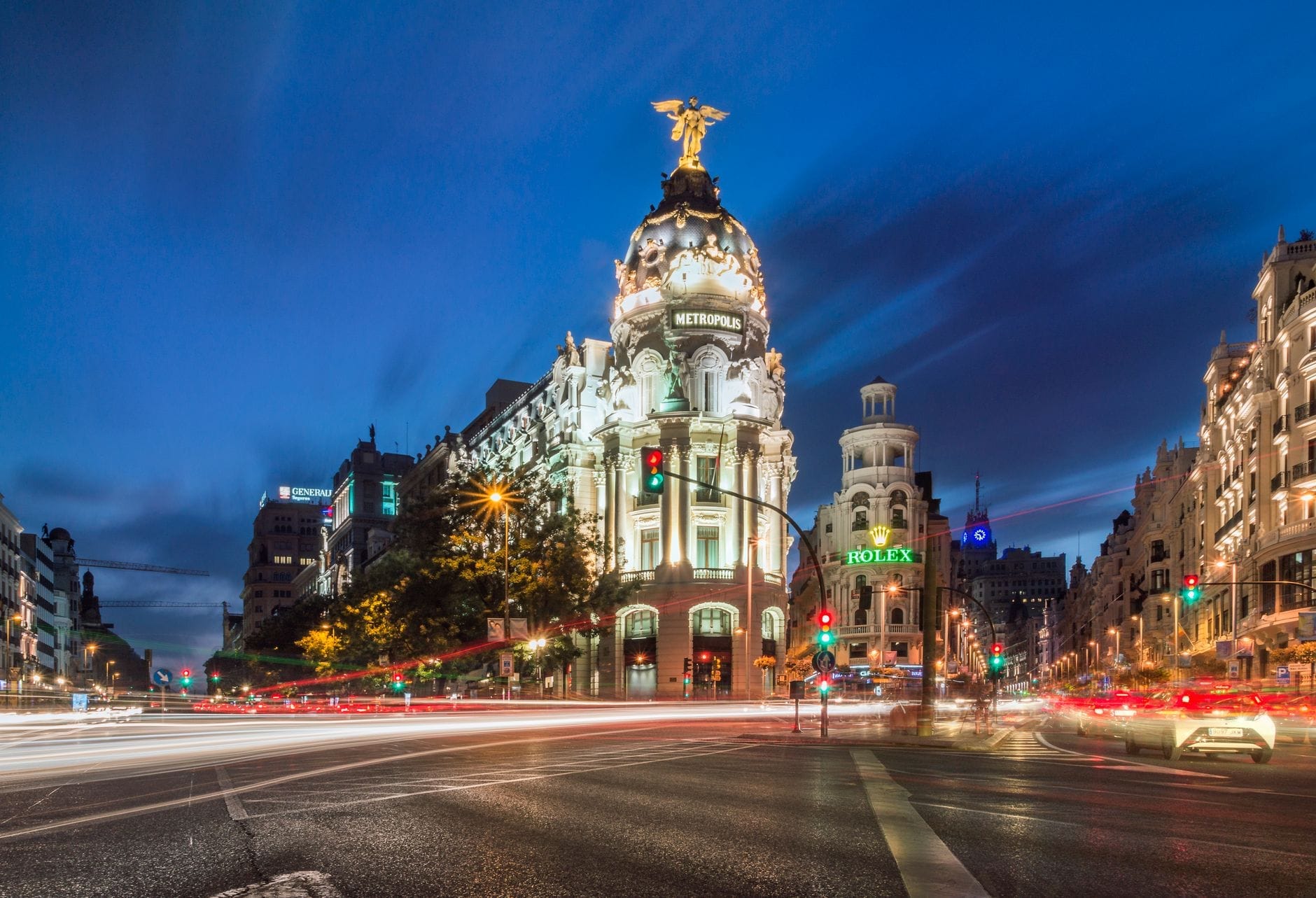
The most celebrated single building on Gran Vía is the Edificio Metropolis, which anchors the street's eastern end at the corner with Calle de Alcalá. Completed in 1911 and designed by the French architects Jules Février and Raymond Février, it is capped with a zinc dome and a gilded winged figure visible from several angles. It was originally built for a French insurance company and the allegorical sculptures on the facade reflect that corporate origin, though most visitors simply recognise it as the most photographed building in central Madrid.
The Edificio Metropolis is best photographed in the early morning from the pavement of Calle de Alcalá, before the traffic and the tour groups arrive. The golden dome catches the low morning sun with particular effect between March and September.
Further along, toward Callao, the Telefónica Building rises to 89 metres. Completed in 1929 to a design by the American architect Louis S. Weeks in collaboration with Ignacio de Cárdenas, it was the tallest building in Spain for several decades. Its relatively plain upper floors contrast sharply with the ornamental lower sections and the building's scale gives the middle section of Gran Vía a canyon-like quality on grey days.
The western section toward Plaza de España has a slightly different character: broader pavements, more Art Deco detailing, and historic cinema facades including the Capitol building, whose curved tower and neon signage recall the street's interwar golden age as Madrid's premier entertainment district.
How Gran Vía Changes Through the Day
Early morning, roughly between 7am and 9am, is the most underrated time to be here. The street is quiet enough to walk at your own pace, the light is soft and directional rather than flat overhead midday glare, and the facades read with clarity. The few people around are mostly commuters moving with purpose, and there is almost none of the performative chaos that defines the midday and afternoon crowds. If you want to photograph the buildings without scaffolding-worth of pedestrians in the frame, arrive before 9am.
By mid-morning the shopping crowds build steadily. Weekday afternoons are busy but manageable. Saturday afternoons between about 1pm and 7pm are the most congested period of the week: the pavement narrows psychologically under the volume of people, and moving in any direction requires patience. If you are sensitive to crowds, a Wednesday morning or a Sunday before noon gives you a version of the same street that feels entirely different.
After dark, Gran Vía develops its own distinct atmosphere. The theatre and cinema marquees light up, the rooftop bars fill with people watching the city below, and the street noise shifts from retail bustle to something more festive. In summer, this evening period stretches past midnight. The neon and LED signage on the older buildings creates a visual density that rewards photography even with a basic camera, provided you manage the exposure for the contrast between lit frontages and dark sky.
⚠️ What to skip
In July and August, daytime temperatures on Gran Vía can exceed 35°C. The street is exposed and mostly shadeless between Callao and Plaza de España. Carry water, wear sunscreen, and consider doing your architectural walk in the early morning or after 7pm.
What to Do Along the Street
The shopping on Gran Vía is predominantly mainstream: Zara, H&M, Primark, El Corte Inglés, and similar chains dominate the ground floors. If you are looking for independent or locally-owned retail, Gran Vía is not the right street, the surrounding neighborhoods offer more. What Gran Vía does well is theatre and live performance. The street has hosted major commercial theatres, and shows range from Spanish-language productions of international musicals to flamenco performances oriented toward visitors.
The rooftop bars attached to several hotels on Gran Vía are consistently good for panoramic views over the city, particularly toward the mountains to the north and the dome of the Almudena Cathedral to the west. For a broader overview of where to get the best elevated views in Madrid, see the guide to the best views in Madrid.
If you want to extend the walk into a longer route through central Madrid, Gran Vía connects naturally eastward toward the Plaza de Cibeles and westward toward Plaza de España, giving you a continuous pedestrian route that covers a large swath of the historic centre without retracing your steps.
Practicalities: Getting There and Getting Around
The easiest Metro access is the Gran Vía station itself, served by Lines 1 and 5, which drops you roughly in the centre of the boulevard. Callao station on Lines 3 and 5 serves the western half. Verify current lift availability before relying on either station for mobility-limited travel.
Since November 2018, Gran Vía has been semi-pedestrianised, meaning private car traffic is heavily restricted and the pavements have been widened significantly. The result is that the walking experience is genuinely more comfortable than it was before the renovation, with more space, more seating, and better street planting. It still gets extremely crowded on peak afternoons, but the physical infrastructure has improved markedly.
The full walk from Calle de Alcalá to Plaza de España is about 1.3 kilometres and takes around 20 minutes at a steady pace without stops, or the better part of a morning if you pause for architecture, coffee, and photography. Comfortable walking shoes are advisable; the pavement is even but long.
ℹ️ Good to know
Gran Vía is a primary pickpocket corridor in Madrid. Keep bags zipped and worn in front, particularly in the densely crowded afternoon and evening hours. The risk is not unique to Gran Vía but the volume of distracted tourists makes it a known target area.
The Verdict
Gran Vía is worth walking once, preferably in the right conditions, but it is not a relaxing or intimate experience. The architecture is strikingly impressive and historically significant, the street's role in Madrid's urban and cultural history is real, and the theatre district still functions as a live entertainment hub. However, the retail offer is almost entirely international chains, the midday crowds can be exhausting, and the rooftop bars charge a significant premium for what they deliver.
Travellers who come expecting something like a grand Parisian boulevard with independent cafes at every corner will find it more commercial than that. Those who arrive with realistic expectations, treat the street as architectural spectacle and urban observation rather than boutique shopping, and time their visit for early morning or late evening will leave satisfied.
If this is your first day in Madrid and you are trying to orient yourself, a walk along Gran Vía combined with time at Puerta del Sol and Plaza Mayor covers the essential geography of the historic centre efficiently. The 3-day Madrid itinerary builds this walk into a logical first-day route.
Insider Tips
- Walk the street eastward, from Plaza de España toward Calle de Alcalá, to approach the Edificio Metropolis head-on for the most dramatic reveal at the end of the boulevard.
- The Telefónica Building on Gran Vía 28 houses the Espacio Fundación Telefónica cultural centre, which hosts rotating contemporary art exhibitions — check current admission rules and exhibitions before you go, and the building interior is worth seeing independently of any show.
- For rooftop drinks without Gran Vía's tourist-premium pricing, walk one or two streets north into Malasaña, where smaller bars offer elevated terraces at neighbourhood prices.
- The Capitol cinema complex at Gran Vía 41 is one of the street's iconic buildings. If a film is showing that suits you, watching it there is a way to experience the building from the inside rather than just the street.
- Sunday mornings before noon offer the quietest version of Gran Vía you will find outside of public holidays. Many shops are closed, but the architecture and street proportions are easiest to appreciate without the crowds.
Who Is Gran Vía For?
- First-time visitors to Madrid wanting a quick orientation to the city's scale and energy
- Architecture enthusiasts interested in Beaux-Arts and early Art Deco building styles
- Evening visitors looking for theatre, cinema, or rooftop bars in a central location
- Photographers working in the early morning or blue-hour window after sunset
- Travellers building a longer walking route connecting the Retiro area to Plaza de España
Nearby Attractions
Other things to see while in Sol & Centro:
- Catedral de la Almudena
The Almudena Cathedral took more than a century from the laying of its foundation stone to its consecration in 1993, making it one of Europe's newest major cathedrals. Free to enter and directly opposite the Royal Palace, it rewards visitors who look beyond its mismatched facade to discover a surprisingly bold and colorful interior.
- Campo del Moro Gardens
The Jardines del Campo del Moro spread across more than 20 hectares directly behind the Royal Palace, offering one of the most dramatic views of the Palacio Real in Madrid. Admission is free, crowds are thin compared to the palace itself, and the romantic English-style landscape feels worlds away from the city streets above.
- Círculo de Bellas Artes
Few buildings in central Madrid earn attention on multiple levels at once. The Círculo de Bellas Artes delivers: a landmark Palacios-designed tower within the Paisaje de la Luz UNESCO World Heritage area with a rooftop terrace above the Gran Vía skyline, rotating art exhibitions, and one of the city's most atmospheric cafés. Entry to the building and La Pecera café is free; the rooftop, exhibitions, and combined tickets have separate fees starting from around €6.
- Edificio Metrópolis
Standing at the junction of Calle de Alcalá and Gran Vía, the Edificio Metrópolis is Madrid's most iconic piece of Belle Époque architecture. Its slate dome, gilded detailing, and winged Victory statue make it a landmark that rewards careful observation, even though the building itself is not a public museum. Here is everything you need to know before you go.