Edificio Metrópolis: Madrid's Most Photographed Corner
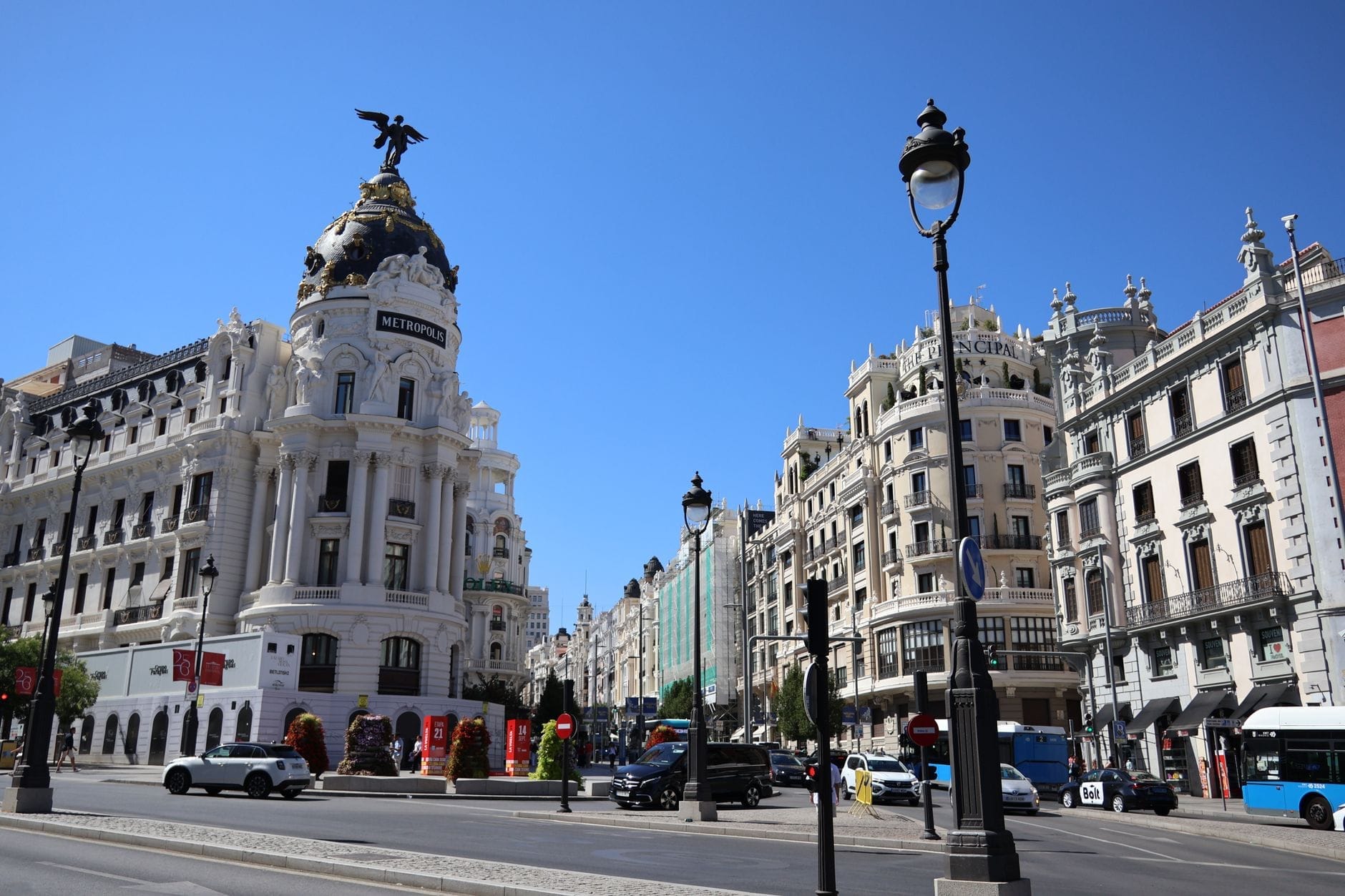
Standing at the junction of Calle de Alcalá and Gran Vía, the Edificio Metrópolis is Madrid's most iconic piece of Belle Époque architecture. Its slate dome, gilded detailing, and winged Victory statue make it a landmark that rewards careful observation, even though the building itself is not a public museum. Here is everything you need to know before you go.
Quick Facts
- Location
- Calle de Alcalá 39, 28014 Madrid (at the corner with Gran Vía)
- Getting There
- Sevilla (Line 2) or Banco de España (Line 2), both approx. 3-minute walk
- Time Needed
- 15–30 minutes for exterior viewing; longer if dining at the venue
- Cost
- Free to view from the street; interior access by membership, reservation, or restaurant booking only
- Best for
- Architecture lovers, photographers, walkers combining Gran Vía and Paseo del Prado
- Official website
- metropolismadrid.es
What the Edificio Metrópolis Actually Is
The Edificio Metrópolis is a private office and hospitality building, not a museum or public monument with timed entry. Its fame is entirely architectural: a curved, ornate corner tower that anchors one of Madrid's busiest intersections and appears in more photographs of the city than almost any other structure. Understanding this upfront saves confusion. You do not buy a ticket. You walk up, look, photograph, and walk on.
The building was designed in 1905 by French architects Jules and Raymond Février, with finishing work attributed to Spanish architect Luis Esteve. Construction ran from 1907 to 1910, and the building officially opened on 25 January 1911. Its original client was La Unión y el Fénix, an insurance company, which is why a bronze phoenix once crowned the dome. When the building changed hands in the 1970s, the phoenix was removed and replaced by the current gilded statue of Victoria, the winged goddess of victory, which now defines its silhouette.
ℹ️ Good to know
The interior now operates as Club Metrópolis, which combines a private members' club with a boutique hotel and several gastronomic spaces open by reservation. Access is by booking or membership only and the building is not open for general sightseeing. All the architectural interest is visible from the street.
The Architecture: What to Look For
The façade is neo-Renaissance in style, and the Février brothers worked in the French Beaux-Arts tradition that dominated European civic architecture at the turn of the twentieth century. What makes it work so well at this particular corner is the curved drum base, which fills the wedge of land between Alcalá and Gran Vía and creates a rotunda effect rather than an angular corner. The building does not feel like it has been squeezed into a gap. It feels like the intersection was designed around it.
The Corinthian columns on the upper levels frame large arched windows, and the transition from the stone-clad lower floors to the rounded slate dome is smoother than it sounds on paper. The dome itself is covered in dark French slate and punctuated with gilded copper details, dormers, and sculptural elements. At the very top, the Victoria statue stands roughly four metres tall and is best appreciated from a distance of at least thirty metres, ideally from the pavement directly across Calle de Alcalá.
Look also at the decorative frieze band running below the dome level, and the carved stone garlands and medallions on the upper storeys. This level of surface detail is characteristic of early-twentieth-century French-influenced work and is rarely replicated in anything built in Madrid after the 1930s. The building's condition appears well maintained, which matters: flaking stonework or stained facades undercut the impact of this kind of architecture, and Metrópolis avoids both.
Tickets & tours
Hand-picked options from our booking partner. Prices are indicative; availability and final rates are confirmed when you complete your booking.
Royal Monastery of El Escorial and the Valley of the Fallen trip from Madrid
From 64 €Instant confirmationFree cancellationFlexible time Real Madrid: Bernabeu Stadium & Museum Entry
From 42 €Instant confirmationMuseum of Senses Madrid entrance ticket
From 19 €Instant confirmationAvila and Segovia full-day tour from Madrid
From 50 €Instant confirmationFree cancellation
How the Experience Changes by Time of Day
Morning light from the east falls directly on the main Calle de Alcalá façade between roughly 8am and 11am, which is when the stone takes on a warm, almost honey-coloured tone and the gilding on the dome catches the sun most dramatically. The surrounding streets are quieter at this hour, and the pavement in front of the building on both sides is much less crowded than it will be by midday.
By midday and through the afternoon, the intersection is extremely busy. Buses, taxis, pedestrians, and delivery vehicles move through continuously. Viewing is perfectly possible but requires patience at the crossings. The building itself is never off-limits to look at, but getting a clean photograph without traffic or crowds in the foreground is harder between noon and 7pm.
Evening is the most atmospheric time to visit. After dark, the Edificio Metrópolis is lit from below with warm spotlights that illuminate the dome and the Victoria statue against a dark sky. The surrounding illumination of Gran Vía adds context, and the combination makes for remarkably striking night photography. Golden hour, roughly forty-five minutes before sunset, also produces excellent conditions with the western sky providing a coloured backdrop behind the dome when viewed from the east side of the intersection.
💡 Local tip
For photography without crowds in the foreground, arrive before 9am on a weekday or around 8am on a Sunday, when both the light and the pedestrian volume are at their most manageable.
Getting There and the Surrounding Area
The building sits at the exact point where Calle de Alcalá meets Gran Vía, one of Madrid's most walked-through corridors. The nearest metro stations are Sevilla and Banco de España, both on Line 2, each about three minutes on foot. From Sevilla station, walk west along Alcalá and the building appears almost immediately. From Banco de España, walk slightly further west along the same street past the Fuente de Cibeles fountain, with the Palacio de Cibeles visible behind you as you approach the building.
A bike docking station is located at Calle Alcalá 48, within fifty metres of the building. The address for the building is Calle de Alcalá 39. The area immediately around it connects naturally to a walk along Gran Vía, Madrid's main commercial boulevard, heading northwest, or to the Paseo del Prado heading south, making this a logical midpoint on a longer walking route.
The intersection is served by multiple bus lines, and the area is flat and easy to navigate on foot. However, the pavements at peak hours are narrow for the volume of people using them, particularly on the Gran Vía side. If you are using a wheelchair or pushchair, the crossings are signalled and dropped kerbs are present, but you will need to navigate through crowd pressure during busy periods.
Historical and Cultural Context
The Edificio Metrópolis opened in the same decade that Gran Vía itself was being carved through the old city fabric, beginning in 1910. These two projects belong to the same moment of urban ambition in Madrid, when the city was investing heavily in infrastructure and civic prestige. The building was designed to impress from the street, functioning partly as corporate branding for La Unión y el Fénix insurance company, and it succeeded. For more on the architectural character of this era, the Madrid architecture guide covers the full sweep of the city's building history.
The phoenix that originally topped the dome was a direct visual reference to the company name, Fénix meaning phoenix in Spanish. When the building passed to Metrópolis insurance company and then to its current private operators, the phoenix was taken down. The Victoria replacement carries its own symbolic weight but lacks the original's narrative logic. Some architectural historians consider this a minor loss, though the current statue is well-executed and visually effective at scale.
The building sits at the eastern edge of central Madrid, near the traditional city centre around Sol, surrounded by a dense mix of nineteenth-century and early-twentieth-century architecture that makes the Metrópolis feel contextually at home rather than anomalous. The corner location was deliberately chosen to maximize visibility from multiple approach directions, a common strategy in Belle Époque civic and commercial architecture.
Photography: Practical Notes
The best single viewpoint for the building is the pavement on the north side of Calle de Alcalá, directly opposite the main façade, at a distance of roughly twenty-five to thirty metres. From here, a standard wide-angle or kit lens covers the full dome and the street-level columns in one frame. A short telephoto in the 50–85mm equivalent range isolates the dome and Victoria statue cleanly against the sky.
For a wider environmental shot that includes the Gran Vía streetscape, stand further back at the Sevilla metro exit and use a moderate wide angle. The slight elevation of the pedestrian island at that corner helps with sight lines. Night shots benefit from a tripod, though police and security are present in this area and tripod use in the middle of a major pedestrian route draws attention and can obstruct others. A fast lens or in-body stabilisation reduces the need for one.
⚠️ What to skip
Drone photography is not permitted over central Madrid streets without prior authorisation from the Spanish Aviation Safety Agency (AESA). Do not fly drones in this area.
Who Might Not Find This Worth the Detour
If your time in Madrid is limited and you are choosing between active itinerary items, the Edificio Metrópolis should not be treated as a standalone destination. It is a façade. You cannot enter, there is no interpretive content, and the experience lasts fifteen minutes. Travellers who are not particularly interested in early twentieth-century European architecture may find it underwhelming once the initial photograph is taken.
The building works best as part of a larger walk connecting the Puerta del Sol area with the Banco de España and the start of Gran Vía. Treated that way, it becomes a natural high point in a ninety-minute circuit rather than a trip in itself. Visitors hoping for a rooftop view, interior access, or any kind of guided tour of the building will be disappointed: none of these are available without a prior reservation as a paying guest of the private venue.
Insider Tips
- The reflected view of the Metrópolis dome in the windows of the building directly opposite on Gran Vía creates an unusual double-image shot that almost no one attempts. Position yourself so the reflection fills the left third of the frame and the real building fills the right.
- Sunday morning between 8am and 10am is the single quietest window at this intersection. The streets are largely empty, light is already active in summer, and you can stand in positions that would be impossible at any other time of the week.
- The Victoria statue is more legible from the Banco de España side of the intersection than from directly below, because the angle reveals more of the figure rather than just the base and wings.
- If you walk along Calle de Alcalá heading west from the Retiro direction, the building appears in a long straight-line approach that lets you see the dome rising incrementally over about three hundred metres. This is one of the best urban approach sequences in central Madrid and is much better than arriving by metro and turning to face it immediately.
- The gastronomic spaces inside Club Metrópolis are bookable online through the official site and represent one of the few ways to see any part of the interior. The setting is genuinely impressive if you are interested in the building's historical fabric, though the experience is primarily a restaurant visit rather than an architectural tour.
Who Is Edificio Metrópolis For?
- Architecture and urban design enthusiasts who want to see France's Belle Époque influence on Madrid's early twentieth-century cityscape
- Photographers looking for a defined, photogenic subject to anchor a central Madrid shooting session
- Walkers building a route that connects Sol, Gran Vía, and the Paseo del Prado in a single loop
- Travellers who appreciate the context of a city's commercial and civic ambitions at a specific historical moment
- Evening visitors combining the illuminated building with a walk along the lit Gran Vía corridor
Nearby Attractions
Other things to see while in Sol & Centro:
- Catedral de la Almudena
The Almudena Cathedral took more than a century from the laying of its foundation stone to its consecration in 1993, making it one of Europe's newest major cathedrals. Free to enter and directly opposite the Royal Palace, it rewards visitors who look beyond its mismatched facade to discover a surprisingly bold and colorful interior.
- Campo del Moro Gardens
The Jardines del Campo del Moro spread across more than 20 hectares directly behind the Royal Palace, offering one of the most dramatic views of the Palacio Real in Madrid. Admission is free, crowds are thin compared to the palace itself, and the romantic English-style landscape feels worlds away from the city streets above.
- Círculo de Bellas Artes
Few buildings in central Madrid earn attention on multiple levels at once. The Círculo de Bellas Artes delivers: a landmark Palacios-designed tower within the Paisaje de la Luz UNESCO World Heritage area with a rooftop terrace above the Gran Vía skyline, rotating art exhibitions, and one of the city's most atmospheric cafés. Entry to the building and La Pecera café is free; the rooftop, exhibitions, and combined tickets have separate fees starting from around €6.
- Espacio Fundación Telefónica
Occupying four floors of the iconic Telefónica building on Gran Vía, Espacio Fundación Telefónica is one of Madrid's most rewarding free cultural spaces. Opened in 2012, it presents rotating exhibitions on art, digital culture, and the history of telecommunications across 6,000 square metres of gallery space inside a 1920s architectural landmark.