Palacio de Cibeles (CentroCentro): Madrid's Most Spectacular Civic Building
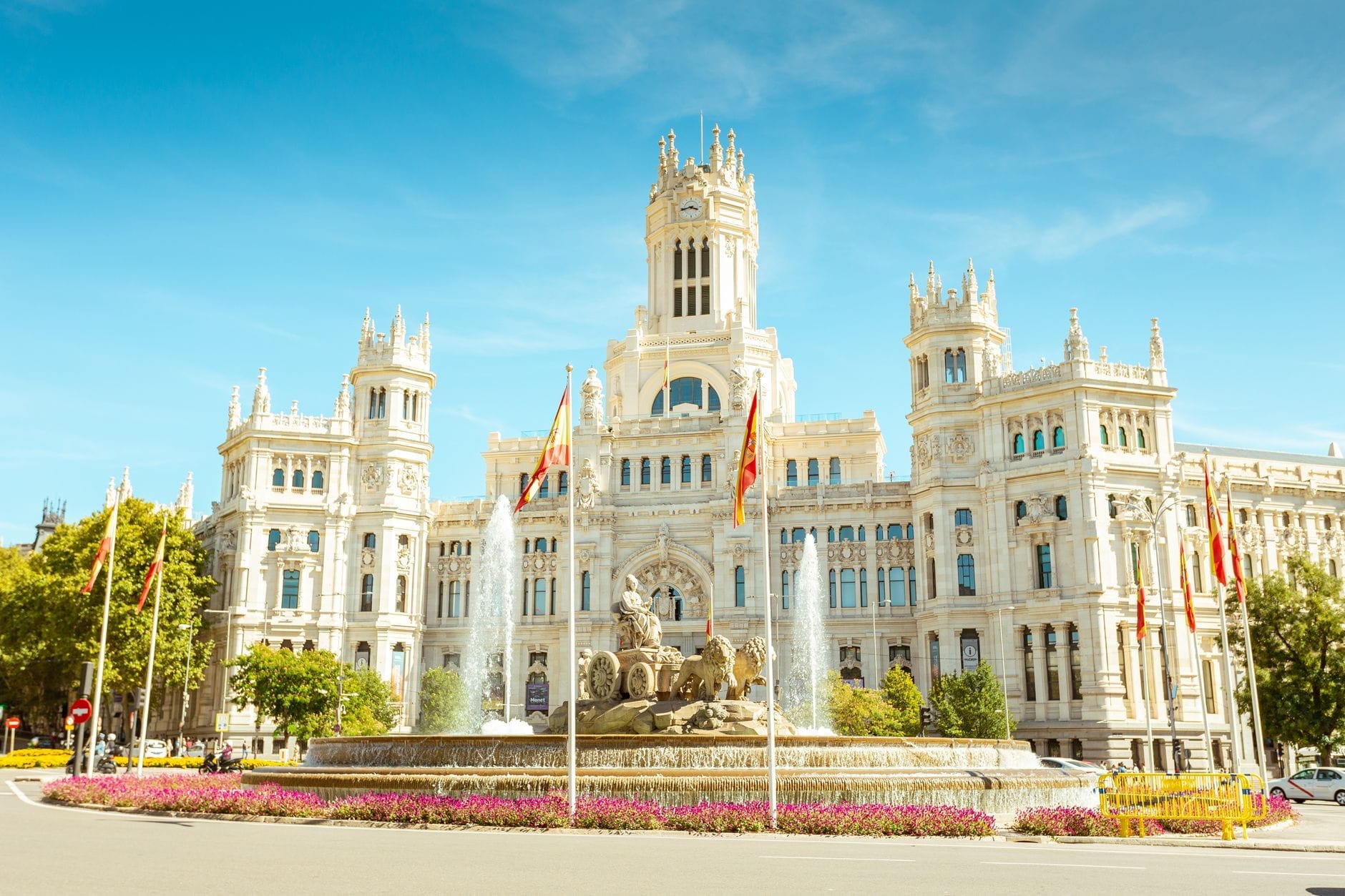
Once Madrid's main post office, the Palacio de Cibeles is now a cultural centre and observation deck at the heart of the city. The building itself is the attraction: a cathedral-like fusion of Gothic, Baroque, and Plateresque detail that towers over Plaza de Cibeles. Entry to the building is free; the rooftop typically costs €4, with some exhibitions free and others ticketed.
Quick Facts
- Location
- Plaza de Cibeles 1, 28014 Madrid (Retiro district)
- Getting There
- Metro Line 2, Banco de España station; Cercanías Recoletos (C2, C7, C8, C10)
- Time Needed
- Around 1–2 hours for exhibitions and rooftop; about 30 minutes if rooftop only
- Cost
- Building: free; exhibitions: check programme. Mirador (rooftop): €4 general, €2 concession, €1 under-6s (+ €0.50 online booking fee)
- Best for
- Architecture lovers, photographers, budget travelers, anyone wanting panoramic city views
- Official website
- www.centrocentro.org
What Is the Palacio de Cibeles?
The Palacio de Cibeles stands at the eastern end of the Paseo del Prado, anchoring Plaza de Cibeles with a presence that stops most first-time visitors mid-stride. The building is officially known as Palacio de Cibeles – CentroCentro, and it functions today as both Madrid's city hall annex and a public cultural centre with rotating exhibitions, a rooftop observation deck, and event spaces open to visitors. But that administrative description does little justice to what you actually encounter.
Designed by architects Antonio Palacios and Joaquín Otamendi, whose design won the state tender in 1904, the building took over a decade to complete. Construction began in late 1907, and it was inaugurated as the central post office and telecommunications hub on 14 March 1919. For most of the 20th century it operated under the name Palacio de Comunicaciones, sorting Madrid's mail inside one of the most ornate civic buildings in Spain. It was declared an Asset of Cultural Interest in the Monument category in 1993, and reopened as CentroCentro on 27 March 2011 after an extensive conversion.
ℹ️ Good to know
The building is free to enter, though some exhibitions may be ticketed. Only the Mirador Madrid observation deck, located high above Plaza de Cibeles, carries an admission charge: €4 general, €2 concession, €1 for children under 6, plus a €0.50 online booking fee. The ticket office is on the 2nd floor, open Tuesday to Sunday.
The Architecture: Why This Building Earns Your Attention
The Palacio de Cibeles is regularly cited in discussions of Madrid's architectural identity, and it earns that status on visual merit alone. Palacios and Otamendi drew from Gothic cathedral forms, Baroque ornamentation, and Plateresque surface decoration to produce something that defies simple classification. The white limestone facade reads differently depending on the angle and the hour: cool and severe at midday under hard summer light, warmly luminous at dusk when the stone catches the late afternoon sun.
The corner towers, the intricate spire above the central body, and the layered carved detail across the facade reward slow observation. Spend five minutes walking the full perimeter of the building from street level before going inside. Notice how the scale shifts as you move from the Cibeles fountain side toward the side streets: the building occupies roughly 30,000 m² of what was once the Buen Retiro gardens, and its mass only becomes apparent from these secondary angles. For broader context on the city's architectural heritage, the Madrid architecture guide covers the key buildings and movements that shaped the capital's streetscape.
Inside, the central nave of the former post office — now the main CentroCentro hall — is the single most impressive interior space in any civic building in Madrid that is freely accessible. The vaulted glass ceiling floods the ground floor with diffuse light. The ironwork railings, tiled floors, and the sheer vertical scale of the atrium make it feel closer to a cathedral than a public office. This interior alone justifies a visit even if you skip the exhibitions and the rooftop.
Tickets & tours
Hand-picked options from our booking partner. Prices are indicative; availability and final rates are confirmed when you complete your booking.
Royal Monastery of El Escorial and the Valley of the Fallen trip from Madrid
From 64 €Instant confirmationFree cancellationFlexible time Real Madrid: Bernabeu Stadium & Museum Entry
From 42 €Instant confirmationMuseum of Senses Madrid entrance ticket
From 19 €Instant confirmationAvila and Segovia full-day tour from Madrid
From 50 €Instant confirmationFree cancellation
The Mirador Madrid: What the Rooftop Actually Offers
The observation deck, known as Mirador Madrid, sits 92 metres above ground level and is the main reason many visitors add the admission charge to their budget. The view covers the Paseo del Prado axis toward Retiro Park to the southeast, Gran Vía running northwest into the city centre, the Almudena Cathedral dome and Royal Palace to the west, and on clear days, the Sierra de Guadarrama mountain range to the north.
In practical terms, the rooftop is partly enclosed and partly open-air, with barriers that allow photography without obstruction. Morning visits (opening is at 10:30) often offer the clearest atmospheric conditions; by midday in summer, heat haze can reduce the mountain views noticeably. Late afternoon in autumn or spring, roughly 17:00–19:00, is usually a rewarding window: the light is directional, the city is in full activity below, and the queue for the lift is often shorter than at midday. For a comparison of Madrid's best high viewpoints, see the best views in Madrid guide.
⚠️ What to skip
Mirador opening hours differ from the rest of the building: Tuesday–Sunday 10:30–14:00 and 16:00–19:30, although times may vary for security reasons or due to weather. The deck can close without notice due to security events at Plaza de Cibeles (which is used for Real Madrid celebrations and political gatherings). Check the official website before visiting.
Photography from the rooftop is unrestricted with personal cameras and phones. If you use a wide-angle lens, the corner positions facing southwest (toward the Royal Palace) and northeast (toward the Salamanca district and the Cuatro Torres skyline) give the most depth. The middle sections facing directly south toward Retiro are slightly obstructed by the building's own decorative elements, though not severely.
CentroCentro: The Cultural Programme
The cultural centre occupies multiple floors of the building and hosts contemporary art exhibitions, design shows, architecture displays, and public debates. Admission to many CentroCentro exhibitions is free, although some may be ticketed depending on the programme.
Visitors who come specifically for the exhibitions should check the current programme on the official website before arriving, since shows rotate and gaps between them do occur. The building also serves as the venue for Madrid's city council events and municipal ceremonies, so occasional closures of specific floors happen without much advance public notice. If your main goal is the major museum circuit, the best museums in Madrid gives a structured overview of how to prioritise your time across the Prado, Thyssen, and Reina Sofía.
Plaza de Cibeles: The Setting Matters
The building cannot be separated from its setting. Plaza de Cibeles is one of the four or five genuinely iconic public spaces in Madrid, and the Palacio de Cibeles defines its eastern edge. The 18th-century Cibeles fountain, depicting the goddess Cybele on a chariot drawn by lions, sits in the centre of the roundabout and is visible from the palace entrance steps. It is one of the most photographed monuments in the city, and the plaza itself is the traditional gathering point when Real Madrid wins a major trophy.
The plaza is surrounded by four significant buildings: the Palacio de Cibeles, the Banco de España, the Palacio de Buenavista (now the Army Headquarters), and the Palacio de Linares (now the Casa de América). Standing at the fountain and turning slowly through 360 degrees gives you a concentrated view of the late 19th and early 20th century architectural ambition that reshaped central Madrid. The full Plaza de Cibeles page covers the square's history and all four surrounding buildings in detail.
Getting There and Practical Logistics
The most direct public transport option is Metro Line 2 to Banco de España, a two-minute walk from the palace entrance. Cercanías lines C2, C7, C8, and C10 serve Recoletos station, which is slightly further but still walkable in under five minutes. A large number of EMT bus lines stop nearby, including lines 1, 2, 5, 9, 10, 14, 15, 20, 27, 34, 37, and 45.
On foot from Puerta del Sol, the palace is a 15-minute walk along the Paseo del Prado, passing the Neptuno fountain and the main facade of the Prado museum. This walk is one of the most rewarding in central Madrid and functions as an informal architectural survey of the 19th-century boulevard. It pairs naturally with a visit to the Paseo del Prado itself, which was designated a UNESCO World Heritage landscape in 2021.
Accessibility is well managed. Lifts serve floors -1, 2, and 3; adapted toilets are available on those floors; and a free wheelchair service can be requested at the information desk on the 2nd floor. Baby-changing facilities are located in toilets on floors 2 and 3.
💡 Local tip
The building is closed on Mondays and on the following dates: 1 and 6 January, 1 May, and 24, 25 and 31 December. On 5 January it opens only 10:00–14:00. Plan accordingly if your Madrid visit falls near these dates.
When to Visit and Who Should Skip
The Palacio de Cibeles works well at almost any time of year because the main draw, the building's interior and the rooftop, is weather-resilient. That said, spring and early autumn (April–May and September–October) offer the best conditions for rooftop visits: temperatures are comfortable for standing outdoors, atmospheric clarity is high, and daylight hours allow afternoon visits before the 19:30 close.
Weekday mornings before noon see the lightest visitor traffic. Weekend afternoons, particularly in summer, bring queues for the Mirador lift that can mean a 20–30 minute wait. The building itself never feels overcrowded because the interior spaces are very large, but the lift to the rooftop is a single bottleneck.
Who might not find this worth their time: travelers who have already done similar rooftop views elsewhere in Madrid and are on a tight schedule, and anyone expecting a major temporary exhibition since the CentroCentro programme is not consistently high-profile. The building is truly extraordinary from outside and from the ground-floor atrium; the €4 rooftop is good value but not essential if panoramic views are low on your priority list.
Insider Tips
- The ground-floor atrium is open during all visiting hours and requires no ticket. If the Mirador queue looks long, go inside first, see the atrium, then return to the ticket office closer to the afternoon session opening at 16:00, when the morning crowd has dispersed.
- The best exterior photography of the building is from the far side of the Cibeles fountain, ideally in the hour before sunset when the light hits the western facade directly. Try to visit on a weekday when traffic on the roundabout is slightly lighter and you can position yourself at the fountain without crowds blocking your sightline.
- The building is a focal point during Real Madrid's Champions League celebrations, which can draw hundreds of thousands of people to Plaza de Cibeles. The Mirador typically closes on those evenings. If you happen to be in Madrid during a final, factor in potential access disruption for the surrounding area.
- For the clearest mountain views from the Mirador, visit on a day after rain has cleared the air. The Sierra de Guadarrama is visible from the rooftop on clean-air days, particularly in winter and early spring.
- The cafe on the upper floors of the building offers seating with partial city views at standard Madrid coffee prices, and is far less visited than the tourist-facing areas. It is a reasonable option for a break between the exhibition floors and the rooftop queue.
Who Is Palacio de Cibeles (CentroCentro) For?
- Architecture enthusiasts who want to see Madrid's grandest civic building from inside and out
- Budget travelers: free building entry and a €4 rooftop make this one of the best-value viewpoints in the city
- Photographers working the Paseo del Prado axis, especially at golden hour
- Visitors combining a walk along the Paseo del Prado with a condensed overview of central Madrid's landmarks
- Families with children who want an accessible, manageable attraction with genuine visual impact
Nearby Attractions
Other things to see while in Retiro:
- CaixaForum Madrid
CaixaForum Madrid is a striking cultural centre on Paseo del Prado, housed in a converted early-20th-century power station redesigned by Herzog & de Meuron. Alongside rotating international exhibitions, it features a celebrated vertical garden by botanist Patrick Blanc and sits within walking distance of the city's three great art museums.
- Estanque Grande del Retiro
The Estanque Grande del Retiro is a vast artificial lake at the center of Parque del Retiro, created in the 17th century for royal festivities and now open to everyone for free. Rent a rowboat, watch street performers, or simply sit on the surrounding promenade as the Alfonso XII monument reflects in the water.
- Museo Nacional del Prado
The Museo Nacional del Prado holds one of the most important collections of European art in the world, with around 7,000–8,000 paintings spanning five centuries of Western painting. Located on the Paseo del Prado in the Retiro district, it is the cultural centerpiece of Madrid and the reason many visitors come to the city at all.
- Museo Nacional Centro de Arte Reina Sofía
The Museo Nacional Centro de Arte Reina Sofía is Spain's national museum of 20th-century art, housed in a converted 18th-century hospital near Atocha station. Its permanent collection includes Picasso's Guernica and major works by Dalí and Miró, making it one of the most significant modern art institutions in Europe.