Plaza de Cibeles: Madrid's Most Iconic Square Explained
At the crossroads of Paseo del Prado and Calle de Alcalá, Plaza de Cibeles brings together an 18th-century fountain, four landmark buildings, and one of Madrid's most recognizable public spaces. It costs nothing to visit and rewards at any hour of the day.
Quick Facts
- Location
- Junction of Paseo del Prado, Paseo de Recoletos and Calle de Alcalá, Madrid
- Getting There
- Banco de España (Metro Line 2); multiple EMT bus lines (1, 2, 9, 10, 15, 20 and others)
- Time Needed
- 20–40 minutes to walk the square; allow longer if visiting CentroCentro inside Cibeles Palace
- Cost
- Free — the square and fountain are public, accessible at all hours
- Best for
- Architecture lovers, photographers, first-time visitors, evening strollers
- Official website
- www.esmadrid.com/en/tourist-information/fuente-de-la-cibeles
What Plaza de Cibeles Actually Is
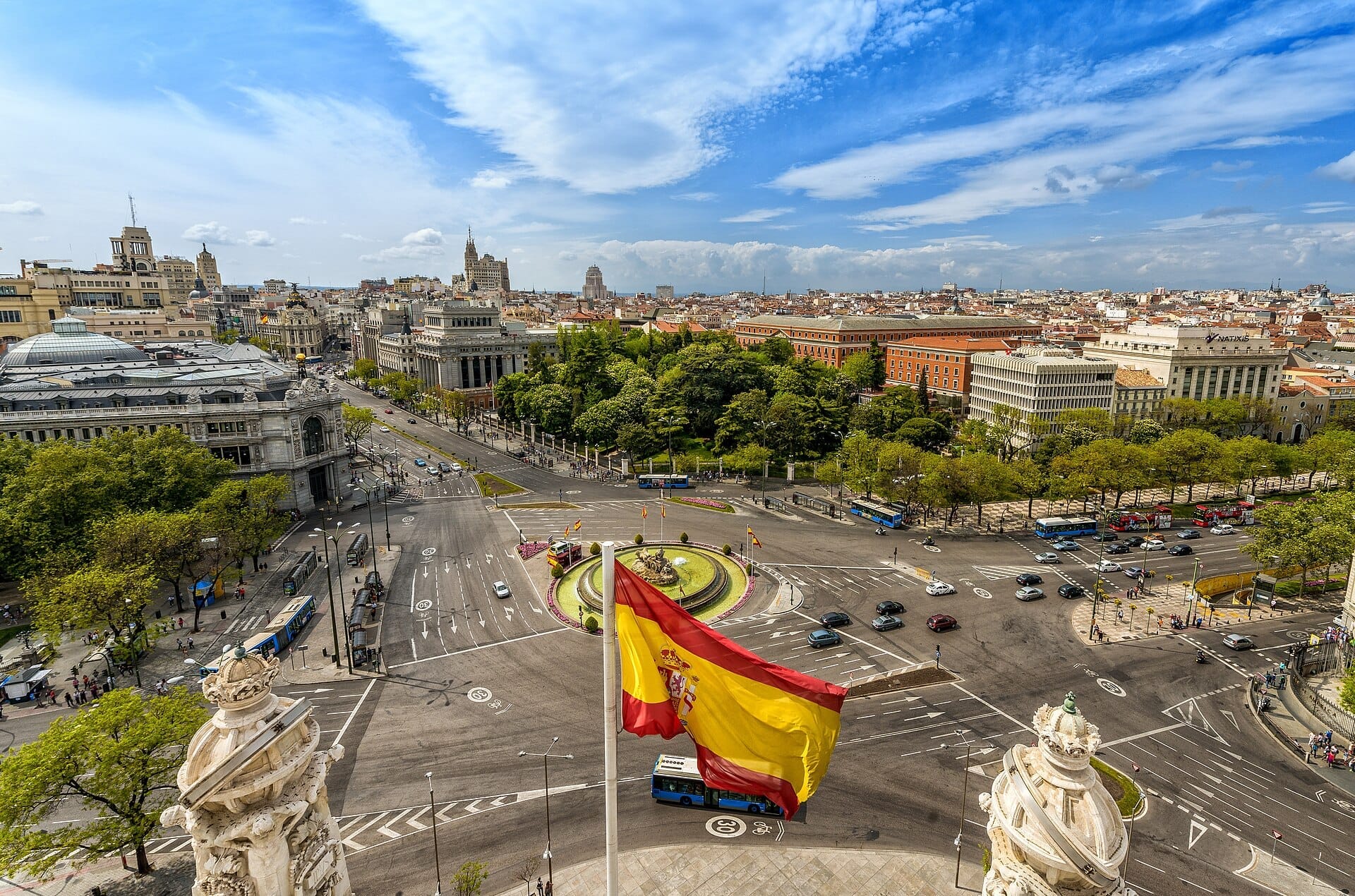
Plaza de Cibeles is not a square in the traditional sense, where you can sit down in the middle and watch life unfold around you. It is a major traffic roundabout at one of Madrid's most important intersections, with the Cibeles Fountain occupying a raised island at its centre. Pedestrian access to the fountain area itself is limited by the surrounding flow of cars, taxis and buses. What you get, instead, is a set of extraordinary buildings arranged at each corner, a fountain that has become shorthand for the city, and sightlines along three of Madrid's grandest avenues.
That distinction matters. Visitors who expect to picnic beside the fountain or linger at its base will find the experience more constrained than they imagined. Those who come to photograph the ensemble from the wide pavements on all sides, or to understand why this particular junction became Madrid's symbolic heart, will leave satisfied.
ℹ️ Good to know
The Cibeles Fountain sits on a traffic island. You can photograph it closely from the surrounding pavements, but direct pedestrian access to the fountain itself is generally restricted to special occasions such as major football celebrations. The best full-composition view of the fountain with Cibeles Palace behind it is from the western pavement on Paseo del Prado.
The Fountain: Mythology and Engineering in White Marble
The Fuente de Cibeles was designed by the architect Ventura Rodríguez and completed in 1782, during the reign of Charles III, the king who transformed much of Madrid into a city of Enlightenment-era public works. The fountain depicts Cybele, the Phrygian goddess of nature and fertility, seated on a chariot drawn by two lions. The sculptural detailing is precise enough that even from across the roundabout you can read the lions' musculature and the loose folds of Cybele's robes.
Originally, the fountain served a functional purpose: supplying water to Madrid's residents and to the water-carriers who distributed it through the city. It was relocated from a different position along the Paseo del Prado to the centre of the new plaza in 1895, where it has stood as a decorative monument ever since.[1][5] The sculptural groups are carved from marble and the rest of the monument from stone, and in direct afternoon light the surfaces take on a warm, almost cream tone. On winter mornings, when low sun hits it from the east along Calle de Alcalá, the fountain reads almost silver against the grey sky.
The fountain is also Madrid's unofficial trophy cabinet. Real Madrid supporters gather here after major victories, and the Cibeles figure is routinely dressed in the club's white kit with a scarf during celebrations.[1][5] The Spanish national football and basketball teams have also been celebrated here. If you visit after a Champions League final or a major tournament, expect the area to be completely impassable on foot.
Tickets & tours
Hand-picked options from our booking partner. Prices are indicative; availability and final rates are confirmed when you complete your booking.
Royal Monastery of El Escorial and the Valley of the Fallen trip from Madrid
From 64 €Instant confirmationFree cancellationFlexible time Real Madrid: Bernabeu Stadium & Museum Entry
From 42 €Instant confirmationMuseum of Senses Madrid entrance ticket
From 19 €Instant confirmationAvila and Segovia full-day tour from Madrid
From 50 €Instant confirmationFree cancellation
The Four Buildings: An Architecture Course in One Junction
What makes Plaza de Cibeles genuinely impressive as a piece of urban design is the quality of what surrounds the fountain. Each of the four corners of the square is anchored by a substantial building, and together they form a concentrated lesson in Madrid's architectural ambitions from the late 18th century onward.
The most prominent is the **Cibeles Palace** (Palacio de Cibeles), now home to Madrid City Hall and the CentroCentro cultural space. Built between 1907 and 1919, it was originally the headquarters of Spain's postal and telegraph services. The building is spectacular: a white stone confection of towers, turrets and ornamental detail that draws comparisons to northern European Gothic revival architecture while remaining distinctly Spanish. It is the kind of building that makes you stop mid-sentence. For views across Madrid from above, the palace's observation deck is worth checking separately. You can read more about the city's architecture in the Madrid architecture guide.
Across from it stands the **Bank of Spain** (Banco de España), a late 19th-century neoclassical structure of considered gravity. Its corner tower, positioned directly on the square, anchors the south-eastern approach from Calle de Alcalá. The building is not open to general visitors, but it is an important visual counterweight to the more exuberant Cibeles Palace.
The **Linares Palace** (Palacio de Linares), now operating as Casa de América, occupies the south-west corner.[5] It is a 19th-century aristocratic mansion with an extravagantly detailed interior that is occasionally accessible on guided tours. The **Buenavista Palace** (Palacio de Buenavista), on the north-west, houses the Army Headquarters and is not open to the public, but its late 18th-century facade contributes to the square's symmetry.[1][5]
How the Square Changes by Time of Day
Early morning, before 8am, Plaza de Cibeles belongs almost entirely to delivery vehicles, joggers, and the occasional night-shift worker waiting at a bus stop. The traffic is light enough that you can hear the fountain's water from the pavement, a low, consistent splash that disappears completely during peak hours. This is the best time for photography: the light from the east catches Cibeles Palace's white stone directly, and there are no tourist groups blocking the sightlines.
By mid-morning, tour groups and individual visitors start arriving in waves. The pavements around the roundabout become more crowded, and the surrounding bus stops fill up. There is no shade at the fountain island itself, and in Madrid's summers, where temperatures routinely climb above 35°C, standing on the exposed pavement in direct sun between noon and 4pm is quite uncomfortable. Bring water, wear a hat, and keep your visit short if you come in July or August.
Evening, from around 7pm through to midnight, is the most atmospheric window. The four buildings are lit from below, the fountain glows, and the square takes on a formal grandeur that daytime busyness tends to obscure. Madrid's evening culture means there are people around — not chaotic crowds, but a steady flow of residents walking, couples pausing for photographs, and tourists who have graduated to seeing the city the way locals do.
💡 Local tip
For photography, arrive at or just after sunrise for soft eastern light on the fountain and Cibeles Palace. In the evening, the building illumination begins around dusk and produces strong, clean compositions. Midday light is flat and harsh — avoid it if image quality matters to you.
Getting There and Moving Through the Area
The most direct public transport option is Metro Line 2 to Banco de España, which deposits you at street level less than 50 metres from the square. The station exit is on the south side of Calle de Alcalá, within immediate sight of the Bank of Spain building and the fountain. Multiple EMT bus lines also stop nearby, including routes 1, 2, 9, 10, 15, 20, 34, 51, 52, 53, 74, 146, 202 and 203.[1][5] BiciMAD bike-share docking stations are available at Paseo del Prado 1B and Calle Alcalá 48.[5]
Plaza de Cibeles sits at the junction of three of Madrid's most important avenues. Walk south along Paseo del Prado and within minutes you reach the Prado Museum and the botanical garden. Walk north along Paseo de Recoletos and you arrive at Plaza de Colón. Head west along Calle de Alcalá toward Puerta del Sol and you pass through the heart of central Madrid. This positioning makes Cibeles a natural orientation point rather than a destination in isolation.
The paved surfaces around the square are accessible to wheelchairs via pedestrian crossings, though the busy traffic and absence of rest areas means the experience is better suited to those comfortable navigating urban street-level conditions. The fountain island itself has no accessible pedestrian crossing.
What to Realistically Expect
Plaza de Cibeles is worth seeing, but it functions primarily as a thoroughfare and a backdrop rather than as a contemplative public space. You will not sit beside the fountain. You will photograph it from across a stream of traffic. You will walk the perimeter, look up at the buildings, and feel the particular Madrid quality of grandeur delivered without fuss or ceremony.
If the four buildings interest you architecturally, combine the visit with a walk toward Edificio Metrópolis on Calle de Alcalá, which is about 200 metres away. The stretch of Alcalá between Cibeles and Gran Vía contains some of Madrid's best early 20th-century facades in close succession. For a broader look at the city's landmark public spaces, the best views in Madrid guide covers nearby vantage points worth pairing with a visit here.
Those looking for a square where they can sit, eat, and absorb neighbourhood life will find other parts of Madrid more rewarding. Plaza de Santa Ana, Plaza de la Paja, and Plaza de Oriente all offer seating, shade, and a different rhythm entirely. Plaza de Cibeles is for looking at, not lingering in.
⚠️ What to skip
After Real Madrid or Spanish national team victories, this area becomes completely overwhelmed with celebrating fans, often for several hours. Expect road closures, noise, and the fountain area to be inaccessible. Plan around this if you want a standard visit.
Insider Tips
- The single best photography position for capturing the Cibeles Fountain with Cibeles Palace behind it is from the western pavement on Paseo del Prado, slightly south of the junction. From here, the composition lines up cleanly without obstructions.
- If you want to go inside the most impressive building on the square, Cibeles Palace houses CentroCentro, a free-entry cultural centre with rotating exhibitions. Check their programme before you visit — the interior alone justifies a separate stop.
- The Banco de España Metro station (Line 2) has a pleasant, low-footfall exit that puts you directly at the square. Avoid driving anywhere near this junction during rush hours: the roundabout creates significant congestion on all approach roads.
- In summer, carry water. There is no shade, no seating, and no refreshment kiosk directly at the square. The nearest cafes are on Calle de Alcalá heading toward the city centre, a short walk west.
- The fountain is illuminated at night, but the Cibeles Palace tower lights are the real spectacle after dark — the upper tiers glow white against the Madrid sky and the reflections carry across the wet pavement after rain.
Who Is Plaza de Cibeles For?
- First-time visitors to Madrid wanting to understand the city's urban scale and formal architecture
- Photographers targeting the fountain at dawn or the illuminated buildings after dark
- Architecture enthusiasts who want to see neoclassical, Baroque revival and early 20th-century eclectic styles side by side
- Travellers using Cibeles as a navigation anchor while walking between the Prado museum district and Gran Vía
- Football fans who want to see the site of Real Madrid's victory celebrations
Nearby Attractions
Other things to see while in Retiro:
- CaixaForum Madrid
CaixaForum Madrid is a striking cultural centre on Paseo del Prado, housed in a converted early-20th-century power station redesigned by Herzog & de Meuron. Alongside rotating international exhibitions, it features a celebrated vertical garden by botanist Patrick Blanc and sits within walking distance of the city's three great art museums.
- Estanque Grande del Retiro
The Estanque Grande del Retiro is a vast artificial lake at the center of Parque del Retiro, created in the 17th century for royal festivities and now open to everyone for free. Rent a rowboat, watch street performers, or simply sit on the surrounding promenade as the Alfonso XII monument reflects in the water.
- Museo Nacional del Prado
The Museo Nacional del Prado holds one of the most important collections of European art in the world, with around 7,000–8,000 paintings spanning five centuries of Western painting. Located on the Paseo del Prado in the Retiro district, it is the cultural centerpiece of Madrid and the reason many visitors come to the city at all.
- Museo Nacional Centro de Arte Reina Sofía
The Museo Nacional Centro de Arte Reina Sofía is Spain's national museum of 20th-century art, housed in a converted 18th-century hospital near Atocha station. Its permanent collection includes Picasso's Guernica and major works by Dalí and Miró, making it one of the most significant modern art institutions in Europe.