Plaza de España, Madrid: What to Expect, See, and Know Before You Go
One of Madrid's largest public squares, Plaza de España anchors the western end of Gran Vía with its famous Cervantes monument, sweeping open space, and easy connections to the Royal Palace gardens and Madrid Río. Entry is free, the square is open around the clock, and the 2021 redesign has made it genuinely pleasant to walk through.
Quick Facts
- Location
- Plaza de España, 28008 Madrid – western end of Gran Vía, on the western edge of the city centre
- Getting There
- Metro: Plaza de España (Lines 3 and 10). Bus lines 3, 44, 46, 74, 75, 133, 138 and 148 stop nearby.
- Time Needed
- 30–60 minutes to walk through and photograph; longer if you continue into the Sabatini Gardens or Campo del Moro
- Cost
- Free – no ticket or reservation required
- Best for
- Architecture lovers, walkers linking Gran Vía to the Royal Palace area, families, and early-morning photographers
- Official website
- www.esmadrid.com/en/tourist-information/plaza-de-espana
What Is Plaza de España?
Plaza de España is one of the largest public squares in Spain, covering approximately 36,900 square metres at the point where Gran Vía meets the western edge of Madrid's historic centre. It is an outdoor, pedestrianised urban space with no admission fee and no formal closing time. What makes it worth a deliberate stop, rather than just a crossroads you pass through, is a combination of monumental scale, an iconic literary sculpture, and a thorough 2021 redesign that transformed it from a traffic-dominated junction into a walkable green space connecting several of Madrid's most significant landmarks.
The square sits at a natural meeting point between the commercial energy of Gran Vía and the calmer, historically rich corridor that leads toward the Royal Palace of Madrid, the Sabatini Gardens, and Campo del Moro. That position alone makes it a practical transit point for any walking itinerary through central Madrid, but the square has enough character to hold your attention on its own terms.
💡 Local tip
The Metro station 'Plaza de España' (Lines 3 and 10) deposits you directly onto the square's southern side. If you are walking from Puerta del Sol, the square is roughly a 10-minute walk west along Gran Vía.
The Cervantes Monument: The Square's Centrepiece
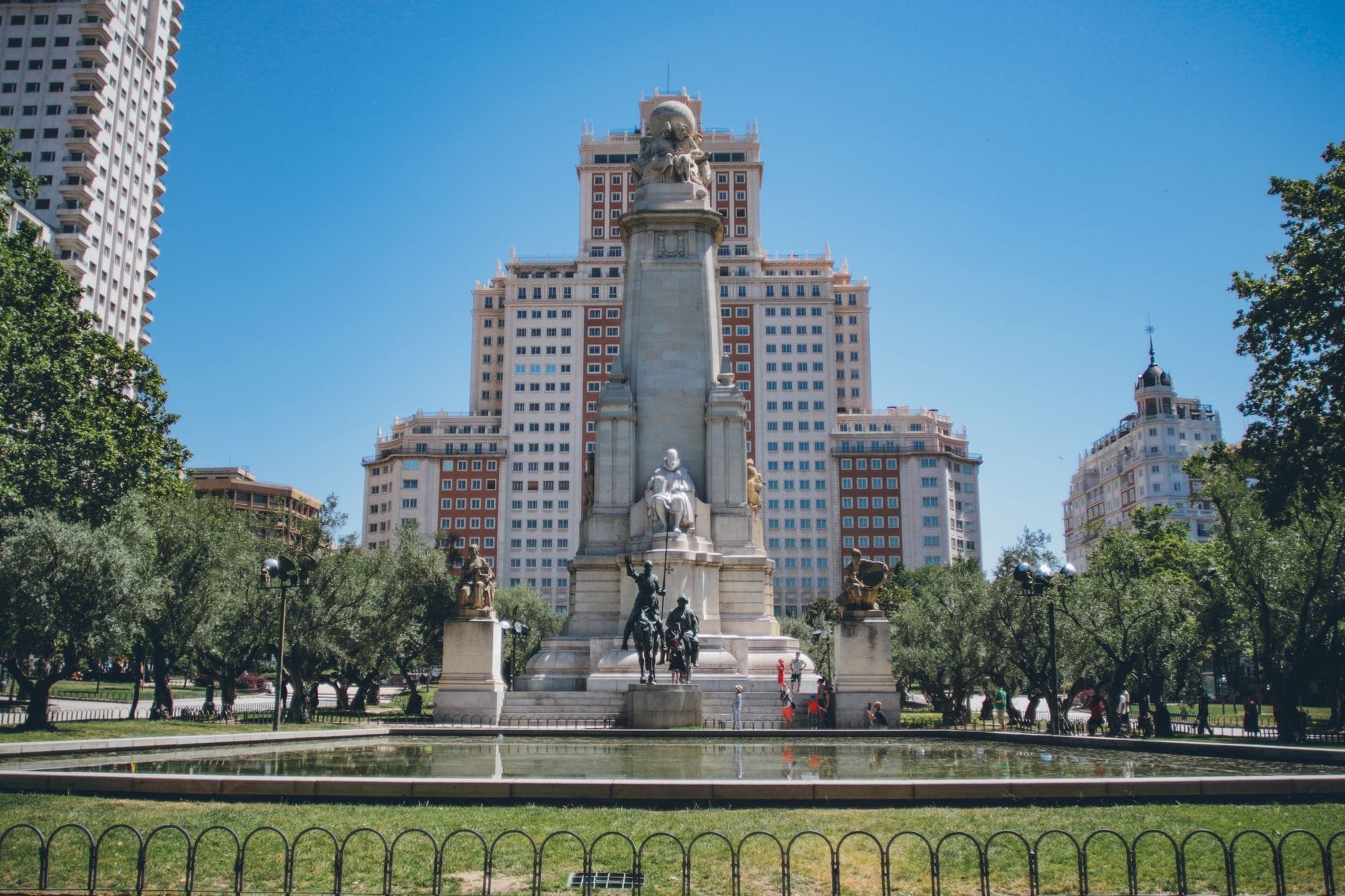
The visual anchor of Plaza de España is the Monument to Miguel de Cervantes, a large sculptural complex at the heart of the square featuring the author himself seated above the world, with bronze figures of Don Quixote on horseback and his squire Sancho Panza on a donkey positioned at the base. The monument has a layered construction history: initial elements were inaugurated around 1915, with the more complete arrangement unveiled in 1929 to mark the third centenary of Cervantes's death.
The stonework is a mix of granite and carved stone, weathered to a pale ochre in full sun. At the base of the monument, two female allegorical figures in marble represent Dulcinea and another character from the novel, and a shallow reflecting pool surrounds the structure. Photographers find the monument best lit in the morning, when eastern light catches the bronze of Don Quixote directly from the Gran Vía end. By midday in summer, the stone reflects hard white light that flattens the texture; late afternoon restores warm tones but draws larger crowds.
The choice of Cervantes as the subject is itself significant. Madrid competed with Alcalá de Henares, Cervantes's birthplace, for the right to dedicate a central monument to the author of Don Quixote. The square became the accepted resolution: a national tribute in the capital rather than a local one. The monument remains one of the more photographed literary memorials in Europe.
Tickets & tours
Hand-picked options from our booking partner. Prices are indicative; availability and final rates are confirmed when you complete your booking.
Puy du Fou Espana and Sueno de Toledo with transfer from Madrid
From 55 €Instant confirmationFree cancellationRoyal Monastery of El Escorial and the Valley of the Fallen trip from Madrid
From 64 €Instant confirmationFree cancellationFlexible time Real Madrid: Bernabeu Stadium & Museum Entry
From 42 €Instant confirmationMuseum of Senses Madrid entrance ticket
From 19 €Instant confirmation
Architecture Framing the Square
Beyond the Cervantes monument, the square is framed by two towers that were among the tallest buildings in Spain when they were completed in the mid-20th century. The Torre de Madrid (1957) and the Edificio España (1953) both rise to the northwest and northeast of the square respectively, their post-war rationalist bulk giving the space a sense of enclosed grandeur that smaller plazas in the city do not have. The Edificio España in particular had a complex decades-long renovation history before reopening as a mixed-use development; its facade, visible from the square, remains one of the more distinctive examples of the architectural ambitions of that era.
For a broader sense of how Madrid's architectural periods layer on top of each other, the view from Plaza de España is instructive: Baroque and Habsburg-era rooflines visible toward the Royal Palace, the eclectic early-20th-century facades along Gran Vía, and the Francoist towers framing the square itself. The Madrid architecture guide places all of this in fuller historical context if you want to plan a dedicated architectural walk.
How the Square Changes Through the Day
Early morning, roughly 7–9 am, is the most peaceful time to visit. Joggers cut through the pedestrian paths, delivery workers use the edges, and the Cervantes monument is largely unoccupied. The light at this hour is soft and directional, the fountain pool mirrors the monument cleanly, and you can walk the full perimeter without navigating around tour groups or selfie sticks. If photography matters to you, this window is not optional.
By late morning and into the afternoon, the square fills with foot traffic from the Gran Vía shopping corridor, school groups, and tourists connecting to the Royal Palace. The planted areas provide shade and the benches are well-used in fair weather. Summer afternoons, particularly in July and August, bring intense heat: Madrid's elevation at 667 metres above sea level produces a dry, sharp heat that feels harsher than coastal cities at the same temperature. There is limited tree canopy over the central monument area specifically, so plan sun protection and water.
Evenings bring the most socially active version of the square. Madrid's late dining culture means that from around 8 pm onward the surrounding streets fill, and the square itself becomes a gathering point, with people sitting on the steps and edges of the monument. The towers are lit, the fountain runs, and the atmosphere is relaxed in a way that midday crowds do not allow. Winter evenings are cold but clear, and the square picks up additional foot traffic during the pre-Christmas period when the surrounding streets are decorated.
⚠️ What to skip
In July and August, the central monument area has limited shade. Visit before 10 am or after 7 pm to avoid the most intense heat. Bring water regardless of the season if you plan to continue walking toward Campo del Moro or Madrid Río.
The 2021 Redesign: What Changed and Why It Matters
For decades, Plaza de España was dominated by surface-level road traffic, and pedestrians were effectively confined to narrow zones around the monument. After approximately two and a half years of works, the square was reopened on 22 November 2021 following a comprehensive redesign that prioritised pedestrian access, green space, and connectivity.
The practical result is that Plaza de España now functions as a genuine urban connector. You can walk on foot, without crossing major traffic lanes, from the end of Gran Vía all the way through to Jardines de Sabatini, and from there toward the Campo del Moro and eventually down to Madrid Río. This pedestrian corridor through several of Madrid's best green and historic spaces is one of the more underused walking routes in central Madrid.
The redesign also increased planted areas and seating. The square is noticeably more pleasant to spend time in now than it was before 2019, which is worth stating plainly because older travel accounts and photos do not reflect the current reality. Accessibility improvements were built into the redesign, with step-free connections and wide pathways that accommodate pushchairs and wheelchairs across the full route toward the palace gardens.
Practical Walkthrough: Using the Square as a Route
The most logical way to use Plaza de España is as a deliberate link between two walking zones rather than a standalone stop. Coming from Gran Vía, enter the square from the east, walk the full length past the Cervantes monument, and exit on the northwest side toward the Jardines de Sabatini. From there you have a clear, mostly flat pedestrian route toward the Royal Palace. The full walk from the Gran Vía entrance of the square to the main Royal Palace facade takes around 15 minutes at a relaxed pace.
Alternatively, if you are planning a longer walk south toward the river, exit the square on its western side and follow the path down to Campo del Moro and then Madrid Río. This gives you access to a green corridor running along the Manzanares River, with separate cycling and walking paths. The things to do in Madrid guide includes this route as part of a half-day itinerary combining the square, palace, and riverside park.
The square's own interior is worth a slow circuit: the base of the Cervantes monument has inscribed text and relief details that most visitors who photograph from a distance overlook. The pool around the monument is shallow and clean, and the surrounding paving uses pale granite that becomes reflective after rain. In spring, flowering trees in the planted zones add colour to the stone-heavy surroundings.
ℹ️ Good to know
The square is fully accessible with wide, level paths throughout. The pedestrian redesign specifically prioritised step-free movement, making it one of the more wheelchair- and pushchair-friendly large plazas in central Madrid.
Who Should Manage Their Expectations
Plaza de España is not a destination in the way that the Prado or Retiro are. If your available time in Madrid is two days or fewer and you are choosing between this and the major museums or parks, the plaza functions better as a ten-minute walking detour than a primary stop. The Cervantes monument is historically interesting but not visually spectacular by the standards of Madrid's architectural set-pieces. Visitors expecting the grandeur of, say, Plaza Mayor will find the scale here more diffuse and the monument more modest in person than in wide-angle photographs.
The square is also not a food or market destination. There are cafés and restaurants on the surrounding streets, but nothing inside the square itself. If you are looking for a sit-down break, the Jardines de Sabatini immediately to the north have shaded benches and a quieter atmosphere.
Insider Tips
- Walk to the very base of the Cervantes monument rather than photographing it from the Gran Vía entrance. The bronze relief details on the pedestal and the allegorical marble figures are particularly fine work that disappears at distance.
- The northwest exit of the square leads directly into Jardines de Sabatini with no road crossing required. Most visitors arriving from Gran Vía do not realise the pedestrian connection continues all the way to the Royal Palace without interruption.
- For the cleanest reflection shots in the monument's pool, visit early morning after any overnight rain. The granite paving mirrors the towers and the monument together in a way that is difficult to achieve when foot traffic disturbs the water.
- Madrid's Plaza de España Metro station (Lines 3 and 10) has direct exits onto the square on its southern side, but the northern exit, signposted for Calle de Ferraz, brings you out closer to the Sabatini Gardens entrance and saves backtracking.
- In late November and December, the route from Gran Vía through the square toward the Royal Palace is one of the better evening walks in central Madrid, with Christmas lighting on the surrounding streets and the floodlit towers as backdrop.
Who Is Plaza de España For?
- Architecture and urban design enthusiasts interested in Madrid's mid-20th-century towers alongside earlier monumental civic work
- Walkers using the square as the link between Gran Vía and the Royal Palace, Sabatini Gardens, or Madrid Río
- Families with pushchairs or visitors with accessibility needs, given the wide step-free paths throughout
- Photographers working at golden hour or early morning who want both the Cervantes monument and the tower skyline in a single composition
- Literary travellers with an interest in Cervantes and the Spanish Golden Age
Nearby Attractions
Other things to see while in Sol & Centro:
- Catedral de la Almudena
The Almudena Cathedral took more than a century from the laying of its foundation stone to its consecration in 1993, making it one of Europe's newest major cathedrals. Free to enter and directly opposite the Royal Palace, it rewards visitors who look beyond its mismatched facade to discover a surprisingly bold and colorful interior.
- Campo del Moro Gardens
The Jardines del Campo del Moro spread across more than 20 hectares directly behind the Royal Palace, offering one of the most dramatic views of the Palacio Real in Madrid. Admission is free, crowds are thin compared to the palace itself, and the romantic English-style landscape feels worlds away from the city streets above.
- Círculo de Bellas Artes
Few buildings in central Madrid earn attention on multiple levels at once. The Círculo de Bellas Artes delivers: a landmark Palacios-designed tower within the Paisaje de la Luz UNESCO World Heritage area with a rooftop terrace above the Gran Vía skyline, rotating art exhibitions, and one of the city's most atmospheric cafés. Entry to the building and La Pecera café is free; the rooftop, exhibitions, and combined tickets have separate fees starting from around €6.
- Edificio Metrópolis
Standing at the junction of Calle de Alcalá and Gran Vía, the Edificio Metrópolis is Madrid's most iconic piece of Belle Époque architecture. Its slate dome, gilded detailing, and winged Victory statue make it a landmark that rewards careful observation, even though the building itself is not a public museum. Here is everything you need to know before you go.