Cava Baja: Madrid's Most Legendary Tapas Street
Calle de la Cava Baja is a 300-meter cobblestone street in La Latina that has been feeding and watering travelers since the 12th century. With more than 50 bars packed into one short stretch, it remains the beating heart of Madrid's tapas culture — best experienced on a Friday evening when the whole neighborhood spills onto the street.
Quick Facts
- Location
- Calle de la Cava Baja, 28005 Madrid — La Latina neighborhood
- Getting There
- Metro La Latina (Line 5), 2-min walk; Tirso de Molina (Line 1), 5-min walk
- Time Needed
- 2–4 hours for a proper tapas crawl; street itself takes 5 minutes to walk end to end
- Cost
- Free to walk; food and drink priced per venue (expect €2–4 per tapa, €2–5 per drink)
- Best for
- Tapas crawls, weekend evenings, local food culture, Spanish wine
What Is Cava Baja, Exactly?
Calle de la Cava Baja is a public street in the La Latina district of central Madrid, running roughly 300 meters through one of the oldest inhabited corners of the city. It is not a market, not a food hall, and not a plaza. It is simply a narrow, uneven cobblestone street lined end to end with traditional taverns, wine bars, and tapas bars — more than 50 of them, by most counts, which gives it a claim to one of the highest densities of drinking establishments per meter in Europe.
The street lies close to Cava Alta, and its name tells you something about its origins: it sits at a lower elevation, tracing the outer edge of Madrid's medieval defensive wall. That wall was built in the 12th century, and the road that formed alongside it became the main route into the city from the south. Travelers arrived here first, and the inns and stables that served them gradually evolved into the tabernas and mesones that define the street today. That continuity is real, not marketing.
ℹ️ Good to know
Cava Baja is a public street, open 24 hours. Individual bars set their own hours — most open for lunch (from around 13:00) and again in the evening from 19:00 or 20:00, with many staying open past midnight on weekends.
The Street Through the Day: How the Atmosphere Shifts
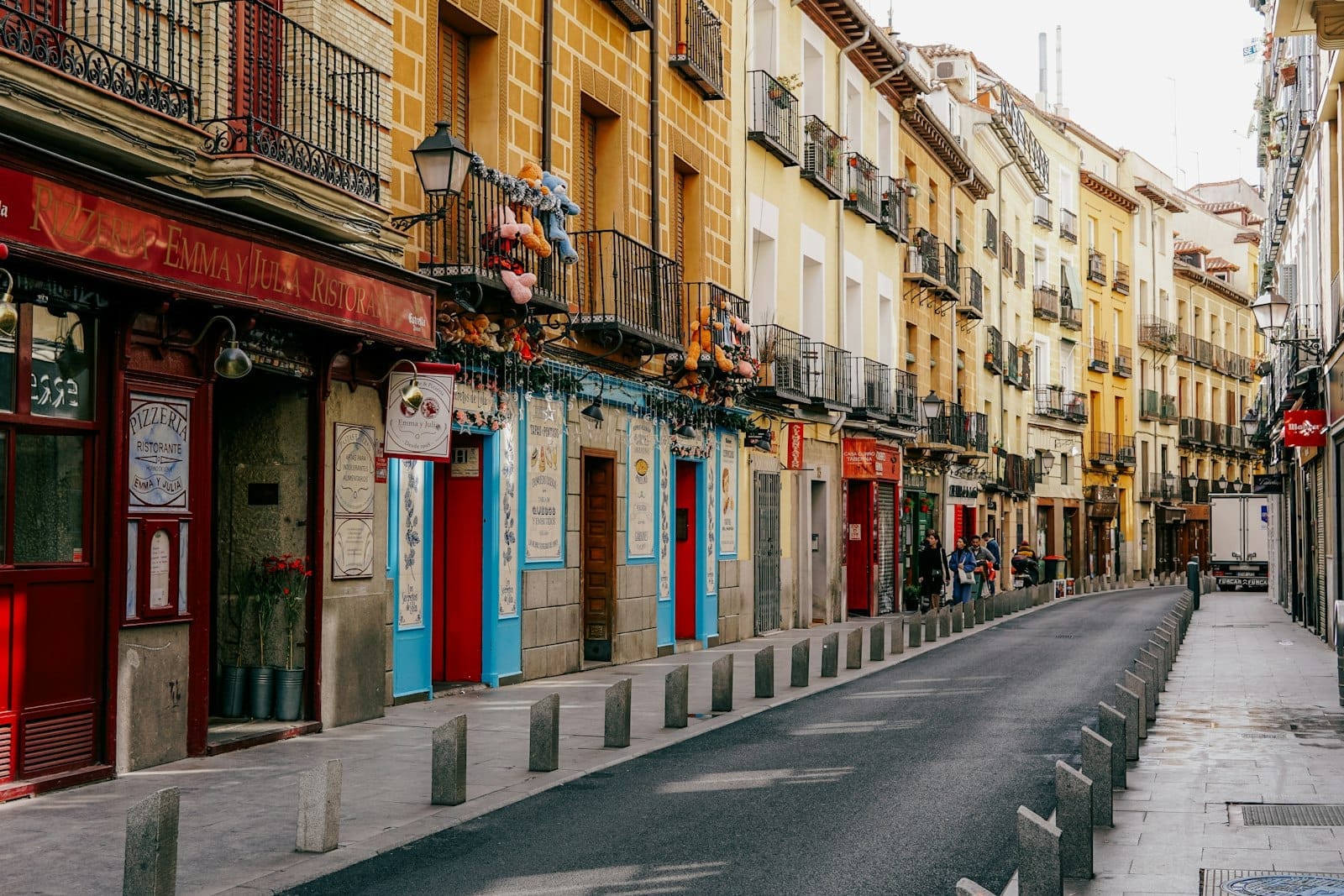
At midday on a weekday, Cava Baja is calm enough to notice the architecture: the narrow facades in ochre and cream, the hand-painted ceramic signs above doorways, the occasional iron balcony draped with a window box. A handful of restaurants have their lunch menus chalked on boards outside, and the smell of garlic hitting olive oil drifts into the street from open kitchen doors. Locals sit at small tables with a glass of house wine and a plate of croquetas. It is entirely unhurried.
By early evening on a Thursday or Friday, the character shifts completely. From around 19:00 onward, people begin flowing out of the bar doors onto the pavement — there is often not enough room inside. The sound level rises considerably: overlapping conversations in Spanish, the clink of small glasses, the thud of beer barrels being moved in a back kitchen. By 21:00 on a weekend, the street is shoulder-to-shoulder. Movement slows to a shuffle. This is not a flaw; it is the point.
Sunday lunchtime deserves its own mention. After the El Rastro flea market wraps up a short walk away, thousands of people funnel into La Latina, and Cava Baja absorbs much of that crowd. The Sunday vermouth hour — the pre-lunch vermut ritual — means bars are packed with people eating olives, anchovies, and small plates from around 12:00 to 15:00. If you are visiting on a Sunday, the street will be at its most chaotic and most alive at the same time.
Cava Baja is at the core of the La Latina neighborhood, which extends in every direction with quieter plazas and side streets worth exploring before or after your crawl.
Tickets & tours
Hand-picked options from our booking partner. Prices are indicative; availability and final rates are confirmed when you complete your booking.
Royal Monastery of El Escorial and the Valley of the Fallen trip from Madrid
From 64 €Instant confirmationFree cancellationFlexible time Real Madrid: Bernabeu Stadium & Museum Entry
From 42 €Instant confirmationMuseum of Senses Madrid entrance ticket
From 19 €Instant confirmationAvila and Segovia full-day tour from Madrid
From 50 €Instant confirmationFree cancellation
The Food and Drink: What to Order, Where to Focus
The tapas culture here leans traditional. You will find patatas bravas with both spicy and aioli sauces, jamón ibérico carved to order, tortilla española served at room temperature in thick wedges, and croquetas de jamón that shatter at the edge and remain molten in the center. Some bars also do raciones — larger shared portions — of dishes like pulpo a la gallega (Galician-style octopus) or berberechos (cockles in brine). The quality varies more than the menus do; price is not always a reliable signal.
For wine, many bars on Cava Baja pour by the glass from barrels or serve house wine in small ceramic cups called chatos. If you want something specific, asking for a Ribera del Duero or a Rioja by region is the quickest way to get something decent without studying a wine list in a noisy bar. Vermouth — either Spanish vermut or a caña of draft beer — is also entirely appropriate at any hour.
💡 Local tip
The most reliable strategy for a tapas crawl: have one or two things at each stop and keep moving. Sitting down for a full meal at one bar defeats the purpose. Pay and go, then let the street lead you to the next door.
If you want broader context on where Cava Baja fits in Madrid's food culture, the Madrid tapas guide covers the city's best tapas neighborhoods and dishes in full detail.
Historical Context: Why This Street Matters
The name Cava Baja refers to the moat (cava) that ran alongside the lower stretch of Madrid's 12th-century Christian fortification wall. The street itself has been documented since that era, making it one of the oldest continuously used thoroughfares in the city. For centuries it served as the primary entry point for goods and people arriving from Toledo and the south, and the mesones that lined it were the equivalent of roadside hotels and taverns: places where muleteers, merchants, and travelers ate, drank, and slept.
Several of the buildings on Cava Baja still show traces of that history in their structure, even if the interiors have been updated. The low doorways, interior courtyards visible through open archways, and thick stone or plastered walls of some of the older bars are not decoration. They are remnants of buildings that predate modern Madrid by centuries.
This is not a street that was designed as a tourist destination. It became one because it retained the tavern culture that formed here organically over hundreds of years. That distinction matters when you are walking it: the bars are not performing tradition, they are continuing it.
For a deeper look at Madrid's medieval and early modern streetscape, the Madrid architecture guide provides useful context on how the city's historic core developed.
Getting There and Getting Around
The easiest approach is Metro Line 5 to La Latina station, which puts you at the top of the street in under two minutes on foot. Tirso de Molina on Line 1 is a five-minute walk and useful if you are coming from the Gran Via or Sol direction. The street itself runs roughly north to south, connecting loosely with Cava Alta at the top end and opening toward the Puerta de Toledo axis at the lower end.
Walking from Plaza Mayor takes about eight minutes through the narrow lanes of the Austrias district — a pleasant route that passes through some of the oldest parts of Madrid. The Mercado de San Miguel is a two-minute walk from the plaza if you want to warm up your appetite with a few bites before hitting Cava Baja proper.
⚠️ What to skip
Accessibility note: Cava Baja is a narrow cobblestone street with uneven surfaces. Wheelchairs and pushchairs will find it difficult, particularly on busy evenings when the pavement is crowded. Individual venues vary in accessibility; call ahead if this is a concern.
Taxis and ride-hailing apps can drop you at the junction with Calle de Toledo, a two-minute walk from the main strip. Driving into La Latina itself is not practical due to the narrow streets and pedestrian zones.
Photography and Practical Logistics
For photographs of the street itself — the painted facades, the ceramic signs, the old tavern fronts — go early on a weekday morning, ideally before 10:00. The light is soft, the street is empty, and you can stand in the middle of the road without causing an incident. By lunchtime, parked motorcycles and delivery vehicles break the sightlines. By evening, the crowd makes architectural photography effectively impossible.
Evening photography of the social scene, on the other hand, is genuinely good. The warm interior lighting spilling from open bar doors, the crowds lit from below by phone screens, the steam from kitchen exhausts catching the glow from signage — Cava Baja at 21:00 on a Friday is visually dense. A phone camera with a decent night mode handles this well. A large camera with a wide lens will make you conspicuous in the crowd.
If your Madrid itinerary includes a full weekend, pairing Cava Baja with the nearby El Rastro flea market on a Sunday morning makes for one of the most satisfying half-days in the city — market first, Cava Baja for the post-market vermut hour.
Who Will Love This Street (and Who Should Reconsider)
Cava Baja is truly excellent for people who enjoy eating and drinking standing up, moving between venues, and navigating a crowd that is clearly enjoying itself. It suits solo travelers looking to slot into local evening rhythms, couples on their first night in Madrid wanting immediate immersion, and groups of friends who can spread across a bar's standing room without needing a reserved table.
It is not a good choice for people who dislike noise and crowds, want a quiet sit-down dinner, or are looking for cutting-edge modern Spanish cuisine. The cooking is traditional and reliable, not innovative. If you want a calm, table-service dinner, choose a restaurant on one of the surrounding side streets in La Latina instead, where there is more space and you can actually hear your companion.
Families with young children can visit at lunchtime or early evening before the crowds build, but by 21:00 on weekends the density makes it impractical with a pushchair or with children who need space to move.
For a broader overview of what the neighborhood offers beyond the bar scene, the full things to do in Madrid guide includes La Latina alongside the city's other major areas.
Insider Tips
- Sunday after El Rastro is the most atmospheric time to visit Cava Baja, but it is also the busiest. Arrive at 12:30 rather than 13:00 to find standing room before the post-market crowd peaks.
- The bars nearest to the La Latina metro exit tend to be the most tourist-facing. Walk to the lower, southern end of the street for slightly less foot traffic and a more local clientele.
- Some of the best value on the street is not in the tapas but in the bocadillos (sandwiches) — thick bread rolls filled with calamares or jamón, ordered at the bar for a fraction of the sit-down price.
- La Latina's side streets, particularly Calle del Almendro and Plaza de la Paja, have excellent bars with more seating and a slightly slower pace if you need a break from Cava Baja's density.
- Avoid arriving hungry and trying to find a free table on a Friday or Saturday evening — you almost certainly will not. The street runs on the logic of standing, eating, and moving. Commit to that rhythm and it works.
Who Is Cava Baja For?
- First-time visitors to Madrid wanting immediate immersion in Spanish bar culture
- Solo travelers looking to drink and eat alongside locals without needing a reservation
- Couples who want a lively, informal evening out in a historic setting
- Food-focused travelers building a Sunday itinerary around El Rastro and the vermouth hour
- Anyone curious about traditional Madrid tavern culture that has genuine continuity with the city's medieval past
Nearby Attractions
Other things to see while in La Latina:
- Basílica de San Francisco el Grande
The Real Basílica de San Francisco el Grande rises over the western edge of La Latina with one of the largest church domes in Spain, a 33-metre diameter structure that soars roughly 58 metres above the floor. Inside, a museum-quality collection of paintings by Goya, Zurbarán, and other masters lines six ornate chapels. Admission policies can change; check current conditions, as free entry is not guaranteed every Thursday.
- El Rastro
Every Sunday morning and official public holiday, a centuries-old flea market takes over the streets of La Latina. El Rastro de Madrid is free to enter, sprawling in scale, and completely unlike any indoor market in the city. Come before 10:30 if you want to browse without being swept along by the crowd.
- Plaza de la Paja
Plaza de la Paja was the commercial heart of medieval Madrid long before Plaza Mayor existed. Today this irregular, sloping square in La Latina remains one of the city's most atmospheric public spaces, framed by the Capilla del Obispo and an 18th-century walled garden, and free to anyone who walks in.