Basílica de San Francisco el Grande: Madrid's Monumental Neoclassical Basilica
The Real Basílica de San Francisco el Grande rises over the western edge of La Latina with one of the largest church domes in Spain, a 33-metre diameter structure that soars roughly 58 metres above the floor. Inside, a museum-quality collection of paintings by Goya, Zurbarán, and other masters lines six ornate chapels. Admission policies can change; check current conditions, as free entry is not guaranteed every Thursday.
Quick Facts
- Location
- Calle San Buenaventura 1, 28005 Madrid (Palacio / Centro)
- Getting There
- Metro: La Latina or Puerta de Toledo (both Line 5); Buses 3, 148 and numerous other lines serving Gran Vía de San Francisco and Carrera de San Francisco
- Time Needed
- 45–90 minutes for the museum visit
- Cost
- €6 general, €3.50 reduced; museum-basilica free on Thursdays
- Best for
- Art lovers, architecture enthusiasts, budget visitors on Thursdays
- Official website
- www.esmadrid.com/informacion-turistica/san-francisco-el-grande
What Is the Basílica de San Francisco el Grande?
The Real Basílica de San Francisco el Grande is a neoclassical church and state museum located at the southern end of Calle Bailén in Madrid's La Latina area of the Palacio district. It is one of the most architecturally ambitious religious buildings in Spain, best known for a circular main dome measuring 33 metres in diameter and rising 58 metres from floor to lantern, making it one of the largest church domes in the country. The building is also a genuine art repository: its six lateral chapels contain paintings by Francisco de Goya, Francisco de Zurbarán, and other significant figures of Spanish painting.
For visitors, this is not a typical church visit. The building functions simultaneously as an active place of worship and, during visiting hours, as a ticketed museum-basilica open Tuesday through Saturday. The museum circuit covers the chapels, the sacristy, the chapter room, and the choir, each containing altarpieces, sculptures, and tapestries of considerable quality. It is, by any reasonable measure, undervisited relative to its cultural weight, which makes it one of the more rewarding stops in central Madrid for anyone willing to venture slightly beyond the main tourist circuit.
💡 Local tip
Thursday is free museum-basilica entry day for visitors. Arrive before 11:00 to beat the small but noticeable midday queue that forms on free days. The ticket office closes 30 minutes before the end of visiting hours.
History and Architectural Context
A Franciscan convent has stood on this site since the 13th century, traditionally linked to a visit by St. Francis of Assisi himself, though the historical evidence for this claim is devotional rather than documentary. What exists today is fundamentally an 18th-century project, although it has undergone later restorations. Construction of the current basilica began in 1761 under architect Francisco Cabezas, continued under Antonio Polo, and was completed by Francesco Sabatini, the Italian-born architect who also worked on the Royal Palace of Madrid. The building was solemnly inaugurated on 6 December 1784 in the presence of King Charles III.
The neoclassical style reflects the Bourbon aesthetic priorities of late 18th-century Spain: rational geometry, restrained ornament on the exterior, and theatrical spatial drama inside. The circular nave plan, which Sabatini resolved with considerable skill, was a bold departure from the Latin-cross churches that dominated Madrid's religious architecture. The dome's dimensions draw inevitable comparisons with the Panthéon in Paris, though San Francisco el Grande predates it. The building was declared a National Monument in 1980 and elevated to the rank of minor basilica by Pope John XXIII in 1963. For broader architectural context in Madrid, the Madrid architecture guide places the basilica within the city's longer tradition of royal and civic building.
Tickets & tours
Hand-picked options from our booking partner. Prices are indicative; availability and final rates are confirmed when you complete your booking.
Discovery Game Madrid grand and majestic secrets
From 26 €Instant confirmationFree cancellationRoyal Monastery of El Escorial and the Valley of the Fallen trip from Madrid
From 64 €Instant confirmationFree cancellationFlexible time Real Madrid: Bernabeu Stadium & Museum Entry
From 42 €Instant confirmationMuseum of Senses Madrid entrance ticket
From 19 €Instant confirmation
The Interior: What You Actually See
Entering the basilica from the main portal, the first thing that registers is scale. The circular nave opens upward with an immediacy that is physically disorienting in the best way. The dome itself is frescoed, though the quality of the painting is secondary to the sheer spatial effect of standing under that 58-metre vertical sweep. Natural light enters through the drum windows and the lantern above, and the quality of that light shifts noticeably with the time of day. Morning visits in the opening hour bring a cooler, more diffuse illumination that suits the stone interior. By early afternoon, the southern light enters more directly and warms the nave considerably.
The six lateral chapels are the real draw for art visitors. The most frequently cited is the Chapel of San Bernardino de Siena, which contains Francisco de Goya's 1784 painting of the saint preaching, completed the same year as the inauguration. Goya reportedly included his own self-portrait among the figures listening to the sermon, on the right side of the composition. It is an early work, painted before Goya's style became the anguished thing he is better known for, and seeing it in situ rather than in a museum setting gives it a contextual weight that reproductions cannot convey.
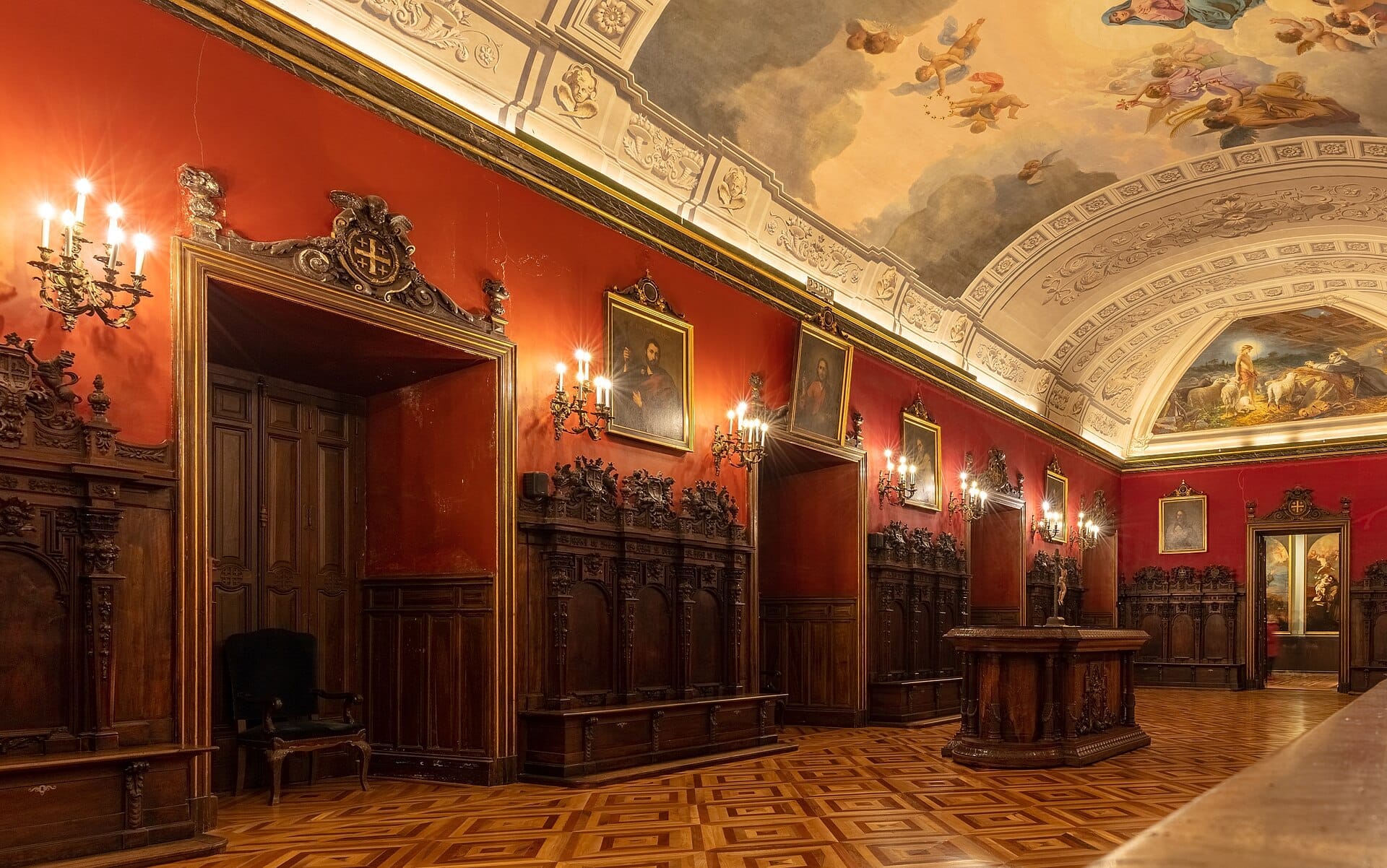
Other chapels contain works attributed to Zurbarán and additional 18th-century masters. The sacristy and chapter room, accessible on the guided circuit, display silverwork, vestments, and documents relating to the basilica's history. The choir stalls, carved in walnut, are detailed to a degree that rewards slow looking. Bring a small pair of binoculars if you own them; some of the upper-register detail in the chapels is difficult to read with the naked eye from floor level.
ℹ️ Good to know
Museum visiting hours: October to June, Tuesday to Saturday, 10:30–14:30 and 16:00–18:30. July to September, Tuesday to Saturday, 10:30–15:30. The basilica-museum is closed to tourist visits on Sundays and Mondays, though masses are held. Verify hours before visiting as they are subject to change.
Visiting Practicalities: Getting There and When to Go
The basilica sits at the intersection of Calle Bailén and Carrera de San Francisco, facing the Plaza de San Francisco on its western side. The closest metro stations are La Latina and Puerta de Toledo, both on Line 5, each a roughly 8-10 minute walk. Bus lines 3 and 148 stop nearby. The neighbourhood around the basilica is part of La Latina, one of Madrid's oldest residential districts, so the walk from either metro station passes through streets of genuine character rather than tourist corridors.
Weekday mornings between 10:30 and noon are consistently the quietest period for a tourist visit. Thursdays draw more visitors due to free admission, but the basilica is large enough that it rarely feels crowded even then. Avoid arriving in the 20 minutes before closing, as the atmosphere becomes transactional and the staff begin to move visitors toward the exit.
Dress modestly as you would for any active church. Shoulders covered and no shorts are the standard expectation, though enforcement is inconsistent. The basilica is listed as accessible for visitors with reduced mobility; if you have specific access requirements, confirm details directly with the site before visiting. Photography is generally permitted in the museum areas without flash, though this policy should be confirmed on site.
The Surrounding Area: Pairing Your Visit
The basilica occupies the western edge of La Latina, close to several other worthwhile stops. The Campo del Moro gardens, which run below the Royal Palace, are a short walk north along Calle Bailén and make a logical pairing, especially in spring when the grounds are at their best. To the south, the weekend flea market El Rastro unfolds across the slopes of La Latina on Sunday mornings, making a combined visit straightforward if you plan around the basilica's Tuesday-to-Saturday schedule.
The Ermita de San Antonio de la Florida to the northwest offers a fascinating comparison: a smaller, more intimate church with Goya ceiling frescoes that represent the painter working at the apex of his powers, rather than the early-career work at San Francisco el Grande. Visiting both in a single day provides a genuinely instructive view of Goya's development. The Palacio Real de Madrid is also within easy walking distance and many visitors combine both in an afternoon.
Who This Is For
The Real Basílica de San Francisco el Grande is remarkably impressive in its scale and more artistically substantive than its relative obscurity suggests. The dome alone justifies the entry price for anyone with an interest in religious architecture. The Goya painting, while not among his greatest works, carries real historical resonance in its original setting.
That said, this is not the Prado. The collection, taken as a whole, is uneven. Several of the chapels contain works of modest quality, and the presentation is functional rather than museographically refined. The guided audio experience, if available, adds context that the sparse in-room signage does not always provide. Visitors expecting the curatorial richness of Madrid's major art museums may find the experience slightly raw.
Those primarily interested in art rather than architecture may find the Museo del Prado or the Real Academia de Bellas Artes de San Fernando more rewarding for the same time investment. But for architecture, spatial drama, and the experience of a Goya in its intended location, San Francisco el Grande delivers something those museums cannot.
⚠️ What to skip
The basilica is closed to tourist visits on Sundays and Mondays. If you arrive outside museum hours, you may be able to observe the nave from the entrance during mass, but the chapels and museum areas will not be accessible. Always check current hours before making a special trip.
Insider Tips
- Thursday free admission to the museum-basilica is official and requires no voucher or registration. Simply arrive and enter during visiting hours. This is confirmed by the Ayuntamiento de Madrid, not a promotional offer subject to change without notice.
- The exterior facade is best photographed in the morning from the Plaza de San Francisco, when the light falls directly on the portico. By afternoon, the western facade is in shade.
- The dome's visual impact is strongest if you stand at the geometric centre of the nave floor immediately after entering. The proportions were designed to be experienced from this exact point.
- If you attend a Sunday mass rather than a tourist visit, the space fills with music that transforms the acoustic of the dome in a way no amount of quiet looking can replicate. The Sunday masses at 10:30, 11:30, 12:30, and 19:00 (20:00 in summer) are open to all.
- The walk from La Latina metro along Carrera de San Francisco passes the old city wall remnants and some of the most authentically unrenovated streets in central Madrid. Budget an extra 10 minutes to walk slowly.
Who Is Basílica de San Francisco el Grande For?
- Architecture enthusiasts interested in neoclassical Spanish religious buildings and dome construction
- Art visitors who want to see a Goya in its original commissioned setting, not a museum gallery
- Budget travellers visiting on Thursdays, when entry is free
- Visitors combining a La Latina neighbourhood walk with a cultural stop of genuine weight
- Travellers who want to experience an active place of worship with a rich artistic interior, away from Madrid's main tourist crowds
Nearby Attractions
Other things to see while in La Latina:
- Cava Baja
Calle de la Cava Baja is a 300-meter cobblestone street in La Latina that has been feeding and watering travelers since the 12th century. With more than 50 bars packed into one short stretch, it remains the beating heart of Madrid's tapas culture — best experienced on a Friday evening when the whole neighborhood spills onto the street.
- El Rastro
Every Sunday morning and official public holiday, a centuries-old flea market takes over the streets of La Latina. El Rastro de Madrid is free to enter, sprawling in scale, and completely unlike any indoor market in the city. Come before 10:30 if you want to browse without being swept along by the crowd.
- Plaza de la Paja
Plaza de la Paja was the commercial heart of medieval Madrid long before Plaza Mayor existed. Today this irregular, sloping square in La Latina remains one of the city's most atmospheric public spaces, framed by the Capilla del Obispo and an 18th-century walled garden, and free to anyone who walks in.