Real Academia de Bellas Artes de San Fernando: Madrid's Overlooked Masterpiece
Founded by royal decree in 1752 and housed in the baroque Goyeneche Palace on Calle de Alcalá, the Real Academia de Bellas Artes de San Fernando holds one of Madrid's finest collections of Old Masters — including major Goyas — with a fraction of the crowds you'll find at the Prado. At €9 general admission, it rewards anyone willing to look beyond the obvious.
Quick Facts
- Location
- Calle de Alcalá 13, 28014 Madrid (Sol-Centro)
- Getting There
- Metro Sevilla (Line 2), 2 min walk; Metro Gran Vía (Lines 1 & 5), 4 min walk
- Time Needed
- 1.5 to 2.5 hours
- Cost
- General €9 / Reduced €4 / Free for under-18s and qualifying categories
- Best for
- Art lovers seeking depth without the crowds
- Official website
- www.realacademiabellasartessanfernando.com
Why This Museum Deserves More of Your Attention
The Real Academia de Bellas Artes de San Fernando sits on Calle de Alcalá, about five minutes' walk from Puerta del Sol, and most visitors walk straight past it on their way to somewhere more famous. That is their loss. Inside the 18th-century Goyeneche Palace, one of the most consequential art institutions in Spanish history quietly holds around 1,400 paintings, 600 sculptures, 15,000 drawings, and 40,000 prints — a collection assembled over nearly three centuries through royal patronage, confiscated ecclesiastical works, and academic donations.
The atmosphere is calm to the point of feeling private. On a typical Tuesday morning, you can stand alone in front of a Goya for as long as you want, which is something you cannot do at the Prado without either arriving at opening or joining a crowd six rows deep. This is not a second-tier museum by quality — it is under-visited by proximity and habit, which is simply good luck for the traveler who knows it exists.
💡 Local tip
Arrive close to opening at 10:00 on a weekday and you will likely have entire rooms to yourself. The museum generally closes at 15:00 (with extended hours to 19:00 on Saturdays during the current "Sábados de Arte" program), so plan accordingly — this is primarily a morning visit.
History and Setting: A Palace Built for Art
The Academy itself was founded on 12 April 1752 by royal decree of Fernando VI, making it one of the oldest fine arts academies in Europe. It moved to the Goyeneche Palace on Calle de Alcalá in 1774, and the building has served as its home ever since. The palace façade is a restrained baroque composition designed by José Benito de Churriguera and later reworked by Diego de Villanueva — the transition between the ornamental Spanish baroque and neoclassical rationalism is visible in the building's details if you look carefully before entering.
The institution's history gives the collection its unusual character. Unlike the Prado, which was built to display royal holdings, the Academia's collection grew through its function as a teaching institution, a regulatory body for Spanish arts and crafts, and a recipient of works seized during the suppression of religious orders in the 19th century. The result is a collection that feels less curated and more accumulated — which gives it an authenticity that more polished museums sometimes lack.
The building sits in the heart of Madrid's historic centre, close to thePuerta del Sol and theGran Vía. The surrounding streets are some of the most walked in the city, yet the museum itself rarely generates a queue.
Tickets & tours
Hand-picked options from our booking partner. Prices are indicative; availability and final rates are confirmed when you complete your booking.
Flexible time Real Madrid: Bernabeu Stadium & Museum Entry
From 42 €Instant confirmationMonasterio de las Descalzas Reales guided tour
From 13 €Instant confirmationReal Madrid Bernabeu Stadium tour and gourmet tasting
From 79 €Instant confirmationFree cancellationMonasterio de las Descalzas tickets and guided tour
From 19 €Instant confirmationFree cancellation
What You Will Actually See Inside
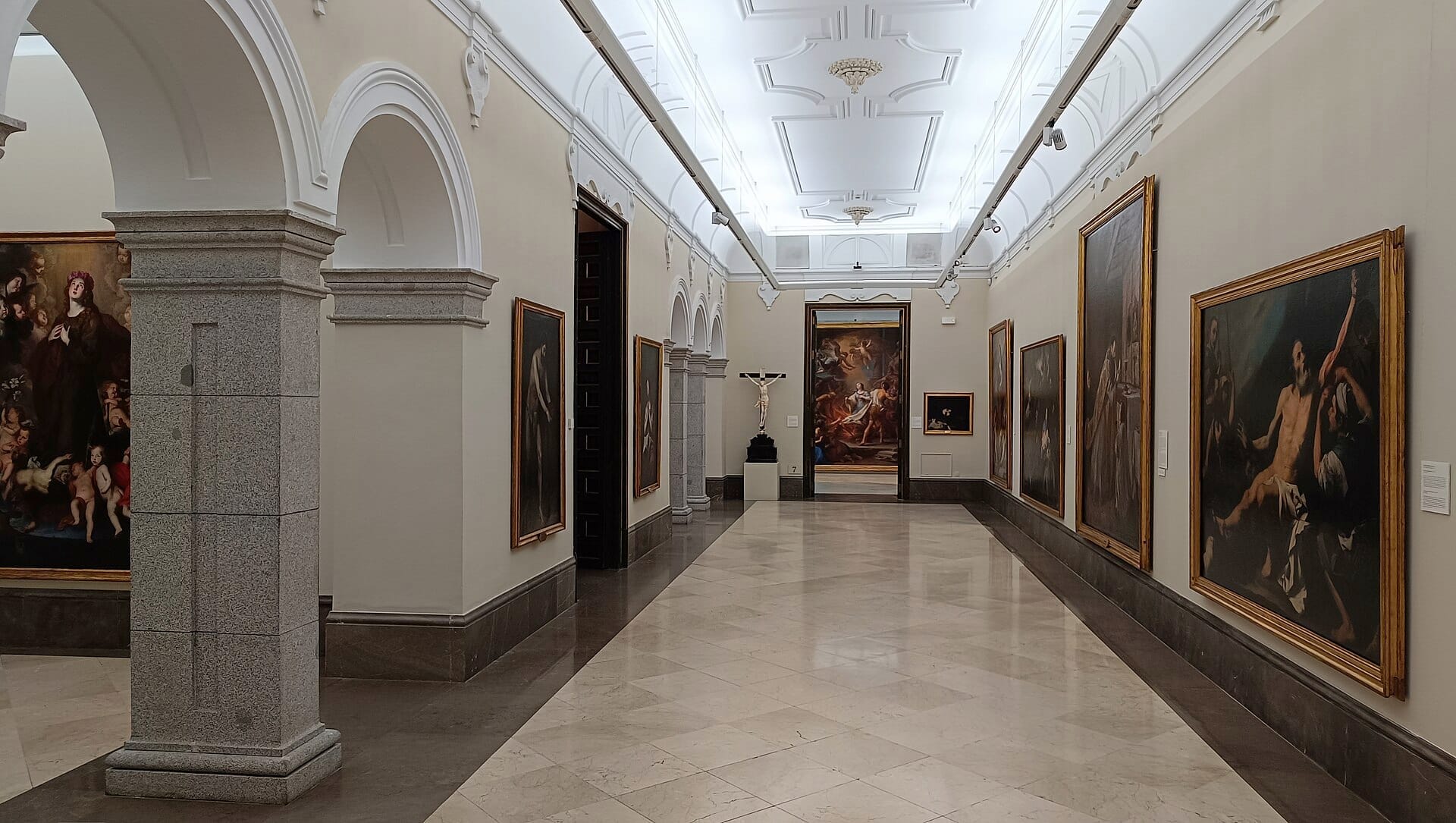
The permanent collection is displayed across several floors of the palace, with the most significant works concentrated in the main gallery rooms. The paintings follow a rough chronological and school-based arrangement, covering Spanish, Flemish, and Italian masters from the 16th through the 19th centuries. The light in the upper rooms is natural, filtered through tall windows, which gives the older paintings a presence they would lose under artificial lighting.
The Goya rooms are the collection's center of gravity. The Academia holds 13 paintings by Francisco de Goya, along with important drawings and prints, including self-portraits from different periods of his life and several works with the dark psychological intensity he is best known for. Goya was not just a subject here — he was Director General of the Academy in 1795, and the institution shaped his career. That biographical connection makes looking at the works in this space feel different from encountering them in a general survey museum.
Beyond Goya, the collection includes significant works by Zurbarán, Murillo, Ribera, Rubens, Bellini, and Archimboldo. There are rooms dedicated to sculpture and to decorative arts, and a prints and drawings cabinet that holds one of the most important collections of its kind in Spain. Not every room is equally compelling, and some of the smaller decorative arts galleries feel more academic than engaging, but the core painting collection justifies the visit on its own.
ℹ️ Good to know
The museum's print and drawing collection — over 15,000 drawings and 40,000 prints — is one of the most important in the country but is not always fully displayed. Check the current exhibition listing on the official website before visiting if this is a specific interest.
How the Experience Changes by Time of Day
The museum opens at 10:00 and generally closes at 15:00 from Tuesday through Friday and on Sundays, with extended hours until 19:00 on Saturdays during the current "Sábados de Arte" program. That compressed window on most days means the visit has a specific rhythm. The first hour is consistently the quietest — natural light is at its best in the main rooms, and the handful of other visitors present are typically art students or serious collectors rather than general tourists. By midday, school groups occasionally pass through, but the museum's scale means they rarely overwhelm individual rooms.
The 14:00 to 15:00 hour is surprisingly pleasant if you do not mind the slight pressure of closing time on most days. Staff begin their rounds, the cafeteria if available winds down, and the galleries feel subdued in a way that suits the older works on the walls. The worst time to visit is on a Saturday or Sunday around noon, when the centre of Madrid is at its most congested and casual foot traffic into the museum increases. Weekday mornings remain the clear recommendation.
Weather has no direct effect on the experience since the visit is entirely indoors, but very hot summer days drive more people off the street and into air-conditioned spaces, which can slightly increase visitor numbers in July and August.
Practical Walkthrough: Getting There and Getting Around
The museum is at Calle de Alcalá 13. The closest Metro stop is Sevilla on Line 2, which puts you at the door in about two minutes. Gran Vía station (Lines 1 and 5) is four minutes away if you are already in that area. There are BiciMAD bike-share docks at Sevilla (Calle Alcalá 28) and Calle Carretas 3 if you prefer cycling.
Tickets are purchased at the entrance. General admission is €9, reduced admission is €4 for qualifying concessions (proof of eligibility required), and free entry applies to children under 18, students under 25, people with disabilities, and registered job seekers, among other categories. Temporary exhibitions may carry an additional charge. The visit takes between 90 minutes and two and a half hours depending on your pace and whether you linger in the prints and drawings rooms.
Accessibility in a historic palace is never guaranteed. The official guidance recommends contacting the Academy directly at +34 91 524 08 64 before visiting if you have specific mobility requirements, as step-free access and lift availability are not fully detailed in published summaries. Photography is generally permitted in the permanent collection without flash, but confirm current policy at the ticket desk.
⚠️ What to skip
The museum is closed on Mondays and on several public holidays including 1 and 6 January, 1 and 30 May, 9 November, all of August, and 23–25 and 31 December. Verify the full holiday schedule on the official website before planning your visit.
Placing This Visit in the Context of Madrid's Art Scene
Madrid's three major art institutions — the Prado, the Reina Sofía, and the Thyssen-Bornemisza — form the so-called Golden Triangle of Art along thePaseo del Prado. The Academia sits slightly to the north, geographically closer to Sol, and is rarely included in the same conversation. That omission is partly a function of scale and partly of marketing, not quality.
If you are working throughMadrid's best museums, the Academia fits naturally as a half-day addition to a day that starts at the Prado. The two institutions are about a ten-minute walk apart, and the contrast between the Prado's overwhelming scale and the Academia's more contained rooms is itself instructive. The Academia is also an easy stop before or after visiting theCírculo de Bellas Artes, which is on the same stretch of Calle de Alcalá.
For visitors following a broader art itinerary, the Academia's collection of Spanish masters provides important context for understanding how painters like Goya developed within institutional frameworks rather than in isolation. The works here are not footnotes to what you will see at the Prado — in some cases, they are earlier or more personal versions of the same artistic voice.
The museum's location in the Sol-Centro area also makes it straightforward to combine with nearby historic sites. ThePlaza Mayor is a ten-minute walk southwest, and theSol-Centro neighborhood itself has enough to fill a full day if you are inclined to explore on foot.
Insider Tips
- The Goya self-portraits are the collection's most discussed works, but the room containing Zurbarán's monastic figures rewards equally patient looking and is usually completely empty.
- The museum building itself is worth examining from the street before you enter. The transition in the façade between Churriguera's baroque detailing and Villanueva's neoclassical revisions is a small architectural lesson compressed into one elevation.
- If you are visiting on a budget, check whether your status qualifies for free entry before paying — the free categories are broader than at many Madrid museums and include students under 25 from any country.
- The museum shop near the exit carries reasonably priced art books and print reproductions that are more specific to the collection than the generic options available at larger venues.
- Combine this visit with the nearby Círculo de Bellas Artes for a full art-focused morning. The Círculo's rooftop terrace is a few hundred meters away and offers one of the better elevated views of central Madrid.
Who Is Real Academia de Bellas Artes de San Fernando For?
- Art historians and serious collectors who want to see major Goyas without the Prado's crowds
- Travelers on a second or third visit to Madrid who have covered the obvious institutions
- Students of Spanish art and architecture seeking institutional context for the Golden Age masters
- Anyone with a compressed schedule who has 90 minutes and wants high-quality fine art rather than a large-format museum experience
- Budget travelers who qualify for the free entry categories and want world-class painting at no cost
Nearby Attractions
Other things to see while in Sol & Centro:
- Catedral de la Almudena
The Almudena Cathedral took more than a century from the laying of its foundation stone to its consecration in 1993, making it one of Europe's newest major cathedrals. Free to enter and directly opposite the Royal Palace, it rewards visitors who look beyond its mismatched facade to discover a surprisingly bold and colorful interior.
- Campo del Moro Gardens
The Jardines del Campo del Moro spread across more than 20 hectares directly behind the Royal Palace, offering one of the most dramatic views of the Palacio Real in Madrid. Admission is free, crowds are thin compared to the palace itself, and the romantic English-style landscape feels worlds away from the city streets above.
- Círculo de Bellas Artes
Few buildings in central Madrid earn attention on multiple levels at once. The Círculo de Bellas Artes delivers: a landmark Palacios-designed tower within the Paisaje de la Luz UNESCO World Heritage area with a rooftop terrace above the Gran Vía skyline, rotating art exhibitions, and one of the city's most atmospheric cafés. Entry to the building and La Pecera café is free; the rooftop, exhibitions, and combined tickets have separate fees starting from around €6.
- Edificio Metrópolis
Standing at the junction of Calle de Alcalá and Gran Vía, the Edificio Metrópolis is Madrid's most iconic piece of Belle Époque architecture. Its slate dome, gilded detailing, and winged Victory statue make it a landmark that rewards careful observation, even though the building itself is not a public museum. Here is everything you need to know before you go.