Mercado de San Miguel: Madrid's Landmark Gourmet Market
Mercado de San Miguel is a beautifully restored 1916 cast-iron market hall one block from Plaza Mayor, now home to over 30 gourmet food and drinks stalls. Entry is free, and it stays open until midnight from Sunday to Thursday and 1am on Fridays, Saturdays and public holiday eves, making it as much an evening gathering spot as a daytime food destination.
Quick Facts
- Location
- Plaza de San Miguel, s/n, 28005 Madrid (Sol–Centro)
- Getting There
- Metro: Ópera (L2, L5) or Sol (L1, L2, L3); Cercanías C3/C4 to Sol
- Time Needed
- 45 minutes to 2 hours, depending on how much you eat and drink
- Cost
- Free entry; individual food and drink purchases from each stall
- Best for
- Food lovers, architecture admirers, early evening grazing
- Official website
- mercadodesanmiguel.es/en
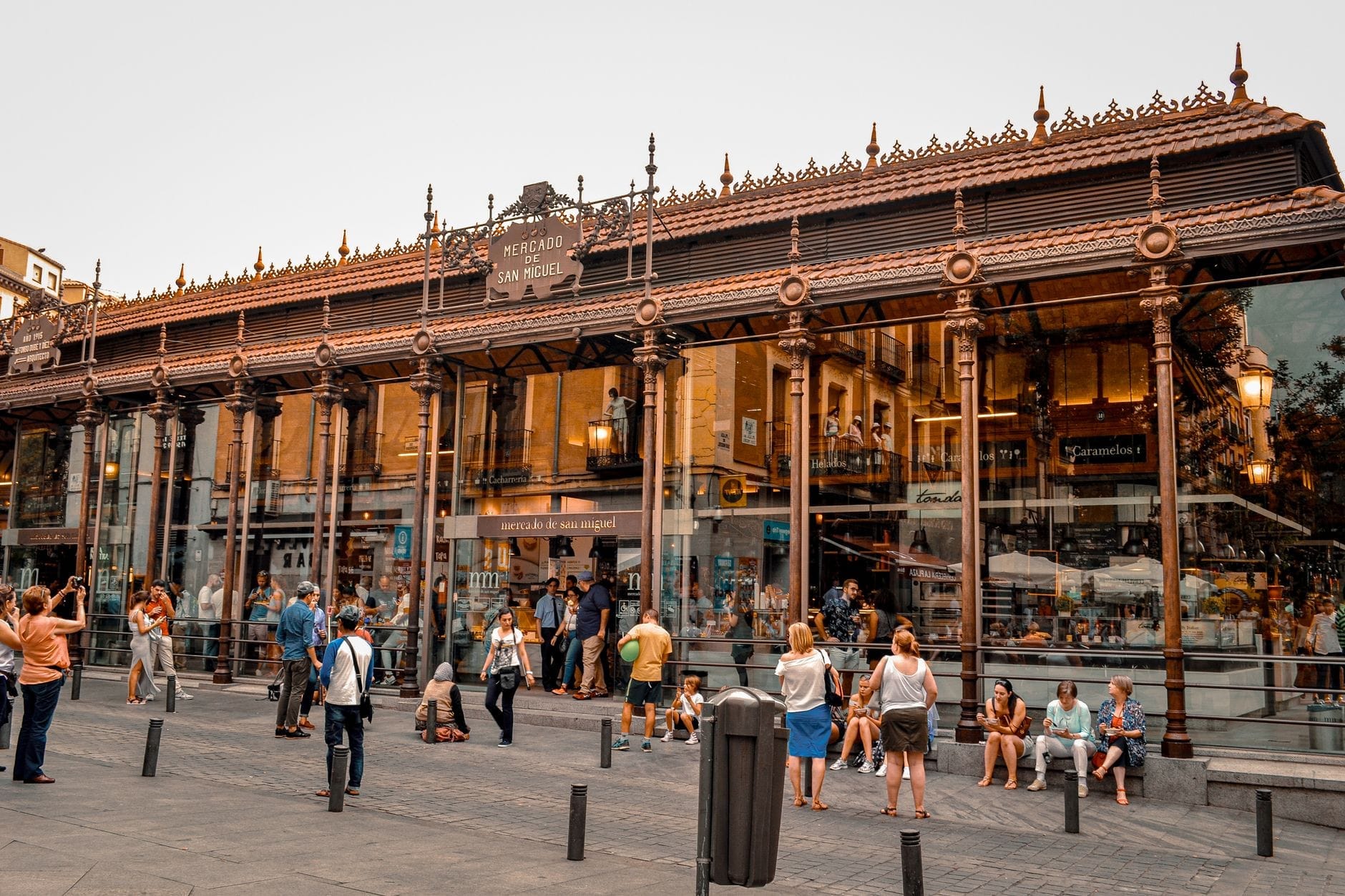
What Mercado de San Miguel Actually Is
Mercado de San Miguel is a covered gourmet food hall housed in one of Madrid's finest surviving examples of early 20th-century cast-iron architecture. The building opened in May 1916 as a functional neighborhood market and, after falling into decline, was purchased by private investors in 2003, fully renovated, and relaunched in 2009 as a curated food and drinks destination. It has been a protected heritage asset (Bien de Interés Cultural) of the Community of Madrid since 2000.
The structure itself is worth pausing to look at before you step inside. The facade is a grid of ornate wrought-iron columns and large glass panels that flood the interior with natural light during the day. At night, the warm glow from inside turns the building into a lantern on the quiet Plaza de San Miguel. It sits one short block from Plaza Mayor, and the contrast between the open, monumental plaza and this intimate iron box is one of those small Madrid pleasures.
ℹ️ Good to know
Opening hours: Sunday to Thursday 10:00 AM to midnight; Friday, Saturday and public holiday eves 10:00 AM to 1:00 AM. Entry is always free. Pay only for what you eat and drink.
The Interior: Layout and What You'll Find
The market operates on a single level, with stalls arranged along a central circulation aisle and around the perimeter. The format is tapas-style: most vendors sell individual portions at small plates or pincho prices, and there is no sit-down restaurant dynamic. You pick up food at one counter, drinks at another, and find a standing spot at one of the shared high tables scattered throughout.
The stall selection covers a wide range of Spanish produce: fresh oysters and seafood, jamón ibérico carved to order, anchovies from the Cantabrian coast, a dedicated vermut bar, olive oil tastings, artisan cheeses, fresh pasta, churros, and several stalls offering creative pintxos. There are also wine, cava, and craft beer options. The quality across most stalls is noticeably higher than what you'd find in the tourist-facing restaurants immediately surrounding Plaza Mayor.
Prices are not cheap by Madrid standards. A single oyster typically costs around 2 to 4 euros, a glass of wine 3 to 6 euros, and a small plate of jamón considerably more. Budget 15 to 25 euros per person for a satisfying round of snacks and two drinks. This is not a place to fill up economically; it is a place to eat well in small quantities.
Tickets & tours
Hand-picked options from our booking partner. Prices are indicative; availability and final rates are confirmed when you complete your booking.
Madrid tapas and wine tour with rooftop drinks
From 85 €Instant confirmationFree cancellationMadrid tapas walking tour with flamenco show
From 80 €Instant confirmationFree cancellationPrivate tapas tour in Madrid
From 70 €Instant confirmationFree cancellationRoyal Monastery of El Escorial and the Valley of the Fallen trip from Madrid
From 64 €Instant confirmationFree cancellation
How the Experience Changes by Time of Day
Mornings, from opening until around noon, are the least crowded window. The light through the glass panels is cool and clear, the smell of fresh bread and coffee dominates, and the vendors are still arranging their counters. If you want to actually look at the building and take photographs without other visitors filling every frame, 10:30 AM on a weekday is your moment.
Lunchtime (2:00 to 4:00 PM) draws a significant crowd, including local workers and tourists moving between Plaza Mayor and the Palacio Real area. The noise level rises sharply; conversations echo off the iron roof and glass walls, and the standing tables fill quickly. This is arguably the most energetic version of the market, but also the most logistically awkward if you are carrying bags or have limited mobility.
The early evening slot, roughly 7:00 to 9:00 PM, tends to draw a mix of locals doing the traditional pre-dinner vermut or caña and tourists who have timed their visit after an afternoon at the nearby museums. This is the most social atmosphere in the market, and the lighting at this hour, with natural dusk filtering through the glass while interior lights warm up, makes it particularly photogenic.
💡 Local tip
Visit on a Tuesday or Wednesday evening between 7 and 9 PM for the best balance of atmosphere and manageable crowds. Weekends after 8 PM are extremely packed, with limited space to move or stand comfortably.
Architecture and Historical Context
The Mercado de San Miguel building belongs to a tradition of late 19th and early 20th century European market architecture that used prefabricated iron frames to create large, airy interior spaces without internal load-bearing walls. Madrid had several of these markets; San Miguel is the last surviving example in the city centre in near-original condition. The heritage designation (reference RI-51-0010569) reflects this status.
The original 1916 market served the working-class and commercial population of the Sol–Centro neighborhood, selling meat, fish, vegetables, and dairy to local households. That version of the market closed progressively as the neighborhood changed and supermarkets replaced neighborhood food halls across Madrid. Its transformation into a gourmet destination mirrors similar conversions across European cities, though the retention of the original iron structure gives San Miguel more architectural credibility than many comparable projects. For broader context on Madrid's food culture, the Madrid food guide covers how the city's eating habits and market culture have evolved.
Getting There and Practical Navigation
The market is a short walk from two Metro stations. From Sol (Lines 1, 2, and 3), the walk takes about 5 minutes southwest through the pedestrian streets behind Puerta del Sol. From Ópera (Lines 2 and 5), approach from the north through the Calle del Arenal, which takes roughly the same time. Cercanías lines C3 and C4 also stop at Sol. Bus lines 3 and N16 serve the area directly. The nearest car park is under Plaza Mayor, but driving to this part of central Madrid is generally not advised given traffic and parking costs.
The market sits on the western edge of Plaza Mayor, connected by a short pedestrian passageway. Most visitors combine the two in a single walk through the historic core, often continuing west toward the Palacio Real or south into the La Latina neighborhood.
The building is single-storey with a flat floor and wide internal aisles, making it step-free and physically accessible. The entrances are large and unobstructed. At peak hours the density of people inside does create sensory overload from noise and competing food smells, which is worth factoring in if you have sensory sensitivities. The surrounding plaza and streets are paved and generally manageable for wheelchairs and pushchairs, though the area gets congested on weekends.
Photography Tips
The interior is a photographer's challenge: high-contrast lighting from the glass ceiling combined with artificial lights at the stalls means auto-exposure can struggle. In the morning, the diffused natural light is more even and forgiving. At night, the warm stall lighting creates attractive but tricky conditions; a camera or phone that handles mixed artificial light well will produce better results.
The exterior shot of the full facade is best captured from the far end of Plaza de San Miguel, stepping back enough to get the entire glass-and-iron structure in frame. In the evening, the interior glow visible through the glass makes for a more dramatic image than any daytime exterior shot.
⚠️ What to skip
The market can get extremely loud and crowded on Friday and Saturday nights. If you have mobility limitations or sensory sensitivities, a weekday morning or early afternoon visit will be significantly more comfortable.
The Verdict
Mercado de San Miguel is frequently cited as one of the top things to do in central Madrid, and it earns that reputation specifically for the quality of the food and the architectural setting. However, it is not an authentic neighborhood market in the traditional sense; it is a premium food hall designed for tourists and gastronomy-oriented visitors. If you arrive expecting the kind of local daily-life market experience you find at, say, the covered section of Mercado de Antón Martín in Lavapiés, you will find San Miguel more curated and considerably more expensive.
That is not a criticism of what it is, only a clarification. As a place to eat excellent jamón, drink a glass of Galician Albariño, and stand inside a beautiful 1916 iron building for an hour, it delivers reliably. As a representation of how most madrileños actually shop for groceries, it does not.
Travelers who prefer exploring the city's less polished food scene will find more authenticity in La Latina just a few minutes south, or in the tapas bars along Cava Baja, where prices are lower and the crowd more local.
Insider Tips
- The oyster stall near the main central aisle often has the shortest queue early in the week. Order a half-dozen with a small pour of cava for one of the best-value combinations in the market.
- If you want a seat, arrive before 1:00 PM on a weekday. The few high stools along the perimeter fill completely by lunchtime and rarely open up until the post-lunch lull around 4:00 PM.
- The vermut bar is one of the quieter corners at most hours. Ordering a house vermouth with olives is both cheap relative to other stall options and gives you something to sip while you take in the architecture without the pressure of moving quickly.
- The market has no formal coat check or bag storage. If you are visiting mid-sightseeing with luggage or heavy bags, the narrow aisles at peak times make navigation genuinely awkward. Leave large bags at your hotel or a luggage storage facility near Sol.
- For the cleanest exterior photographs of the iron facade, position yourself at the far western end of Plaza de San Miguel early on a weekday morning before the market fills and before tour groups arrive from Plaza Mayor.
Who Is Mercado de San Miguel For?
- Food travelers who want to try multiple Spanish products in one stop without committing to a full restaurant meal
- Architecture enthusiasts interested in early 20th-century cast-iron market buildings
- Couples looking for a relaxed early evening drinks and snacks spot before dinner
- Visitors combining a walk through the historic centre with a stop for jamón and wine
- Travelers with limited time who want a condensed, high-quality taste of Spanish gastronomy near the city's main landmarks
Nearby Attractions
Other things to see while in Sol & Centro:
- Catedral de la Almudena
The Almudena Cathedral took more than a century from the laying of its foundation stone to its consecration in 1993, making it one of Europe's newest major cathedrals. Free to enter and directly opposite the Royal Palace, it rewards visitors who look beyond its mismatched facade to discover a surprisingly bold and colorful interior.
- Campo del Moro Gardens
The Jardines del Campo del Moro spread across more than 20 hectares directly behind the Royal Palace, offering one of the most dramatic views of the Palacio Real in Madrid. Admission is free, crowds are thin compared to the palace itself, and the romantic English-style landscape feels worlds away from the city streets above.
- Círculo de Bellas Artes
Few buildings in central Madrid earn attention on multiple levels at once. The Círculo de Bellas Artes delivers: a landmark Palacios-designed tower within the Paisaje de la Luz UNESCO World Heritage area with a rooftop terrace above the Gran Vía skyline, rotating art exhibitions, and one of the city's most atmospheric cafés. Entry to the building and La Pecera café is free; the rooftop, exhibitions, and combined tickets have separate fees starting from around €6.
- Edificio Metrópolis
Standing at the junction of Calle de Alcalá and Gran Vía, the Edificio Metrópolis is Madrid's most iconic piece of Belle Époque architecture. Its slate dome, gilded detailing, and winged Victory statue make it a landmark that rewards careful observation, even though the building itself is not a public museum. Here is everything you need to know before you go.