Templo de Debod: Madrid's Ancient Egyptian Temple
Standing in the Parque de la Montaña near Plaza de España, the Templo de Debod is a real ancient Egyptian temple, dating to the 2nd century BC, that was dismantled, shipped to Spain, and rebuilt stone by stone in Madrid. Entry is free, the sunset views are among the best in the city, and the experience is unlike anything else in Spain
Quick Facts
- Location
- Parque de la Montaña (Parque del Cuartel de la Montaña), near Plaza de España, Madrid
- Getting There
- Metro Plaza de España (Lines 3, 10) or Ventura Rodríguez (Line 3)
- Time Needed
- 45–90 minutes (interior visit is about 30 minutes; allow time for the park and views)
- Cost
- Free; advance reservation strongly recommended
- Best for
- Sunset views, history lovers, photography, couples, solo explorers
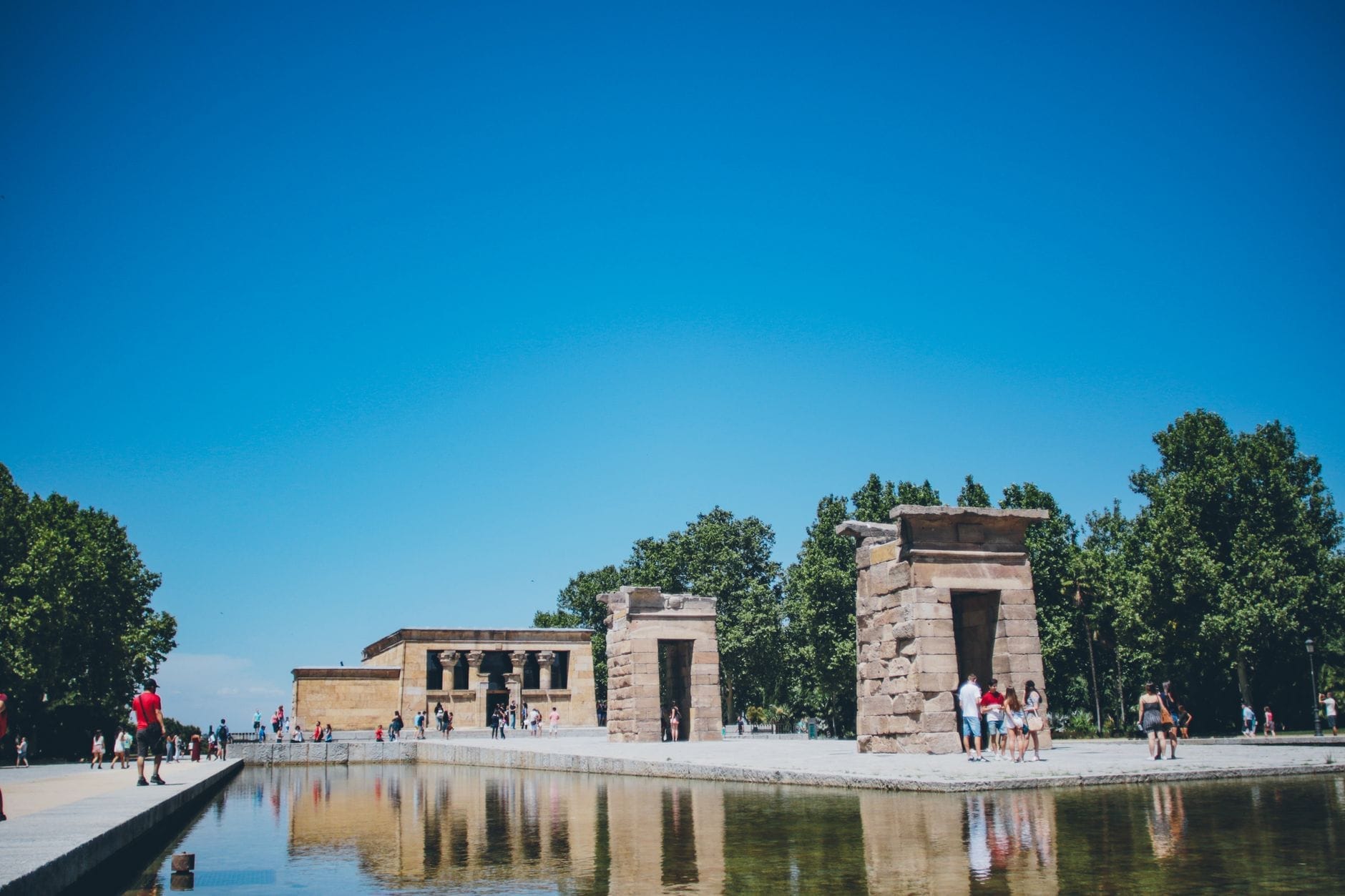
What You're Actually Looking At
The Templo de Debod is not a replica, a reconstruction from blueprints, or a modern homage. It is a genuine ancient Egyptian temple, built originally in Nubia during the 2nd century BC and dedicated to the gods Amun and Isis. The structure was later expanded under several pharaohs and Roman emperors, and its carved reliefs and hieroglyphs reflect centuries of accumulated religious use. When the construction of the Aswan High Dam in the 1960s threatened to permanently submerge Nubian monuments under the rising waters of Lake Nasser, Egypt launched an international campaign to save them. Spain contributed engineering expertise and funds to the rescue effort. In gratitude, the Egyptian government gifted the temple to Spain in 1968. It arrived in pieces, was reassembled in Madrid, and opened to the public in 1972.
The temple sits within a shallow reflecting pool inside the Parque de la Montaña, a small elevated park that overlooks the Manzanares River valley and the Casa de Campo. Two reconstructed pylons stand in front, framing the entrance in the style of classical Egyptian temple design. The stone has weathered to a warm honey-gold colour that deepens dramatically in afternoon light.
ℹ️ Good to know
Opening hours differ by season. From 15 June to 15 September, the temple opens Tuesday to Sunday 10:00–19:00 (last entry 18:30). The rest of the year, hours run 10:00–20:00 (last entry 19:30). Closed Mondays and on 1 and 6 January, 1 May, and 24, 25, and 31 December.
The Experience: Outside Versus Inside
Most visitors spend more time outside the temple than inside, and that is not a complaint. The exterior and the park around it deliver the most memorable moments. The reflecting pool mirrors the pylons and the sky, and the western esplanade opens onto an unobstructed panoramic view toward the Sierra de Guadarrama mountains. At golden hour, the light hits the stone from almost exactly the right angle, turning the scene into something that feels staged but isn't.
Inside the temple, the chambers are small and the decoration is worn, but what remains of the carved reliefs is genuinely striking up close. The interior visit is limited by a conservation-focused capacity control and an average duration of about 30 minutes, and group bookings are regulated. This keeps the experience calm and unhurried, though it does mean queues can form on weekends. The capacity limit was introduced for conservation reasons, and it shows respect for the structure. Arrive early or book in advance through the city's official reservation system.
💡 Local tip
Advance reservation is strongly recommended, especially on weekends and in summer. Walk-in entry is possible if space allows, but the limited capacity fills quickly on busy days.
Tickets & tours
Hand-picked options from our booking partner. Prices are indicative; availability and final rates are confirmed when you complete your booking.
Enjoy a personalized half-day tour in Madrid with a local
From 131 €Instant confirmationFree cancellationEssential Madrid bike or e-bike tour
From 0 €Instant confirmationEssential Madrid bike or e-bike tour
From 0 €Instant confirmationRoyal Monastery of El Escorial and the Valley of the Fallen trip from Madrid
From 64 €Instant confirmationFree cancellation
Timing Your Visit: How the Temple Changes by Hour
Morning visits, especially on weekdays, offer the quietest conditions. The park is mostly occupied by dog walkers and joggers before 11:00, and the queue for the temple interior is minimal. The light at this hour is softer and cooler, hitting the stone from the east, which suits photography of the entrance pylons.
The late afternoon is when this attraction reaches its peak. From roughly 60 to 90 minutes before sunset, the western terrace fills with people who have come specifically for the view. The crowd is a mix of Madrid residents and tourists, and the atmosphere is relaxed rather than frantic. Photographers set up tripods along the railing. Couples sit on the low walls. The mountains, on a clear day, are visible across the river valley. This is one of the better sunset viewpoints in the city.
For context on how Templo de Debod fits among the city's other great panoramas, see the full guide to best views in Madrid.
Midday in summer is the least comfortable time to visit. Madrid sits at 667 metres above sea level and has a semi-arid climate; summer afternoons can exceed 35°C with little shade in the park. If you visit between late June and late August, bring water, wear sunscreen, and plan around the morning or early evening windows.
Historical and Cultural Context
The temple's origins trace to a Nubian king named Adijalamani, who began construction around 200 BC at Debod, a site now submerged under Lake Nasser in what was then the Meroitic Kingdom. Subsequent pharaohs from the Ptolemaic dynasty, including Ptolemy VI and Ptolemy VIII, added to the structure. Roman emperors Augustus and Tiberius also contributed modifications, making the building a layered document of Egyptian and Roman religious patronage spanning several centuries.
The international campaign to save Nubian monuments following the Aswan Dam project resulted in the relocation of several temples across the world. The most famous is Abu Simbel, which was cut into blocks and raised. Debod was one of four temples gifted to countries that contributed to the preservation effort; the others went to the United States (Dendur), the Netherlands (Taffeh), and Italy (Ellesyia). Madrid's acquisition of the Templo de Debod gives the city a piece of ancient history that belongs to its story.
The neighbourhood surrounding the temple, Moncloa-Argüelles, has its own layered identity: part university district, part residential quarter, with a stretch of Paseo del Pintor Rosales running along the park edge that fills with terrace cafés in warmer months.
Getting There and Getting In
The temple is a short walk from Metro Plaza de España (Lines 3 and 10) or Ventura Rodríguez (Line 3). From Plaza de España, head northwest up Calle de Ferraz for about 10 minutes on foot; the park entrance appears on your right. BiciMAD docking stations are located at Paseo del Pintor Rosales and at Plaza de España if you prefer to cycle.
Entry to both the park and the temple is free. The interior visit is subject to a limited capacity, and temporary closures for conservation or safety can occur. It is worth checking the Madrid City Council's official site before planning your visit around the interior, particularly if you are travelling with children or have limited time.
⚠️ What to skip
The temple interior is occasionally closed for safety and conservation work, and opening hours or room access can change. The exterior park and views are always accessible during park hours. Don't build an itinerary where seeing the interior is non-negotiable.
Photography, Accessibility, and Practical Notes
For photography, the classic composition places the temple's reflecting pool in the foreground with the pylons centred and the sky above. This works best with a wide-angle lens in the late afternoon. The western terrace above the park wall captures the panoramic view but requires positioning among other visitors. The interior chambers are dimly lit; a camera with good low-light performance helps, though flash is generally discouraged in historic spaces.
Accessibility to the park is reasonable, with paved paths from the street level. The temple interior involves steps and narrow passages, which may be difficult for visitors with mobility limitations. The exterior experience, including the pool view and the western panorama, is fully accessible without entering the building. There are no café or restroom facilities within the temple site itself; the Paseo de Pintor Rosales terrace bars directly adjacent to the park are the practical option for both.
If you are planning a broader day in the area, the Parque del Oeste is directly adjacent and worth combining with a visit to the temple, especially in spring when its rose garden is at its best.
Who Might Want to Skip This
If your primary goal is a deep museum experience with substantial interpretive content, the Templo de Debod may feel thin. The interior is compact, the informational signage is limited, and the visit is capped at 30 minutes. Visitors who have just returned from Egypt, or who want a comprehensive Egyptology experience, are better served by dedicated collections.
Travelers whose Madrid time is very limited and who are prioritising the major art museums should note that the Prado, Reina Sofía, and Thyssen-Bornemisza all offer far greater depth per hour. A combined pass and strategy is covered in the guide to best museums in Madrid.
The temple is also a poor choice in extreme summer heat if you have no tolerance for outdoor exposure. The park has limited shade, and the terrace is fully exposed. That said, the short interior visit provides some relief, and the adjacent boulevard's café terraces have umbrellas.
Insider Tips
- Book the interior visit through the Madrid City Council's online reservation system even if the day looks quiet. The limited capacity fills faster than it looks like it should, especially on Saturday afternoons.
- The best sunset photography position is not directly in front of the temple but slightly to the north along the park railing, where you can frame the pylons against the Sierra de Guadarrama with the reflecting pool in the foreground.
- Weekday mornings between 10:00 and 12:00 reliably have the shortest queues and the most comfortable temperature for lingering. This is when local residents tend to bring children to the park, and the atmosphere is calm.
- The Paseo de Pintor Rosales terrace bars along the park boundary are a natural extension of the visit. Order a vermouth or a coffee after watching the sunset; several of them have direct sightlines back toward the temple.
- If the interior is temporarily closed on your visit day, do not treat the trip as wasted. The exterior, the pool, and the view to the west are the real draw for most people who love this spot, and they require no reservation.
Who Is Templo de Debod For?
- Sunset seekers and photographers wanting an unusual foreground for Madrid's western skyline
- History and archaeology enthusiasts curious about Nubian and Egyptian antiquity in Europe
- Couples looking for a scenic, low-cost evening outing away from the crowded centro
- Solo travelers combining a cultural stop with a walk through Moncloa-Argüelles
- Families with older children who can engage with ancient history and enjoy outdoor space
Nearby Attractions
Other things to see while in Moncloa & Argüelles:
- Casa de Campo
Once a royal hunting ground reserved for Spanish kings, Casa de Campo is now Madrid's largest public park, covering 1,535.52 hectares west of the Royal Palace. Free to enter year-round, it offers a lake, forest trails, a cable car connection, and two family attractions, all within reach of the city centre.
- Ermita de San Antonio de la Florida
A small neoclassical hermitage beside the Manzanares River holds one of the most extraordinary ceiling fresco cycles in Spain, painted by Francisco de Goya in 1798. Entry is free, crowds are light, and the painter himself is buried beneath the dome he decorated.
- Madrid Río
Madrid Río is a roughly 150-hectare linear park stretching about 7 kilometres along the Manzanares River, built on top of the buried M-30 motorway. Free to enter and open around the clock, it offers cycling paths, playgrounds, riverside promenades, and views of the Royal Palace — all within walking distance of central Madrid.
- Faro de Moncloa
At 92 metres above street level, the Faro de Moncloa observation deck delivers sweeping 360-degree views of Madrid for as little as €4. Built in 1992, this slender 110-metre tower is one of the most affordable viewpoints in the city, and one of the least crowded.