Faro de Moncloa: Madrid's Underrated Observation Tower
At 92 metres above street level, the Faro de Moncloa observation deck delivers sweeping 360-degree views of Madrid for as little as €4. Built in 1992, this slender 110-metre tower is one of the most affordable viewpoints in the city, and one of the least crowded.
Quick Facts
- Location
- Avenida de la Memoria, 2, Ciudad Universitaria, Moncloa-Aravaca, Madrid
- Getting There
- Metro: Moncloa (Lines 3 & 6), short walk
- Time Needed
- 30–45 minutes (max 30 min on deck per slot)
- Cost
- General €4 / Reduced €2 / Super-reduced €1
- Best for
- Budget travelers, skyline photography, families, city orientation
- Official website
- www.esmadrid.com/en/tourist-information/faro-de-moncloa
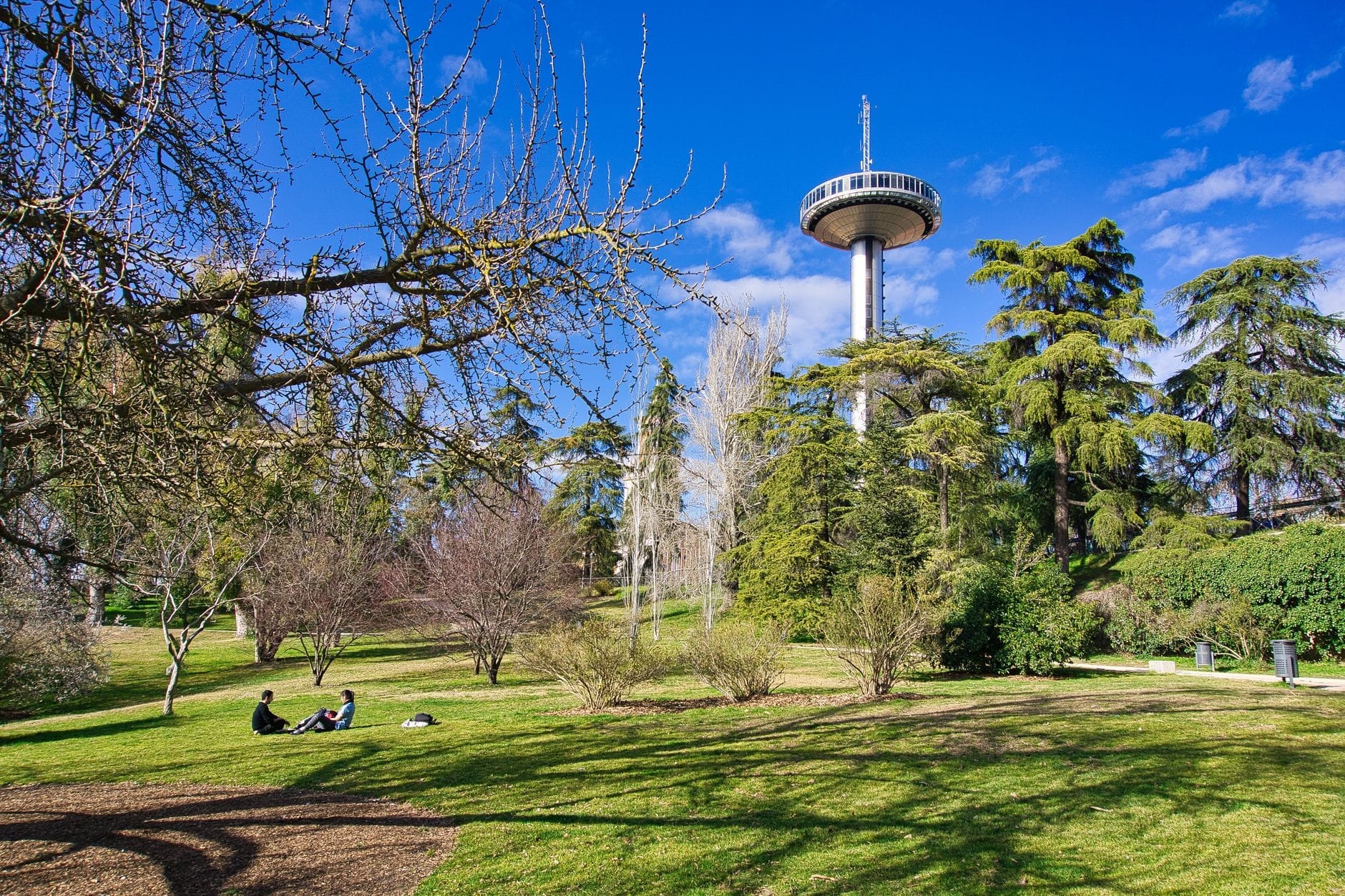
What Is the Faro de Moncloa?
The Faro de Moncloa is a 92-metre transmission and observation tower in the Ciudad Universitaria quarter of Madrid's Moncloa-Aravaca district. Its viewing platform sits at roughly 92 metres above ground, enclosed by full-height glass panels that wrap around the entire deck. Designed by architect Salvador Pérez Arroyo and completed in 1992 to celebrate Madrid's designation as European Capital of Culture that year, the tower has a clean, functional silhouette: a narrow concrete shaft crowned by the glazed observation ring, with a broadcast antenna rising above it.
Despite its height and genuine panoramic reach, the Faro de Moncloa draws a fraction of the crowds that queue for rooftop bars and paid viewpoints in the city centre. For a traveler trying to get a clear mental map of how Madrid is laid out, few places do the job as efficiently or as cheaply.
ℹ️ Good to know
Opening hours: Tuesday to Sunday, 09:30–20:00 (last entry 19:30). Closed Mondays, with exceptions on certain holidays. The deck closes in adverse weather, so check conditions before you go.
The View: What You Actually See
From the observation deck, Madrid spreads out in every direction without obstruction. To the south and east, the dense grid of the city centre comes into sharp focus: you can trace the axis of the Gran Vía, pick out the dome of the Almudena Cathedral, and on clear days identify the high-rises of the Cuatro Torres business district to the north. The Sierra de Guadarrama mountain range forms a long wall across the northwestern horizon, snow-capped for much of autumn and winter, and it is genuinely impressive to see how close those peaks are to the city.
To the west and northwest, the view shifts to green: the Casa de Campo, Madrid's largest park, fills much of the middle distance, and you can follow the silver thread of the Manzanares River as it curves south. The Palacio Real and the long green corridor of the Campo del Moro are visible directly below and to the southwest, giving you an aerial perspective that makes their scale suddenly legible.
The glass enclosure is clean enough for photography, though slight reflections are unavoidable in direct sun. Polarizing filters help. The deck is narrow, so it can feel tight when more than a dozen people are present at the same time, but the 30-minute slot system means it never becomes uncomfortably crowded.
For context on the landmarks you can spot from the deck, the guide to best views in Madrid covers how the Faro compares with other high vantage points across the city.
Tickets & tours
Hand-picked options from our booking partner. Prices are indicative; availability and final rates are confirmed when you complete your booking.
Royal Monastery of El Escorial and the Valley of the Fallen trip from Madrid
From 64 €Instant confirmationFree cancellationFlexible time Real Madrid: Bernabeu Stadium & Museum Entry
From 42 €Instant confirmationMuseum of Senses Madrid entrance ticket
From 19 €Instant confirmationAvila and Segovia full-day tour from Madrid
From 50 €Instant confirmationFree cancellation
How the Experience Changes by Time of Day
Morning visits, especially on weekdays, are quiet. Arriving when the deck opens at 09:30 means you will often have the glass panels largely to yourself. The light comes from the east at that hour, which means the western views toward the Casa de Campo and the mountains are photographically flat but the city centre is lit from behind you, a clean and even look.
Late afternoon is arguably the best time for photography. From roughly 17:00 onward, the low western sun catches the city's limestone and granite facades at an angle that turns them gold. The Sierra de Guadarrama is silhouetted against the sky to the northwest, and the light over the Manzanares valley becomes strikingly cinematic. This is also when visitor numbers pick up slightly, so if you prefer quiet, arrive before 17:00 on weekends.
The tower closes at 20:00, which in summer falls well before sunset (Madrid's sun sets after 21:30 in June and July). Dusk and night views are not possible. If you want a night panorama over Madrid, you will need to look elsewhere. For visitors visiting in autumn or winter, however, the closing time is much closer to golden hour, making October through February the most photogenic season to visit.
💡 Local tip
The deck faces no single direction better than another, but the northwest corner — facing the Sierra de Guadarrama — rewards attention on clear winter mornings when the peaks carry snow. Bring binoculars if you have them.
Getting There and Practical Details
The most straightforward route is Metro Line 3 (yellow) or Line 6 (circular) to Moncloa station, which places you a short walk from the tower. Exit the station toward the Intercambiador de Moncloa (the large transport interchange), then walk north and slightly west through the university campus. The tower is visible from a distance and easy to orientate toward.
Numerous EMT bus lines serve the Moncloa interchange. If you are already in the Moncloa-Argüelles area, the tower is reachable on foot from the Parque del Oeste, a pleasant 10-minute walk through green space.
The surrounding Moncloa-Argüelles neighborhood is worth exploring before or after your visit. The Parque del Oeste and the Templo de Debod Egyptian temple are both within easy walking distance.
Tickets are sold on-site for specific time slots; tickets can also be bought online on the official Madrid Tourism page. Arrive a few minutes before your preferred slot. At €4 for the general ticket, or €2 for visitors aged 7–14, over 65s, unemployed visitors, and people with disabilities (plus companion), this is one of the most affordable paid viewpoints in any European capital. Children under 6 pay €1.
On the accessibility side: the entrance has a ramp with a handrail. For safety, only one wheelchair is permitted on the viewing deck at a time.
Historical and Architectural Context
The Faro de Moncloa was purpose-built for Madrid's 1992 Cultural Capital year. The Faro was one such investment: a functional broadcast tower given a public-access viewing platform, designed by Salvador Pérez Arroyo in a style that prioritizes structural honesty over ornament.
After a long closure, the tower reopened in April 2015 after a renovation that brought it up to current standards. The decade-long closure explains why many long-term Madrid residents have never been up it, and why it remains relatively unknown even among locals.
The tower stands in Ciudad Universitaria, the university district that was almost entirely destroyed during the Spanish Civil War (1936–39) when it formed the front line of the Battle of Madrid. The campus was rebuilt from the 1940s onward, and the grid of faculty buildings you see from the deck is largely mid-20th century in character. That history sits quietly beneath what looks like a standard modern campus.
If architectural history interests you, the broader Madrid architecture guide covers the city's building layers from the Habsburg era to the present.
Who Will Get the Most From This Viewpoint (and Who Might Not)
The Faro de Moncloa suits visitors who want a clear, elevated orientation of the city without paying premium rooftop-bar prices or competing with selfie crowds. It is particularly good for people who arrive in Madrid for the first time and want to understand the city's geography before diving into the streets. Families with children will find the price point hard to beat, and the 30-minute slot structure keeps the visit focused.
Photographers who shoot architecture or landscapes will appreciate the unobstructed sight lines and the mountain backdrop, though the glass enclosure does require some care to avoid reflections. The deck itself is not large, and the slot system means you cannot linger past your 30 minutes if others are waiting.
Visitors primarily interested in views of the historic centre at night should know this tower cannot deliver that. The 20:00 closing time and the distance from central Madrid mean the Faro is more useful as a daytime complement to a Moncloa afternoon than as a standalone evening destination. If your priority is a dramatic dusk skyline, the Circulo de Bellas Artes rooftop terrace in the centre offers that experience instead.
For a fuller picture of what to do in the area and across the city, the guide to things to do in Madrid organizes options by neighborhood and interest.
Insider Tips
- Slot capacity is small, so weekend midday visits can sell out. Weekday mornings between 10:00 and 12:00 almost always have immediate availability at the ticket window.
- The tower closes in adverse weather with no notice, and Madrid can get sudden afternoon storms in spring and autumn. Check the sky before making the trip from the city centre.
- Combine the visit with the Templo de Debod (15 minutes on foot to the south) for a half-afternoon in the Moncloa area at minimal cost — both together come in well under €10.
- For the clearest mountain views, visit between November and March when the Sierra de Guadarrama peaks are snow-covered and the air is drier. Summer haze can reduce visibility significantly.
- The 30-minute maximum is enforced when demand requires it, but during quiet periods on weekday mornings, staff have been known to be flexible. Do not bank on it, but arrive early and you may find the deck almost to yourself with no pressure to leave.
Who Is Faro de Moncloa For?
- First-time visitors wanting a city orientation before exploring on foot
- Budget travelers: one of Madrid's cheapest paid panoramic viewpoints
- Families with children aged 6 and under, who pay just €1
- Landscape and architecture photographers targeting the Sierra de Guadarrama backdrop
- Anyone combining a morning in Moncloa-Argüelles with the Parque del Oeste or Templo de Debod
Nearby Attractions
Other things to see while in Moncloa & Argüelles:
- Casa de Campo
Once a royal hunting ground reserved for Spanish kings, Casa de Campo is now Madrid's largest public park, covering 1,535.52 hectares west of the Royal Palace. Free to enter year-round, it offers a lake, forest trails, a cable car connection, and two family attractions, all within reach of the city centre.
- Ermita de San Antonio de la Florida
A small neoclassical hermitage beside the Manzanares River holds one of the most extraordinary ceiling fresco cycles in Spain, painted by Francisco de Goya in 1798. Entry is free, crowds are light, and the painter himself is buried beneath the dome he decorated.
- Madrid Río
Madrid Río is a roughly 150-hectare linear park stretching about 7 kilometres along the Manzanares River, built on top of the buried M-30 motorway. Free to enter and open around the clock, it offers cycling paths, playgrounds, riverside promenades, and views of the Royal Palace — all within walking distance of central Madrid.
- Museo Cerralbo
Museo Cerralbo is a rare thing: a 19th-century aristocratic palace preserved almost exactly as its owner left it, filled with over 50,000 objects across paintings, armour, ceramics, and gilded ballrooms. Located in the Argüelles neighbourhood near Plaza de España, it offers an unusually personal window into aristocratic Madrid life at a fraction of the price of the city's blockbuster museums.