Museo del Romanticismo: Madrid's Most Intimate Museum
The Museo del Romanticismo is Madrid's best-preserved window into 19th-century bourgeois life, housed in a 1776 palace in the Malasaña neighborhood. With original furniture, personal objects, and period paintings arranged as a lived-in home, it rewards slow, curious visitors far more than most of the city's larger institutions.
Quick Facts
- Location
- Calle de San Mateo, 13, Malasaña, Madrid
- Getting There
- Tribunal (Lines 1 and 10) or Alonso Martínez (Lines 4, 5, 10)
- Time Needed
- 1.5 to 2.5 hours
- Cost
- €3 general; €1.50 reduced for eligible groups; free Sat after 14:00 and Sundays
- Best for
- History lovers, art enthusiasts, slow travelers, couples
- Official website
- www.cultura.gob.es/mromanticismo
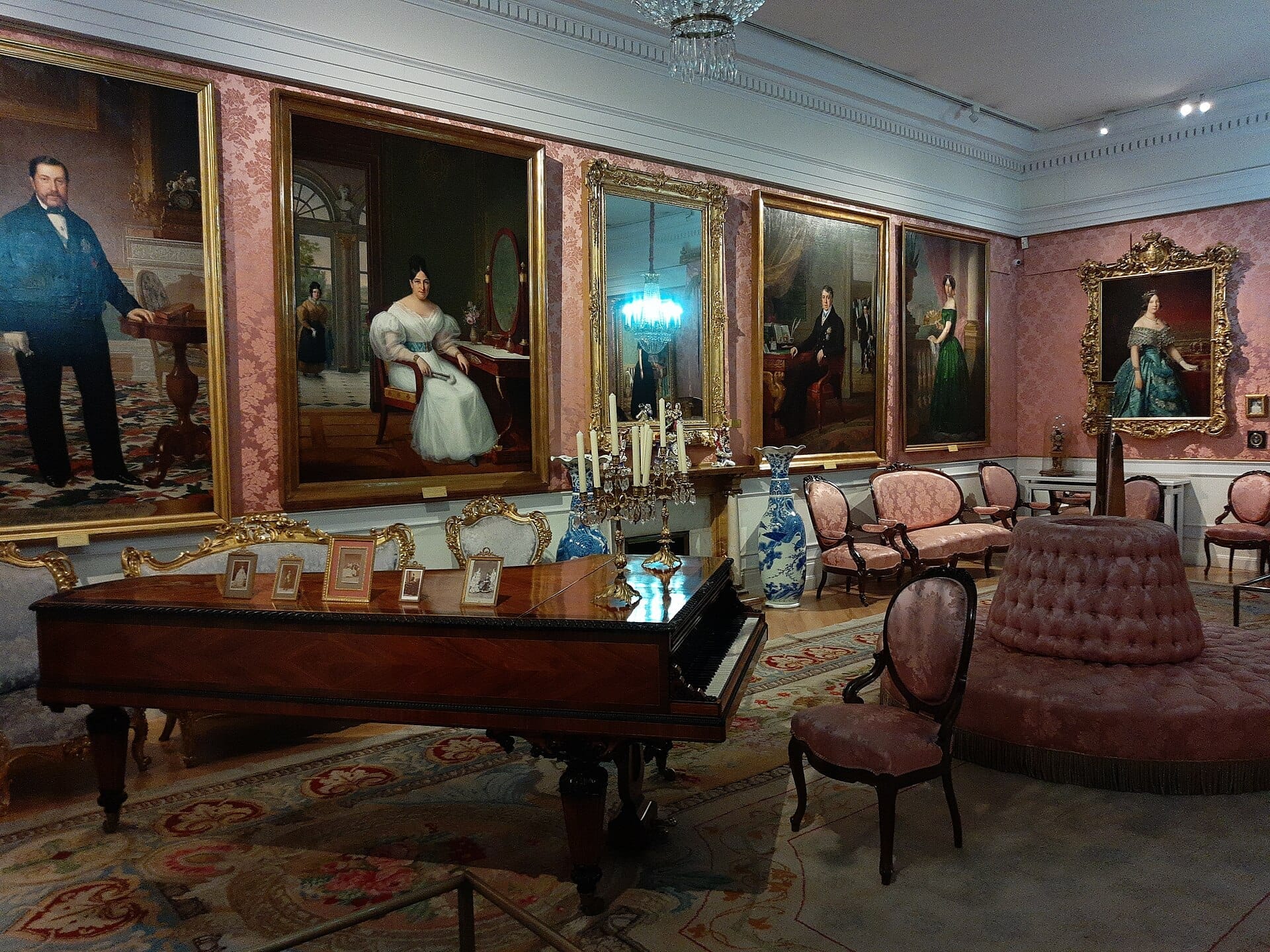
What the Museo del Romanticismo Actually Is
The Museo del Romanticismo is not a typical art museum. It is a 19th-century aristocratic residence that has been preserved and interpreted as a total environment: furniture, paintings, books, clocks, fans, dueling pistols, and personal letters arranged in rooms that feel occupied rather than curated. The effect is closer to walking into a frozen moment than to touring a conventional gallery.
Opened in 1921, the museum occupies the former palace of the Marquis of Matallana, a structure built in 1776 on Calle de San Mateo in what is now the Malasaña neighborhood. The founding collection came from the Marquis of la Vega-Inclán, an aristocrat and early conservationist who assembled period objects to document Spanish Romantic culture between roughly 1800 and 1868. That editorial eye, focused on an era rather than an artist, gives the museum a coherence that larger collections rarely achieve.
💡 Local tip
Entry is free on Saturdays after 14:00 and all day Sundays. Arrive just after 14:00 on a Saturday to avoid any midday queue and still have several hours to explore before closing.
The Building and Its Rooms
The palace exterior is understated by Madrid standards: a restrained neoclassical facade that gives little indication of what waits inside. The interior is organized across two floors, with rooms named and themed according to their 19th-century function: the ballroom, the oratory, the library, the bedroom suites. Ceilings are high, light comes through tall shuttered windows, and the scale is domestic rather than palatial, which is precisely the point.
The ballroom on the piano nobile is the most photographed space: deep red walls, a large crystal chandelier, and a floor-to-ceiling oil painting by Esquivel showing the literary and artistic elite of Madrid in 1846. That single painting is a who's-who of Spanish Romanticism, depicting figures including the poet José Zorrilla. Stand in front of it long enough and you start recognizing how interconnected that world was.
The oratory contains a small private chapel with an ornate gilded altarpiece, the kind of intimate religious space that wealthy families maintained in their homes. The bedroom and dressing rooms are filled with period clothing, mirrors, and toiletry sets. The library holds leather-bound volumes and writing desks arranged as if someone just stepped away. None of these rooms are large, but each one is dense with period detail.
Tickets & tours
Hand-picked options from our booking partner. Prices are indicative; availability and final rates are confirmed when you complete your booking.
Paseo del Arte pass for Museo Nacional Thyssen-Bornemisza, Reina Sofia Museum and Prado Museum
From 37 €Instant confirmationImperial Madrid walking tour
From 16 €Instant confirmationFree cancellationTapas and history tour through old Madrid
From 75 €Instant confirmationFree cancellationRibera del Duero wine tour and tasting from Madrid
From 170 €Instant confirmation
The Collection: What to Look For
The paintings here are not the blockbusters you find at the Prado, but they are chosen with precision. Works by Federico de Madrazo, Leonardo Alenza, and Eugenio Lucas Velázquez define the Spanish Romantic style: theatrical lighting, emotional gesture, and a preoccupation with historical and literary subjects. Several portraits of identifiable historical figures from the Isabeline period add biographical texture to the paintings.
Look for the pistol case in the collection. According to museum records, it belonged to Mariano José de Larra, one of Spain's most important Romantic writers, and was used in his suicide in 1837. The object is small and sits in a glass case, but it carries an outsized weight for anyone who has read his essays. This kind of object-with-biography is what separates the Museo del Romanticismo from a conventional fine arts museum. For a broader survey of Madrid's art institutions, the best museums in Madrid guide provides useful context for how this museum fits into the city's wider offer.
The decorative arts collection is equally strong: Talavera ceramics, carved furniture, Romantic-era fans with painted scenes, and clocks from French and Spanish makers. These objects are not labeled as artworks but as household items, which changes how you look at them. They are evidence of how a specific class lived and what they considered beautiful.
How the Experience Changes by Time of Day
Morning visits, especially on weekdays, offer the museum at its quietest. The light through the tall windows is soft and directional in the early hours, catching dust motes above the furniture and casting long shadows across the parquet floors. The smell of old wood and aged fabric is noticeable in the smaller rooms. At this hour, it is entirely possible to stand in a bedroom or the library for several minutes without another visitor appearing.
By early afternoon, particularly on weekends, group visits from Spanish secondary schools are common. The rooms are small enough that a single group of fifteen students effectively fills one floor. If your priority is solitude and careful looking, arrive before noon on a weekday or just after 14:00 on a Saturday, when the free entry period begins but the tour groups have usually dispersed.
Summer evening hours (the museum stays open until 20:30 from May through October) offer a quite pleasant late-afternoon visit. The exterior light softens, the building has cooled somewhat from the afternoon heat, and the upper-floor rooms catch a warm glow through the shutters. This is a particularly comfortable option in July and August, when midday temperatures in Madrid regularly exceed 35°C and outdoor sightseeing becomes uncomfortable.
⚠️ What to skip
The museum is closed on Mondays and on selected public holidays. Hours differ significantly between winter (closes 18:30) and summer (closes 20:30). Check the official website before visiting, especially around Spanish national holidays in May and October.
Getting There and Practical Access
The museum is a 7 to 10 minute walk from both the Tribunal station (Lines 1 and 10) and Alonso Martínez station (Lines 4, 5, and 10). From Tribunal, walk north along Calle de Fuencarral and turn right onto Calle de San Mateo. The entrance is at number 13. Calle de San Mateo is a quiet residential street with no particular commercial character, which adds to the sense of stumbling into something private. The Malasaña neighborhood that surrounds it is worth exploring before or after: dense with independent cafes, bookshops, and small bars.
Visitors with reduced mobility should note that the main entrance on Calle de San Mateo has steps. The accessible entrance is located at Calle Beneficencia, 14, one street behind the main facade. Staff are helpful about directing visitors, but it is worth knowing this in advance to avoid unnecessary backtracking.
Admission is €3 for general entry and €1.50 for the reduced rate for eligible groups. The free entry periods on Saturday afternoons and Sundays make this one of the more accessible cultural options in central Madrid for budget-conscious travelers. There is no need to book in advance for individual visitors; the museum rarely reaches capacity, and queues outside are unusual except during special exhibition openings.
The Garden Café: An Underrated Detail
The museum has a small interior garden and, when open, a café that opens onto it. In spring and early autumn, this is one of the more pleasant café terraces in the Malasaña area: quiet, shaded by a wisteria-covered pergola, and entirely invisible from the street. It operates as a separate concession and is accessible to visitors who have paid museum admission when in service. Coffee and light snacks are available. It is not a serious restaurant, but as a place to sit after an hour of careful looking, it earns its place in the itinerary.
If you plan to spend a half-day in the area, the café makes a natural midpoint. The Madrid food guide covers the broader neighborhood dining scene if you want to extend into lunch or dinner nearby.
Photography and What to Bring
Photography without flash is permitted in most areas of the museum. The interior lighting is warm and relatively low in several rooms, so a camera or phone that handles low light reasonably well will produce better results than flash-lit shots. The ballroom, with its red walls and chandelier, photographs well in the late morning when natural light reaches it through the front windows. The oratory and bedroom suites are darker and benefit from steady hands or a device with good optical stabilization.
No special equipment is needed for a visit. The museum is fully indoors and temperature-controlled. In summer, it offers a cool retreat from the heat. In winter, it is comfortably warm. Comfortable shoes are all that is required; the floors are original parquet and smooth throughout.
Who Will Get the Most From This Museum
Visitors with an interest in 19th-century European history, Spanish literature of the Romantic period, or decorative arts will find the Museo del Romanticismo unusually satisfying. It rewards people who read labels and look closely at objects, rather than those who move quickly through large galleries. If your Madrid itinerary is centered on the major art institutions, consider this as a half-morning complement to a Prado afternoon: see the Museo del Prado for monumental scale and this museum for intimate texture.
Visitors who find small, densely decorated rooms oppressive rather than atmospheric may not enjoy the experience. The rooms are genuine 19th-century domestic spaces, not purpose-built galleries, and they do not offer the breathing room of a modern museum layout. Young children are also likely to find the museum difficult to engage with: there are no interactive elements, and the content is almost entirely text-and-object based.
For travelers working through Madrid's cultural offer more broadly, the Madrid architecture guide provides useful background on the 18th-century urban fabric that the museum building belongs to.
Insider Tips
- The free Saturday afternoon entry (after 14:00) is genuinely uncrowded compared to Sunday mornings. Most visitors assume weekends are busier across the board, but Saturday afternoons here tend to be lighter than Sunday late mornings.
- The museum publishes a detailed room-by-room guide in English on its official website. Download it before visiting rather than relying on in-room labels alone: the English text in the rooms is abbreviated, and the full guide adds significantly to the context of several key objects.
- The accessible entrance on Calle Beneficencia, 14 is also a quieter arrival point even for visitors who do not require step-free access. Staff there are often more available for questions than at the main door.
- Ask at the information desk about any temporary exhibitions running alongside the permanent collection. The museum mounts small thematic shows, usually focused on a single artist or object type from the Romantic period, that are included in the general admission price and rarely mentioned in standard tourist listings.
- The garden café closes in cold or rainy weather even if the museum is open. If sitting outside is part of your plan, check conditions before making it a fixed element of the visit.
Who Is Museo del Romanticismo For?
- History and literature enthusiasts interested in 19th-century Spain
- Slow travelers who prefer depth over volume
- Couples looking for a wonderfully atmospheric and quiet cultural experience
- Design and decorative arts visitors interested in period interiors
- Budget travelers: free entry on Saturday afternoons and Sundays makes it one of Madrid's best-value cultural stops
Nearby Attractions
Other things to see while in Malasaña:
- Centro Cultural Conde Duque
Occupying a former 18th-century royal barracks in the heart of Malasaña, the Centro Cultural Conde Duque is one of Madrid's most architecturally striking public cultural spaces. With around 58,000 m² dedicated to exhibitions, theatre, music, and community events, most of it free to enter, it rewards visitors who go beyond the obvious tourist circuit.
- Mercado de San Ildefonso
Mercado de San Ildefonso on Calle Fuencarral is Madrid's original vertical street food market, spreading across three floors with around 16 to 20 gastronomy stalls, three bars, and two semi-covered terraces. Entry is free. The food costs money, but the atmosphere is part of the deal.
- Museo de Historia de Madrid
Housed in a stunning 18th-century Baroque building in Malasaña, the Museo de Historia de Madrid is one of the capital's most underrated cultural institutions. Free to enter and holding over 60,000 objects, it tells the story of Madrid from its medieval origins to the 20th century through maps, paintings, scale models, photographs, and decorative arts.
- Plaza de Dos de Mayo
Plaza del Dos de Mayo is a free, open public square in Madrid's Malasaña neighborhood that marks the site of the 1808 uprising against Napoleon. Anchored by a monumental arch and statues of Captains Daoíz and Velarde, it shifts from a quiet morning garden to a lively afternoon meeting point as the day unfolds.