Mercado de San Ildefonso: Malasaña's Three-Floor Food Market
Mercado de San Ildefonso on Calle Fuencarral is Madrid's original vertical street food market, spreading across three floors with around 16 to 20 gastronomy stalls, three bars, and two semi-covered terraces. Entry is free. The food costs money, but the atmosphere is part of the deal.
Quick Facts
- Location
- Calle Fuencarral 57, 28004 Madrid
- Getting There
- Tribunal (Lines 1 & 10) or Chueca (Line 5)
- Time Needed
- 1 to 2 hours
- Cost
- Free entry; food and drinks paid separately
- Best for
- Grazing, evening drinks, casual group meals
- Official website
- http://www.mercadodesanildefonso.com
What Is Mercado de San Ildefonso?
Mercado de San Ildefonso occupies a compact but cleverly stacked building at Calle Fuencarral 57, a few metres from where what is described as Madrid's first covered food market once stood before it was demolished in 1970. The modern incarnation bills itself as Spain's first vertical street food market, and the label fits: three floors of stalls, bars, and terraces rise above Fuencarral, a street that cuts through the lower edge of Malasaña toward Chueca.
The concept is simple. You enter for free, walk between around 16 gastronomy stalls offering everything from Spanish tortilla and Galician octopus to Asian-inspired small plates and craft beer, order what you want from individual vendors, and find a spot at the communal tables. Each floor has its own bar. There is no single kitchen, no table service, and no set menu. It is grazing architecture, built for browsing.
💡 Local tip
Arrive at opening (13:00) on a weekday if you want to eat without competition for tables. By 15:00 on weekends the communal seating fills up quickly and queues form at the most popular stalls.
The Space Floor by Floor
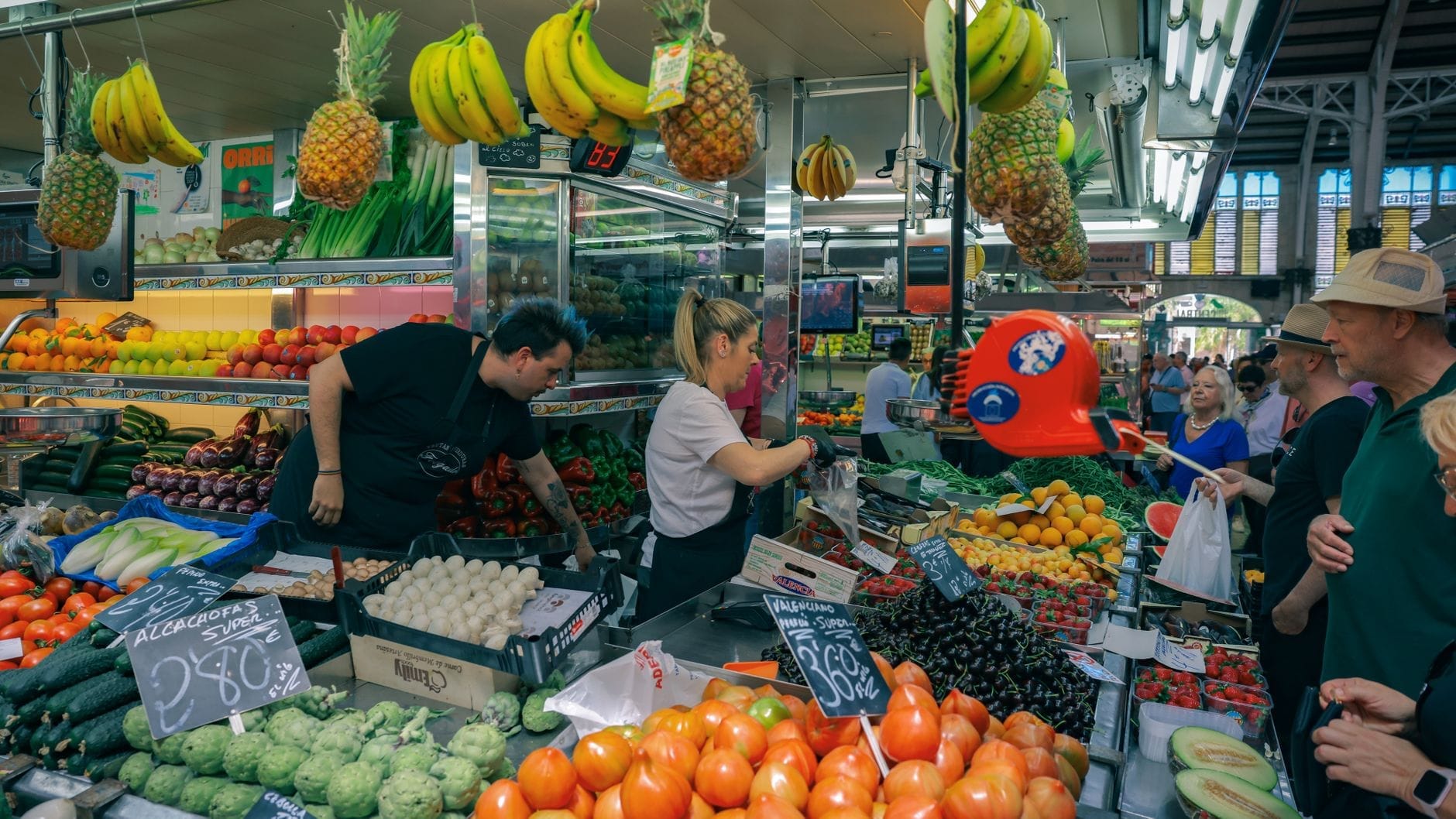
The ground floor greets you with the densest concentration of stalls and the loudest ambient noise. Vendors call out, overhead lighting hits the food displays, and the smell of grilled meat mingles with something sweeter from a neighbouring pastry counter. It is designed for stimulation, and it works. Navigation is tight during peak hours, so if you are travelling with a pushchair or have limited mobility, note that the building spans multiple levels and accessibility details are not confirmed on the official site. Contact the market directly before visiting if this matters to you.
The upper floors tend to be quieter, especially during the early part of the afternoon, which makes them better for sitting down and actually eating rather than just circulating. The semi-covered terraces are the most sought-after spots in mild weather. On a clear spring or autumn evening, with a glass of wine and a plate of jamón, they offer a direct view onto the Fuencarral streetscape below.
Fuencarral itself is worth understanding as context. It is one of Malasaña's main arteries, lined with independent fashion shops, chain stores, and bars. See our guide to Calle Fuencarral for a fuller picture of the street and its surrounding shops before or after your visit.
Tickets & tours
Hand-picked options from our booking partner. Prices are indicative; availability and final rates are confirmed when you complete your booking.
Royal Monastery of El Escorial and the Valley of the Fallen trip from Madrid
From 64 €Instant confirmationFree cancellationFlexible time Real Madrid: Bernabeu Stadium & Museum Entry
From 42 €Instant confirmationMuseum of Senses Madrid entrance ticket
From 19 €Instant confirmationAvila and Segovia full-day tour from Madrid
From 50 €Instant confirmationFree cancellation
How It Changes Through the Day
The market opens at 13:00 every day, catching the Spanish lunch rush. Between 13:00 and 15:00, it draws a mix of local workers on their midday break and tourists who have timed their visit for early afternoon. This window is your best opportunity for unhurried exploration: stalls are fully stocked, the terraces are pleasantly lit, and the noise level stays manageable.
By early evening, around 19:00 to 21:00, the character shifts. The lunch crowd clears, a short quieter period follows, and then a younger evening crowd begins arriving. This is when the bars on each floor start doing serious business and the market leans more toward drinks and casual bites than full meals. On Friday and Saturday nights, when closing time is 01:00, the upper terraces become an informal outdoor bar with the animated background noise of a Malasaña weekend.
ℹ️ Good to know
Opening hours: Sunday to Thursday 13:00 to 00:00. Friday and Saturday 13:00 to 01:00. Hours may vary on public holidays — check the official website or Instagram before visiting.
The Food: What to Expect
The stall lineup at Mercado de San Ildefonso rotates over time, so specific vendor names are less useful than knowing the general range. Expect traditional Spanish bites alongside international options: cured meats, tortilla española, fresh oysters on some days, burgers, wok dishes, and dessert counters. The quality varies by stall, as it does in any food hall, and prices tend to be slightly higher than a neighbourhood bar. You are paying in part for the setting.
The best strategy is to walk all three floors before buying anything. Identify which stalls have the shortest queues and the most appealing display, then return. Trying to navigate with a full plate while looking for a table adds unnecessary difficulty. Secure a seat first, especially if you are in a group.
If the market's food hall format appeals to you, Madrid has several others worth comparing. Mercado de San Miguel near Plaza Mayor skews more toward upscale tapas and tourism, while Mercado de San Antón in Chueca offers a rooftop terrace bar with a similar vertical structure but a more neighbourhood feel.
Historical Context: The Market That Came Before
The site has food market history behind it. The original Mercado de San Ildefonso is described as the first covered food market in Madrid, a civic infrastructure project that predated the modern food hall concept by generations. It was demolished in 1970. The current building is not a restoration or preservation of that structure. It is a contemporary food venue built near the original footprint, trading on the name and the neighbourhood's memory of the place.
This is worth knowing because Malasaña carries significant urban history more broadly. The neighbourhood is named after Manuela Malasaña, a seamstress who became a symbol of the 1808 uprising against French occupation. Walking the streets around Mercado de San Ildefonso, you are in one of Madrid's most historically layered barrios. For more context on the neighbourhood itself, see the Malasaña neighbourhood guide.
Practical Details: Getting There, Photography, and Known Limitations
The most direct metro access is Tribunal station on Lines 1 and 10, roughly a two-minute walk from the market entrance. Chueca station on Line 5 is also walkable, around five minutes along Fuencarral heading south. Bus lines 40 and 149 stop at stop 5542, and line M2 stops at stop 4144. If arriving by car, the market has a car park at the corner of Calle Santa Bárbara and Fuencarral.
Photography inside the market is possible but the combination of mixed artificial lighting, close-packed stalls, and constant movement makes it challenging. The terraces offer better light in the late afternoon. If you are photographing food specifically, ask vendors before pointing a camera at their stall. Most will not object.
One practical limitation: Mercado de San Ildefonso is not the most authentic or the cheapest eating experience in Malasaña. It is curated and commercially polished, and the crowd on weekends skews heavily toward visitors and young locals out for drinks rather than anyone seeking a deep dive into Madrid food culture. For that, the tapas bars and neighbourhood restaurants further up Fuencarral or around Plaza del Dos de Mayo offer better value and more local atmosphere.
⚠️ What to skip
The market closes well after midnight on weekends and the noise levels on the upper floors can be high by 22:00. Not suitable for young children late in the evening or for anyone looking for a quiet dinner.
If you are building a broader Malasaña evening, Mercado de San Ildefonso works well as an early stop before heading deeper into the neighbourhood's bar scene. For ideas on what else the area offers after dark, our Madrid nightlife guide covers the neighbourhood's bar clusters in detail.
Insider Tips
- Walk all three floors before ordering. Stall quality and queue lengths vary considerably, and you will make better choices with a full picture than by stopping at the first thing that looks good.
- The semi-covered terraces fill up faster than indoor seats. If terrace seating is a priority, go straight upstairs when you arrive and claim a spot before you order food.
- Weekday lunches from 13:00 to 14:30 are significantly calmer than weekend afternoons. The food selection is identical, the tables are easier to find, and conversations with vendors are actually possible.
- Bring cash as a backup. While most stalls accept cards, a busy Friday night with multiple small purchases across several vendors goes faster with cash.
- The parking at Calle Santa Bárbara is a genuine convenience if you are driving in from outside central Madrid, but Malasaña's streets are narrow and weekend parking in the surrounding area is difficult. The metro is almost always the better option.
Who Is Mercado de San Ildefonso For?
- Casual groups who want to eat different things without committing to a single restaurant
- Visitors who want a relaxed introduction to Spanish street food formats without navigating a full sit-down meal
- Evening drinkers who want to combine food and cocktails in a single venue before moving on
- Solo travellers comfortable eating at communal tables and striking up conversations
- Couples looking for an informal early dinner before exploring Malasaña's nightlife
Nearby Attractions
Other things to see while in Malasaña:
- Centro Cultural Conde Duque
Occupying a former 18th-century royal barracks in the heart of Malasaña, the Centro Cultural Conde Duque is one of Madrid's most architecturally striking public cultural spaces. With around 58,000 m² dedicated to exhibitions, theatre, music, and community events, most of it free to enter, it rewards visitors who go beyond the obvious tourist circuit.
- Museo de Historia de Madrid
Housed in a stunning 18th-century Baroque building in Malasaña, the Museo de Historia de Madrid is one of the capital's most underrated cultural institutions. Free to enter and holding over 60,000 objects, it tells the story of Madrid from its medieval origins to the 20th century through maps, paintings, scale models, photographs, and decorative arts.
- Museo del Romanticismo
The Museo del Romanticismo is Madrid's best-preserved window into 19th-century bourgeois life, housed in a 1776 palace in the Malasaña neighborhood. With original furniture, personal objects, and period paintings arranged as a lived-in home, it rewards slow, curious visitors far more than most of the city's larger institutions.
- Plaza de Dos de Mayo
Plaza del Dos de Mayo is a free, open public square in Madrid's Malasaña neighborhood that marks the site of the 1808 uprising against Napoleon. Anchored by a monumental arch and statues of Captains Daoíz and Velarde, it shifts from a quiet morning garden to a lively afternoon meeting point as the day unfolds.