Plaza del Dos de Mayo: Malasaña's Historic Heart
Plaza del Dos de Mayo is a free, open public square in Madrid's Malasaña neighborhood that marks the site of the 1808 uprising against Napoleon. Anchored by a monumental arch and statues of Captains Daoíz and Velarde, it shifts from a quiet morning garden to a lively afternoon meeting point as the day unfolds.
Quick Facts
- Location
- Plaza del Dos de Mayo, 28004 Madrid (Malasaña)
- Getting There
- Tribunal (Lines 1, 10) or Bilbao (Lines 1, 4)
- Time Needed
- 20–45 minutes for the square itself; longer if you explore the surrounding streets
- Cost
- Free — open public plaza, no tickets required
- Best for
- History, people-watching, neighborhood atmosphere, afternoon socializing
- Official website
- www.esmadrid.com/en/tourist-information/plaza-dos-de-mayo
What Is Plaza del Dos de Mayo?
Plaza del Dos de Mayo is a medium-sized public square at the geographical and social center of Malasaña, one of Madrid's most distinctive inner-city neighborhoods. The square is entirely free to enter, open around the clock, and requires no advance planning. What makes it worth your time is the combination of genuine historical weight and the organic, unscripted life that plays out here on any given day.
The plaza sits in what was administratively part of the Centro district's Universidad neighborhood, though in everyday Madrid usage everyone calls this area Malasaña. That local identity matters: this is not a tourist attraction managed at a distance. It is a working neighborhood square where residents outnumber visitors most hours of the day.
ℹ️ Good to know
Getting here is straightforward. Metro Tribunal (Lines 1 and 10) drops you two blocks south, while Metro Bilbao (Lines 1 and 4) is about three blocks north. Either walk takes under five minutes along streets lined with independent coffee shops and record stores.
The History Behind the Name
The date in the square's name, 2 May 1808, is one of the most significant in modern Spanish history. On that morning, Madrid's population rose against the occupying French forces of Napoleon Bonaparte in a spontaneous and ultimately brutal uprising. The rebellion began near the Royal Palace and spread across the city, but its symbolic climax came at the Monteleón Artillery Barracks, which stood on exactly the ground you are walking across today.
Two Spanish army officers, Captain Luis Daoíz and Captain Pedro Velarde, chose to open the barracks armory and distribute weapons to the civilian rebels rather than comply with French orders to stand down. Both officers died that day. Their decision to arm the people made them national martyrs and figures central to the myth of Spanish resistance. The uprising of 2 May, and the reprisals carried out by French forces on the following day, were later immortalized by Francisco Goya in his paired paintings now hanging in the Museo del Prado.
The square as it exists today was not the Monteleón Barracks itself. After the barracks were demolished in the mid-19th century, along with the adjacent Convent of Las Maravillas, the city redesigned the space as a formal memorial garden. The current configuration, with its planted areas, benches, and central monument, was inaugurated on 1 May 1869. If you want to trace the full arc of Madrid's history from this period, the paintings at the Museo del Prado offer the most powerful visual companion to what happened here.
Tickets & tours
Hand-picked options from our booking partner. Prices are indicative; availability and final rates are confirmed when you complete your booking.
Royal Monastery of El Escorial and the Valley of the Fallen trip from Madrid
From 64 €Instant confirmationFree cancellationFlexible time Real Madrid: Bernabeu Stadium & Museum Entry
From 42 €Instant confirmationMuseum of Senses Madrid entrance ticket
From 19 €Instant confirmationAvila and Segovia full-day tour from Madrid
From 50 €Instant confirmationFree cancellation
The Monument: Daoíz and Velarde
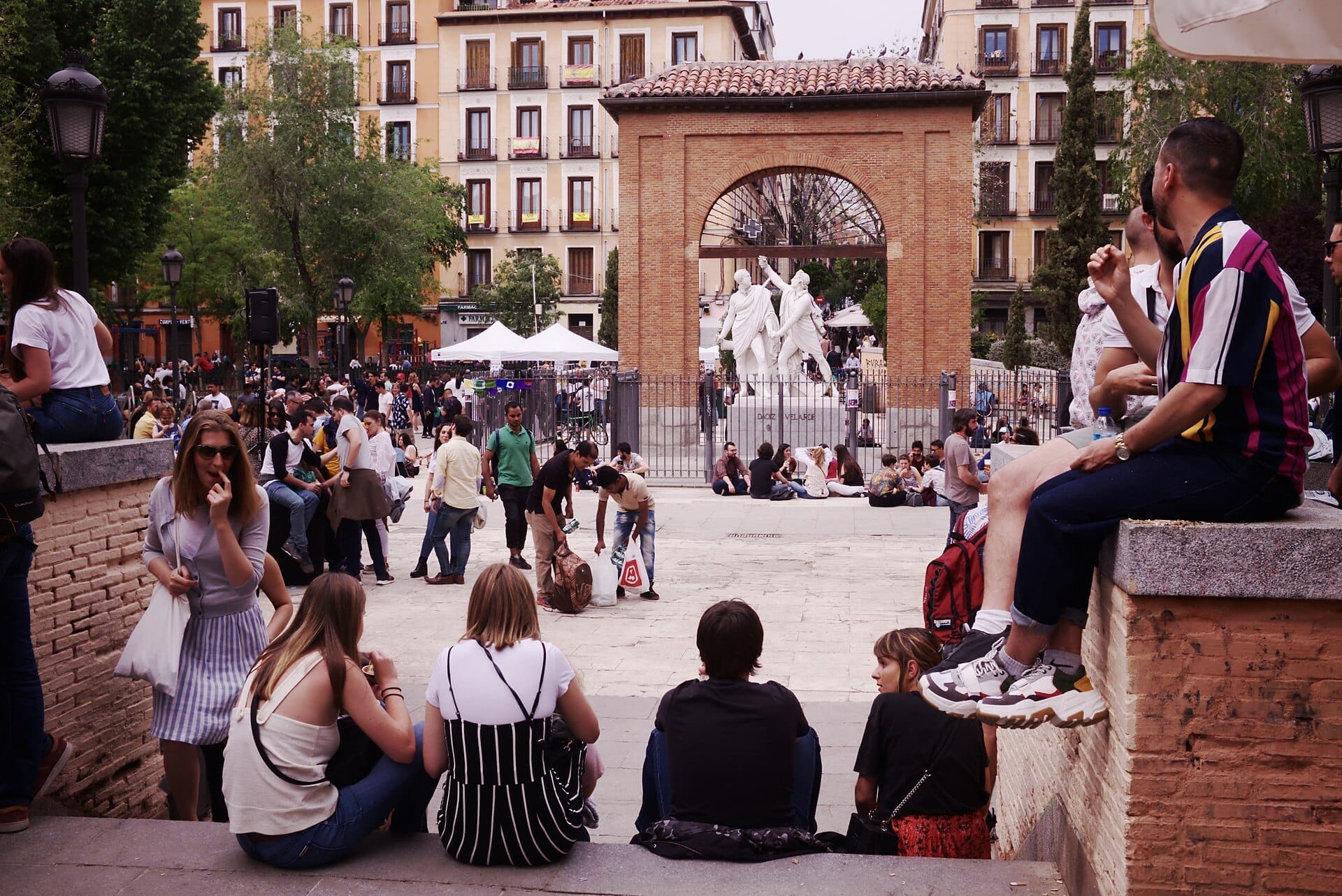
At the center of the plaza stands a monumental brick arch flanked by statues of Daoíz and Velarde. The arch itself is a fragment of the original Monteleón Barracks gateway, preserved deliberately as a physical remnant of the site. It is not a reproduction or a reconstruction. The masonry you see is what remained of the real structure, incorporated into the monument as an authentic relic.
The statues show both captains at the moment of the defense, Daoíz with a cannon, Velarde in a posture of command. The sculptural style is solidly 19th-century academic, prioritizing legibility and heroic clarity over ambiguity. It is not the most artistically daring public sculpture in Madrid, but the emotional directness works well in context. Locals walk past it daily without ceremony, which is itself a kind of tribute: the monument has been absorbed into ordinary life rather than cordoned off for reverence.
💡 Local tip
For the clearest photographs of the arch, come in the morning when the sun is still low and light falls from the east across the brickwork. By midday the square fills with shadow from surrounding buildings on several sides.
How the Square Changes Through the Day
The experience of Plaza del Dos de Mayo shifts considerably depending on when you arrive. In the morning, roughly from 8 to 11 in the summer months, the square has an unhurried domestic quality. Dog owners loop the paths. Older residents occupy the stone benches in the sun. The surrounding bars are setting out chairs and sweeping entrances. The air, at Madrid's elevation of 667 metres, often carries a freshness in the early hours that disappears by noon.
From the early afternoon onward the square transitions. Groups of younger people begin to arrive, particularly in the warmer months, often bringing their own drinks and food to sit on the steps around the monument or on the grass edges. This is a long-established Madrid habit called el botellón in its informal version, the practice of gathering outdoors rather than spending money in bars. On spring and autumn evenings the square can hold a few hundred people easily, the sound building to an even background hum of overlapping conversations.
Late at night, especially on weekends, the square remains occupied well past midnight. Malasaña's bar and music venue scene is concentrated in the streets immediately surrounding the plaza, so foot traffic between venues keeps the square active. It is vibrantly animated rather than performatively so: people are here because they want to be, not because a guidebook sent them.
⚠️ What to skip
If you are sensitive to noise or visit with young children, weekend evenings after 10pm may be overwhelming. The square itself is open, but the surrounding streets narrow the sound considerably. Weekday mornings are the quietest option by a significant margin.
Malasaña as Context
Plaza del Dos de Mayo does not exist in isolation. It is the anchor of a neighborhood that has its own distinct character in Madrid's urban geography. Malasaña was the center of the countercultural movida madrileña movement of the late 1970s and 1980s, the explosion of creative energy that followed the end of the Franco dictatorship. Traces of that era remain in the street art, the independent record shops, the older bars with their original tile interiors. The neighborhood has gentrified considerably since then, but it has not become uniform. You can find a 90-year-old taberna next to a specialty coffee roaster next to a vintage clothing store, all on the same block. For a broader look at what to do across the neighborhood and the city, the Madrid attractions overview is a useful reference.
The streets immediately radiating from the square, particularly Calle del Ruiz, Calle de San Vicente Ferrer, and Calle de Velarde, are worth exploring on foot. Each has a slightly different feel: some tilted toward nightlife, others quieter and more residential. If you are building a day around this area, pair the plaza visit with a walk north toward the Glorieta de Bilbao or south toward Gran Vía, which is about a ten-minute walk downhill.
Accessibility and Practical Notes
The square is accessible by wheelchair via a ramp at the main entrance. The interior paths are paved, though some edges near the monument base have uneven stone surfaces worth noting if mobility is a concern.
There are no facilities inside the square itself: no public toilets, no kiosks, no ticket office. The surrounding bars and cafés provide the practical support structure. Most are open from mid-morning through late night and are accustomed to foot traffic from the plaza. Prices in Malasaña are generally moderate by Madrid standards, lower than in the tourist corridors around Puerta del Sol or the Prado.
Madrid's climate means the square experience varies sharply by season. Summer days regularly exceed 35°C, making midday visits uncomfortable on benches in direct sun. Spring, particularly April and May, offers the best conditions: mild temperatures, longer daylight hours, and the trees in the square are in leaf. For a broader picture of seasonal timing, the best time to visit Madrid guide covers the tradeoffs in detail.
💡 Local tip
Bring water in summer. The square has no water fountain visible at the entrance level, and the heat on stone surfaces can be significant between 12pm and 5pm in July and August.
Insider Tips
- Visit on 2 May itself, the Día de la Comunidad de Madrid, which is a public holiday in the region. The square hosts commemorative events and the atmosphere is noticeably different from any ordinary day.
- The arch's brickwork is original Monteleón Barracks masonry. Look at the wear patterns on the lower courses — they predate the square's 1869 inauguration by at least sixty years.
- For the quietest and most photogenic visit, arrive on a weekday between 8am and 10am in spring or autumn. You will often have the monument largely to yourself with good morning light.
- The bar Café Manuela, a short walk from the square on Calle de San Vicente Ferrer, has an interior that dates to the movida era and is one of the few genuinely intact survivors of that period's design aesthetic. Worth a coffee stop.
- If you are visiting in the evening, note that Malasaña's bars tend to fill from around 9pm onward. The square becomes a natural overflow space between venues, so the energy peaks later than most outdoor spaces in Madrid.
Who Is Plaza de Dos de Mayo For?
- History travelers who want to stand on the actual site of the 1808 uprising, not just read about it in a museum
- Neighborhood explorers using the square as a base for walking Malasaña's independent shops and bars
- Photographers looking for authentic urban Madrid rather than postcard compositions
- Evening visitors who want to experience Madrid's outdoor social culture at its most natural
- Budget travelers: the square is free, the surrounding area is affordable, and there is plenty to observe without spending anything
Nearby Attractions
Other things to see while in Malasaña:
- Centro Cultural Conde Duque
Occupying a former 18th-century royal barracks in the heart of Malasaña, the Centro Cultural Conde Duque is one of Madrid's most architecturally striking public cultural spaces. With around 58,000 m² dedicated to exhibitions, theatre, music, and community events, most of it free to enter, it rewards visitors who go beyond the obvious tourist circuit.
- Mercado de San Ildefonso
Mercado de San Ildefonso on Calle Fuencarral is Madrid's original vertical street food market, spreading across three floors with around 16 to 20 gastronomy stalls, three bars, and two semi-covered terraces. Entry is free. The food costs money, but the atmosphere is part of the deal.
- Museo de Historia de Madrid
Housed in a stunning 18th-century Baroque building in Malasaña, the Museo de Historia de Madrid is one of the capital's most underrated cultural institutions. Free to enter and holding over 60,000 objects, it tells the story of Madrid from its medieval origins to the 20th century through maps, paintings, scale models, photographs, and decorative arts.
- Museo del Romanticismo
The Museo del Romanticismo is Madrid's best-preserved window into 19th-century bourgeois life, housed in a 1776 palace in the Malasaña neighborhood. With original furniture, personal objects, and period paintings arranged as a lived-in home, it rewards slow, curious visitors far more than most of the city's larger institutions.