Bilbao Architecture Guide: Iconic Buildings & Bridges
Bilbao's architectural story spans Gothic old-town churches, grand 19th-century boulevards, and one of the most consequential buildings of the 20th century. This guide covers every major landmark, the best walking routes, seasonal tips, and what to prioritize if your time is limited.
Plan and book this trip
Tools from our partner Travelpayouts help you compare flights and hotels. If you book through them, we may earn a commission at no extra cost to you.
Flights
Hotels map
TL;DR
- Frank Gehry's Guggenheim Museum Bilbao (1997) is the centerpiece of a full riverfront regeneration that reshaped the city's global identity, and remains the building most worth understanding before you arrive.
- The Abandoibarra waterfront concentrates the best modern architecture: the Guggenheim, Iberdrola Tower, Euskalduna Palace, Isozaki Atea Towers, and the Zubizuri footbridge are all within a 15-minute walk.
- Bilbao is not only modern: the Casco Viejo preserves Gothic cathedrals, Baroque churches, and 19th-century iron markets that predate the regeneration by centuries.
- Zubizuri's deck can become dangerously slippery in rain (the original glass surface was replaced). The Guggenheim is open Tuesday to Sunday, generally 10:00 to 19:00 (with extended 20:00 closing on certain summer and holiday dates), with standard adult tickets around €18. Always confirm hours on the official museum website before visiting.
- A self-guided architectural walk from the Old Town to Euskalduna Palace covers 4 km and can be done in 2-3 hours without entering any buildings.
The Guggenheim Effect: How One Building Changed a City
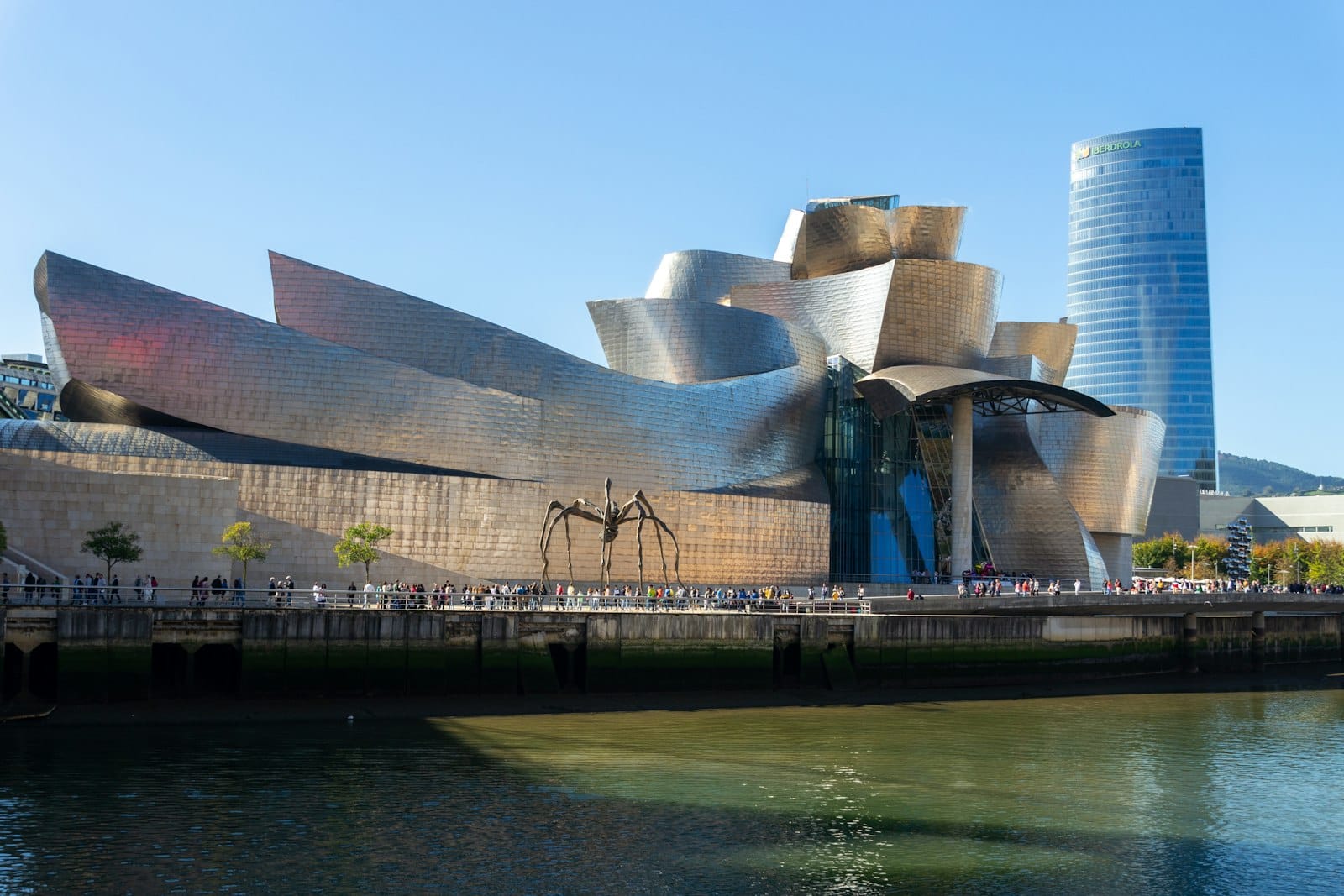
When the Guggenheim Museum Bilbao opened in October 1997, it did something no museum had done before at that scale: it became the primary reason people flew to a city. Designed by Frank Gehry, the building is clad in approximately 33,000 titanium panels that shift color across the day, from silver-grey under cloud to warm gold in direct sun. The form itself is deliberately disorienting: there is no obvious front facade, no clear axis, and the volumes seem to collide rather than resolve.
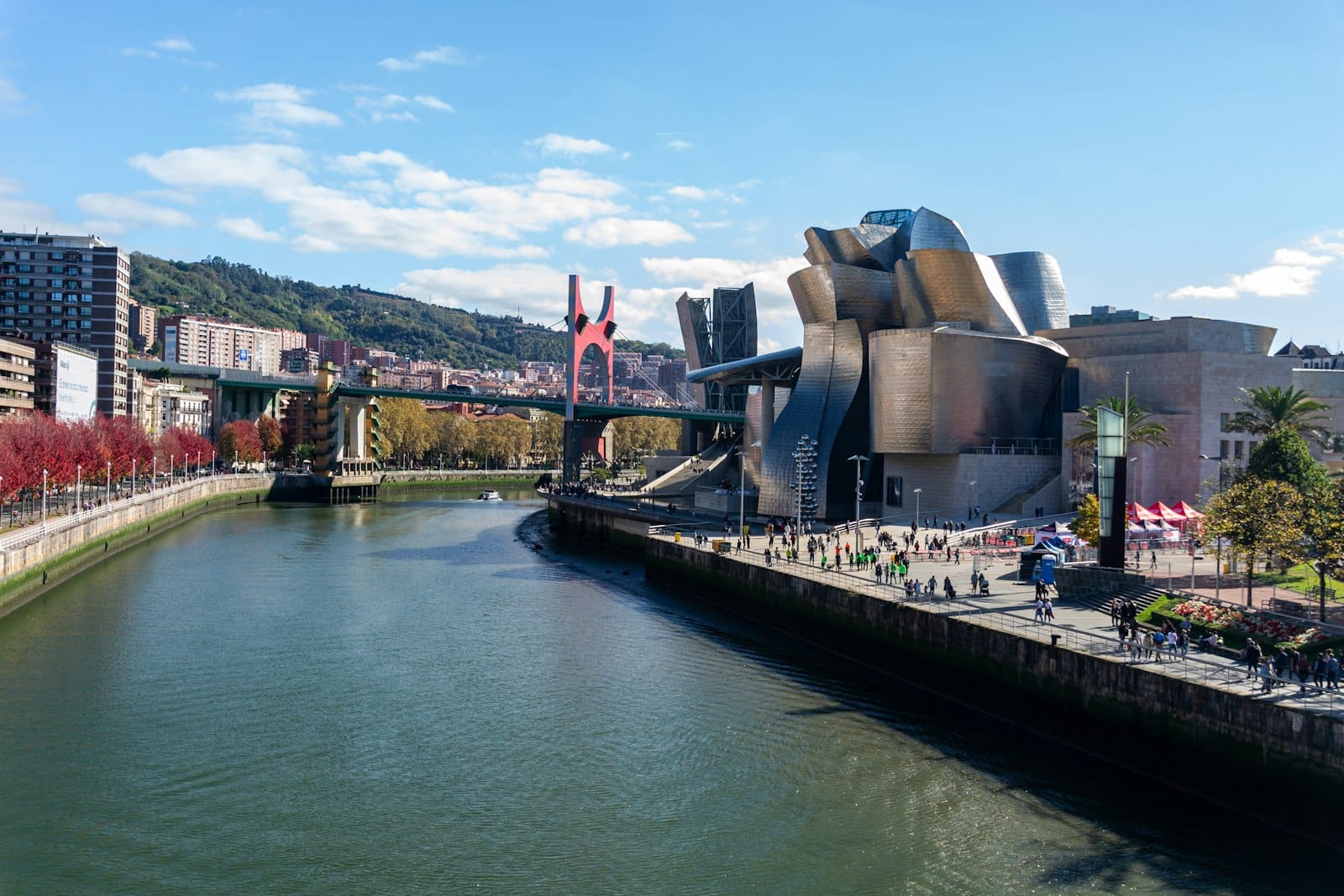
This was not an accident. Gehry designed the building to be experienced in motion, walking around it along the Nervión estuary rather than confronting it from a single fixed viewpoint. The effect is different at every angle. From the riverside promenade to the north, the titanium curtain billows like a sail. From the Salve Bridge to the east, the red-painted arch (added later by Daniel Buren as part of the Arcos Rojos installation) frames the building dramatically. From the Puppy sculpture on the main approach, the full asymmetric complexity of the plan becomes clear.
💡 Local tip
Admission to the Guggenheim exterior, terraces, and riverfront plaza is completely free. You can spend a full hour exploring the building's architecture without buying a ticket. If you do go inside, the atrium — the so-called 'fish' gallery — is architecturally extraordinary even without the art. Book tickets online in advance; the queue for walk-ins can reach 45 minutes on summer weekends.
The Guggenheim's cultural impact is well documented, but its urban impact is equally significant. The site it occupies was previously industrial wasteland: a derelict port area cut off from the city by rail lines and highways. Its construction triggered the full regeneration of Abandoibarra, which now constitutes the most architecturally concentrated stretch of any Spanish city. The building attracted investment, visitors, and — critically — other major architectural commissions. Without the Guggenheim, none of what surrounds it today would exist.
The Abandoibarra Waterfront: A Concentration of Modern Architecture
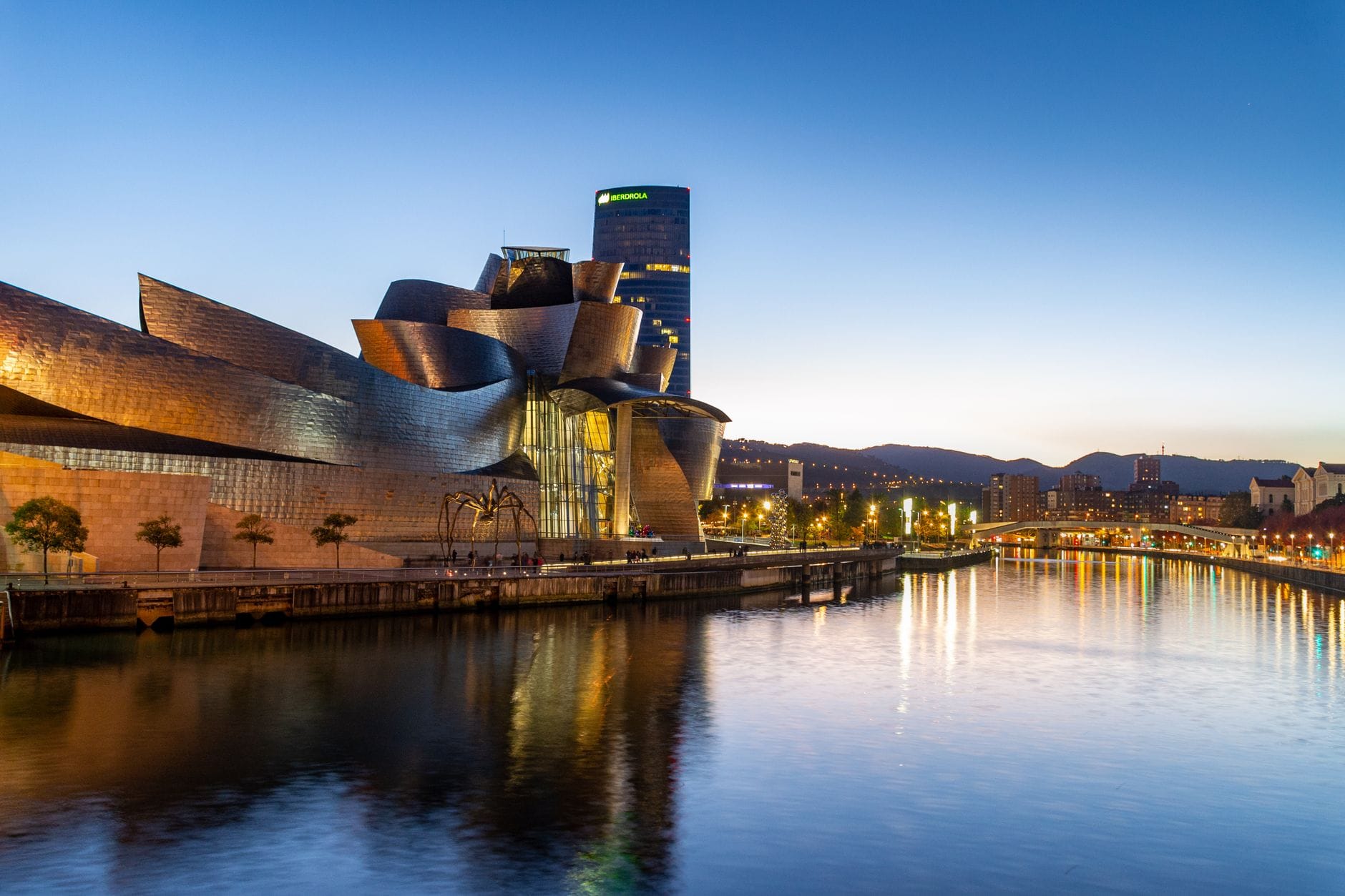
Starting from the Guggenheim and walking southwest along the river toward the Euskalduna district, you encounter the highest density of landmark 20th and 21st-century buildings in the Basque Country. This stretch of approximately 1.5 km was largely developed between 1997 and 2010 and functions as an open-air gallery of contemporary architecture.
- Iberdrola Tower (Torre Iberdrola) Designed by César Pelli and completed in 2011, this 165-meter skyscraper is the headquarters of the energy company Iberdrola and one of the tallest office buildings in Spain. Its glass curtain wall reflects the surrounding sky and changes character entirely depending on the weather. The ground-floor public plaza connects directly to the riverfront promenade.
- Isozaki Atea Towers Twin towers by Japanese architect Arata Isozaki, positioned at the entrance to the Abandoibarra district to form a symbolic urban gate. At around 81 meters each, they are deliberately scaled as a threshold rather than a terminus, framing views toward the Guggenheim from the Gran Vía axis.
- Euskalduna Conference Centre and Concert Hall Opened in 1999 on the site of the last Basque shipyard, designed by Federico Soriano and Dolores Palacios. The building's rusted Corten steel exterior directly references the hull of the final ship built on the site. It now houses the Bilbao Symphony Orchestra and is considered one of the best concert halls acoustically in northern Spain.
- Zubizuri Bridge Santiago Calatrava's white pedestrian arch bridge completed in 1997. The curved walkway connects Abandoibarra to the Indautxu district. Architecturally it is among Calatrava's most refined works; the original glass deck was replaced, though the surface can still be slippery when wet.
- Deusto Bridge (Puente de Deusto) A more recent addition completed in 2009, connecting Abandoibarra to the Deusto neighborhood. Its vertical-lift mechanism is rarely used but visible from the riverfront walk.
⚠️ What to skip
Zubizuri's deck becomes slippery when wet, which in Bilbao's oceanic climate means much of the year. The original glass panels were replaced with a more slip-resistant surface, but several visitors have still slipped and fallen. Wear rubber-soled shoes and exercise caution, particularly in autumn and winter. The bridge has been the subject of formal complaints and modifications to improve grip.
Historic Architecture: What Existed Before the Regeneration
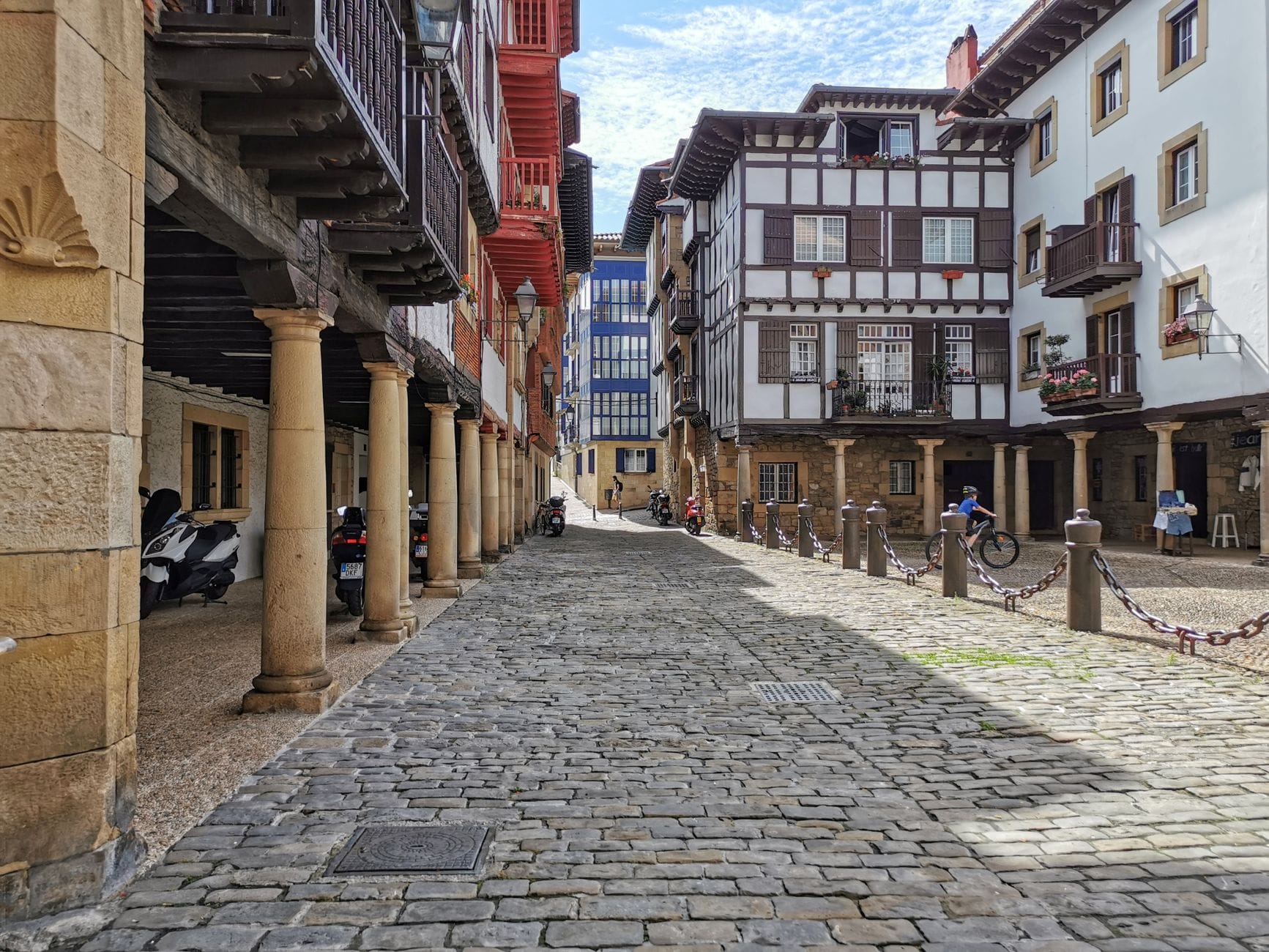
A common mistake is treating Bilbao as a purely modern architecture destination. The city has a documented history stretching back to its founding charter of 1300, and its oldest surviving buildings predate the Guggenheim by six centuries. The Casco Viejo (Old Town), also called the Siete Calles or Zazpikaleak, was declared a Historic-Artistic Monument in 1972. Its narrow medieval grid survives largely intact on the right bank of the Nervión.
The Santiago Cathedral is the most significant Gothic structure in the city, begun in the 14th century and completed with a neo-Gothic spire in the early 20th century. The cloister is architecturally the most interesting part: a 15th-century Gothic arcade that survived the various rebuildings. Entry is low-cost and the interior is modest by Spanish cathedral standards, but it rewards anyone interested in medieval construction. Nearby, the Church of San Nicolás de Bari presents a Baroque facade facing the Arenal riverside square, with twin bell towers that have anchored this view since the 18th century.
The Teatro Arriaga is arguably the finest piece of 19th-century architecture in the city: a neo-Baroque opera house completed in 1890 on the edge of the old town, named after the Bilbao-born composer Juan Crisóstomo de Arriaga. Its ornate exterior is best seen at night when lit. The Mercado de la Ribera is a 1929 Art Deco covered market — reportedly one of the largest indoor markets in Europe by surface area — with a distinctive riverfront facade and stained glass that floods the interior with colored light on bright mornings.
The 19th-century Ensanche district (the grid expansion west of the old town, centered on Gran Vía) offers a different architectural layer again: wide Haussmann-influenced boulevards lined with ornate apartment buildings from the 1880s through the 1930s. The mix of eclecticism, modernisme, and early rationalism gives Gran Vía a character distinct from both the medieval old town and the contemporary waterfront.
The Best Architectural Walking Route in Bilbao
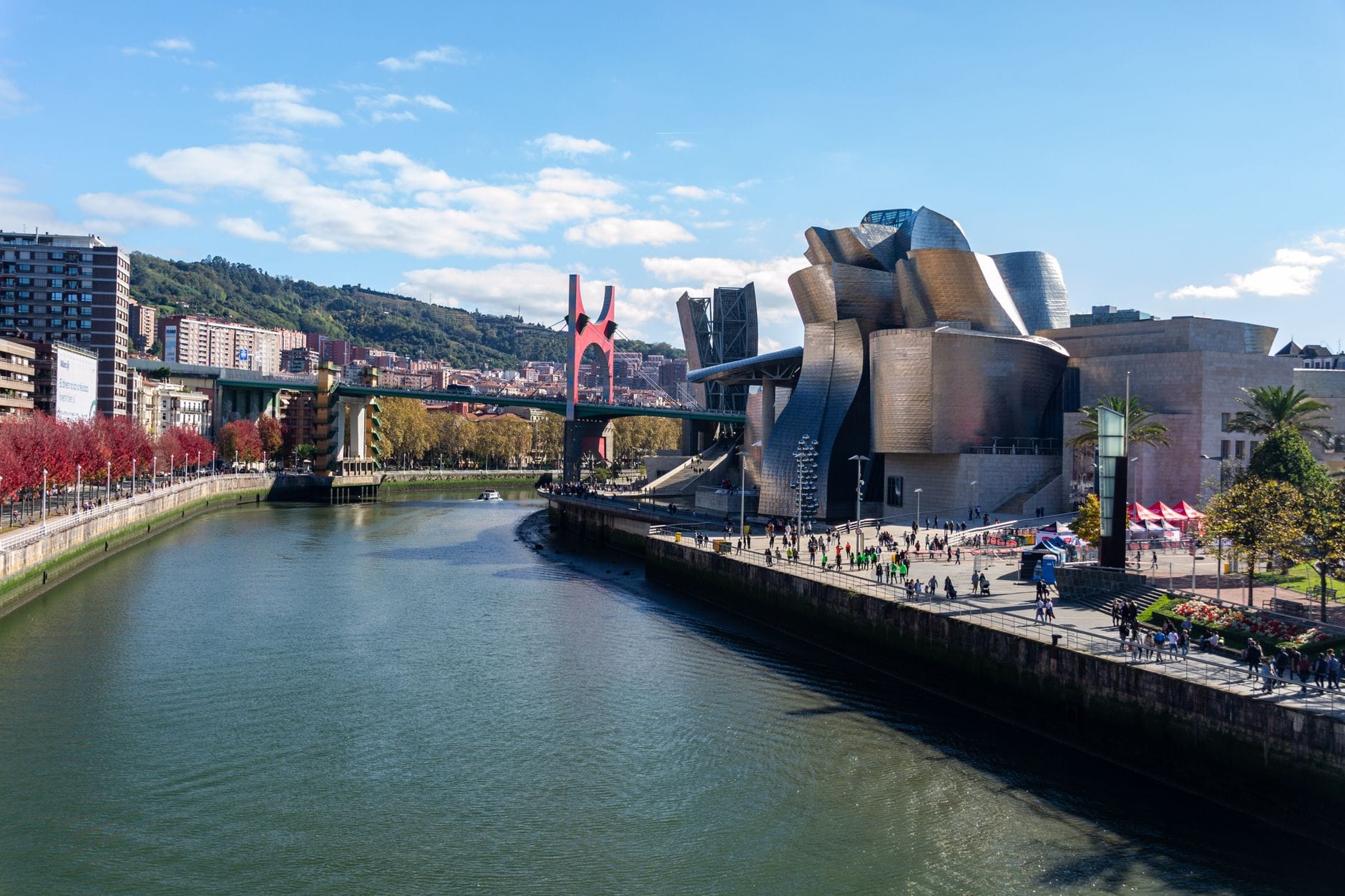
Bilbao's official tourism office publishes a themed walk called 'Down the River Past the Bridges' that covers the main contemporary landmarks. The route described below incorporates that itinerary and extends it to include the historic core, making for a comprehensive 4-kilometer circuit that requires no transport.
- Start: Plaza Nueva, Casco Viejo Begin in the neoclassical arcaded square completed in 1851. From here walk north to the Teatro Arriaga and the Arenal riverside, noting the contrast between Baroque, neoclassical, and the iron Arenal bridge.
- Cross to Abandoibarra via La Salve Bridge Walk west along the river, cross the Salve Bridge (Puente de la Salve), whose red arch installation frames the Guggenheim from above. This is one of the definitive photographs of the building.
- Guggenheim Museum and surroundings Allow 30-60 minutes simply for the exterior circuit: the riverside terrace, Jeff Koons' Puppy sculpture, the Maman spider by Louise Bourgeois, and the water garden. The exterior experience is genuinely different at each cardinal point.
- Iberdrola Tower and Isozaki Atea Continue southwest along the promenade past the Iberdrola Tower base plaza and the twin Isozaki towers. This section of the waterfront was designed by César Pelli's office as an integrated urban landscape, not just individual buildings.
- Zubizuri Bridge Cross the Zubizuri on foot (carefully if wet) and return north along the opposite bank toward the Ensanche, noting the skyline view of the Guggenheim and Iberdrola Tower from the Indautxu side.
- End: Euskalduna Palace Continue southwest to the Euskalduna Conference Centre. The Corten steel exterior and the riverfront sculpture terrace complete the circuit. From here the tram or a short taxi ride returns you to the center.
Seasonal Considerations and Practical Logistics
Bilbao's oceanic climate (humid, mild, and frequently wet) has direct consequences for architectural sightseeing. Summer (June to August) offers the best conditions for the outdoor waterfront walk, with temperatures in the low-to-mid 20s Celsius and statistically lower rainfall. That said, even July sees rain, so a waterproof layer is always sensible.
Winter visits are entirely workable for architecture. The Guggenheim, Euskalduna, and the Mercado de la Ribera are all indoor experiences, and the titanium facade of the Guggenheim has a particular character under grey winter light that many photographers prefer to the summer glare. The winter guide to Bilbao covers this in more detail, but the short version is: bring rain gear and prioritize indoor venues for the middle of the day, saving the waterfront walk for any dry windows.
✨ Pro tip
The Guggenheim's titanium panels photograph best on partly cloudy days with intermittent sun — the shifting light creates the full range of the material's tonal variation. Full overcast flattens the surface; direct midday sun bleaches it. Early morning on a partly cloudy summer day, roughly 10:00 to 11:30, tends to give the best results from the riverside terrace.
The Guggenheim is open Tuesday through Sunday, generally 10:00 to 19:00, with Monday closures except on certain public holidays and during the high summer season when hours extend to 20:00. Standard adult admission is around €18, though this changes periodically — always check the official Guggenheim Bilbao website before visiting. If you are planning a focused architecture trip, consider combining the Guggenheim with the Museo de Bellas Artes nearby, which is housed in a more conventional but architecturally interesting early 20th-century building beside the Doña Casilda park.
What Overrated and What Is Underrated
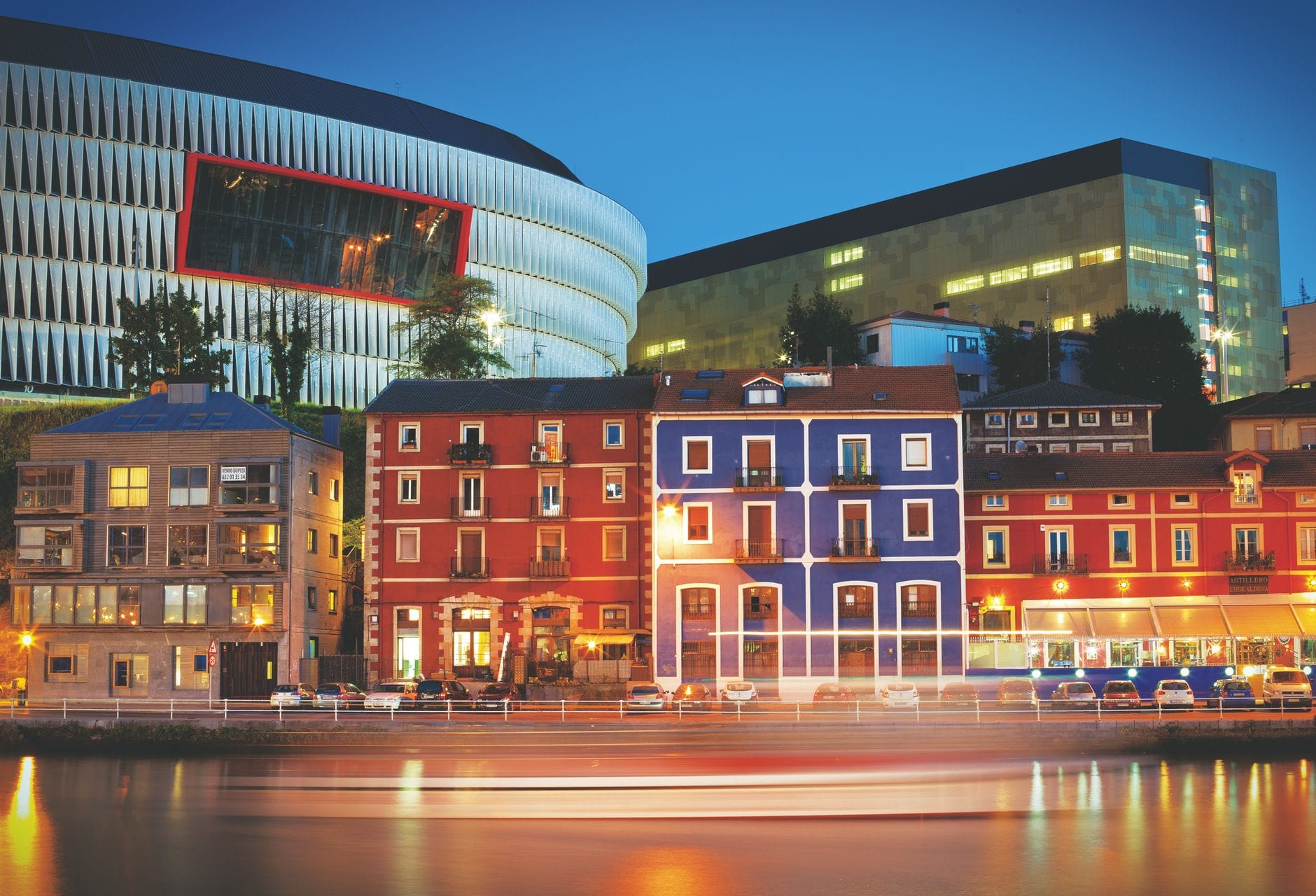
Most architecture guides to Bilbao spend 80% of their space on the Guggenheim and mention everything else in passing. That emphasis is partially justified — Gehry's building really is in a different category from everything around it — but it leads visitors to underestimate what else is worth attention.
The Euskalduna Palace is consistently underrated by international visitors and consistently admired by architects. The Corten steel hull metaphor is carried through to interior details, and the acoustic quality of the main concert hall is exceptional. If there is an evening performance during your visit, the building is worth experiencing from inside for that reason alone, independent of the program.
The Mercado de la Ribera is underrated for architecture specifically: most visitors treat it as a food destination (correctly) without noticing the 1929 Art Deco structure, the stained glass, or the three-level river facade. Arrive before 10:00 on a weekday to see it without the pintxos-bar crowd and look up. The pintxos culture is the draw for most people, but the building itself is architecturally significant.
What is overrated: the Zubizuri bridge gets disproportionate attention relative to its actual architectural quality. It is elegant and photogenic, but Calatrava has produced more interesting bridges elsewhere. In Bilbao it functions primarily as a photographic subject and a connecting element between districts rather than as a destination in itself. See it, cross it, but do not build an itinerary around it.
ℹ️ Good to know
Bilbao's architectural regeneration is studied in urban planning programs globally under the label 'the Bilbao Effect' — the idea that a single landmark cultural building can trigger broader urban and economic transformation. Whether this model is replicable or was specific to Bilbao's circumstances remains debated by urbanists. What is not debated is that Bilbao itself is transformed: a city that was internationally associated with heavy industrial decline in the 1980s is now among the most architecturally significant medium-sized cities in Europe.
FAQ
Who designed the Guggenheim Museum Bilbao?
Frank Gehry, the Canadian-American architect, designed the Guggenheim Museum Bilbao. It opened in October 1997 and is widely regarded as one of the most important buildings of the 20th century. The titanium-clad structure was developed using CATIA software, then a novel application of aerospace design technology to architecture.
Can you see the Guggenheim Bilbao without paying admission?
Yes. The exterior, riverfront terraces, surrounding plaza, and public sculptures (including Jeff Koons' Puppy and Louise Bourgeois' Maman) are freely accessible at all times. You only need a ticket to enter the building itself. Many visitors spend an hour or more exploring the exterior for free, which is architecturally substantive in its own right.
How long does the Abandoibarra architectural walk take?
The core waterfront stretch from the Guggenheim to the Euskalduna Palace is about 1.5 km and takes around 30-40 minutes at a steady pace with brief stops. Adding the Casco Viejo historic buildings at one end and allowing time at each landmark extends a complete circuit to 2-3 hours. The Bilbao tourism office also publishes a guided version of this route called 'Down the River Past the Bridges'.
What is the best time of year to visit Bilbao for architecture?
For outdoor architecture sightseeing, May through September offers the most reliable weather, with warmer temperatures and statistically lower rainfall. However, the Guggenheim's titanium facade photographs particularly well on partially overcast days common in shoulder seasons. Winter is viable for those prioritizing indoor venues. Avoid August weekends if crowds at the Guggenheim are a concern, as this is peak tourist season coinciding with local festival periods.
Is Bilbao worth visiting only for the Guggenheim?
The Guggenheim alone justifies a visit for anyone with serious architectural interest, but it would be a narrow trip. Bilbao has a complete architectural narrative spanning Gothic (Santiago Cathedral), Baroque (San Nicolás church), 19th-century neoclassicism and eclecticism (Ensanche, Teatro Arriaga), Art Deco (Mercado de la Ribera), and a full suite of late 20th and early 21st-century landmarks. A two-day architecture-focused visit can be structured without repetition.