Guggenheim Museum Bilbao: What to Expect Before You Go
Frank Gehry's titanium-clad masterpiece on the Nervión River isn't just Bilbao's most famous building — it's the reason the city reinvented itself. This guide covers the architecture, the permanent collection, crowd patterns, and everything a first-time or returning visitor needs to know.
Quick Facts
- Location
- Abandoibarra Etorbidea, 2, 48009 Bilbao — Abandoibarra waterfront, beside La Salve Bridge
- Getting There
- Metro: Moyua (L1/L2), approx. 10-minute walk. Tram: Guggenheim stop (Euskotren Tranbia)
- Time Needed
- 2–4 hours for the collection; allow extra time for the exterior and surroundings
- Cost
- Adults €18; students 18–26 and seniors €9; under 18 free. Closed most Mondays. Check guggenheim-bilbao.eus
- Best for
- Contemporary art, architecture, photography, design lovers, and anyone visiting Bilbao for the first time
- Official website
- www.guggenheim-bilbao.eus/en
Why This Building Changed Everything
The Guggenheim Museum Bilbao opened on 18 October 1997, inaugurated by King Juan Carlos I, and within a few years had generated enough international attention to coin a term: the 'Bilbao Effect.' The idea was simple and radical: a post-industrial port city, scarred by decades of steel and shipbuilding decline, bet its future on a single building. It worked. The museum, designed by Canadian-American architect Frank O. Gehry, drew visitors who had never thought to come to the Basque Country. They came for the building and stayed for the city.
That transformation is now visible all around the museum. The Abandoibarra district where it sits was once a functioning industrial port. Today it is a continuous waterfront promenade, with the Guggenheim at its center, flanked by the Euskalduna Concert Hall downstream and the green expanse of the Doña Casilda Park a few blocks inland. Understanding this context helps you read the building's intent: it was never just a museum. It was urban surgery.
The Building Itself: Reading the Architecture
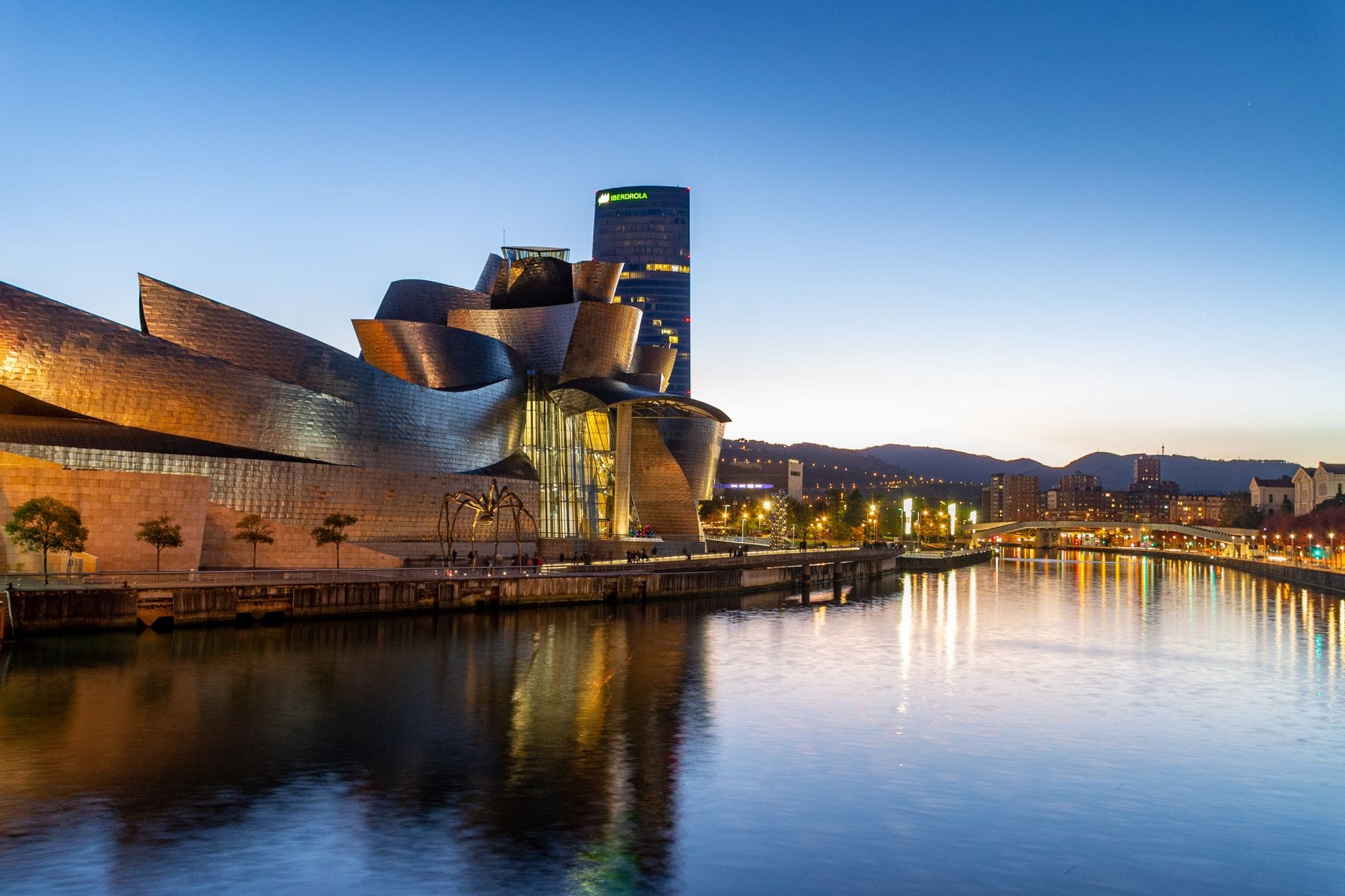
The Guggenheim Museum Bilbao covers approximately 24,000 square meters in total, with around 11,000 square meters dedicated to exhibition space across three interconnected floors. Gehry used titanium panels — over 33,000 of them — for the exterior cladding. Titanium was chosen partly for its light weight and its capacity to hold color: on overcast northern Spanish days, the panels shift between silver, grey, and a dim gold. On rare sunny mornings, the surface appears to move.
The building's shapes are not arbitrary. Gehry described the design as fish-scale forms referencing Bilbao's maritime identity. Up close, you notice the panels are not flat but slightly curved and irregular, creating an effect closer to organic matter than industrial construction. The limestone sections of the building — flatter, more muted — serve as deliberate contrast, grounding the metallic chaos into something compositionally legible.
💡 Local tip
Photography tip: The best exterior light falls on the river-facing facade in the late morning, when the titanium panels catch the northern Spanish sun at a low angle. The reflection pool in front of the building mirrors the curves above — worth framing carefully.
Inside, three levels connect via curved walkways, glass elevators, and open staircases. The central atrium rises 50 meters and is the clearest illustration of Gehry's spatial ambition: it is designed for the experience of being inside a building. The galleries branch off from this central void in ways that feel exploratory — you turn corners and encounter different scales, different ceiling heights, different relationships to light.
Tickets & tours
Hand-picked options from our booking partner. Prices are indicative; availability and final rates are confirmed when you complete your booking.
Bilbao walking tour
From 16 €Instant confirmationFree cancellationAll Iron Bilbao tour: Athletic Club and Guggenheim Museum
From 107 €Instant confirmationFree cancellationGuggenheim Museum Bilbao entrance ticket and in-app audio tour
From 0 €Instant confirmationFull-day tour to Biarritz, Bayonne and Saint-Jean-de-Luz from Bilbao
From 69 €Instant confirmationFree cancellation
The Collection and What You'll Actually See
The permanent collection spans 20th- and 21st-century art, with an emphasis on large-scale works that exploit the museum's generously sized galleries. Richard Serra's 'The Matter of Time' occupies the enormous Ground Floor Gallery 104 — a suite of curved steel structures that visitors physically walk through. The experience is disorienting in a deliberate way: the steel walls tower several meters high, the floor curves, and spatial perception shifts. It is one of the most immersive sculpture experiences in any European museum.
Rotating temporary exhibitions cycle through the upper galleries and frequently attract significant loans from international institutions. The mix of permanent and temporary shows means repeat visitors will find new content, but also that the core experience around Serra and the building itself remains consistent. Check the museum's exhibition schedule before planning — occasionally a major temporary show fills spaces that are otherwise part of the permanent route.
If contemporary art is your primary interest rather than architecture, consider pairing this visit with the Museo de Bellas Artes de Bilbao, a few minutes' walk away, which covers Basque and Spanish art from the 12th century onward. The two museums together represent a full picture of visual culture in this region.
When to Go: Crowd Patterns and Time of Day
The museum opens at 10:00 Tuesday through Sunday and is closed most Mondays. Tuesday mornings tend to be the quietest periods, with school groups more common on weekday late mornings. Weekend afternoons between 12:00 and 15:00 draw the largest crowds, particularly in July and August. If you arrive at opening on a Tuesday or Wednesday, the Serra hall is often near-empty, which transforms the experience: you can hear the steel creak faintly in temperature changes, and your own footsteps echo across the curved floor.
Bilbao's climate is oceanic and rainy for much of the year, which affects the exterior experience significantly. On wet days, the titanium panels shift to a darker, more subdued tone, and the reflection pool disappears under ripples. This is not necessarily worse — the building reads differently in grey weather, more industrial and deliberate. The interior, naturally lit through skylights and glass walls, is bright enough on all but the darkest winter days.
⚠️ What to skip
Opening hours: Tuesday–Sunday from 10:00; closed most Mondays (exceptions may apply in summer and holiday periods). Always verify the current schedule at guggenheim-bilbao.eus before visiting, especially around public holidays.
For a broader sense of when Bilbao is worth visiting overall, the best time to visit Bilbao guide covers seasonal tradeoffs in detail. The museum itself is a year-round destination — the quality of the experience does not depend heavily on season the way outdoor attractions do.
Getting There and Practical Navigation
The most direct metro option is Moyua station, served by Lines 1 and 2, approximately a 10-minute walk from the museum along the Alameda de Mazarredo. The Euskotren Tranbia tram has a stop called Guggenheim directly on the riverfront, which deposits you within 100 meters of the entrance — useful if you are coming from the Casco Viejo direction or the main rail stations.
The museum is fully accessible, with glass elevators connecting all three levels alongside the curved walkways and staircases. For more on getting around Bilbao efficiently, the getting around Bilbao guide covers the metro, tram, and Barik card in detail.
Book tickets online in advance, particularly for weekends in summer and for major temporary exhibitions. The museum website offers timed-entry tickets that bypass the box office entirely. Audio guides are available for rent at the museum; the app-based guide is also worth downloading before arrival if you want deeper context on specific works.
Outside the Entrance: Puppy, Maman, and the Waterfront
Two sculptures flank the museum and have become as recognizable as the building itself. Jeff Koons' 'Puppy' (1992/1997) — a 12-meter West Highland Terrier covered in flowering plants — sits on the terrace facing the city. The floral coating changes seasonally, maintained by the museum's horticultural team. It is routinely photographed by people who haven't paid for admission and have no intention of entering. Louise Bourgeois' 'Maman' (1999) — a 9-meter steel spider — stands near the water's edge, its bronze egg sac visible beneath the abdomen. Both works are free to view from the public promenade.
The riverfront walkway continues in both directions from the museum. Upstream, the Zubizuri Bridge — another piece of architectural set dressing, designed by Santiago Calatrava — is a 10-minute walk east. The route along the water, past the outdoor sculptures and across the pedestrian bridges, gives the Abandoibarra district its coherence as a planned urban landscape rather than a collection of individual landmarks.
What Disappoints Some Visitors
The Guggenheim Museum Bilbao is not the right museum for everyone. If your primary interest is classical European painting, Old Masters, or historical art before the 20th century, this is not the collection for you — and that is not a criticism of the museum, simply an accurate description of its scope. Visitors who come expecting a broad survey of art history will feel the collection is thin relative to the ticket price.
Some visitors, particularly those not engaged with contemporary art, find that the building itself is the actual exhibition and the art inside plays a secondary role. That reading is not entirely wrong. If you are comfortable spending 45 minutes outside the building and another 45 inside — focused primarily on the Serra installation and the Gehry architecture — you will leave satisfied. If you need a full afternoon of richly contextualised art across centuries, adjust expectations accordingly or extend your Bilbao museum itinerary.
ℹ️ Good to know
The museum restaurant, Nerua, holds a Michelin star and requires a separate reservation. The ground-floor café is more accessible for a coffee or light lunch during your visit.
Insider Tips
- The tram stop named Guggenheim drops you on the river side of the building, which means your first view of the museum is the water-facing facade — the most dramatic angle. If you take the metro to Moyua instead, you approach from the city side and miss this reveal. Use the tram for arrival, metro for departure.
- The Richard Serra hall (Gallery 104) is enormous enough that even on busy days you can find relative quiet inside one of the curved steel tunnels. Move to the innermost curves of the taller ellipses — other visitors tend to cluster at the entrances.
- Free entry days exist for Bilbao residents, but the museum also periodically offers reduced or free admission for specific visitor categories. Check the museum website's 'Plan your visit' section for current concessions — student and under-26 discounts can be significant.
- The reflection pool in front of 'Puppy' is shallow and children frequently wade in on warm days. The museum does not actively stop this, but the floor is uneven — worth knowing if you have small children with you.
- For the best panoramic view of the building's full scale, cross to the opposite bank of the Nervión via the La Salve Bridge and look back. Most photographs of the Guggenheim are taken from river level or the entrance plaza; the elevated view from across the water shows the full massing of the titanium forms against the hills behind the city.
Who Is Guggenheim Museum Bilbao For?
- First-time visitors to Bilbao for whom the Guggenheim is the primary reason for the trip
- Architecture and design enthusiasts who want to read a building as closely as any artwork inside it
- Contemporary art collectors and gallery-goers who want to see the Serra installation in context
- Photographers working in urban or architectural subjects — the building offers exterior compositions at almost any time of day
- Travelers on a short Bilbao itinerary who want a single landmark that anchors the city's identity
Nearby Attractions
Other things to see while in Abandoibarra:
- Euskalduna Conference Centre and Concert Hall
The Euskalduna Conference Centre and Concert Hall stands on the Abandoibarra riverfront as one of Bilbao's most significant post-industrial buildings. Inaugurated in 1999, it combines a world-class auditorium with a striking design that pays tribute to the shipyard that once occupied the same ground. Whether you are attending a symphony concert, an opera production, or simply walking the waterfront, this building rewards attention.
- Itsasmuseum Bilbao (Maritime Museum)
Built on the bones of the Euskalduna shipyard, Itsasmuseum Bilbao traces the industrial and seafaring history that shaped this Basque city. With a site covering roughly 27,000 m² that combines indoor galleries and outdoor quayside space, historic vessels on the water, and general admission at €10 (reduced €5; under 18 free), it rewards visitors who want more than the Guggenheim's titanium curves.
- Puppy (Jeff Koons)
Standing over 12 metres tall and covered in thousands of flowering plants, Jeff Koons' Puppy has guarded the entrance of the Guggenheim Museum Bilbao since 1997. Viewing it costs nothing, it is accessible at any hour of the day, and it remains one of Bilbao's most recognisable works of public art.
- Zubizuri Bridge
Designed by Santiago Calatrava and completed in 1997, the Zubizuri is a free pedestrian bridge spanning the Nervión River in Bilbao's Campo Volantín and Uribitarte area. Its sweeping white arch and curved deck have made it one of the most photographed structures in the Basque Country, and a key landmark of the city's remarkable urban transformation.