Euskalduna Conference Centre and Concert Hall: Bilbao's Architectural Landmark on the Waterfront
The Euskalduna Conference Centre and Concert Hall stands on the Abandoibarra riverfront as one of Bilbao's most significant post-industrial buildings. Inaugurated in 1999, it combines a world-class auditorium with a striking design that pays tribute to the shipyard that once occupied the same ground. Whether you are attending a symphony concert, an opera production, or simply walking the waterfront, this building rewards attention.
Quick Facts
- Location
- Avenida Abandoibarra 4, Abandoibarra district, Bilbao
- Getting There
- Moyua Metro station (Lines 1 & 2), plus Bilbao tram stop at Euskalduna
- Time Needed
- 30–45 min for exterior and foyer; 2–3 hours for a full concert or event
- Cost
- Free to view exterior; event tickets priced per performance — check official site
- Best for
- Architecture lovers, classical music fans, waterfront walkers, cultural evenings
- Official website
- www.euskaldunabilbao.com/en
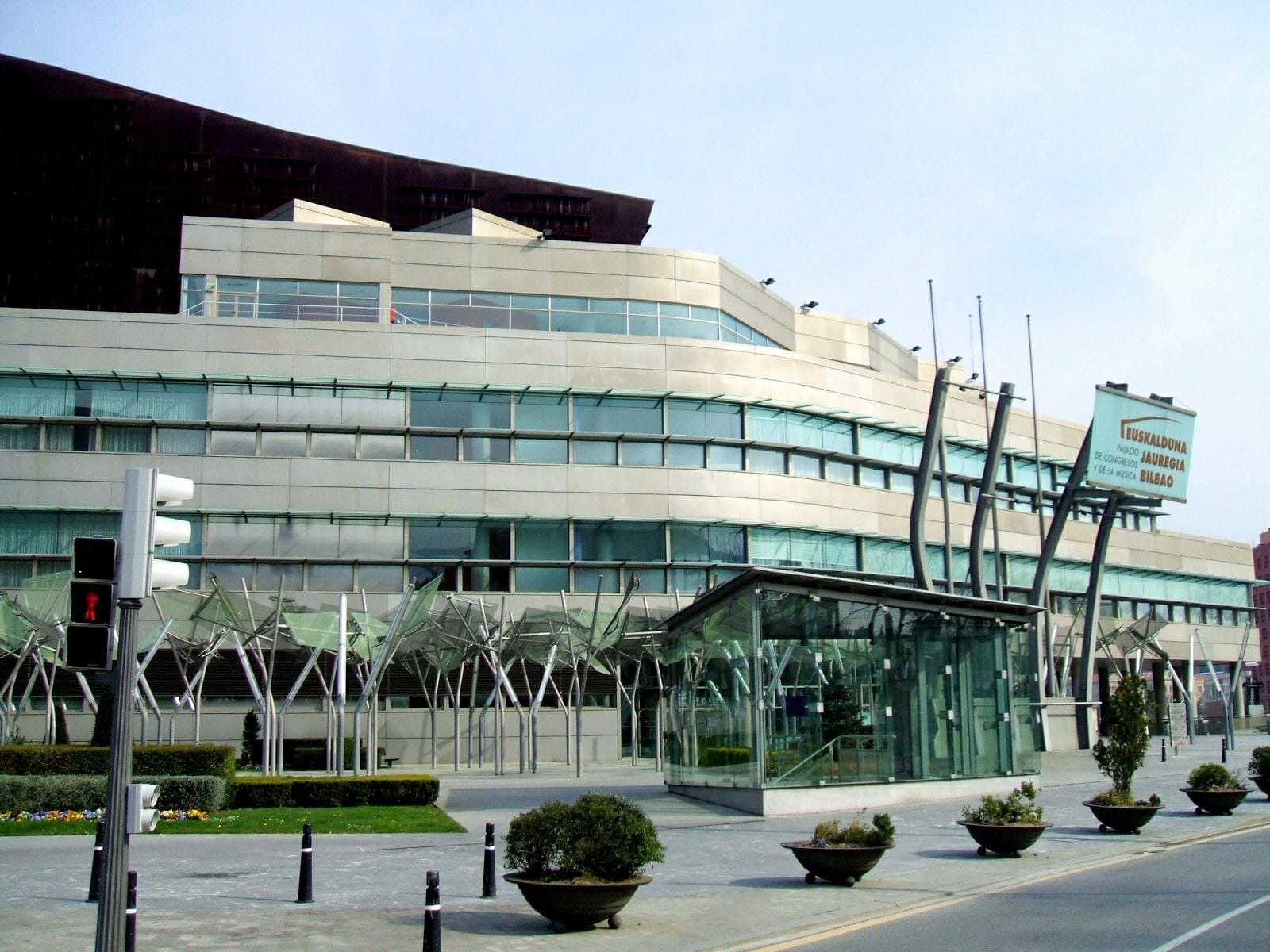
A Building That Remembers Its Past
The Euskalduna Conference Centre and Concert Hall is not trying to look like a concert hall. That is precisely the point. Designed by architects Federico Soriano and Dolores Palacios and inaugurated on 19 February 1999, the building was conceived as a direct architectural response to the site it occupies: part of the former Euskalduna shipyard area beside the Estuary of Bilbao in Bilbao's Abandoibarra district.
The shipyard closed in the 1980s, a casualty of the same industrial collapse that gutted large sections of Bilbao's economy. When the city began reimagining its derelict waterfront in the 1990s, this site was earmarked for culture and civic life. The architects answered with a structure whose rusted-iron cladding, angular deck-like terraces, and layered steel surfaces deliberately evoke the last ship that could have been built there. The result is a building that feels like it has been pulled from the estuary rather than placed beside it.
That industrial memory is deliberate and worth understanding before you arrive. The Euskalduna does not stand in isolation either: it sits within the broader Abandoibarra regeneration corridor, a ten-minute walk upriver from the Guggenheim Museum Bilbao, sharing a waterfront that also includes the Iberdrola Tower, public gardens, and the Zubizuri footbridge. Together, these form the physical evidence of Bilbao's widely studied urban transformation.
What the Building Looks and Feels Like
Approach from the riverside promenade and the Euskalduna reads as a horizontal mass: long, low, and clad in Corten steel panels that have weathered to deep amber and brown. The surface texture is deliberately rough — the kind of industrial patina you associate with old dock structures, not performing arts venues. Up close, the steel panels catch the light differently depending on the time of day and the cloud cover typical of Bilbao's Atlantic climate.
Morning visits, especially under the diffuse grey light that characterises the city for much of the year, emphasise the building's mass and its horizontal relationship with the water. In late afternoon, when the sun drops low over the estuary, the Corten panels shift from brown to something close to copper, and the building becomes significantly more photogenic. Evening, when the venue is lit for performances, is the third reading entirely: the glass facades glow, and the foyer activity visible from outside gives the whole structure a different, warmer energy.
💡 Local tip
Photography tip: The best exterior angles are from the riverside promenade to the south and from the Zubizuri bridge looking upriver. Evening, when the building is lit for a performance, gives the most compelling shots.
The main entrance leads into a large glazed foyer that spans multiple levels. Inside, the scale is immediately apparent: the complex covers approximately 58,000 square metres, and the foyer itself is generously proportioned, with views back out to the estuary. The interior circulation is designed for large crowds moving between conference halls, meeting rooms, and the main auditorium. Even when no event is running, the foyer communicates the ambition of the building.
Tickets & tours
Live prices and dates from our booking partner. If you book, we may earn a commission at no extra cost to you.
Escape Tour self-guided, interactive city challenge in Bilbao
From 30 €Instant confirmationEscape Tour self-guided, interactive city challenge in Bilbao
From 30 €Instant confirmationSan Juan de Gaztelugatxe guided tour from Bilbao
From 65 €Instant confirmationFree cancellationSan Sebastian, Hondarribia, Hendaye, and Getaria from Bilbao
From 54 €Instant confirmationFree cancellation
The Auditorium: Bilbao's Premier Classical Music Venue
The main auditorium seats 2,164 people and is the home venue of the Bilbao Orkestra Sinfonikoa (BOS), the city's symphony orchestra. Acoustically, the hall was designed as a serious concert space, not a multipurpose room with acoustic compromises. The interior finishes — warm wood panelling, angled side walls, a carefully proportioned ceiling — reflect this intent.
Opera, ballet, and major touring productions also appear in the programme alongside the symphony season. The scale of the auditorium is appropriate for grand productions without feeling cavernous: sight lines from the upper tiers are good, and the hall's shape keeps the audience reasonably close to the stage for most seating positions. If you are attending a concert here, arrive a few minutes early to walk the foyer levels before the doors open — the pre-concert atmosphere is part of the experience.
Ticket pricing varies considerably by event and seat category. Check the official Euskalduna website for the current programme and book in advance for popular performances. The symphony season and major opera productions frequently sell out well ahead of time. For context on how Bilbao's cultural scene fits together, the best museums and cultural venues in Bilbao guide covers the broader landscape.
The Abandoibarra Waterfront: Setting and Surroundings
The Euskalduna sits at the western end of the Abandoibarra strip, the section of Bilbao's waterfront that was most radically transformed from the late 1990s onward. Walking east from the building along the riverside promenade takes you past public sculptures, the Guggenheim's iconic titanium curves, and toward the Zubizuri bridge, Santiago Calatrava's white pedestrian arc that has become one of the city's most photographed structures.
The neighbourhood context matters for visitors who are deciding how to structure their time. Abandoibarra is not a residential area in the traditional sense: it is a purpose-built cultural and commercial strip with relatively little street-level life outside of event times and weekend afternoons. The Abandoibarra district is best experienced as part of a longer waterfront walk rather than as a stand-alone destination, especially if no event is scheduled at the Euskalduna.
ℹ️ Good to know
On weekday mornings when no major conference is scheduled, the area around the Euskalduna is very quiet. If you are visiting purely for the architecture, a weekend afternoon or an evening with a performance in progress will give you a more complete picture of how the building functions.
Getting There and Practical Logistics
The most straightforward public transport option is Metro Bilbao to Moyua station (Lines 1 and 2), followed by a ten-minute walk west along the riverside promenade. The Bilbao tram (Euskotren Tranbia) also serves the Abandoibarra area and stops closer to the venue at the Euskalduna stop. Multiple Bilbobus city bus lines pass through the district as well.
If you are arriving from elsewhere in the Basque Country or from the airport, check connections via the getting around Bilbao guide for current route and fare information. The Barik smart card covers metro, tram, and Bilbobus travel at discounted fares compared to single tickets, and is worth picking up if you plan to use public transport more than once.
Underground parking is available beneath the building with direct internal access, which is useful for evening events when you want to avoid the walk from a metro station in Bilbao's often rainy weather. The city's Atlantic climate means rain is genuinely possible at any time of year, so a waterproof layer is practical regardless of season.
Accessibility: the Euskalduna is a modern, purpose-built venue with lifts, step-free internal circulation, and large foyer spaces. For specific event accessibility requirements — adapted seating, assisted listening systems, wheelchair spaces — contact the venue directly before booking, as provision varies by configuration.
Is It Worth Visiting Without a Ticket?
If you have a strong interest in architecture or in Bilbao's urban renewal story, yes. The exterior is genuinely distinctive and rewards slow observation rather than a quick glance. The building occupies a pivotal position in the sequence of landmarks along the Abandoibarra waterfront, and understanding its industrial reference points deepens your reading of the entire district.
For visitors with limited time in Bilbao who are not attending an event, the Euskalduna is best treated as a stop on a longer waterfront walk rather than a primary destination. A two-day itinerary in the city would reasonably include it as part of the Abandoibarra route without dedicating a separate block of time to it. See the 2 days in Bilbao itinerary for a practical sequence.
Those who should consider skipping a dedicated visit: if your priorities are food, the old town's pintxos bars, or beach access, the Euskalduna will not add much to your trip without an event booking. The building's interior is not open for general visiting, and the foyer, while impressive, is not a museum or exhibition space.
⚠️ What to skip
There are no fixed general visiting hours. The building is an active event venue. If you want to see the interior, you need a ticket to a performance or conference. Check the official website for the current programme before your trip.
Architecture in Context: Bilbao's Broader Building Story
The Euskalduna is one part of a larger architectural narrative that reshaped Bilbao from the late 1990s onward. The Guggenheim, completed in 1997, is the most famous element of that story, but the full architecture guide to Bilbao traces how the city used major public buildings, bridges, and infrastructure projects to reinvent its identity after deindustrialisation.
What the Euskalduna adds to that story, specifically, is the idea that reinvention need not mean erasure. Where the Guggenheim imports an entirely foreign visual language, the Euskalduna insists on remembering what stood here before. The Corten rust, the shipyard silhouette, the industrial scale of the foyer: these are deliberate acts of architectural memory on a site that could easily have become just another glass tower. Whether or not that distinction interests you as a casual visitor, it is why architects and urban planners continue to cite the building in discussions of post-industrial regeneration.
Insider Tips
- The BOS (Bilbao Orkestra Sinfonikoa) season runs from autumn through spring. Tickets for mid-week performances are often easier to obtain than weekend shows and occasionally available at short notice. Check the official site the week of your visit.
- The riverside terrace on the south face of the building is publicly accessible even without an event ticket. It offers one of the better elevated views along the Abandoibarra waterfront, particularly in the late afternoon.
- If you arrive early for an evening performance, the upper-level foyer bar fills slowly and offers a quieter space to observe the building's interior volumes before the pre-concert crowd density increases significantly.
- The Corten steel exterior photographs best in flat, overcast light — which Bilbao provides reliably. Harsh midday sun bleaches the colour from the panels and flattens the texture. Dull mornings and golden-hour evenings are the two best conditions.
- Conference and event schedules are published well in advance on the official website. If your travel dates coincide with a major international congress, the surrounding streets and the building itself will be noticeably busier, which affects both access and the feel of the waterfront walk.
Who Is Euskalduna Conference Centre and Concert Hall For?
- Architecture and design enthusiasts interested in post-industrial regeneration
- Classical music and opera attendees looking for a world-class auditorium
- Waterfront walkers combining the Guggenheim-to-Euskalduna riverside route
- Travellers with a specific interest in Bilbao's urban transformation story
- Evening cultural outings — the building at night, lit for a performance, is a different and more dramatic experience than a daytime exterior visit
Nearby Attractions
Other things to see while in Abandoibarra:
- Guggenheim Museum Bilbao
Frank Gehry's titanium-clad masterpiece on the Nervión River isn't just Bilbao's most famous building — it's the reason the city reinvented itself. This guide covers the architecture, the permanent collection, crowd patterns, and everything a first-time or returning visitor needs to know.
- Itsasmuseum Bilbao (Maritime Museum)
Built on the bones of the Euskalduna shipyard, Itsasmuseum Bilbao traces the industrial and seafaring history that shaped this Basque city. With a site covering roughly 27,000 m² that combines indoor galleries and outdoor quayside space, historic vessels on the water, and general admission at €10 (reduced €5; under 18 free), it rewards visitors who want more than the Guggenheim's titanium curves.
- Puppy (Jeff Koons)
Standing over 12 metres tall and covered in thousands of flowering plants, Jeff Koons' Puppy has guarded the entrance of the Guggenheim Museum Bilbao since 1997. Viewing it costs nothing, it is accessible at any hour of the day, and it remains one of Bilbao's most recognisable works of public art.
- Zubizuri Bridge
Designed by Santiago Calatrava and completed in 1997, the Zubizuri is a free pedestrian bridge spanning the Nervión River in Bilbao's Campo Volantín and Uribitarte area. Its sweeping white arch and curved deck have made it one of the most photographed structures in the Basque Country, and a key landmark of the city's remarkable urban transformation.
Planning a trip? Discover personalized activities with the Nomado app.