Itsasmuseum Bilbao: What to Expect at the Maritime Museum of the Nervión Estuary
Built on the bones of the Euskalduna shipyard, Itsasmuseum Bilbao traces the industrial and seafaring history that shaped this Basque city. With a site covering roughly 27,000 m² that combines indoor galleries and outdoor quayside space, historic vessels on the water, and general admission at €10 (reduced €5; under 18 free), it rewards visitors who want more than the Guggenheim's titanium curves.
Quick Facts
- Location
- Muelle Ramón de la Sota, 1, 48013 Bilbao — Abandoibarra riverfront
- Getting There
- Tram: Euskalduna stop (Euskotren Tranbia). Metro: San Mamés (L1/L2), 10-min walk
- Time Needed
- 1.5 to 2.5 hours for indoor galleries; add 30–45 min for the outdoor dry dock
- Cost
- General €10 / Reduced €5 / Under 18 free. Tuesdays free for Bizkaia residents only; Sundays from 17:00 free for the general public
- Best for
- History lovers, families with older children, architecture fans, rainy-day visits
- Official website
- www.itsasmuseum.eus/en
What Itsasmuseum Bilbao Actually Is
Itsasmuseum Bilbao — formally the Museo Marítimo Ría de Bilbao — opened in 2003 on the site of the old Euskalduna shipyard, an industrial heart of a city long tied to shipbuilding and maritime trade. The name is a hybrid of Basque ('itsas' means sea) and English, a small but deliberate signal that the museum sees itself as part of a wider Atlantic maritime community. It sits on the Abandoibarra waterfront, the same regenerated corridor that gave Bilbao the Guggenheim and the Euskalduna Concert Hall, yet it draws a fraction of those crowds.
The building was designed by architect Juan Francisco Paz and covers more than 3,000 m² of enclosed gallery space. What sets the museum apart from comparably sized maritime institutions is its outdoor component: a dry dock and open-air quay that form part of a total site of roughly 27,000 m². Historic vessels float directly in the Nervión estuary alongside the museum, visible from the quayside without paying a euro.
💡 Local tip
Tuesdays are free for Bizkaia residents only. Sundays from 17:00 are free for the general public. If your schedule is flexible, a weekday morning visit — ideally before noon — is usually the least crowded window across the week.
The Site's Industrial Past: Why It Matters
The Euskalduna shipyard operated from the late 19th century until 1984, when its closure became one of the defining moments of Bilbao's long industrial decline. Workers occupied the yard in protest for months, a standoff that entered Basque collective memory. Building a museum to the sea and the estuary on the exact ground where those ships were assembled is not a neutral act — it is an acknowledgment that this waterway made Bilbao what it is.
The Nervión and Ibaizabal rivers converge to form the estuary that carried Bilbao's iron ore, coal, steel, and finished ships to global markets for over a century. By the time the Guggenheim opened in 1997, the river was heavily polluted and economically dormant. Itsasmuseum frames that full arc: the estuary as trade route, as industrial artery, and, now, as an urban amenity.
Understanding this context makes the museum far more rewarding. If you want background on the broader transformation of the city before your visit, the Bilbao architecture guide explains how Abandoibarra went from scrapyard to cultural quarter in less than three decades.
Tickets & tours
Live prices and dates from our booking partner. If you book, we may earn a commission at no extra cost to you.
San Juan de Gaztelugatxe guided tour from Bilbao
From 65 €Instant confirmationFree cancellationSan Sebastian, Hondarribia, Hendaye, and Getaria from Bilbao
From 54 €Instant confirmationFree cancellationGaztelugatxe and Mundaka small group guided tour from Bilbao
From 50 €Instant confirmationFree cancellationBilbao walking tour
From 16 €Instant confirmationFree cancellation
Inside the Galleries: What You Will Actually See
The indoor exhibitions are spread across a single main building with interconnected halls. The layout is intuitive: you move roughly chronologically, from the earliest navigational history of the estuary through the boom years of iron and steel shipbuilding and into the 20th-century transformation of the port. Signage is in Basque, Spanish, and English throughout.
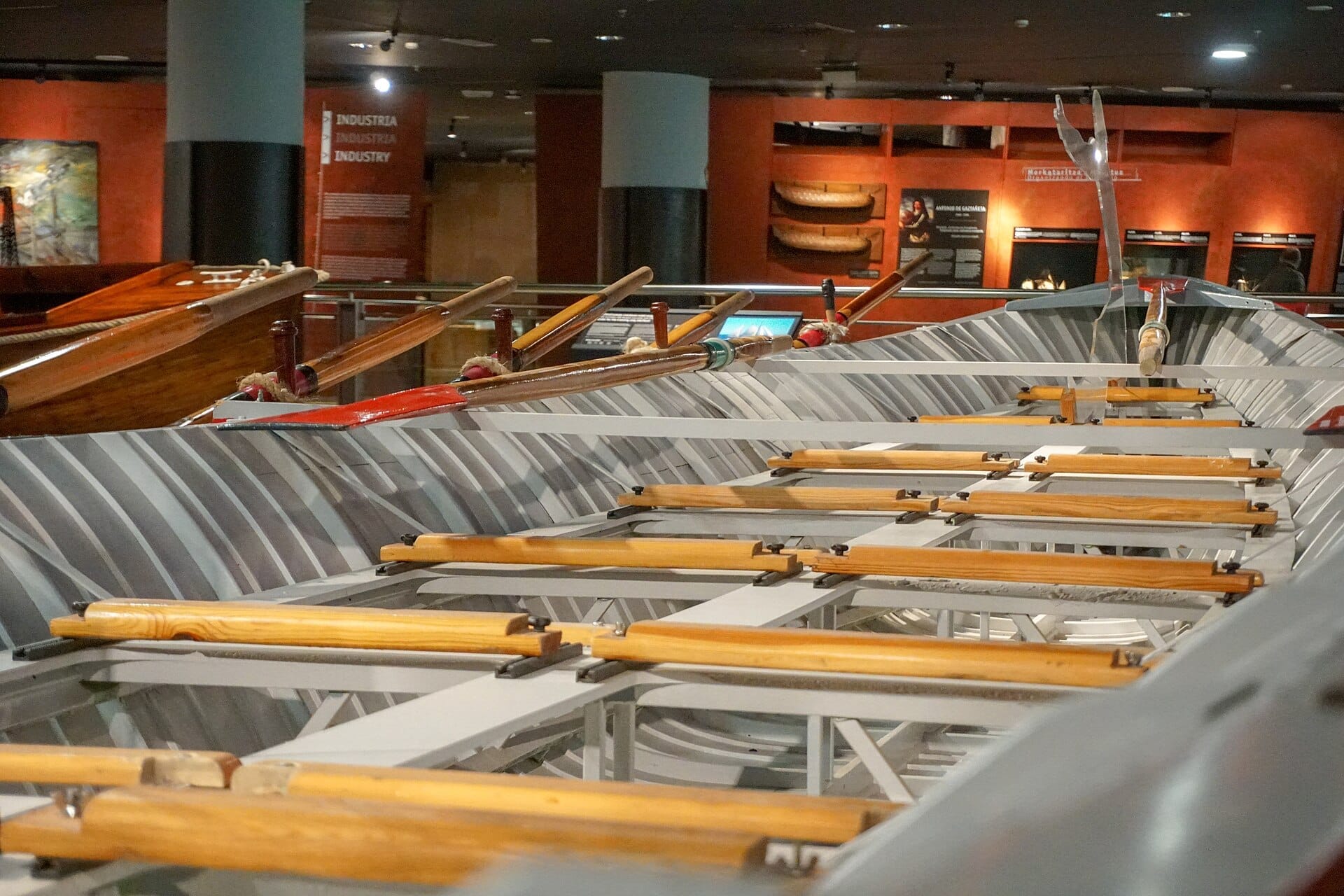
Scale models are a recurring device — some large enough to require a full step back to appreciate — and they are used well, showing not just individual ships but the physical geography of the estuary at different historical moments. Navigation instruments, original charts, and shipbuilding tools fill the cases with the kind of tactile specificity that separates a serious maritime museum from a decorative one. The smell inside is faintly metallic near the sections that incorporate original industrial equipment; it suits the subject.
A dedicated section addresses fishing culture along the Basque coast, connecting the estuary to the open Atlantic. Whaling history, cod fishing in Newfoundland, and the deep-sea traditions of the Basque fleet are covered with enough depth to surprise visitors who associate this coast only with pintxos bars. Audioguides are available and provide additional commentary that the panel texts alone do not always cover.
ℹ️ Good to know
The museum opens Tuesday to Sunday, 11:00–19:00. It is closed on Mondays, except when Monday falls on or precedes a public holiday, in which case regular hours apply. Always confirm on the official website before visiting.
The Outdoor Dry Dock: The Most Distinctive Part of the Visit
The outdoor area is where Itsasmuseum most clearly separates itself from conventional museum experiences. The preserved dry dock is a cavernous concrete basin that once held ships during construction and repair. Standing at its edge on a grey northern morning, with the smell of the estuary and the distant hum of the city behind you, the scale of what once happened here registers differently than any exhibit panel can achieve.
Historic vessels are moored along the quay in the actual water. The lineup changes over time as the museum acquires, restores, and loans vessels, so confirm what is currently on display. Past exhibits have included tugboats, a dredger, and traditional fishing craft of the type that worked these waters for generations. Children tend to gravitate here immediately and are absorbed by the vessels in a way that the indoor galleries do not always sustain.
Photography is excellent in the outdoor area. The combination of industrial architecture, river reflections, and vintage vessels makes for compelling images at almost any light level. Morning light from the east hits the water well; afternoon visits offer softer, diffused light that suits the weathered surfaces of the boats.
⚠️ What to skip
The outdoor sections are exposed to the weather. Bilbao's oceanic climate means rain is possible year-round. Bring a waterproof layer if you plan to spend serious time on the quay, especially between October and April.
Practical Walkthrough: Getting There and Around
The museum is on Muelle Ramón de la Sota, directly beside the Euskalduna Bridge. The easiest approach on foot from the city centre takes about 15 minutes along the riverfront promenade from the Guggenheim, which makes the two museums natural companions on the same half-day. From the Guggenheim, simply follow the river upstream (west) along the south bank.
By public transport, the Euskotren Tranbia tram stops at Euskalduna, a two-minute walk from the entrance. Metro users should alight at San Mamés on Lines 1 or 2 and walk roughly 10 minutes toward the river. Both options are covered by the Barik rechargeable card, which reduces fares compared to buying single tickets. For broader orientation around the city, the getting around Bilbao guide covers all transport modes in detail.
Parking exists nearby but the Abandoibarra area fills quickly on weekends and during events at the adjacent Euskalduna Concert Hall. Public transport or walking from a central hotel is the practical choice.
Accessibility
The museum includes dedicated accessible areas, and the main building is generally step-free. The outdoor quayside has some uneven surfaces typical of waterfront industrial heritage sites, so visitors with mobility requirements should check current conditions with the museum directly before arrival. Audioguides are available at the reception desk.
How It Fits Into a Wider Bilbao Itinerary
Itsasmuseum works particularly well as a second museum stop paired with the Guggenheim Museum Bilbao, which is a 15-minute riverside walk away. The contrast is instructive: the Guggenheim deals in the global contemporary art world; Itsasmuseum deals in the specific, material history of the city those galleries replaced. Doing them in sequence, Itsasmuseum first, gives the industrial past a chance to inform the architectural spectacle that followed.
If maritime and industrial heritage interests you more broadly, the Euskal Museoa in Casco Viejo covers Basque ethnographic history from an entirely different angle, and the two complement each other well across a full day. For families considering the museum as part of a longer trip, Bilbao with kids has broader suggestions for child-friendly stops in the city.
The museum café provides a functional stop for coffee and light food. The gift shop stocks nautical-themed items, books on Basque maritime history, and some design objects that are a cut above the usual museum fare — worth a look before leaving.
Who Should Skip It (and Who Should Not)
Visitors on a single day in Bilbao who must choose between this and the Guggenheim should choose the Guggenheim — it is simply one of the world's great buildings and art experiences, and that hierarchy is worth acknowledging. Itsasmuseum is not in that league for visual drama or international recognition.
That said, anyone with two or more days, an interest in industrial or maritime history, or a desire to understand what Bilbao actually was before the titanium arrived will find it rewarding. It is also one of the better rainy-day options in the city: the covered galleries are extensive, the subject matter holds attention, and the €10 general admission (or free on Sunday from 17:00) is a reasonable ask on the waterfront.
Visitors seeking a pure art experience or those with very young children who cannot engage with display cases and scale models may find the indoor sections slow. The outdoor area, however, tends to land well with almost any age group willing to brave the weather.
Insider Tips
- Tuesday free admission applies to Bizkaia residents only. For everyone else, Sundays from 17:00 are free. Arrive at opening (11:00) on a quieter weekday morning and the galleries are often nearly empty for the first hour.
- Walk the full length of the outdoor quay before entering the building. The view from the far end of the dry dock, looking back toward the city skyline and the Euskalduna Bridge, is one of the better urban panoramas in this part of Bilbao and costs nothing.
- The museum's auditorium hosts occasional lectures, film screenings, and events related to maritime and Basque cultural themes. Check the events calendar on the official site before your trip — a coinciding programme can significantly deepen the visit.
- If you are combining this with the Guggenheim, do Itsasmuseum first, in the morning. The Guggenheim's interior is best experienced with afternoon light coming through the atrium, and you avoid the midday crowds at both venues.
- The Euskalduna Concert Hall directly next door has a striking exterior by architects Federico Soriano and Dolores Palacios — it is worth a slow walk around the building's perimeter even if you are not attending a performance.
Who Is Itsasmuseum Bilbao (Maritime Museum) For?
- History and industrial heritage enthusiasts who want context behind Bilbao's transformation
- Families with children aged 7 and above, particularly for the outdoor vessels and dry dock
- Travellers on a second or third day in Bilbao looking beyond the headline attractions
- Rainy-day visitors needing substantive indoor programming at a reasonable price
- Photography-minded visitors interested in industrial architecture and working waterfront aesthetics
Nearby Attractions
Other things to see while in Abandoibarra:
- Euskalduna Conference Centre and Concert Hall
The Euskalduna Conference Centre and Concert Hall stands on the Abandoibarra riverfront as one of Bilbao's most significant post-industrial buildings. Inaugurated in 1999, it combines a world-class auditorium with a striking design that pays tribute to the shipyard that once occupied the same ground. Whether you are attending a symphony concert, an opera production, or simply walking the waterfront, this building rewards attention.
- Guggenheim Museum Bilbao
Frank Gehry's titanium-clad masterpiece on the Nervión River isn't just Bilbao's most famous building — it's the reason the city reinvented itself. This guide covers the architecture, the permanent collection, crowd patterns, and everything a first-time or returning visitor needs to know.
- Puppy (Jeff Koons)
Standing over 12 metres tall and covered in thousands of flowering plants, Jeff Koons' Puppy has guarded the entrance of the Guggenheim Museum Bilbao since 1997. Viewing it costs nothing, it is accessible at any hour of the day, and it remains one of Bilbao's most recognisable works of public art.
- Zubizuri Bridge
Designed by Santiago Calatrava and completed in 1997, the Zubizuri is a free pedestrian bridge spanning the Nervión River in Bilbao's Campo Volantín and Uribitarte area. Its sweeping white arch and curved deck have made it one of the most photographed structures in the Basque Country, and a key landmark of the city's remarkable urban transformation.
Planning a trip? Discover personalized activities with the Nomado app.