Zubizuri Bridge: Bilbao's Calatrava Masterpiece on the Nervión
Designed by Santiago Calatrava and completed in 1997, the Zubizuri is a free pedestrian bridge spanning the Nervión River in Bilbao's Campo Volantín and Uribitarte area. Its sweeping white arch and curved deck have made it one of the most photographed structures in the Basque Country, and a key landmark of the city's remarkable urban transformation.
Quick Facts
- Location
- Paseo de Campo Volantín, Bilbao (links the right bank to Uribitarte on the left bank of the Nervión)
- Getting There
- Tram: Uribitarte or Guggenheim stop (Euskotren Tranbia); Metro: Moyúa (Lines 1 & 2) or Abando, both within walking distance
- Time Needed
- 15–30 minutes to cross and photograph; 1 hour if combining with a riverside walk
- Cost
- Free — open public infrastructure, no ticket required
- Best for
- Architecture lovers, photographers, walkers, and anyone doing the Abandoibarra riverside route
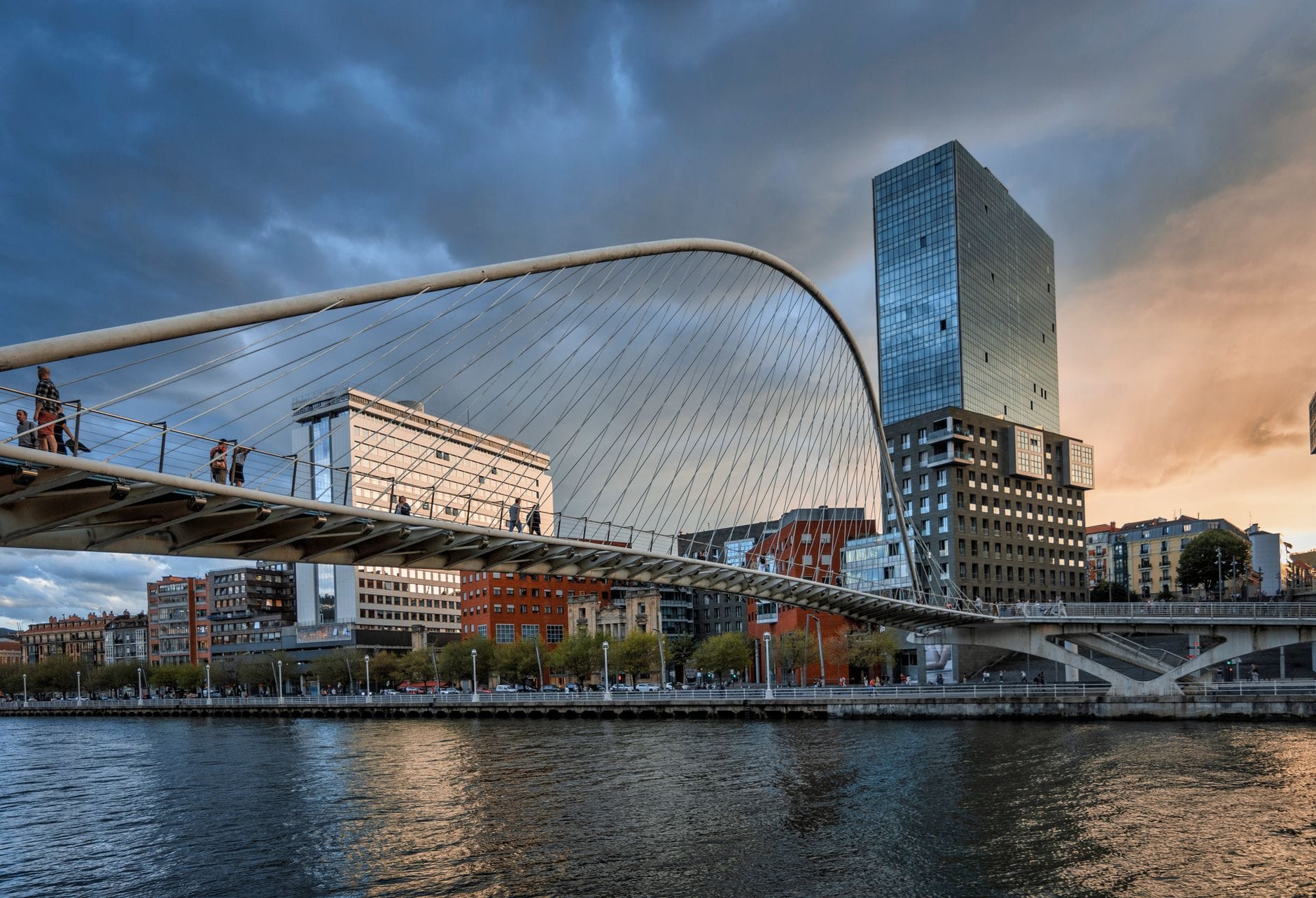
What Is the Zubizuri Bridge?
The Zubizuri — Basque for 'white bridge' — is a tied-arch pedestrian bridge spanning the Nervión River in central Bilbao. Also known as the Puente del Campo Volantín, it was designed by Spanish-Swiss architect Santiago Calatrava, with the project awarded in 1994 and the bridge inaugurated in 1997. It stretches approximately 75 metres across the river, connecting the Paseo Campo Volantín on the right bank with the Paseo de Uribitarte on the left.
The structure belongs to a generation of landmark civic projects commissioned during Bilbao's post-industrial reinvention in the 1990s — the same era that brought the Guggenheim Museum Bilbao and the Euskalduna Concert Hall to the waterfront. The Zubizuri wasn't a trophy project added as an afterthought: it was part of a deliberate effort to reconnect the two banks of the Nervión for pedestrians, improving daily life while making a visual statement about the city's ambitions.
💡 Local tip
The bridge is open 24 hours a day, every day of the year, and is completely free to access. There is nothing to book or queue for.
The Architecture: What Calatrava Built Here
The Zubizuri is a single inclined arch bridge. The arch itself tilts outward at an angle over the river, supported by a network of white steel cables that fan down to the curved, enclosed deck below. From a distance, particularly from upstream or from the opposite bank, the silhouette reads as something between a harp and a sail — taut, white, and cleanly geometric against the grey-green water of the Nervión.
The deck is roughly 6.5 to 7.5 metres wide and sits around 8.5 metres above the river surface. The original walking surface was glass — translucent curved panels intended to catch and scatter light. In practice, the glass proved problematic: it became slippery in wet weather, which is a significant issue in a city with Bilbao's rainfall. The original glass panels were eventually replaced with a more slip-resistant material.
The ramp addition caused its own controversy. Calatrava famously objected to the extension that connects the bridge to a nearby building, arguing it altered his design without consent — a dispute that drew significant attention in architectural circles. The later addition of a covered lateral ramp for accessibility changed the visual flow at the Campo Volantín approach. It's worth knowing this history when you arrive: the slight awkwardness at one end of the bridge is not accidental imperfection but the trace of a genuine architectural and legal dispute.
Tickets & tours
Hand-picked options from our booking partner. Prices are indicative; availability and final rates are confirmed when you complete your booking.
Biscay Bridge, Gaztelugatxe and txakoli tasting small group tour
From 40 €Instant confirmationFree cancellationBiscay Bridge, Gaztelugatxe and txakoli wine tasting from Bilbao
From 50 €Instant confirmationFree cancellationSan Juan de Gaztelugatxe guided tour from Bilbao
From 65 €Instant confirmationFree cancellationSan Sebastian, Hondarribia, Hendaye, and Getaria from Bilbao
From 54 €Instant confirmationFree cancellation
The Experience on the Bridge: Time of Day Matters
Walking the Zubizuri takes about three minutes end to end, but most people slow down considerably once they reach the mid-span. From the centre of the bridge, you get an unobstructed view along the Nervión in both directions: upstream toward the older city bridges and the neighbourhood of Deusto, downstream toward the Guggenheim's titanium curves visible between the buildings on the left bank. The sound is a constant low hum of city traffic softened by the distance from the roads, occasionally broken by a tram crossing the embankment below.
Early morning — before 8:00 — is when the bridge shows its best light. The water catches the soft Atlantic morning sun at a low angle, and the white arch and cables reflect cleanly. Almost no one else is around except the occasional commuter crossing quickly. The deck surface is cool underfoot and the metal handrails are cold to the touch. It feels like a private viewing of something that usually belongs to crowds.
At midday, particularly in summer, the bridge draws a steady flow of tourists and walkers doing the Abandoibarra riverside route between the Guggenheim and Casco Viejo. It can feel genuinely crowded at the mid-span. Evening is the other strong option: the bridge has integrated lighting that illuminates the cables and arch from below after dark, giving it a theatrical quality. On clear evenings, the reflection in the Nervión is close to mirror-perfect.
⚠️ What to skip
The deck surface can be slippery when wet, and Bilbao is a rainy city. Wear footwear with grip, especially outside the summer months. The bridge has no roof.
The Abandoibarra Context: A Neighbourhood Built Around Ambition
The Zubizuri doesn't stand alone. It sits in the middle of the Abandoibarra district, a former industrial and port zone that was essentially rebuilt from scratch during the 1990s and 2000s. The Guggenheim was the anchor project, but the riverfront transformation included new parks, pedestrian promenades, tram lines, and bridges — of which the Zubizuri is the most architecturally significant.
Walking the riverside from the bridge toward the museum takes about ten minutes along a well-maintained promenade. Along the way you pass the Puppy sculpture outside the Guggenheim and the Maman spider sculpture before reaching the main entrance. In the other direction, toward Casco Viejo, the walk takes you past the Arriaga Theatre and the old town's river frontage. The Zubizuri acts as a geographic midpoint on this axis and is the most logical place to pause and orient yourself.
For a more complete picture of how Bilbao transformed itself through architecture, the Bilbao architecture guide covers the full set of landmark projects from this era, including the Euskalduna Concert Hall, the Azkuna Zentroa, and the metro stations designed by Norman Foster.
Photography: Getting the Shot
The Zubizuri is one of the most photographed structures in Bilbao, and for good reason: it has a clean, graphic form that works in almost any light. The best exterior shots are taken from the riverside promenades on either bank, ideally at water level near the embankment steps. From the Uribitarte side (left bank), you get the arch framed against the older residential buildings of the right bank. From the Campo Volantín side, you look across to the modern riverbank with the arch in the foreground.
For reflection shots, calm evenings after rain are ideal: the water surface is usually still enough to produce a near-perfect mirror image of the arch and cables. Wide-angle lenses work well for showing the full span and surrounding context. From mid-bridge looking down at the deck, the curved geometry of the walkway and the pattern of the cables creates strong geometric compositions. Photographing upward from inside the arch, toward the sky through the cable network, is a shot almost every visitor ends up attempting.
💡 Local tip
For the cleanest architectural shots with minimal people, arrive before 8:00 AM. The bridge sees heavy foot traffic from mid-morning onward on most days.
Practical Walkthrough: Getting There and Around
The Zubizuri is easy to reach on foot from most central Bilbao starting points. From the Guggenheim Museum Bilbao, the walk along the left bank of the Nervión takes about ten minutes. From the Casco Viejo, cross to the riverfront and walk upstream along the right bank for around fifteen minutes.
By public transport, the most convenient option is the Euskotren tram, which stops at the Guggenheim station a short walk from the bridge. Metro Line 1 and Line 2 stop at nearby central stations within walking distance. Bilbobus routes serve the surrounding streets as well. The Barik rechargeable card offers the best value if you are using multiple forms of transport during your stay.
Accessibility: ramps were added at both ends of the bridge after the initial opening to allow wheelchair and mobility aid access. The gradient on the ramps is noticeable given the bridge deck sits 8.5 metres above the river, but the ramps are the designated accessible route. The bridge surface itself is even and manageable for most mobility needs in dry conditions.
The Zubizuri fits naturally into a half-day or full-day riverside walking route. Combine it with the Euskalduna Concert Hall upstream and the Guggenheim downstream, and you have the core of Bilbao's modern architectural corridor covered without needing any transport.
Is the Zubizuri Worth Your Time?
As a destination in itself, the Zubizuri is a ten-minute stop, not a half-day commitment. It doesn't have an interior to explore, there is no exhibition or guided tour, and there is nothing to buy. Its value is almost entirely visual and contextual: it is a striking object in a striking setting, and it makes the walk between the Guggenheim and the old town more interesting than any alternative route.
Travelers who prioritize interiors, museums, and curated experiences over urban observation may find it underwhelming if treated as a primary destination. But for anyone with an interest in contemporary architecture, urban design, or Bilbao's post-industrial story, stopping at the Zubizuri costs nothing and takes no meaningful time away from other priorities.
If you are trying to decide how to structure your time in the city, the 2 days in Bilbao itinerary places the Zubizuri within a logical sequence of the city's major draws, so you never go out of your way for it.
Insider Tips
- Stand on the mid-span at low tide and look straight down through the deck: the Nervión drops significantly at low water, making the height feel more dramatic than expected.
- The lights inside the arch structure activate automatically at dusk. On winter evenings, dusk falls before 6:00 PM, meaning you can catch the illuminated bridge before dinner without staying out late.
- The best vantage point for photographing the full bridge is not from the banks directly beside it, but from the next bridge upstream (Puente de La Salve, the one incorporated into the Guggenheim's design). From there you get both structures in a single frame.
- Bilbao's tram runs along the Uribitarte promenade (left bank) and passes close to the bridge approach. If you are timing a riverside walk, you can hop the tram at the Guggenheim stop to skip back to the centre rather than doubling back on foot.
- The original glass walkway tiles are partially visible near the ramp additions. Look closely at the transition zones between old and new surface material — it is a physical record of the bridge's contested renovation history.
Who Is Zubizuri Bridge For?
- Architecture enthusiasts wanting to see Calatrava's engineering in context alongside the rest of Bilbao's 1990s urban renewal
- Photographers seeking clean geometric subjects along the Nervión at dawn or at dusk when the bridge is illuminated
- Walkers doing the full Abandoibarra riverside route between the Casco Viejo and the Guggenheim
- Families with children who enjoy the visual drama of the bridge without needing to manage ticket queues or timed entry
- Visitors with limited time who want to absorb the spirit of Bilbao's transformation in a single free, effortless stop
Nearby Attractions
Other things to see while in Abandoibarra:
- Euskalduna Conference Centre and Concert Hall
The Euskalduna Conference Centre and Concert Hall stands on the Abandoibarra riverfront as one of Bilbao's most significant post-industrial buildings. Inaugurated in 1999, it combines a world-class auditorium with a striking design that pays tribute to the shipyard that once occupied the same ground. Whether you are attending a symphony concert, an opera production, or simply walking the waterfront, this building rewards attention.
- Guggenheim Museum Bilbao
Frank Gehry's titanium-clad masterpiece on the Nervión River isn't just Bilbao's most famous building — it's the reason the city reinvented itself. This guide covers the architecture, the permanent collection, crowd patterns, and everything a first-time or returning visitor needs to know.
- Itsasmuseum Bilbao (Maritime Museum)
Built on the bones of the Euskalduna shipyard, Itsasmuseum Bilbao traces the industrial and seafaring history that shaped this Basque city. With a site covering roughly 27,000 m² that combines indoor galleries and outdoor quayside space, historic vessels on the water, and general admission at €10 (reduced €5; under 18 free), it rewards visitors who want more than the Guggenheim's titanium curves.
- Puppy (Jeff Koons)
Standing over 12 metres tall and covered in thousands of flowering plants, Jeff Koons' Puppy has guarded the entrance of the Guggenheim Museum Bilbao since 1997. Viewing it costs nothing, it is accessible at any hour of the day, and it remains one of Bilbao's most recognisable works of public art.