Puppy by Jeff Koons: The Floral Giant Outside the Guggenheim Bilbao
Standing over 12 metres tall and covered in thousands of flowering plants, Jeff Koons' Puppy has guarded the entrance of the Guggenheim Museum Bilbao since 1997. Viewing it costs nothing, it is accessible at any hour of the day, and it remains one of Bilbao's most recognisable works of public art.
Quick Facts
- Location
- Guggenheim Museum forecourt, Abandoibarra, Bilbao
- Getting There
- Metro Moyua (approx. 8-min walk); Euskotren Tranbia tram stop nearby
- Time Needed
- 15–30 minutes to view and photograph
- Cost
- Free — no ticket required to view from the public plaza
- Best for
- Families, art lovers, first-time visitors to Bilbao
- Official website
- www.guggenheim-bilbao.eus/en/exhibition/puppy
What Is Puppy, Exactly?
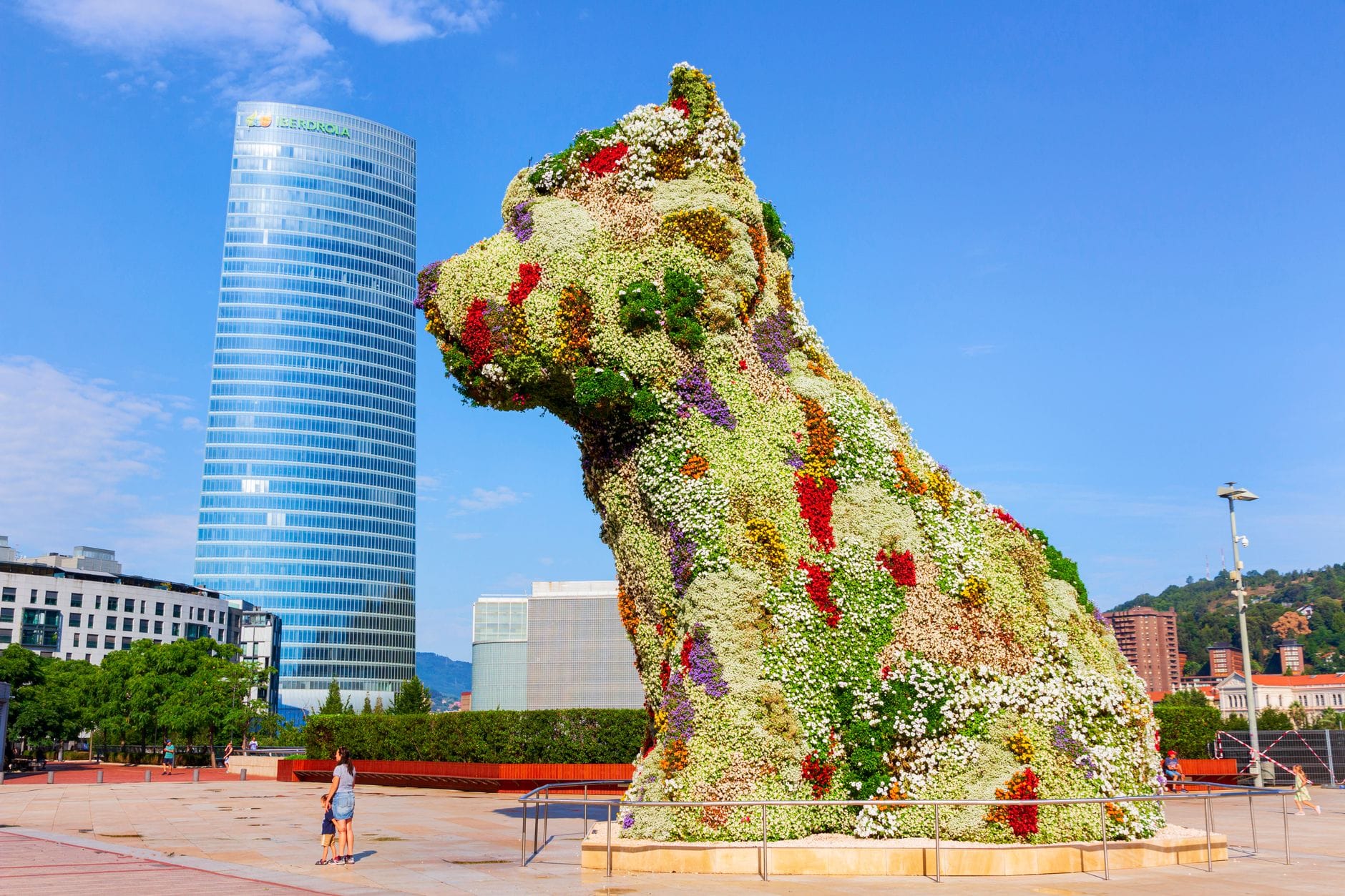
Puppy is a monumental sculpture by American artist Jeff Koons, created in 1992 and installed permanently outside the Guggenheim Museum Bilbao in September 1997, coinciding with the museum's inauguration. It depicts a West Highland White Terrier in a seated pose, rendered at a scale that stops people in their tracks. The official dimensions are 1,240 x 830 x 910 cm, roughly 12 to 13 metres in height. That is taller than a four-storey building.
The sculpture is not a static object. Its stainless steel armature supports a soil-filled internal structure that is planted with tens of thousands of flowering plants, replaced each season so the palette of colours shifts across the year. In spring you might see marigolds and petunias in blocks of yellow and violet; by summer the coat thickens with impatiens and begonias in warmer tones. The effect is somewhere between horticulture and spectacle, which is very much the point.
ℹ️ Good to know
Viewing Puppy from the public plaza is entirely free. You do not need a Guggenheim Museum ticket. The sculpture stands on the forecourt and is accessible from the riverside esplanade at any time of day.
The Abandoibarra Setting: Context Matters
Puppy does not stand in isolation. It sits on the city/plaza (south) forecourt of the Guggenheim Museum Bilbao on the Abandoibarra waterfront, a district that was a functioning industrial port and shipyard until the 1980s. The entire area was derelict when the decision was made to build Frank Gehry's titanium-clad museum here. By the time the Guggenheim opened in October 1997, the riverfront had been transformed into one of the most discussed pieces of urban regeneration in modern Europe.
Standing in front of Puppy, you are at the hinge point between the old city and the new waterfront. The Nervión river runs to your left. The titanium curves of the museum rise behind the sculpture. Across the water, the hills that ring Bilbao are visible on clear days. The spatial contrast between Koons' deliberately playful, overtly decorative work and the industrial gravity of Gehry's building is intentional, or at least productive. Neither overpowers the other.
The Zubizuri pedestrian bridge, designed by Santiago Calatrava, is a five-minute walk east along the river. The Euskalduna Concert Hall sits a short walk west. Abandoibarra is compact enough that most visitors cover the whole stretch in under an hour on foot.
Tickets & tours
Hand-picked options from our booking partner. Prices are indicative; availability and final rates are confirmed when you complete your booking.
Bilbao walking tour
From 16 €Instant confirmationFree cancellationAll Iron Bilbao tour: Athletic Club and Guggenheim Museum
From 107 €Instant confirmationFree cancellationGuggenheim Museum Bilbao entrance ticket and in-app audio tour
From 0 €Instant confirmationFull-day tour to Biarritz, Bayonne and Saint-Jean-de-Luz from Bilbao
From 69 €Instant confirmationFree cancellation
What Visiting Feels Like at Different Times of Day
Early morning, before 9am, is when the sculpture reads most clearly. The plaza is almost empty, the light from the east catches the flower colours without the wash of midday brightness, and you can walk a full circle around the base without navigating crowds. The smell of damp soil and fresh flowers is noticeably stronger in the morning hours, particularly after overnight rain, which is not uncommon in Bilbao's Atlantic climate.
From late morning onward, tour groups and individual visitors accumulate steadily. By noon the plaza can feel congested, with people jostling for the same unobstructed photographs. The sculpture still impresses at this hour, but the experience becomes a social one rather than a contemplative one. If you are visiting with children, this crowd energy can actually work in your favour since the atmosphere becomes festive and there is usually something to look at beyond the sculpture itself.
Late afternoon light, from around 5pm in summer, catches the western flank of Puppy and brings out texture in the planting that is flattened by overhead midday sun. This is often the best window for photography if the sky has any cloud interest. After the museum closes its doors for the day, the forecourt becomes quieter again, and visitors linger at the riverside benches nearby.
💡 Local tip
For the cleanest photographs with no people in frame, arrive before 9am on a weekday. The sculpture faces north-northeast, so early morning light falls on the front of the figure rather than creating harsh backlit conditions.
The Artwork Itself: What to Actually Look At
Most visitors photograph Puppy from the front and move on. The full experience rewards a slower circuit. Walking around the full perimeter takes about five minutes at a leisurely pace, and the rear and side profiles reveal structural details that the frontal view conceals: the stainless steel framework visible at the paws, the irrigation channels woven into the base, and the density variation in the planting where different species cluster at different heights.
The scale is genuinely difficult to process until you are standing directly beneath the sculpture and looking up. At that angle the chest and chin of the dog loom overhead and the floral surface becomes a dense, almost abstract pattern. Children tend to respond strongly to this close-up perspective, and it is worth crouching to their eye level to understand what they are actually seeing.
Koons described Puppy as representing love, warmth, and happiness. The choice of a puppy as subject is precisely as calculated as it sounds: the artist has been consistently interested in objects and forms that carry maximum emotional charge with minimum ambiguity. Whether you find that straightforwardly moving or conceptually suspect will depend on your relationship to contemporary art. Both reactions are legitimate, and neither prevents you from appreciating the horticultural engineering involved.
Practical Details for Your Visit
Puppy is free to view at any time from the public forecourt. No reservation is needed. If you plan to enter the Guggenheim Museum Bilbao itself, check the museum's official website for current opening hours and ticket prices, as these are updated periodically. The Guggenheim Museum Bilbao typically closes on Mondays outside of peak season, but Puppy remains accessible from the plaza regardless.
Getting there by public transport is straightforward. The nearest Metro Bilbao station is Moyua (Lines 1 and 2), from which the walk to Puppy is approximately eight minutes along Alameda de Mazarredo. The Euskotren Tranbia tram also stops near the museum, connecting the Guggenheim to the main Abando railway station and Basque Country rail services. By foot from the Casco Viejo (Old Town), the walk takes around 15 minutes along the riverbank.
The forecourt is a largely flat, paved surface and is accessible for wheelchair users and visitors with pushchairs. The Guggenheim Museum's full accessibility facilities, including ramps and accessible parking, serve the museum complex as a whole and are available to visitors viewing Puppy from outside.
⚠️ What to skip
Bilbao's Atlantic climate means rain is possible year-round. The flowers on Puppy look their best during the main growing season, roughly April through October. In winter, the planting thins out and the effect is less dramatic. Check forecasts if the floral appearance is important to your visit.
Is It Worth Your Time?
Puppy takes 15 to 30 minutes to experience properly, costs nothing, and requires no planning beyond showing up. On those terms alone it is worth including in any visit to Bilbao. If you are already coming to the Guggenheim, the sculpture is literally in your path and unavoidable. If you are not entering the museum, Puppy plus the riverside walk to the Zubizuri bridge makes a satisfying 45-minute loop.
Visitors who are sceptical of Jeff Koons' reputation for commercial sentimentality sometimes find the physical reality of the sculpture more affecting than they expected. The sheer horticultural effort, maintained year after year since 1997, has a cumulative seriousness that photographs do not convey. That said, if large-scale populist public art holds no interest for you and you have limited time in Bilbao, the Museo de Bellas Artes six minutes' walk away offers a deeper, quieter experience of Spanish and Basque art across several centuries.
For those planning a full day around this part of the city, the Bilbao walking tour routes through Abandoibarra before continuing into the Ensanche district, making Puppy a natural starting point rather than a standalone stop.
Insider Tips
- The seasonal flower change happens several times a year. If you visit in early spring or just after a planting change, the flowers will be small and the coat will look sparse. By late spring and early summer the planting is at full density and the colours are most saturated.
- Stand on the raised walkway along the river, east of the museum entrance, for an elevated side view of Puppy that most visitors miss entirely. From this angle the full silhouette of the dog reads against the museum's titanium curves.
- The area around the base of the sculpture in low evening light shows the stainless steel framework and internal irrigation structure most clearly. If the engineering interests you as much as the art, this is when to look closely.
- Bilbao's Aste Nagusia festival in August brings street performers and crowds to the Abandoibarra waterfront, and Puppy becomes a backdrop for an entirely different kind of spectacle. If you are visiting during the festival, expect the forecourt to be packed but the atmosphere to be exceptional.
- Local Bilbainos sometimes refer to the sculpture affectionately as Txakurkumea, the Basque word for puppy. Using it in conversation with residents tends to go down well.
Who Is Puppy (Jeff Koons) For?
- First-time visitors to Bilbao wanting a quick, free introduction to the Guggenheim complex without committing to museum entry
- Families with young children who respond strongly to the scale and colour of the sculpture
- Photographers working the Abandoibarra waterfront looking for an anchor subject in different light conditions
- Architecture and urban design enthusiasts interested in the Bilbao regeneration story as a whole
- Travellers on a tight budget who want to experience landmark contemporary art without museum admission costs
Nearby Attractions
Other things to see while in Abandoibarra:
- Euskalduna Conference Centre and Concert Hall
The Euskalduna Conference Centre and Concert Hall stands on the Abandoibarra riverfront as one of Bilbao's most significant post-industrial buildings. Inaugurated in 1999, it combines a world-class auditorium with a striking design that pays tribute to the shipyard that once occupied the same ground. Whether you are attending a symphony concert, an opera production, or simply walking the waterfront, this building rewards attention.
- Guggenheim Museum Bilbao
Frank Gehry's titanium-clad masterpiece on the Nervión River isn't just Bilbao's most famous building — it's the reason the city reinvented itself. This guide covers the architecture, the permanent collection, crowd patterns, and everything a first-time or returning visitor needs to know.
- Itsasmuseum Bilbao (Maritime Museum)
Built on the bones of the Euskalduna shipyard, Itsasmuseum Bilbao traces the industrial and seafaring history that shaped this Basque city. With a site covering roughly 27,000 m² that combines indoor galleries and outdoor quayside space, historic vessels on the water, and general admission at €10 (reduced €5; under 18 free), it rewards visitors who want more than the Guggenheim's titanium curves.
- Zubizuri Bridge
Designed by Santiago Calatrava and completed in 1997, the Zubizuri is a free pedestrian bridge spanning the Nervión River in Bilbao's Campo Volantín and Uribitarte area. Its sweeping white arch and curved deck have made it one of the most photographed structures in the Basque Country, and a key landmark of the city's remarkable urban transformation.