Santiago Cathedral: Bilbao's Gothic Heart in the Old Town
Santiago Cathedral is Bilbao's oldest building and the spiritual anchor of Casco Viejo, its Gothic bones dating to the 14th century and its dramatic Neo-Gothic facade rebuilt in the 19th. A combined ticket also covers the nearby San Antón Church, making this a compact but genuinely rewarding stop on any Bilbao itinerary.
Quick Facts
- Location
- Plaza de Santiago 1, Casco Viejo, Bilbao 48005
- Getting There
- Metro Casco Viejo (Line 1/2), ~5 min walk; Metro Abando, ~7 min
- Time Needed
- 45–75 minutes
- Cost
- General €10 (combined ticket with San Antón Church); seniors 65+ €9; visitors with disabilities (33–64% recognition) €9; reduced €8; groups €5; pilgrims €5; children may enter free — check official site
- Best for
- Architecture lovers, history enthusiasts, pilgrimage route walkers, Casco Viejo explorers
- Official website
- catedralbilbao.com/public-visit
What Is Santiago Cathedral and Why Does It Matter?
The Catedral Basílica de Santiago — known in English as Santiago Cathedral or Bilbao Cathedral — is among Bilbao's oldest surviving buildings and the diocesan seat since 1949. It occupies a commanding position at the heart of Casco Viejo, the medieval old town on the right bank of the Nervión estuary. For a city that has reinvented itself so thoroughly over the past three decades, the cathedral is a rare fixed point: a structure whose foundations predate Bilbao's industrial boom, its post-industrial crisis, and the Guggenheim-driven transformation that followed.
The building was constructed between the last quarter of the 14th century and the early 16th century in Gothic style, erected on the site of an earlier shrine connected to the Jacobean pilgrimage routes that passed through the Basque Country on the way to Santiago de Compostela. That pilgrimage heritage is still legible in the architecture and in the visitor mix: on any given morning you might find a group of serious walkers with scallop shells on their backpacks standing alongside tourists who wandered in from the pintxos bars of Calle Somera.
ℹ️ Good to know
Opening hours: Mon–Fri 10:00–18:30, Sat 10:00–18:30, Sun 13:00–18:30. Last entry is 45 minutes before closing. Hours may shift around major liturgical celebrations, so check the official site before visiting.
Architecture: Gothic Origins, Neo-Gothic Reinvention
The first thing most visitors notice is the facade. Its tall, sharply pointed tower and ornate stonework look almost too pristine for a medieval building, and that instinct is correct: the current exterior is the product of a substantial 19th-century reconstruction carried out in Neo-Gothic style. This was a common approach across Europe at the time, when Romantic-era architects were as interested in idealized medieval forms as in authentic preservation.
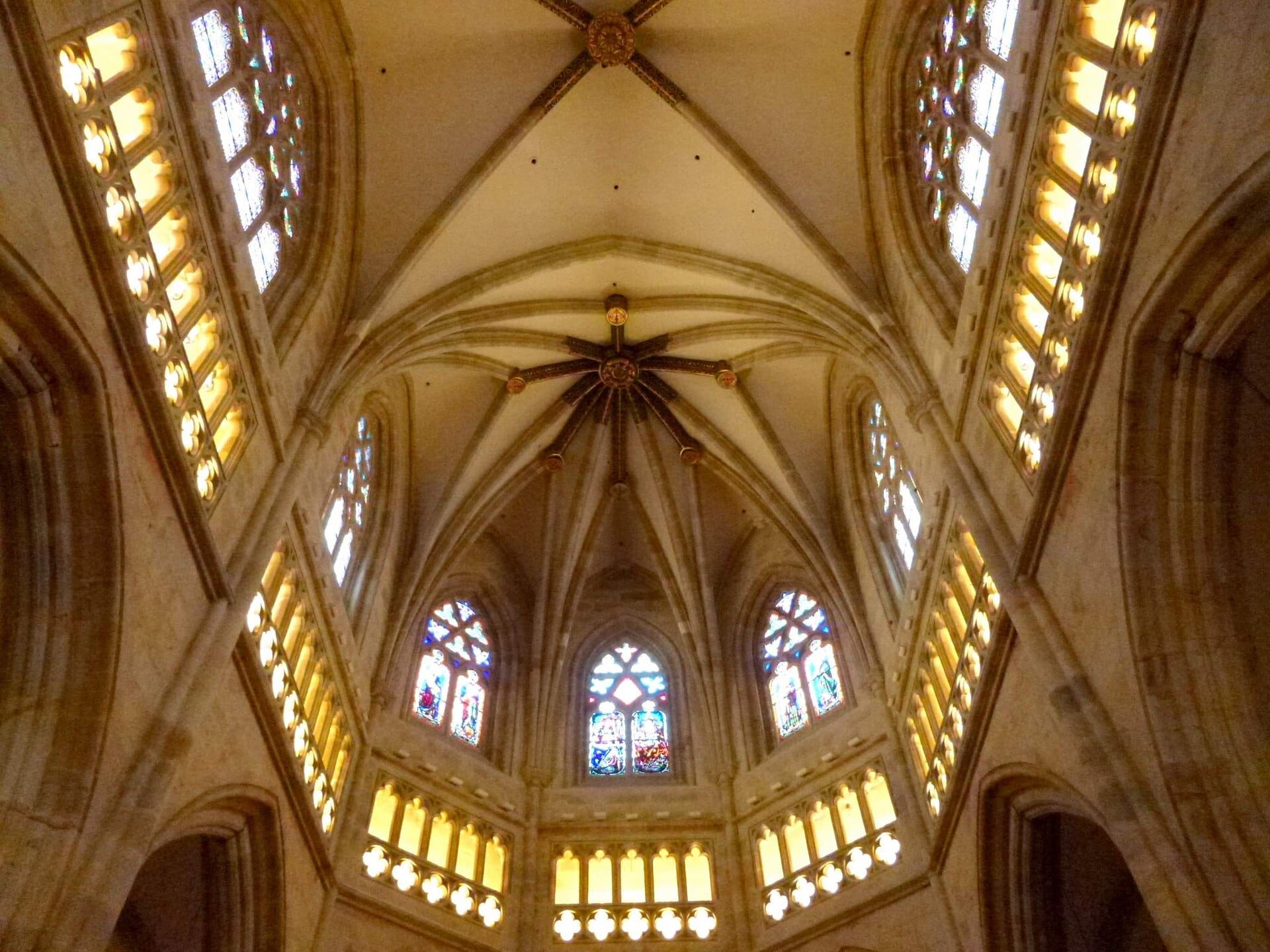
Step inside and the atmosphere shifts. The interior preserves far more of the original 14th and 15th-century fabric. The nave is tall and narrow, with ribbed vaulting overhead and stone piers that draw the eye upward in the way Gothic interiors are specifically engineered to do. The light is cool and diffuse even on sunny days, filtered through stained glass that softens the contrast between the pale stone walls and the deep shadows along the side aisles.
The cloister is the most architecturally interesting space in the complex and the part that rewards slower visitors. Its tracery and proportions are distinctly medieval, and it gives a better sense of the building's age than the restored facade ever can. The combined ticket includes access to the nearby San Antón Church, another Gothic structure with a different character, so budget time for both if you are interested in Bilbao's pre-industrial architectural history.
Tickets & tours
Live prices and dates from our booking partner. If you book, we may earn a commission at no extra cost to you.
San Juan de Gaztelugatxe guided tour from Bilbao
From 65 €Instant confirmationFree cancellationSan Sebastian, Hondarribia, Hendaye, and Getaria from Bilbao
From 54 €Instant confirmationFree cancellationGaztelugatxe and Mundaka small group guided tour from Bilbao
From 50 €Instant confirmationFree cancellationBilbao walking tour
From 16 €Instant confirmationFree cancellation
The Experience by Time of Day
Mornings on weekdays offer the quietest visit. The Plaza de Santiago itself is a small, enclosed square that compresses sound: you can hear the scrape of chairs from the adjacent cafe, the distant echo of a tram bell on the nearby streets, and the particular hush that falls inside the nave even when a handful of other visitors are present. The stone underfoot is worn smooth in the center aisle, polished by centuries of foot traffic in a way that no restoration can replicate.
By mid-morning on weekends and throughout the afternoon in high summer, the cathedral receives significantly more visitors and the square outside fills with people moving between the old town's bars, the Mercado de la Ribera, and the riverfront. The interior never becomes truly crowded in the way major cathedrals in more touristed cities do, but the contemplative quality of the morning visit gives way to something more social.
Sunday afternoons present a specific situation: the cathedral only opens to tourists from 13:00 to 18:30, which means morning services take priority. If you are visiting Bilbao on a Sunday and planning to combine the cathedral with a walk through the old town, structure your morning around the Mercado de la Ribera and Plaza Nueva first, then arrive at the cathedral after lunch.
💡 Local tip
Photography tip: The cloister receives the best natural light in the late morning. The interior nave photographs well from the main entrance looking toward the altar — bring a camera that handles low light, as flash photography may be restricted.
Pilgrimage Context and Cultural Significance
The cathedral's dedication to Saint James (Santiago in Spanish) is not decorative. Bilbao lay along the northern pilgrimage route to Santiago de Compostela, and the original shrine on this site served as a waypoint for medieval pilgrims traveling the coastal Camino del Norte. That lineage is recognized today: pilgrims with a credencial (pilgrim passport) qualify for a reduced entry price of €5, and the cathedral's symbolic connection to the broader Jacobean network gives it a significance that extends well beyond Bilbao's city limits.
The Diocese of Bilbao was established only in 1949, which made Santiago Cathedral its official seat relatively recently in ecclesiastical terms. Before that, Bilbao belonged to the Diocese of Calahorra, a reflection of how the city's rapid industrial growth in the 19th and early 20th centuries outpaced its ecclesiastical structures. The cathedral is therefore both ancient and institutionally young, a combination that mirrors something broader about Bilbao itself.
Practical Walkthrough: Getting There and Getting the Most Out of It
The easiest approach is Metro Casco Viejo station, which deposits you directly into the old town. From the station exit, the cathedral is about five minutes on foot through the narrow medieval streets. If you are coming from the Guggenheim or Abandoibarra waterfront, cross the Zubizuri Bridge and walk into the old town from the riverfront side — the approach through Casco Viejo's lanes is a better introduction to the neighborhood than arriving by metro.
The combined ticket (€10 general) covers both Santiago Cathedral and the San Antón Church, which sits on the river bank a short walk away. The ticket is good value if you visit both. If your time is limited and you are primarily interested in architecture, prioritize the cathedral's cloister and the nave; San Antón is smaller and less ornate but has an interesting riverside position.
Wear comfortable shoes with some grip: the stone floors inside the cathedral and cloister can be slippery, particularly after rain. Bilbao's oceanic climate means rain is a genuine possibility in any month, and the narrow streets of Casco Viejo channel wind in ways that make them feel colder than open spaces. A light layer is worth carrying even in summer.
⚠️ What to skip
Accessibility: The cathedral's historic structure means physical accessibility is not straightforward. Visitors with mobility requirements should contact the cathedral directly before visiting to confirm current arrangements. The official site lists tiered pricing for visitors with disabilities (33–64% recognition) but does not detail specific physical infrastructure.
Is It Worth Your Time?
Santiago Cathedral is not a spectacular building in the way the Guggenheim Museum Bilbao is spectacular. It will not stop you in your tracks from across the street. What it offers is context: an older, quieter layer of the city that helps make sense of everything that came after. Visitors who approach it expecting a Burgos-scale Gothic cathedral will be disappointed. Visitors who want to understand where Bilbao came from, and who find meaning in worn stone and restrained medieval space, will find it well worth the stop.
For travelers on a tight schedule who have already committed their time to the Guggenheim, the Museo de Bellas Artes, and a proper pintxos crawl, the cathedral is a lower priority. But as part of a broader walking tour of Bilbao, it earns its place: small enough to visit without sacrificing half a day, and meaningful enough to repay a little prior reading.
Those who will not enjoy it: visitors primarily interested in modern architecture and design, families with young children who find enclosed historic interiors frustrating, and anyone who finds religious buildings without strong collections (paintings, relics, treasuries) unrewarding. The cathedral has no major art collection on display, and its atmosphere is its primary offering.
Insider Tips
- The cloister is often overlooked by visitors who walk straight to the nave. It is architecturally the most authentic medieval space in the building — give it at least 10 minutes.
- If you are walking the Camino del Norte, your pilgrim credencial (pilgrim passport) qualifies you for a reduced €5 ticket. Bring it with you.
- The Plaza de Santiago directly in front of the cathedral has a small cafe with outdoor seating. It is a good spot to sit and look at the Neo-Gothic facade from across the square before going inside — the tower reads better from a distance than it does up close.
- Weekday mornings between 10:00 and 11:30 are consistently the quietest window. Avoid Saturday afternoons in July and August when tour groups from the coast overlap with local weekend traffic in Casco Viejo.
- The combined ticket with San Antón Church is only worth buying if you plan to visit San Antón on the same trip. San Antón is a five-minute walk toward the river and has a striking position on the Nervión bank, but it is a secondary stop rather than a destination in its own right.
Who Is Santiago Cathedral (Bilbao Cathedral) For?
- Travelers interested in pre-industrial Bilbao and medieval Basque history
- Architecture enthusiasts comparing Gothic originals with 19th-century Neo-Gothic reconstructions
- Pilgrims walking the Camino del Norte who want to connect with the route's spiritual geography
- Visitors on a full Casco Viejo walking day who want to cover the neighborhood thoroughly
- Anyone seeking a quiet, uncrowded counterpoint to Bilbao's busy modern attractions
Nearby Attractions
Other things to see while in Casco Viejo (Old Town):
- Basílica de Begoña
Perched on a hill above the old town, the Basílica de Begoña is the spiritual heart of Bilbao and home to the city's patron, the Virgin of Begoña. Gothic in structure, free to enter, and surprisingly uncrowded, it offers both architectural interest and a genuine window into Basque religious life.
- Church of San Nicolás de Bari
Standing at the gateway to Bilbao's old town, the Iglesia de San Nicolás de Bari is one of the city's most accomplished examples of 18th-century Baroque architecture. Built between 1743 and 1756 to an unusual Greek-cross plan set within a square, it anchors one of the most photogenic corners of the Casco Viejo, steps from the Arenal riverside and Teatro Arriaga.
- Parque de Etxebarria
Covering around 170,000 square metres above Casco Viejo, Parque de Etxebarria is Bilbao's largest park and one of its most rewarding free attractions. Built on the site of a former steel foundry that closed in 1982, it offers sweeping views over the city, open lawns for locals to unwind, and a quiet contrast to the streets below.
- Euskal Museoa (Basque Museum)
Housed in a 17th-century former Jesuit college on Plaza Miguel de Unamuno, Euskal Museoa is Bilbao's oldest and most comprehensive museum of Basque history and culture. With general admission at €10 (reduced €5; under 18 free; free on Wednesdays) and a central Casco Viejo location steps from the metro, it rewards curious travelers who want more than architecture and pintxos. Reopened 10 June 2026 after renovation.
Planning a trip? Discover personalized activities with the Nomado app.