Plaza Nueva, Bilbao: The Arcaded Square at the Soul of Casco Viejo
Plaza Nueva is a grand neoclassical square in the heart of Bilbao's Casco Viejo, completed in 1851 after 65 years of construction. Free to visit at any hour, it draws locals for morning coffee, Sunday antique markets, and evening pintxos under its 64 stone arches. It is one of the few spaces in Bilbao that feels genuinely lived-in rather than curated for tourists.
Quick Facts
- Location
- Plaza Nueva, s/n, 48005 Bilbao — Casco Viejo (Old Town)
- Getting There
- Metro: Casco Viejo station. Tram: Arriaga stop. Buses A3521, A3631, A3632, A3911, A3912 stop nearby.
- Time Needed
- 30–60 minutes for the square itself; 2–3 hours if you stay for pintxos and a drink
- Cost
- Free to enter. You pay only for what you eat or drink under the arcades.
- Best for
- Architecture lovers, pintxos seekers, Sunday market browsers, and anyone wanting to watch Bilbao go about its day
- Official website
- www.spain.info/en/places-of-interest/plaza-nueva-bilbao
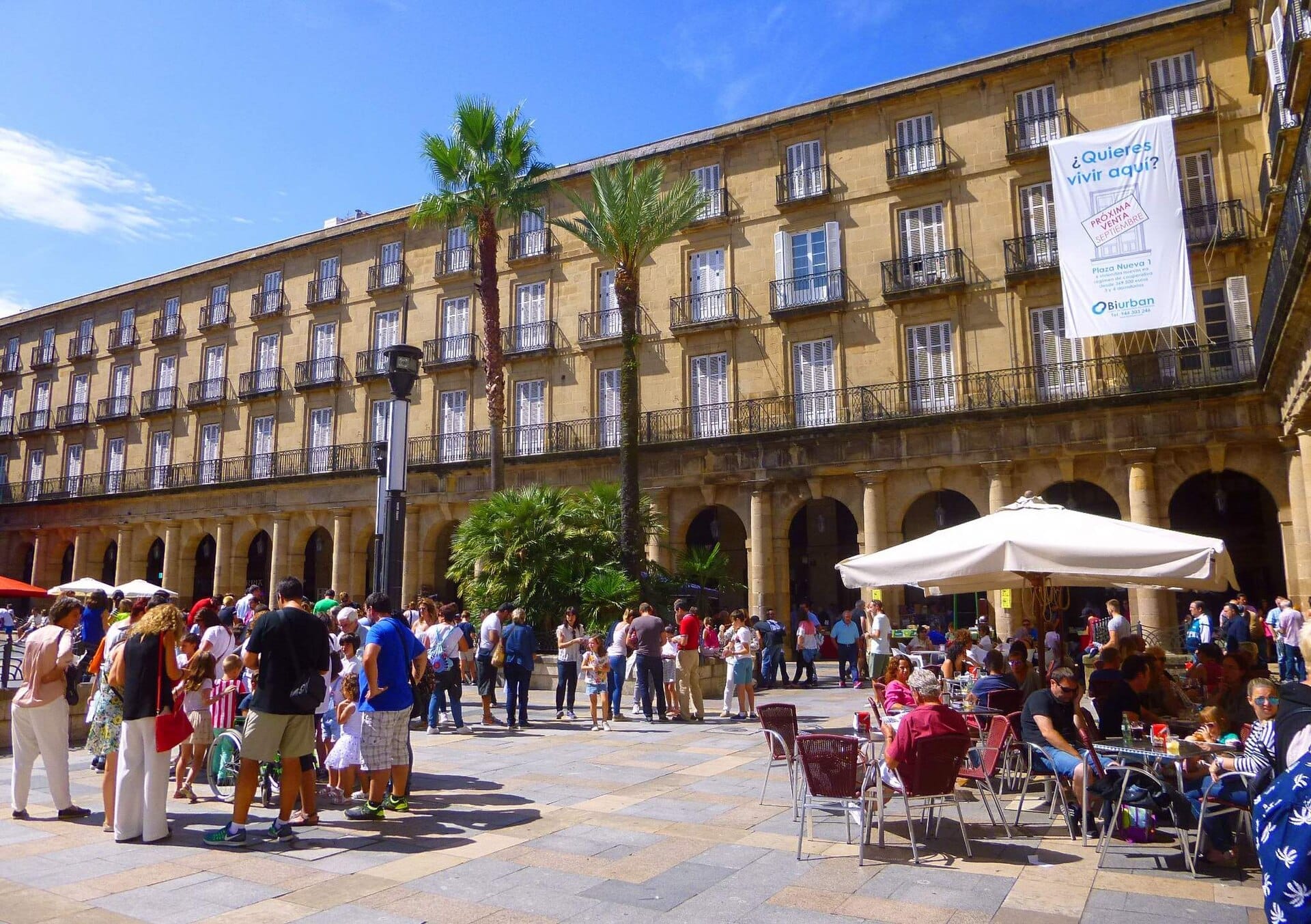
What Plaza Nueva Actually Is
Plaza Nueva (also known in Basque as Plaza Barria) is a fully enclosed neoclassical square measuring 3,400 square metres, set in the Casco Viejo, Bilbao's medieval old quarter. Its 64 semicircular arches, arranged 24 per long side and 14 per short side, run on square pillars with attached Doric columns — a formal, symmetrical design that feels more like Madrid's Plaza Mayor or Vitoria-Gasteiz's Plaza de la Virgen Blanca than the narrow, improvised streets surrounding it.
Construction began in the early 19th century and stretched across 65 years before the square was finally inaugurated in 1851. That long gestation explains why the finished result feels unusually considered: every facade matches, every arch aligns, and the proportions hold up from every corner. The main building on the north side now houses Euskaltzaindia, the Royal Academy of the Basque Language, which lends the square a quiet institutional gravity beyond its role as a social gathering point.
ℹ️ Good to know
Plaza Nueva is a public square with no entrance fee and no closing time. Bars and restaurants under the arcades open and close on their own schedules, typically from mid-morning through late evening.
The Experience at Different Times of Day
Early morning is the quietest and, for architecture, the best time. Before 9am, when weekend visitors have not yet arrived and weekday commuters are already heading to offices, you can walk the full arcade perimeter without interruption. The stone columns carry a faint damp smell from overnight, the inner courtyard catches a cool northern light, and the bars are just sliding open their shutters and pulling chairs down from tables.
By late morning, a different crowd takes over: retired men reading newspapers, small groups debating at the bar counters, locals stopping for a coffee and a slice of tortilla. This is the square at its most routine and, arguably, its most honest. The tourist wave arrives around midday and stays through the afternoon, which does not detract from the space but does change the soundtrack from Basque to a patchwork of European languages.
Sunday mornings bring a flea market to the square where coin dealers, stamp collectors, and bric-a-brac sellers set up under the arches. It draws a genuine mix of regulars and occasional browsers rather than the souvenir-heavy markets you find near major monuments elsewhere in Spain. If you are visiting on a Sunday, plan to arrive before noon.
Evening is the peak pintxos hour. From around 7pm, the bars under the arcades fill quickly, and groups spill out onto the square itself when the weather allows. The stone paving amplifies sound, so the square becomes notably loud on warm evenings. Rain drives everyone under the arches and creates a compressed, convivial atmosphere that actually suits the covered walkways well.
Tickets & tours
Live prices and dates from our booking partner. If you book, we may earn a commission at no extra cost to you.
San Juan de Gaztelugatxe guided tour from Bilbao
From 65 €Instant confirmationFree cancellationSan Sebastian, Hondarribia, Hendaye, and Getaria from Bilbao
From 54 €Instant confirmationFree cancellationGaztelugatxe and Mundaka small group guided tour from Bilbao
From 50 €Instant confirmationFree cancellationBilbao walking tour
From 16 €Instant confirmationFree cancellation
The Architecture in Detail
The design is attributed to the Bilbao architect Silvestre Pérez, who conceived the original plan in the neoclassical tradition. The style was practical as much as aesthetic: the arcades provide shelter from Bilbao's reliable rainfall, making the square usable year-round in a city that receives high annual precipitation throughout all seasons. This is not decorative colonnade work — it is a functional response to Atlantic weather, and it works.
The uniformity of the facades is unusual for a street-level European city square: there are no later additions breaking the skyline, no mismatched floors added across different eras. The result is a rare example of neoclassical urban planning that survived intact in Bilbao's otherwise heavily industrialised and redeveloped 20th century. For a broader appreciation of how this square fits into Bilbao's architectural story, the Bilbao architecture guide provides useful context, tracking the city from its medieval lanes through to the titanium curves of the Guggenheim.
Pintxos, Bars, and What to Order
The bars lining the arcades are among the most visited in Casco Viejo, and quality varies enough that it is worth pausing to look at the pintxos trays in the window before committing to a counter. The square specialises in traditional Basque pintxos: slices of bread topped with anchovy, jamón, cured cheese, or a small tortilla, typically eaten standing up with a glass of txakoli (a tart, slightly sparkling white wine from the Basque coast) or a small beer. For a fuller breakdown of how pintxos culture works in Bilbao — what to order, where to eat, and how to bar-hop correctly — the pintxos guide to Bilbao covers it in detail.
A practical note: the bars on the interior arcade faces (looking into the square) tend to fill faster and charge slightly more than those facing the outer streets. If the square is busy, the surrounding blocks of Casco Viejo have equally good bars with shorter queues — the square is a natural starting point, not necessarily the best place to spend your whole evening.
💡 Local tip
If you find the square too crowded on weekend evenings, walk one block in any direction — the streets immediately surrounding Plaza Nueva are part of the same pintxos circuit and often less busy.
Getting There and Getting Around
Plaza Nueva sits at the centre of Casco Viejo, which is best approached on foot or by public transport. The nearest Metro station is Casco Viejo (Line 1 and Line 2), a few minutes' walk away. The tram stop at Arriaga, named for the Teatro Arriaga that faces the estuary, is also within easy walking distance and useful if you are arriving from the Abandoibarra waterfront or the Ensanche district.
Casco Viejo itself is a pedestrian area with restricted vehicle access, so once you are in the neighbourhood you move on foot. The streets are flat along the main axis but rise quickly toward the hillside above, where the Basílica de Begoña sits above the old town. The square is paved and effectively step-free around the arcade perimeter, making it accessible for wheelchairs and pushchairs, though the surrounding streets of the old quarter are narrow and occasionally cobbled.
If you are planning a wider walk through the old town, the Bilbao walking tour guide threads together Plaza Nueva, the Ribera Market, the cathedral, and the riverfront into a logical half-day route.
Photography and Practical Notes
For architecture shots, the best position is from the centre of the square looking toward the Euskaltzaindia building on the north face, where the arcade runs cleanest and the proportions are most apparent. Early morning and overcast days produce the most even light — direct afternoon sun creates strong shadows under the arches that break the visual rhythm. A wide-angle lens is useful given the square's enclosed dimensions.
The square is partly covered by the arcades but the central paving is open to the sky. Bilbao's weather is often unpredictable regardless of season, with rain possible on any given day year-round. The arcade walkway is wide enough to stay dry in moderate rain while still watching the square, which makes it a reasonable place to wait out a shower. Bring a light waterproof layer if you are visiting outside summer months.
⚠️ What to skip
Plaza Nueva is at its most congested on Saturday evenings and during Aste Nagusia (Bilbao's major August festival week). If crowds are a concern, visit on a weekday morning.
Who Will and Won't Get Much From This Square
Plaza Nueva rewards people who slow down. If you treat it as a box to tick between the Guggenheim and the Ribera Market, you will walk through it in five minutes and wonder what the fuss is about. Its value is in sitting under the arches with a drink and paying attention to how it functions as an actual public space rather than a monument: the retired men arguing over newspapers, the bar owners shouting across to each other, the children running across the open paving on Sunday afternoons.
Visitors primarily interested in contemporary architecture or Bilbao's post-industrial transformation should prioritise the Guggenheim Museum Bilbao and the Abandoibarra waterfront, where the architectural ambition is more dramatic. Plaza Nueva is a neoclassical square, not a modern landmark, and it offers a specific, quieter kind of experience.
Insider Tips
- The Sunday coin and stamp market runs from roughly 9am to 2pm. It is small but genuine — dealers know their stock, and if you are patient you can find old postcards and local ephemera at reasonable prices.
- Look up at the upper floors of the arcade buildings while you walk the perimeter. The ironwork balconies and window details above street level are often overlooked but add considerably to the architectural coherence of the square.
- Txakoli is poured from a height to aerate it — the bar staff are not being theatrical. Order it if you want the most locally appropriate drink with your pintxos, but note it is dry and low-alcohol, so expect a wine that tastes more like sharp cider than Rioja.
- Euskaltzaindia, the Basque Language Academy housed on the north side of the square, occasionally holds public lectures and cultural events. Check their schedule if you have a specific interest in Basque language and culture.
- If it starts raining while you are in the square, claim a spot under the arcade and stay — bars will fill but the covered walkway is wide enough to remain comfortable, and the square looks particularly atmospheric in wet weather when the stone turns darker and the lights from the bar windows reflect on the paving.
Who Is Plaza Nueva For?
- Architecture and urban design enthusiasts who appreciate neoclassical form
- Travellers doing a proper pintxos crawl through Casco Viejo
- Sunday visitors who want to combine the flea market with a slow morning coffee
- Anyone seeking a contrast to Bilbao's modernist waterfront — this is the city's older, quieter register
- Families with young children, given the flat open paving, covered walkways, and tolerant bar culture
Nearby Attractions
Other things to see while in Casco Viejo (Old Town):
- Basílica de Begoña
Perched on a hill above the old town, the Basílica de Begoña is the spiritual heart of Bilbao and home to the city's patron, the Virgin of Begoña. Gothic in structure, free to enter, and surprisingly uncrowded, it offers both architectural interest and a genuine window into Basque religious life.
- Church of San Nicolás de Bari
Standing at the gateway to Bilbao's old town, the Iglesia de San Nicolás de Bari is one of the city's most accomplished examples of 18th-century Baroque architecture. Built between 1743 and 1756 to an unusual Greek-cross plan set within a square, it anchors one of the most photogenic corners of the Casco Viejo, steps from the Arenal riverside and Teatro Arriaga.
- Parque de Etxebarria
Covering around 170,000 square metres above Casco Viejo, Parque de Etxebarria is Bilbao's largest park and one of its most rewarding free attractions. Built on the site of a former steel foundry that closed in 1982, it offers sweeping views over the city, open lawns for locals to unwind, and a quiet contrast to the streets below.
- Euskal Museoa (Basque Museum)
Housed in a 17th-century former Jesuit college on Plaza Miguel de Unamuno, Euskal Museoa is Bilbao's oldest and most comprehensive museum of Basque history and culture. With general admission at €10 (reduced €5; under 18 free; free on Wednesdays) and a central Casco Viejo location steps from the metro, it rewards curious travelers who want more than architecture and pintxos. Reopened 10 June 2026 after renovation.
Planning a trip? Discover personalized activities with the Nomado app.