Teatro Arriaga: Bilbao's Grand Opera House at the Heart of the Old Town
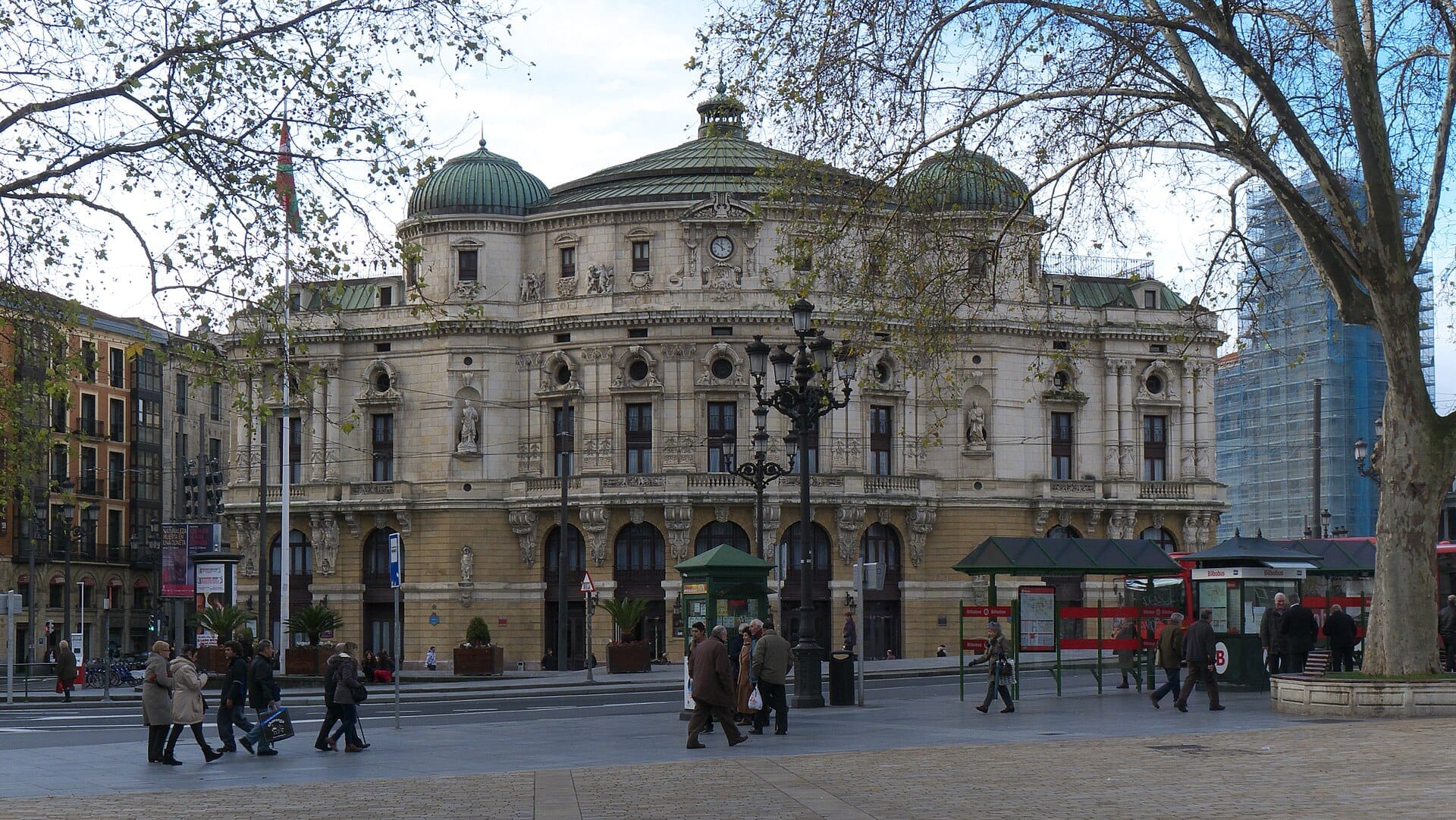
Standing at the gateway to Bilbao's medieval quarter, Teatro Arriaga is one of northern Spain's most architecturally striking performance venues. Built between 1886 and 1890, the neo-baroque theatre has survived fire, floods, and full restoration to remain the cultural centerpiece of the Casco Viejo. Whether you come for a performance or simply to admire the facade, it rewards the visit.
Quick Facts
- Location
- Plaza Arriaga, 1, 48005 Bilbao — at the entrance to the Casco Viejo
- Getting There
- Metro: Casco Viejo (~5 min walk) or Abando (~4 min walk) on Line 1
- Time Needed
- 15–30 min to view exterior and foyer; 2–3 hours for a performance
- Cost
- Free to view exterior; performance tickets priced by show — check teatroarriaga.eus
- Best for
- Architecture lovers, classical music fans, first-time visitors to the Casco Viejo
- Official website
- www.teatroarriaga.eus
What Is Teatro Arriaga?
Teatro Arriaga is Bilbao's principal opera house and one of the finest examples of neo-baroque civic architecture in the Basque Country. Positioned at the foot of the Casco Viejo, where the old town meets the Nervión estuary and the broader city beyond, the building functions as both a working theatre and an architectural landmark that frames the entry to Bilbao's medieval quarter.
The theatre takes its name from Juan Crisóstomo de Arriaga, a Bilbao-born composer who died in Paris at just 19 years old in 1826. His prodigious output earned him the unofficial title of the 'Spanish Mozart,' and the city honored him posthumously by dedicating the theatre to his name from its inauguration. The name has stuck, and Arriaga remains an important cultural touchstone for the city.
This is not a museum piece operating on reduced hours. Teatro Arriaga runs an active programme of opera, theatre, dance, and orchestral concerts throughout the season, drawing audiences from across the Basque Country and beyond. Visiting it properly means either attending a performance or joining a guided tour when available, though the exterior and entrance lobby alone justify a stop during any walk through the old town.
The Building: Architecture and History
Construction began in 1886 and the theatre opened on 31 May 1890, designed by architect Joaquín Rucoba in a style that draws heavily from the French neo-baroque tradition. The facade is immediately arresting: a layered composition of stone columns, arched windows, and carved ornament rising above a broad plaza at the river's edge. At night, when the building is lit for performances, the contrast between the warm stone and the dark water of the Nervión is one of the more quietly impressive sights in the city.
The theatre has had a turbulent structural history. A major fire gutted significant interior sections in 1914, though the original facade was preserved through the subsequent restoration, which brought the building back into use in 1919. A second disaster came with the catastrophic floods of 1983, which caused severe damage throughout the Casco Viejo and led to a comprehensive rebuilding of the interior. The restored theatre reopened on 5 December 1986. One surviving feature particularly worth seeing is the imperial staircase, which was retained and restored during that post-flood reconstruction.
ℹ️ Good to know
The facade you see today closely resembles the 1890 original. The interior, however, reflects the 1986 restoration following the 1983 flood damage. It is a building whose exterior tells one story and whose interior tells another.
For travelers with a broader interest in Bilbao's architectural heritage, the Teatro Arriaga works well as part of a longer circuit. The Bilbao architecture guide covers how the city's building tradition evolved from the Casco Viejo's medieval core through the Ensanche expansion and into the post-industrial transformation anchored by the Guggenheim.
Tickets & tours
Live prices and dates from our booking partner. If you book, we may earn a commission at no extra cost to you.
Bilbao Food Tour with Pintxos & Drinks with a Local
From 85 €Instant confirmationFree cancellationCathedral, History and anecdotes of the Old Town
From 25 €Instant confirmationFree cancellationVisit to the funicular of Artxanda and the Old Town of Bilbao
From 25 €Instant confirmationDiscover Bilbao in 60 Minutes with a Local
From 51 €Instant confirmationFree cancellation
The Experience: Time of Day and Setting
Plaza Arriaga, the square in front of the theatre, is a natural gathering point at the border between the old and new parts of the city. In the mornings, it is relatively quiet: a few locals cutting through toward the Siete Calles, the odd tourist consulting a map, pigeons on the stone paving. The building reads clearly in morning light from across the plaza, and this is the best time to photograph the facade without pedestrian interference.
By early evening, particularly on weekdays, the square fills with people moving between the old town pintxo bars and the wider city. On performance nights, the atmosphere shifts noticeably: audience members in smart-casual dress cluster under the portico, the interior lights warm up the stone arches visible through the entrance doors, and the contrast with the surrounding medieval streetscape becomes especially clear. If you want to understand how the theatre functions as a social anchor for the neighborhood, arriving at around 7:30pm on a concert evening is instructive.
The immediate surroundings reward attention. The Nervión flows directly in front, and the Zubizuri footbridge and the riverfront promenade are a short walk downstream. Behind the theatre, the narrow streets of the Casco Viejo open up almost immediately: the grid of the medieval seven streets, the covered arcade of Plaza Nueva, the Ribera market.
💡 Local tip
If rain is forecast (and in Bilbao's Atlantic climate it often is, especially outside summer), the theatre's broad portico provides genuine shelter and makes a practical vantage point for watching the square. The stone overhang is deep enough to stay comfortably dry.
Attending a Performance
The programming at Teatro Arriaga covers opera, zarzuela (Spanish lyric theatre), ballet, contemporary dance, and orchestral concerts. The season typically runs from autumn through spring, with summer programming lighter or variable. Ticket prices depend entirely on the production and seat category, and are sold through the theatre's own online ticketing portal. There is no single standard admission price.
The auditorium capacity and layout reflect the 1986 restoration: a traditional horseshoe configuration with stalls, boxes, and upper tiers. The acoustics are considered good for vocal performance, and the scale is intimate enough that even upper-tier seats maintain a reasonable connection with the stage. For opera specifically, the line of sight from the side boxes should be checked before booking if you care about full stage visibility.
Booking in advance is advisable for popular productions. The box office also operates in person, and the theatre's website carries the full programme calendar in Spanish and Basque, with an English interface for ticketing. Note that the theatre may close between seasons or for production changeovers; check the official site before planning an evening around a performance.
⚠️ What to skip
Ticket prices are not displayed on third-party sites accurately. Always book through the official portal at ticket.teatroarriaga.eus or the box office to get current pricing and seat availability.
Visiting Without a Ticket: Exterior and Guided Tours
You do not need a ticket to appreciate a significant portion of what Teatro Arriaga offers. The facade, the portico, and the immediate plaza setting are publicly accessible at all hours. The entrance lobby and foyer may be accessible during box office opening times, which is when you can see the imperial staircase at close range, but this is not guaranteed outside performance periods and varies seasonally.
Guided tours of the interior have been offered at weekends, but availability changes with the programming schedule and season. The official website and Bilbao Turismo (the city's tourism office) are the most reliable sources for current tour information. If a guided visit matters to you, check both well before your trip rather than assuming tours will be running on any given weekend.
For a fuller orientation to the neighborhood the theatre anchors, a structured Bilbao walking tour covering the Casco Viejo will typically pass through Plaza Arriaga as one of its key waypoints, alongside the Ribera market, Plaza Nueva, and the Santiago Cathedral.
Getting There and Practical Details
Teatro Arriaga is at Plaza Arriaga, 1, in the 48005 postal district of Bilbao. It sits at the point where the Casco Viejo meets the Nervión riverfront, making it easy to locate on foot from either side of the old town.
The two most convenient metro stations are Casco Viejo on Line 1 (approximately a 5-minute walk through the old town) and Abando on Line 1 (approximately 4 minutes walking along the river). Either works depending on where you are coming from. The tram line that runs along the Abandoibarra waterfront does not stop directly at the theatre, but the riverfront promenade from the Guggenheim area to the Arriaga is a pleasant flat walk of around 15 minutes.
If you are using a Barik card on the metro, a single journey costs less than a single ticket and covers the full network including connecting buses. For any visit combining the theatre with the wider Casco Viejo, arriving by metro at Casco Viejo station and exiting through the old streets toward the riverfront gives you a good orientation walk.
For broader transport logistics across the city, the getting around Bilbao guide covers metro lines, tram routes, bus passes, and the Barik card in detail.
Accessibility: The theatre is a historic building dating from 1890 with restorations in 1919 and 1986. Specific accessibility provisions, including lift locations and adapted seating, are not comprehensively listed on public tourism pages. Visitors with mobility requirements should contact the theatre directly before attending: telephone +34 944 792 036 or email informacion@teatroarriaga.eus.
How It Fits Into the Casco Viejo
The Teatro Arriaga does not stand in isolation. It is the most prominent public building at the threshold of a neighborhood that rewards slow exploration. Directly behind it, the Mercado de la Ribera is one of the largest covered markets in Spain, and its riverside facade faces the same stretch of the Nervión. A few streets further in, the Plaza Nueva offers the best concentration of pintxo bars in the old quarter, under a colonnaded arcade from the early 19th century.
The Santiago Cathedral sits a few minutes' walk into the medieval grid, its Gothic tower visible above the rooftops. And the Euskal Museoa (Basque Museum), one of the oldest ethnographic museums in the Basque Country, is within easy reach of the same square. The teatro is the right place to start or end a half-day circuit of the old town.
Who might find this underwhelming: if your primary interest is contemporary architecture or the post-industrial transformation of Bilbao, the Abandoibarra waterfront and the Guggenheim area will hold your attention far longer. The Arriaga is a building rooted in the 19th-century civic tradition, and visitors expecting something on the visual scale of the Guggenheim will be comparing incomparable things. On its own terms, though, as the anchor of a historic urban quarter and a functioning cultural institution, it is genuinely worth the stop.
Insider Tips
- The best exterior photographs are taken from the far side of the Nervión, on the Abandoibarra promenade, where the full volume of the building and its riverside setting are visible. Morning light falls directly on the facade from this angle.
- Performance evenings in the October to March period are when the building is most alive. The lobby fills with people and the staircase is accessible as audiences move to their seats. If you want to see the interior without booking a full performance, arriving slightly before curtain time and observing the foyer from the entrance is possible during ticketed events.
- Check the programme in advance on teatroarriaga.eus. The website lists not just performances but also any open rehearsals, educational events, or public activities that occasionally allow non-ticketed access to the building.
- The square outside is an informal meeting point on weekend evenings before the old town bar circuit begins. If you are planning a pintxo evening in the Casco Viejo, using the teatro's plaza as a starting reference makes orientation easier.
- Guided tours vary significantly by season and can be cancelled when technical staff are preparing a production. If a tour is the specific purpose of your visit, call ahead on +34 944 792 036 rather than arriving and assuming one is running.
Who Is Teatro Arriaga For?
- Travelers interested in historic civic architecture and European opera house design
- Classical music and opera fans wanting to attend a performance in an authentic 19th-century setting
- First-time visitors using the theatre as the starting point for a Casco Viejo walking circuit
- Photographers looking for a well-composed architectural subject in a riverside setting
- Travelers on multi-day itineraries who want to balance the modern (Guggenheim, Abandoibarra) with the historic (Casco Viejo, Arriaga)
Nearby Attractions
Other things to see while in Casco Viejo (Old Town):
- Basílica de Begoña
Perched on a hill above the old town, the Basílica de Begoña is the spiritual heart of Bilbao and home to the city's patron, the Virgin of Begoña. Gothic in structure, free to enter, and surprisingly uncrowded, it offers both architectural interest and a genuine window into Basque religious life.
- Church of San Nicolás de Bari
Standing at the gateway to Bilbao's old town, the Iglesia de San Nicolás de Bari is one of the city's most accomplished examples of 18th-century Baroque architecture. Built between 1743 and 1756 to an unusual Greek-cross plan set within a square, it anchors one of the most photogenic corners of the Casco Viejo, steps from the Arenal riverside and Teatro Arriaga.
- Parque de Etxebarria
Covering around 170,000 square metres above Casco Viejo, Parque de Etxebarria is Bilbao's largest park and one of its most rewarding free attractions. Built on the site of a former steel foundry that closed in 1982, it offers sweeping views over the city, open lawns for locals to unwind, and a quiet contrast to the streets below.
- Euskal Museoa (Basque Museum)
Housed in a 17th-century former Jesuit college on Plaza Miguel de Unamuno, Euskal Museoa is Bilbao's oldest and most comprehensive museum of Basque history and culture. With general admission at €10 (reduced €5; under 18 free; free on Wednesdays) and a central Casco Viejo location steps from the metro, it rewards curious travelers who want more than architecture and pintxos. Reopened 10 June 2026 after renovation.
Planning a trip? Discover personalized activities with the Nomado app.