Mercado de la Ribera: Bilbao's Grand Market and the Soul of Casco Viejo
Built in 1929 and spanning 10,000 square metres beside the Nervión estuary, Mercado de la Ribera is one of the largest covered markets in Spain. It combines a working food market with pintxos bars, a riverside terrace, and a history stretching back to the 14th century.
Quick Facts
- Location
- Calle Ribera / Erribera Kalea s/n, 48005 Bilbao — riverside edge of Casco Viejo
- Getting There
- Metro Casco Viejo; buses 11, 22, 40, 50, 56, 58, 75, 77, 85 stop nearby
- Time Needed
- 45 minutes to browse; 2+ hours if eating and drinking
- Cost
- Free entry; individual stall and bar prices vary
- Best for
- Food lovers, morning market culture, Basque produce, architecture, rainy-day visits
- Official website
- mercadodelaribera.biz
What Is the Mercado de la Ribera?
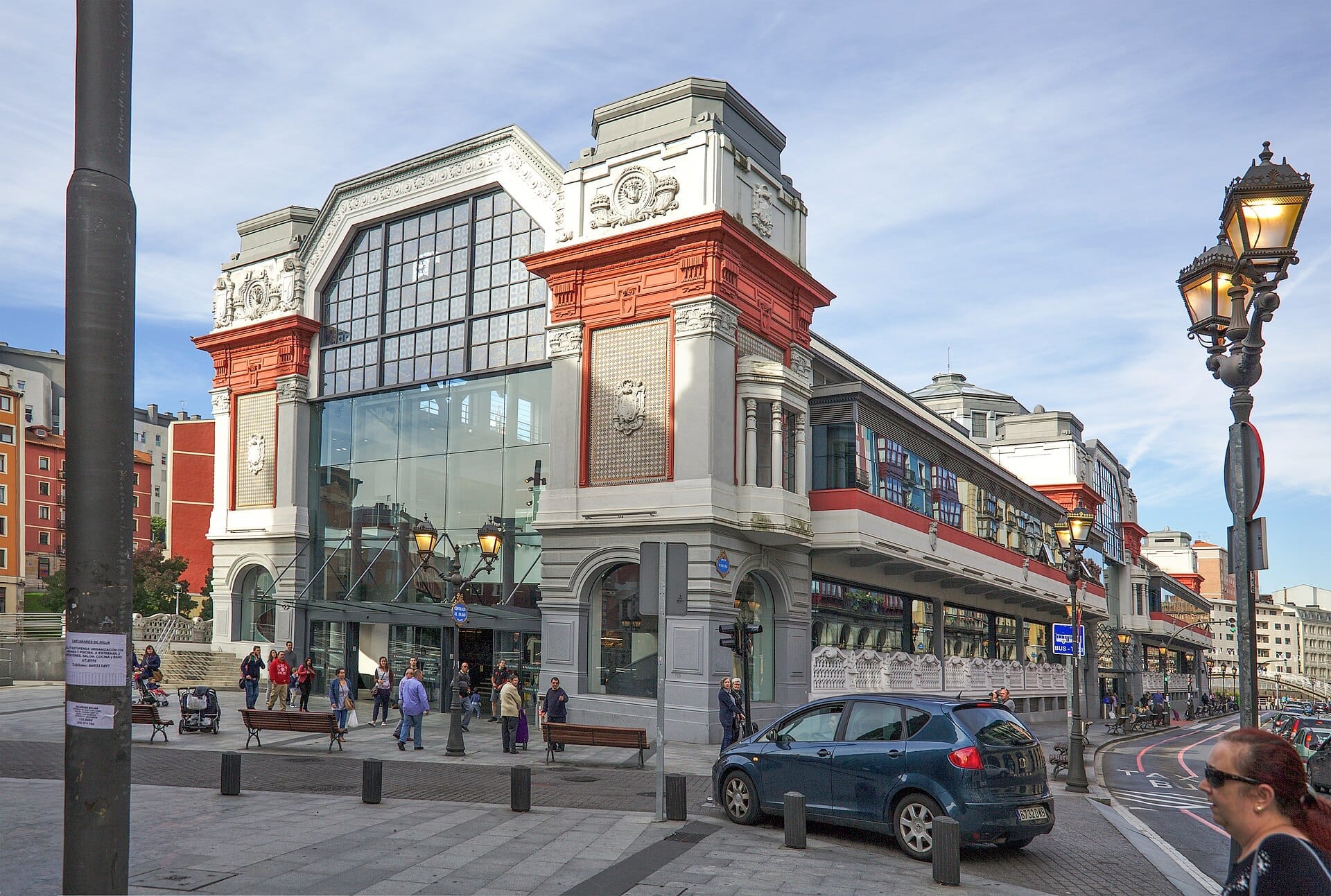
The Mercado de la Ribera is a covered public market occupying a prominent Art Deco building on the right bank of the Bilbao estuary, beside Casco Viejo. With roughly 10,000 square metres of commercial floor space spread across three levels, it is frequently cited as one of the largest covered markets in Spain. It has served Bilbao's historic market area for centuries, and the current structure, inaugurated in 1929, made that tradition permanent in concrete, glass, and wrought iron.
The building opens up dramatically once you step inside. Light pours through large glazed sections, the floor plan is generous and uncluttered after a thorough renovation in 2010, and the stalls are arranged across multiple levels. The lowest floor, which opens towards the river, houses a food hall format with pintxos bars and prepared food counters.
💡 Local tip
Opening hours: Monday to Friday 08:00–14:00 and 16:30–19:00; Saturdays 11:30–14:30. The market is closed on Sundays. Confirm via the official site before visiting.
A Market with Seven Centuries of History
The riverside location is not accidental. Trading activity along this stretch of the Nervión has a long history, and the market area's role as a commercial hub helped make it a natural center for the old town for centuries before any permanent structure existed.
The 1929 building formalised what had always been an open-air and semi-permanent market culture. It was designed in a rationalist Art Deco style that was modernist enough to feel ambitious but grounded enough not to clash with the historic streetscape of Casco Viejo. The 2010 renovation preserved the architectural shell while replacing interior fittings, improving circulation between floors, and adding gastronomy-focused areas to adapt to how Bilbaínos actually use markets today: less as pure grocery runs and more as social and culinary spaces.
The market sits within easy walking distance of the key landmarks of Casco Viejo, including the arcaded Plaza Nueva and the neoclassical Teatro Arriaga. Combining all three in a single morning walk is one of the most efficient ways to understand how the old town functions.
Tickets & tours
Hand-picked options from our booking partner. Prices are indicative; availability and final rates are confirmed when you complete your booking.
San Juan de Gaztelugatxe guided tour from Bilbao
From 65 €Instant confirmationFree cancellationSan Sebastian, Hondarribia, Hendaye, and Getaria from Bilbao
From 54 €Instant confirmationFree cancellationGaztelugatxe and Mundaka small group guided tour from Bilbao
From 50 €Instant confirmationFree cancellationBilbao walking tour
From 16 €Instant confirmationFree cancellation
What You'll Actually Find Inside
The ground floor is where the daily produce trade happens: fish counters stacked with hake, anchovies, sea bream, and the occasional live shellfish tank; butchers with Basque-reared beef, txistorra sausage, and whole lamb cuts; and greengrocers whose displays tilt heavily towards seasonal local produce. The vendors here are regulars who have worked the same stalls for years, and the transactions are brisk and familiar. On a Tuesday morning, the floor sounds like a controlled, low-level roar of conversations, price calls, and the thud of fish on chopping boards.
The lower riverside floor is where the pace changes. This area contains pintxos bars and counters selling prepared food. The river-facing aspect of this level means that even on grey Bilbao mornings, there is natural light and a sense of the city's relationship with the Nervión.
If you want to understand the wider context of Basque food culture before your visit, the Basque food guide for Bilbao covers the ingredients, traditions, and etiquette that give market visits like this one their full meaning.
ℹ️ Good to know
The Mercado de la Ribera is a working food market, not a tourist attraction with a fixed script. Some stalls may be closed on slower mornings or during mid-afternoon hours. The Saturday morning visit is particularly popular with locals stocking up for the weekend.
When to Visit: Time of Day and Day of Week
The best time to visit for market atmosphere is weekday mornings between 09:00 and 12:00. This is when the fish and meat counters are fully stocked, the produce is freshest, and local residents are actually shopping rather than taking photos. Saturday mornings are lively but noticeably busier, and the bar area tends to fill quickly with people treating the market as a pre-lunch social destination.
The afternoon session, from 16:30 to 19:00 on weekdays, is calmer and more subdued. If you are primarily interested in the food and drink side rather than the market mechanics, the late morning on any weekday gives you the best combination of produce selection and available seating at the bars.
The building itself is worth examining regardless of trading hours. The exterior, facing the river promenade, has a visual weight that is easy to underestimate when you approach from the Casco Viejo side streets. Come around to the riverside face to appreciate the full length and the proportions of the 1929 structure, which is more monumental than it first appears from the narrow streets behind it.
⚠️ What to skip
The market is closed on Sundays. If you are visiting Bilbao on a weekend itinerary and have only one chance to visit, plan for Saturday morning.
Getting There and Moving Around
The most direct route from most of central Bilbao is the Metro Casco Viejo station. From there, the market is a short walk through the narrow streets of Cruz and Tendería, both of which are pedestrianised and pass through the densest part of the old town. This walk is part of the experience: you pass through the commercial spine of Casco Viejo, with small food shops, cheese vendors, and bakeries that give a preview of what you'll find in larger volume inside the market.
Multiple bus lines (11, 22, 40, 50, 56, 58, 75, 77, and 85) stop nearby on the riverside road. If you are coming from the Guggenheim or Abandoibarra area, it is also possible to walk along the river promenade in under 20 minutes, which gives you a different view of how the two halves of Bilbao relate to each other across the water.
For a broader look at how to move around the city efficiently, the guide to getting around Bilbao covers metro lines, tram routes, and walking distances between neighbourhoods.
Photography, Architecture, and Practical Notes
The interior of the Mercado de la Ribera is well-lit, particularly on the upper floors where natural light enters through the glazed roof sections. Wide-angle shots of the market floor work best soon after opening, when stalls are being set up.
The riverside exterior is most photogenic in soft morning light from the promenade side. Nearby river crossings provide elevated vantage points looking back towards the building's facade and the old town roofline behind it.
The three-floor layout means there are stairs throughout. While the renovation improved internal circulation, the market is not entirely flat, and visitors with significant mobility limitations should plan accordingly. Contact the market directly via the official site for current access information.
If you want to combine the Mercado de la Ribera with a broader walk through the old town, the Bilbao walking tour guide outlines a route that connects the market with the key squares and streets of Casco Viejo in a logical sequence.
Who Might Not Enjoy It
Travellers who are primarily interested in contemporary gastronomy or upscale food halls will find the Mercado de la Ribera more traditional and workmanlike than destinations like the Boqueria in Barcelona or San Miguel in Madrid. The bar area is good without being exceptional, and the market does not stage cooking demonstrations or sell artisanal products beyond what local producers supply directly. It is a functional, lived-in market that happens to be housed in a historically significant building, not a curated food tourism experience.
Visitors who arrive on a Sunday will find it closed entirely. Those who come during the afternoon on a weekday may find the atmosphere thin, with limited stalls operating and the energy considerably reduced compared to the morning session.
Insider Tips
- Position yourself at the fish counters around 09:30 on a weekday morning to see the full range of Cantabrian catch at its freshest. By 13:00, the best cuts are gone and some vendors have already started packing down.
- The riverside lower floor is the quietest part of the market for a sit-down pintxos breakfast. Locals use it between 09:00 and 11:00 before the tourist flow picks up. Order a café con leche and whatever is being prepared hot that day rather than defaulting to the pre-set bread pintxos on the counter.
- Walk around to the estuary-facing facade before you enter. The exterior is more architecturally substantial than the narrow approach streets suggest, and the proportions of the 1929 building only become clear when you see the full riverside elevation.
- Further along the river, the Zubizuri footbridge—designed by Santiago Calatrava—is one of Bilbao's best-known modern crossings. From the market area you can walk west along the Nervión and cross it and follow the left bank of the Nervión westward for a walk to the Guggenheim without retracing any steps.
- If you are planning a self-catered meal or a picnic, the market is genuinely better value than most Bilbao supermarkets for fresh fish and local charcuterie. The vendors sell in small quantities without issue, so you do not need to buy in bulk.
Who Is Mercado de la Ribera For?
- Food-focused travellers who want to understand Basque ingredients at source
- Architecture enthusiasts interested in 1920s rationalist design in Spain
- Families looking for a covered, free-entry activity that works in wet weather
- Early risers who want to experience the rhythm of a working Basque market morning
- Travellers pairing a Casco Viejo walk with an authentic local eating stop
Nearby Attractions
Other things to see while in Casco Viejo (Old Town):
- Basílica de Begoña
Perched on a hill above the old town, the Basílica de Begoña is the spiritual heart of Bilbao and home to the city's patron, the Virgin of Begoña. Gothic in structure, free to enter, and surprisingly uncrowded, it offers both architectural interest and a genuine window into Basque religious life.
- Church of San Nicolás de Bari
Standing at the gateway to Bilbao's old town, the Iglesia de San Nicolás de Bari is one of the city's most accomplished examples of 18th-century Baroque architecture. Built between 1743 and 1756 to an unusual Greek-cross plan set within a square, it anchors one of the most photogenic corners of the Casco Viejo, steps from the Arenal riverside and Teatro Arriaga.
- Parque de Etxebarria
Covering around 170,000 square metres above Casco Viejo, Parque de Etxebarria is Bilbao's largest park and one of its most rewarding free attractions. Built on the site of a former steel foundry that closed in 1982, it offers sweeping views over the city, open lawns for locals to unwind, and a quiet contrast to the streets below.
- Euskal Museoa (Basque Museum)
Housed in a 17th-century former Jesuit college on Plaza Miguel de Unamuno, Euskal Museoa is Bilbao's oldest and most comprehensive museum of Basque history and culture. With general admission at €10 (reduced €5; under 18 free; free on Wednesdays) and a central Casco Viejo location steps from the metro, it rewards curious travelers who want more than architecture and pintxos. Reopened 10 June 2026 after renovation.