Basílica de Begoña: Bilbao's Hilltop Patron Basilica
Perched on a hill above the old town, the Basílica de Begoña is the spiritual heart of Bilbao and home to the city's patron, the Virgin of Begoña. Gothic in structure, free to enter, and surprisingly uncrowded, it offers both architectural interest and a genuine window into Basque religious life.
Quick Facts
- Location
- Calle Virgen de Begoña 38, 48006 Bilbao (above Casco Viejo)
- Getting There
- Metro: Casco Viejo (approx. 7–10 min walk uphill via the Mallona steps). Urban buses (including lines 3 and 30) also serve the area.
- Time Needed
- 30–60 minutes for the interior; allow extra for the climb and exterior views
- Cost
- Free admission
- Best for
- Architecture enthusiasts, those curious about Basque culture, and anyone seeking a quieter alternative to the main tourist circuit
- Official website
- begona.org/en/sanctuary/history
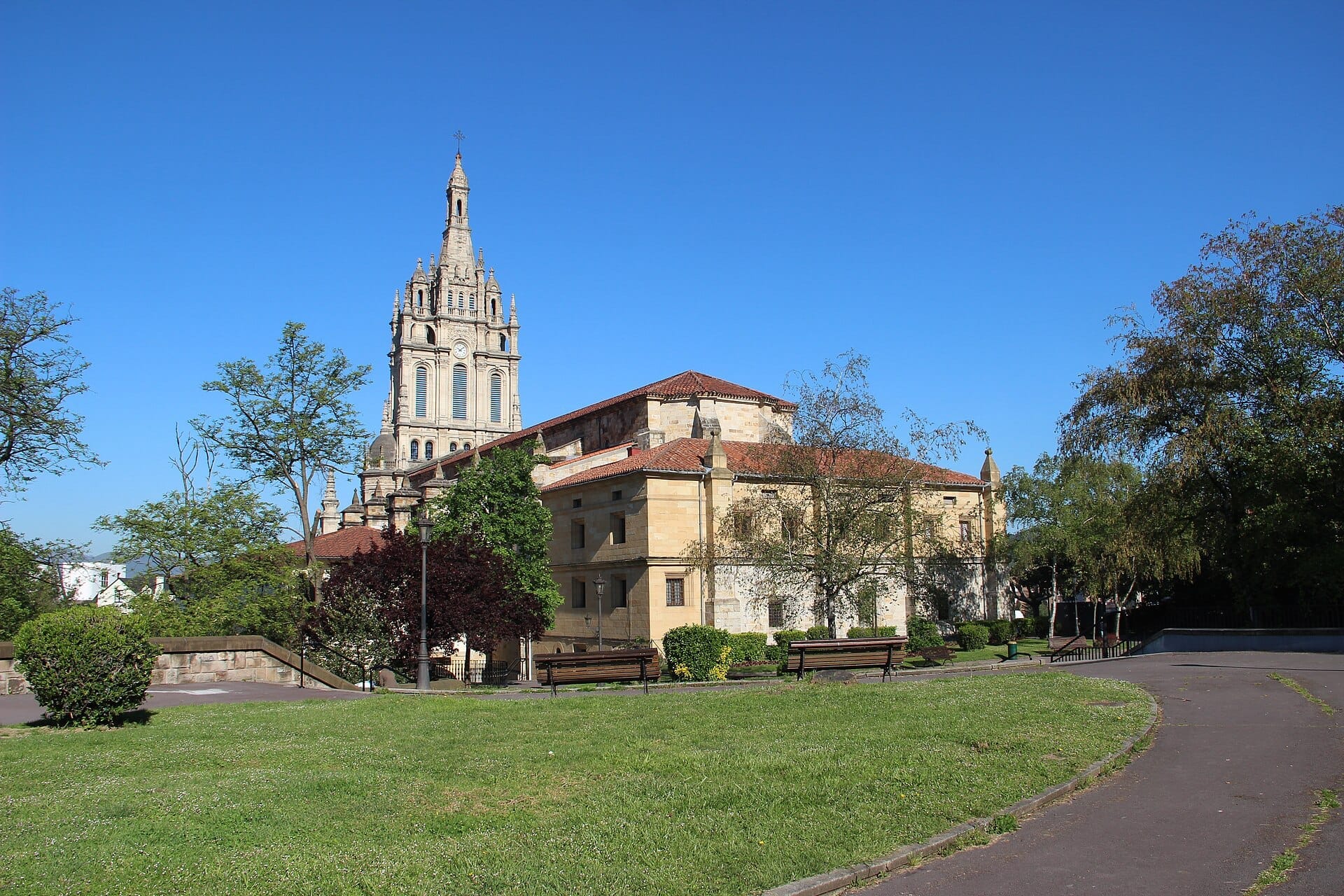
What the Basílica de Begoña Actually Is
The Basílica de Nuestra Señora de Begoña, or Begoñako Basilika in Basque, is one of Bilbao's most significant religious buildings and the seat of devotion to the Virgin of Begoña, the official patron of the province of Biscay. It sits on a prominence above the old town, at an elevation that puts its bell tower in the city's skyline without most visitors realising it's there.
This is not a cathedral in the administrative sense, but it carries the honorary title of basilica and functions as a place of deep, ongoing pilgrimage. Bilbainos bring their children here for baptisms, return for major festivals, and mark significant life events within its walls. For visitors, this means you're entering a working religious site, not a museum. The atmosphere shifts accordingly: quieter, more purposeful, and less performative than many famous churches in Spain.
ℹ️ Good to know
Opening hours vary by source and season. One commonly cited schedule is Monday to Saturday, 08:30–13:30 and 17:00–20:00, with Sundays 09:30–14:00 and 17:00–20:00. Verify current hours locally or via the official website before visiting, as times may change for festivals and religious observances.
The Architecture: Late Gothic in a Basque Context
Construction of the basilica began in the early 16th century, with 1511 widely cited by local heritage sources as the start of building. The structure is late Gothic in character, a style that was already giving way to Renaissance forms elsewhere in Spain but took firm hold in the Basque Country, where Gothic traditions persisted longer. The main body of the church has the solid, slightly austere quality typical of northern Spanish religious architecture: thick stone walls, ribbed vaulting, and narrow windows that keep the interior cool and dim even in summer.
The campanile, the tall bell tower that punctuates the Bilbao skyline when viewed from the right bank of the estuary, was added in the early 20th century, giving the building a slightly composite character. The tower reads as more neo-Gothic than the older fabric, but it integrates well with the overall silhouette.
Inside, the centrepiece is the image of the Virgin of Begoña, housed in a richly decorated retablo. The surrounding stonework is considerably more restrained, which creates a contrast typical of Spanish churches where devotional focal points receive elaborate treatment while the surrounding space remains plain. Look at the vaulting above the nave: the carved keystones and the proportions of the arches give a clear sense of the building's original late Gothic ambition.
If you want to set this basilica in broader context, the Cathedral of Santiago in Casco Viejo makes for an instructive comparison: it's older and more centrally located, but the Basílica de Begoña carries more living devotional weight for locals.
Tickets & tours
Hand-picked options from our booking partner. Prices are indicative; availability and final rates are confirmed when you complete your booking.
San Juan de Gaztelugatxe guided tour from Bilbao
From 65 €Instant confirmationFree cancellationSan Sebastian, Hondarribia, Hendaye, and Getaria from Bilbao
From 54 €Instant confirmationFree cancellationGaztelugatxe and Mundaka small group guided tour from Bilbao
From 50 €Instant confirmationFree cancellationBilbao walking tour
From 16 €Instant confirmationFree cancellation
Getting There: The Climb Is Part of the Experience
The basilica stands on high ground above the Casco Viejo neighbourhood. From the Plaza de Unamuno, the main square at the northern edge of the old town, the standard approach is on foot via a series of steps and steep streets. The walk takes roughly 10 minutes at a moderate pace. The route passes through a quiet residential area that feels genuinely removed from the tourist flow, even though you're only a few minutes from the Seven Streets.
For those with limited mobility, taxis or road access via Avenida Zumalacárregui are the most reliable alternatives to the steps, and practical details of any elevator connections from the Casco Viejo area should be confirmed locally before relying on them. The Santutxu metro station provides an alternative approach from the other side of the hill, reportedly around a 5-minute walk from that exit.
💡 Local tip
Wear shoes with grip. The stone paths and steps leading up to the basilica can be slippery when wet, and Bilbao's climate means rain is possible year-round. This approach is not suitable for pushchairs or wheelchairs without using the lift alternative.
The climb also rewards you with views back over the rooftops of the Casco Viejo and the surrounding hills. These views are best in the morning when the light falls on the old town from the east, and visibility is generally clearer before the afternoon cloud that often builds over Bilbao's hills.
When to Visit and What to Expect
Early morning, before 10:00, the basilica is at its most peaceful. Local worshippers attend morning mass, the stone interior is cool and quiet, and the quality of light through the windows is at its most interesting. If you arrive mid-morning on a weekday, you may have the nave almost to yourself.
Late afternoons are also calm. The midday closure means there's a natural rhythm to visiting: morning or late afternoon works well, mid-afternoon does not. Avoid arriving on the assumption it will be open during the 13:30–16:30 window; it almost certainly won't be.
The Feast of the Virgin of Begoña falls on 11 October, while the major Bilbao festival of Aste Nagusia (Semana Grande) takes place in August. During the feast day in October, the basilica draws significant crowds of pilgrims, masses are more elaborate, and the surrounding area becomes considerably more animated. This is genuinely special to witness, but it is not a quiet experience.
If your Bilbao trip falls during August, this intersection of religious and civic festivity is worth knowing about. Our guide to Bilbao in August and Aste Nagusia covers the full picture of what to expect that week.
Photography and Practical Details
Photography inside the basilica is generally permitted in Catholic churches in Spain unless signs indicate otherwise, but use judgement: during mass or moments of active prayer, it's appropriate to hold off. The exterior is freely photographable from any angle. The best exterior shot, combining the full height of the tower with the main facade, is taken from the small plaza directly in front of the entrance.
For interior photography, the dim lighting means you'll need to shoot without flash (flash photography is typically discouraged) and either use a high ISO setting or accept the atmospheric grain that comes with low-light stone interiors. The retablo is the most photogenic element, particularly when lit for services.
💡 Local tip
The view from the exterior terrace beside the basilica looking back toward the Nervión estuary and the hills beyond Bilbao is worth lingering over. It's not a postcard view of the city's modern face, but it gives a genuine sense of Bilbao's topography and the relationship between the old town and the surrounding landscape.
Admission is free. There is no ticket desk, no timed entry, and no audio guide system.
Cultural Significance: Why This Matters to Bilbao
The Virgin of Begoña has been venerated on this hilltop site since at least the 16th century, with the current structure built over an earlier chapel. For Bilbainos, Begoña is not a historical curiosity but an active part of the city's identity. The patron's image appears on civic symbols, and the feast day draws people who may not attend mass regularly for the rest of the year.
The basilica also sits within the broader history of Basque religious architecture, which combines Iberian Catholic tradition with the particular cultural identity of the Basque people. The Basque Country has its own linguistic and cultural distinctiveness, and religious sites like Begoña operate within that layered identity, not simply as Spanish churches but as Basque ones.
To understand more of how Basque heritage is preserved and interpreted in Bilbao, the Euskal Museoa (Basque Museum) in Casco Viejo is the most direct complement to a visit here, covering the broader history and anthropology of the Basque people in depth.
Who Should Think Twice
Travelers with very limited time who are prioritising Bilbao's contemporary architectural landmarks may find the climb and the visit don't fit naturally into a packed itinerary. The basilica is genuinely rewarding, but it asks something of you: a moderate uphill walk, a willingness to slow down, and an interest in religious and historical context rather than spectacle. If you're looking for dramatic interiors comparable to the great Spanish cathedrals, this will feel modest by comparison.
It is also not an attraction for anyone with significant mobility difficulties unless the lift access from Casco Viejo is confirmed to be operational. The uneven stone paths and steep steps are a real barrier. Always check this in advance if it affects your planning.
Insider Tips
- The steps up from Plaza de Unamuno pass by a handful of small local bars and a bakery. Stopping for a coffee and something from the counter before the climb is a good way to settle into the pace of the neighbourhood before entering the basilica.
- If you time your visit to coincide with one of the regular masses, you'll hear the acoustics of the Gothic nave functioning as they were intended to. The stone carries sound in a way that recorded music and tourist crowds never replicate.
- The exterior plaza in front of the basilica is a genuine local meeting point, particularly on Sunday mornings after mass. Sitting on the steps and watching the rhythm of the neighbourhood for 10–15 minutes gives you more insight into Bilbao than most guided tours will.
- Bring a light layer regardless of the season. The interior is notably cooler than outside in summer and can feel cold in winter. The transition from the warm Bilbao streets to the stone interior is more abrupt than you expect.
- The approach from the Santutxu side is less walked by tourists and passes through a thoroughly residential stretch. If you want to see Bilbao as a working city rather than a curated tourist destination, this route up and the Casco Viejo route down (or vice versa) gives you both perspectives in one visit.
Who Is Basílica de Begoña For?
- Travelers interested in Gothic architecture and religious heritage outside the standard circuit
- Anyone who wants to understand Bilbao's Basque identity beyond the contemporary regeneration story
- Visitors in August who want to witness the living devotional culture of the city during Aste Nagusia
- Photographers looking for quieter, less-staged subjects within easy reach of the old town
- Those who have already covered the main museums and want to add depth rather than more spectacle to their trip
Nearby Attractions
Other things to see while in Casco Viejo (Old Town):
- Church of San Nicolás de Bari
Standing at the gateway to Bilbao's old town, the Iglesia de San Nicolás de Bari is one of the city's most accomplished examples of 18th-century Baroque architecture. Built between 1743 and 1756 to an unusual Greek-cross plan set within a square, it anchors one of the most photogenic corners of the Casco Viejo, steps from the Arenal riverside and Teatro Arriaga.
- Parque de Etxebarria
Covering around 170,000 square metres above Casco Viejo, Parque de Etxebarria is Bilbao's largest park and one of its most rewarding free attractions. Built on the site of a former steel foundry that closed in 1982, it offers sweeping views over the city, open lawns for locals to unwind, and a quiet contrast to the streets below.
- Euskal Museoa (Basque Museum)
Housed in a 17th-century former Jesuit college on Plaza Miguel de Unamuno, Euskal Museoa is Bilbao's oldest and most comprehensive museum of Basque history and culture. With general admission at €10 (reduced €5; under 18 free; free on Wednesdays) and a central Casco Viejo location steps from the metro, it rewards curious travelers who want more than architecture and pintxos. Reopened 10 June 2026 after renovation.
- Mercado de la Ribera
Built in 1929 and spanning 10,000 square metres beside the Nervión estuary, Mercado de la Ribera is one of the largest covered markets in Spain. It combines a working food market with pintxos bars, a riverside terrace, and a history stretching back to the 14th century.