Votivkirche: Vienna's Cathedral of Gratitude
Built to give thanks after a failed assassination attempt on Emperor Franz Joseph I, the Votivkirche is one of the most architecturally ambitious Gothic Revival churches in Europe. Its twin 99-metre spires dominate the northern Ringstrasse, and its interior rewards unhurried visitors with extraordinary stained glass, a medieval altarpiece, and near-total quiet even in peak tourist season.
Quick Facts
- Location
- Rooseveltplatz 8, 1090 Wien (9th District, Alsergrund, facing the Ringstrasse)
- Getting There
- U2 Schottentor (approx. 100 m); Trams 37, 38, 40, 41, 42 at Schottentor; Bus 1A at Schottentor
- Time Needed
- 30–60 minutes for the church; add 45 minutes if visiting the museum (Antwerp Altarpiece)
- Cost
- Church: free. Museum (Antwerp Altarpiece): Adults €8, Seniors & Students €7, Children under 14 free
- Best for
- Architecture lovers, history enthusiasts, photography, quiet contemplation
- Official website
- http://www.votivkirche.at
A Church Born from an Assassination Attempt
On 18 February 1853, a Hungarian tailor named János Libényi lunged at Emperor Franz Joseph I with a knife on the Bastion Walk in Vienna. The blade struck the Emperor's collar, deflected by a metal buckle, and the young monarch survived with only a minor wound. The Habsburg court interpreted the escape as divine intervention, and Archduke Maximilian, the Emperor's brother, launched a public subscription to build a church in thanksgiving. The Votivkirche, formally the Propsteipfarrkirche 'Zum göttlichen Heiland' (Parish Church of the Divine Saviour), was the result.
Construction ran from 1856 to 1879 under the architect Heinrich von Ferstel, who was just 25 years old when he won the design competition. Ferstel drew inspiration from the great Gothic cathedrals of France and the Rhineland, aiming to produce something that could stand alongside them in ambition if not in age. The church was consecrated in 1879, specifically timed to coincide with the silver wedding anniversary of Franz Joseph and Empress Elisabeth. That layered symbolism, gratitude, dynastic celebration, and imperial power made visible in stone, runs through every detail of the building.
ℹ️ Good to know
The church is free to enter. The small museum housing the Antwerp Altarpiece has separate, limited opening hours (Tuesday to Friday 13:00–15:00, Saturday 14:00–17:00) and charges a modest admission fee. Confirm hours directly with the church before visiting, as they can change.
The Architecture: What You Are Actually Looking At
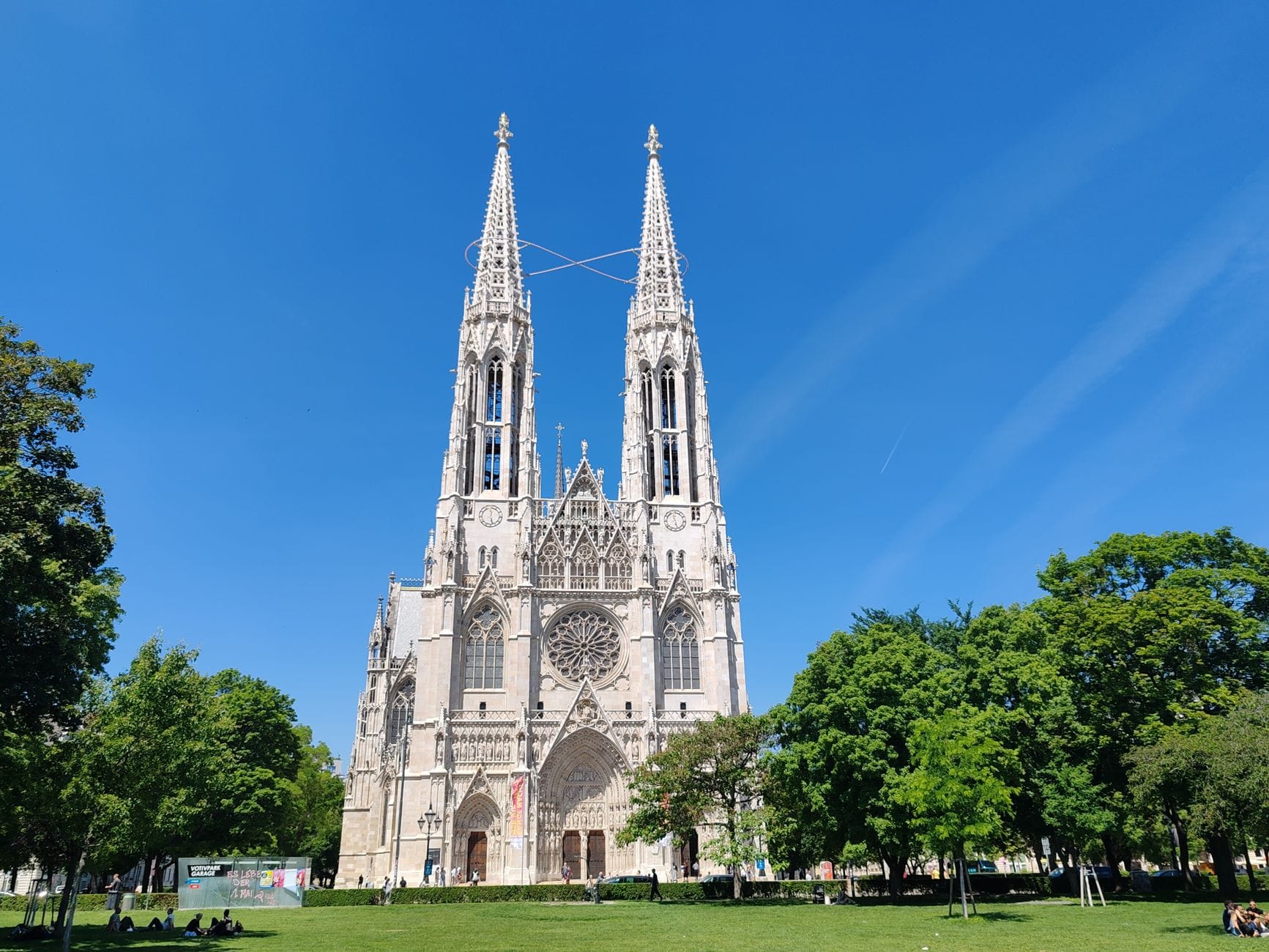
The exterior of the Votivkirche delivers an immediate visual impact from Rooseveltplatz. The two spires reach 99 metres, making this the second-tallest church in Vienna after St. Stephen's Cathedral. Unlike the weathered grey of St. Stephen's, the Votivkirche is built from pale limestone that catches morning light in a way that makes it look almost bleached. The filigree stonework on the spires and the three ornate portal entrances along the facade follows French High Gothic models, with pointed arches, elaborate tracery, and rows of carved figures in the tympana above the doors.
Step inside and the scale shifts perception. The nave is long and narrow, drawing the eye immediately toward the apse. The floor plan follows a classic Latin cross, and the clerestory windows run the full length of the nave at a height that floods the central aisle with coloured light on sunny mornings. The columns are clustered piers of dark stone that contrast sharply with the lighter vaulted ceiling, a deliberate compositional choice that adds vertical drama without heaviness.
The stained glass deserves specific attention. The windows in the choir and transept are among the finest 19th-century examples in Austria, depicting scenes from the life of Christ and the Virgin alongside imperial and aristocratic donors. They were produced by various European workshops, and the colour palette is rich without being garish. For context on how this fits into Vienna's broader architectural heritage, the Vienna architecture guide provides a useful overview of the Ringstrasse building programme that shaped the city during this period.
Tickets & tours
Hand-picked options from our booking partner. Prices are indicative; availability and final rates are confirmed when you complete your booking.
Imperial Vienna 72-hour hop-on hop-off bus
From 55 €Instant confirmationFree cancellationSkip-the-Line Entrance with Guide to Schonbrunn Palace and Gardens
From 45 €Instant confirmationFree cancellationLuggage Storage in Vienna
From 6 €Instant confirmationFree cancellationStrauss Dinner Show
From 99 €Instant confirmationFree cancellation
Opening Hours and the Best Time to Visit
The church is open Tuesday through Friday from 10:00 to 16:00, Saturday from 11:00 to 19:00, and Sunday and church holidays from 09:00 to 13:00. It is closed on Mondays. These hours are subject to change for religious services and special events, so checking in advance is wise.
The best light for the interior falls on sunny mornings, when the stained glass in the south transept throws warm colour across the stone floor. Arrive shortly after opening on a Tuesday or Wednesday and you will likely have long stretches of the nave to yourself. Weekend afternoons bring more visitors and occasional tour groups, though the church is large enough that crowding is rarely a problem. Saturday evenings until 19:00 are an underused window: the late light on the exterior is excellent for photography, and the interior is calm after the mid-afternoon tour groups have moved on.
💡 Local tip
Photography tip: Stand on the central axis of Rooseveltplatz in the late afternoon with the sun slightly behind you and to the west. The pale limestone of the facade picks up warm tones, and the twin spires frame cleanly without needing a wide-angle lens. Early morning offers cooler, more neutral light that renders the tracery detail better.
Inside the Church: A Practical Walkthrough
Entering through the main west portal, you step into a shallow narthex before the full nave opens up. The acoustics are immediately noticeable: footsteps echo, voices carry, and on quiet weekday mornings the ambient sound is reduced to distant traffic and the occasional creak of the wooden choir stalls. It is a genuinely contemplative space regardless of religious affiliation.
Walk the central aisle toward the high altar and take time to look up at the vaulting rather than just ahead. The ribs of the vault branch from the column capitals in a fan pattern that is more complex than it appears from photographs. The high altar itself is a 19th-century neo-Gothic construction, ornate but secondary in visual interest to the windows.
The side chapels along the nave contain a range of devotional objects, memorial plaques, and sculptural work of varying quality. The military chapel is worth a pause: it commemorates Austrian soldiers and contains regimental insignia that document the Habsburg army's multinational character. The Antwerp Altarpiece, housed in the small museum accessible from inside the church, dates to around 1460 and is considered one of the most significant pieces of early Flemish carving in Austria. Its presence in Vienna is the result of 16th-century Habsburg collecting, and the craftsmanship of the figures, rendered in delicate polychrome wood, is remarkable for its age.
Getting There and Navigating the Area
The Votivkirche sits at the northern end of the Ringstrasse boulevard, on the edge of the 9th District (Alsergrund), directly facing the 1st District across Rooseveltplatz. The U2 metro stop Schottentor is roughly 100 metres from the main entrance, making this one of the most transit-accessible churches in Vienna. Tram lines 37, 38, 40, 41, and 42 stop at Schottentor, and bus line 1A also serves the same stop. From the city centre, it is a ten-minute walk along the Ringstrasse from the Burgtheater.
The surrounding neighbourhood transitions from the institutional buildings of the university quarter (the main University of Vienna campus is immediately adjacent) to the residential streets of Alsergrund heading north. If you are combining this with other attractions, the Sigmund Freud Museum is a short walk north along Berggasse, and the Ringstrasse itself is best explored on foot. The Innere Stadt walking tour can be extended to include the Votivkirche as a northern anchor point.
💡 Local tip
Accessibility: Vienna Tourism lists accessibility provisions for the Votivkirche, suggesting adapted access exists. Visitors with specific mobility requirements should confirm details directly with the church before their visit, as conditions in historic religious buildings can vary.
Honest Assessment: Is It Worth Your Time?
The Votivkirche is not a replica or a faded imitation of Gothic architecture. Ferstel's design is a fully realised Neo-Gothic building executed with precision and genuine ambition, and it holds up against its historical models. For anyone with an interest in 19th-century religious architecture or the broader Habsburg building programme that transformed Vienna during the Ringstrasse era, it is a significant stop.
That said, travellers who have already spent time inside St. Stephen's Cathedral and the Karlskirche may find the Votivkirche offers diminishing architectural returns unless they engage with its specific history and the altarpiece museum. It is also not a place with much sensory variety: there is no café, no garden, no surrounding park. The square in front of it (Rooseveltplatz) is a traffic roundabout rather than a pedestrian plaza. The attraction works best as part of a broader Ringstrasse or university-quarter itinerary rather than a standalone destination. For a fuller picture of Vienna's churches, the Vienna churches guide sets it in useful context alongside the city's other major religious buildings.
Visitors who prioritise interior grandeur over exterior spectacle might leave slightly underwhelmed compared to St. Stephen's, simply because the Votivkirche's nave is narrower and its interior furnishings are less historically layered. Those who approach it as a piece of deliberate architectural scholarship, which is precisely what it was intended to be, will find it rewarding.
Seasonal Considerations
Vienna's winters are cold and often grey, and the exterior of the Votivkirche in overcast conditions loses the warmth that makes it photogenic in better light. The interior, however, is equally worth visiting year-round, and the church provides genuine shelter on cold days. In summer, the surrounding university district fills with students and the outdoor seating of nearby cafés, which gives the walk from Schottentor more life. For broader seasonal planning, the best time to visit Vienna guide covers the trade-offs across all seasons.
Insider Tips
- The Votivkirche is often quieter than St. Stephen's Cathedral even on busy tourist days. If you want a large Gothic interior without tour-group crowds, arrive here on a Tuesday or Wednesday morning shortly after 10:00.
- The Antwerp Altarpiece museum has very restricted opening hours (Tuesday to Friday 13:00–15:00, Saturday 14:00–17:00). If this is your primary reason for visiting, plan your schedule around it first, then build the rest of your day accordingly.
- The best exterior photograph of the full facade requires standing at the far end of Rooseveltplatz, but the square is a working traffic roundabout. Cross carefully and use the central pedestrian island for an unobstructed line of sight to both towers.
- Late Saturday afternoon (after 16:00) is one of the least-visited windows in the week. The church remains open until 19:00, and the combination of low visitor numbers and warm late-day light through the stained glass is genuinely striking.
- The university campus directly adjacent to the church holds a small arcaded courtyard with memorial busts of distinguished faculty. It is free to enter during university hours and makes a quiet ten-minute detour before or after the church.
Who Is Votivkirche For?
- Architecture enthusiasts interested in 19th-century Gothic Revival and the Ringstrasse building programme
- History-minded travellers who want to trace the Habsburg imperial narrative beyond the Hofburg
- Photographers looking for a dramatic exterior shot without the crowds that surround St. Stephen's
- Visitors interested in medieval art, specifically the Antwerp Altarpiece dating to around 1460
- Travellers who want a moment of genuine quiet in a monumental space without paying an entry fee
Nearby Attractions
Other things to see while in Innere Stadt (1st District):
- Albertina Museum
Housed in a former Habsburg palace at the edge of the Ringstrasse, the Albertina holds one of the largest and finest graphic art collections in the world. With over one million drawings and prints alongside rotating exhibitions of modern masters, it rewards both the casual visitor and the serious art traveler.
- Austrian National Library (Prunksaal State Hall)
The Prunksaal, or State Hall of the Austrian National Library, is a Baroque masterpiece built for Emperor Charles VI between 1723 and 1726. At roughly 80 metres long and crowned by Daniel Gran's sweeping ceiling frescoes, it is one of the most visually arresting interiors in central Europe, and still holds around 200,000 historic volumes in its carved walnut shelves.
- Burgtheater
The Burgtheater is Austria's national theatre and one of the most significant German-language stages in the world. Its Neo-Renaissance building on Vienna's Ringstraße dates to 1888, and its institutional history stretches back to the court of Empress Maria Theresa. Whether you come for a performance or a guided tour, it rewards attention.
- Café Central
Housed inside the Palais Ferstel in Vienna's historic first district, Café Central has been serving coffee and conversation since 1876. Once the gathering point for Freud, Trotsky, and a constellation of Central European intellectuals, it remains one of the most architecturally remarkable coffeehouses in the world.