Union Station Great Hall: Chicago's Most Magnificent Room You Can Visit for Free
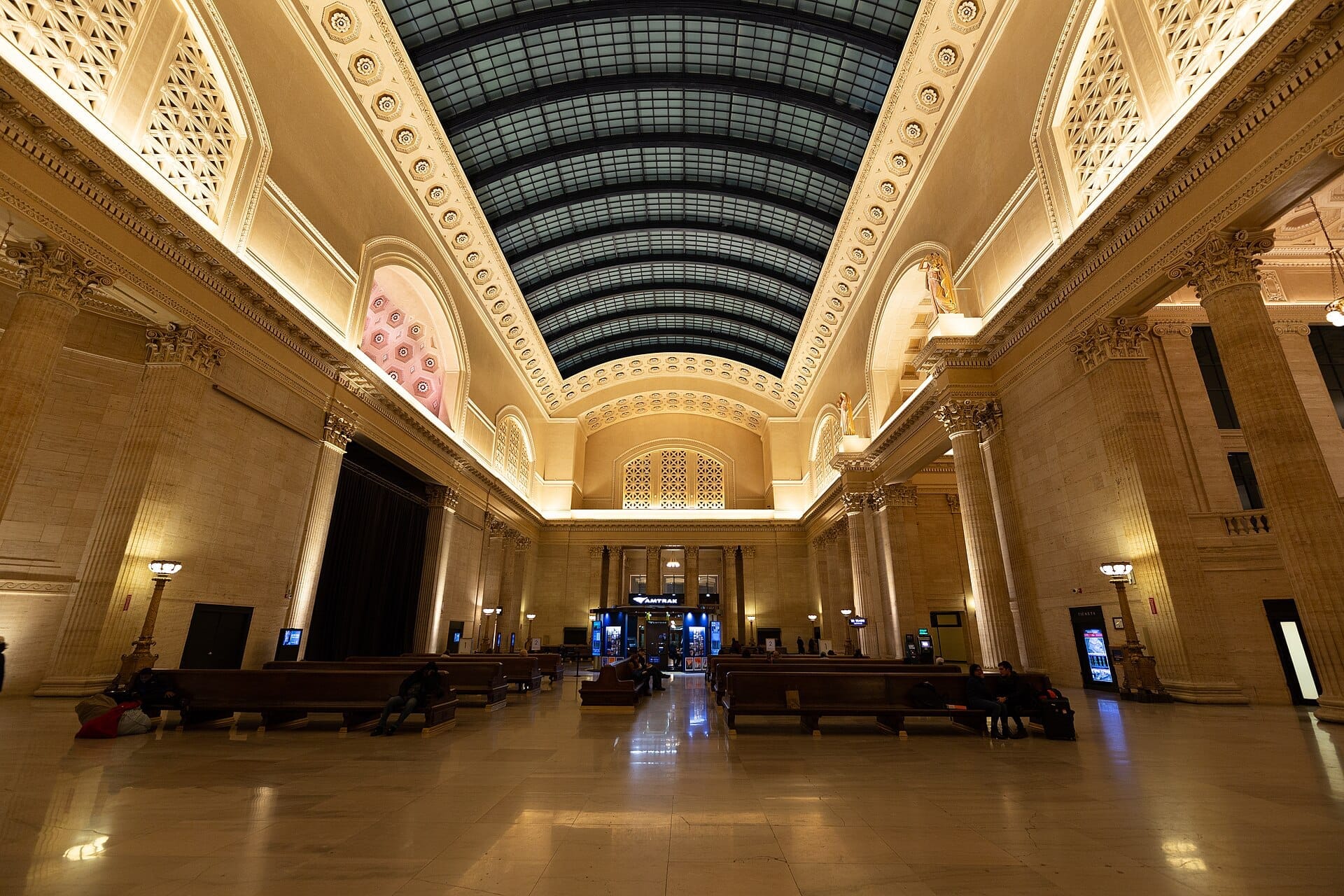
The Great Hall at Chicago Union Station is one of the finest Beaux-Arts interiors in North America. Completed in 1925 and fully restored in 2019, it features a 219-foot barrel-vaulted skylight soaring 115 feet above a marble-columned waiting room that still serves real travelers every day.
Quick Facts
- Location
- 500 W. Jackson Blvd, Chicago, IL (West Loop Gate)
- Getting There
- Metra & Amtrak at Union Station; CTA buses on Canal St & Jackson Blvd
- Time Needed
- 20–45 minutes for the Great Hall alone
- Cost
- Free to enter as a public waiting room (no ticket required)
- Best for
- Architecture lovers, history buffs, photographers, commuters with a few minutes to spare
- Official website
- chicagounionstation.com
What Is the Great Hall, and Why Does It Matter?
The Great Hall is the central waiting room of Chicago Union Station, located inside the station's headhouse at 500 W. Jackson Blvd in the West Loop Gate area. It is not a museum, not a ticketed exhibit, and not a reconstruction. It is a functioning railroad terminal that happens to contain one of the grandest civic interiors in the United States, and you can walk in off the street for free.
The hall stretches 219 feet in length beneath a barrel-vaulted skylight that peaks 115 feet above the marble floor. Corinthian columns line both sides. Ornate plasterwork fills the upper registers. The light that falls through the skylight changes quality entirely depending on the hour and the season, shifting from pale winter gray to warm afternoon gold. On clear summer days the entire room seems to glow from above.
The station was originally conceived by legendary Chicago architect Daniel Burnham as part of his ambitious urban planning vision, then completed after his death by the firm Graham, Anderson, Probst & White. It opened in 1925, after construction delays caused by World War I. The architectural style is Beaux-Arts classicism, the same tradition that produced Grand Central Terminal in New York and Washington Union Station. If you want deeper context on how this building fits into Chicago's architectural legacy, the Chicago architecture guide covers the city's major movements and key buildings.
ℹ️ Good to know
The Great Hall may occasionally be closed or restricted for private events. If your visit is specifically timed around the interior, check with Amtrak or the station before you go. Most weekday mornings it is reliably open and busy with commuters.
The History Behind the Space
When Union Station opened in 1925, it was one of the busiest passenger rail hubs in the world. Chicago sat at the crossroads of nearly every major rail line in the country, and this station was the physical expression of that centrality. The Great Hall was designed to project power and permanence, the architectural equivalent of a promise that American rail travel was here to stay.
The following decades were less kind. Passenger rail declined sharply after World War II as automobiles and commercial aviation took over. The station was sold, modified, and subdivided. Amtrak took over operations in 1971, and for years the building existed in a state of partial neglect. The great skylight was covered over, obscuring the hall's signature quality of light. It became one of those places where you could sense something magnificent beneath the grime, but had to work to imagine it.
Chicago designated the station an official landmark in 2002, and a serious $22 million restoration of the Great Hall was completed in 2019. The skylight was reopened and reglazed, the original paint colors were researched and reapplied, and the structural fabric was comprehensively repaired. The result is as close to the 1925 original as modern conservation allows. What you see today is not a nostalgic approximation; it is a genuinely restored historic interior at something near its peak condition.
Tickets & tours
Hand-picked options from our booking partner. Prices are indicative; availability and final rates are confirmed when you complete your booking.
Six Flags Great America admission tickets
From 50 €Instant confirmationGo City | Chicago All-Inclusive Pass
From 127 €Instant confirmationFree cancellationiFLY Chicago Lincoln Park indoor skydiving experience
From 126 €Instant confirmationFree cancellationiFLY Chicago Rosemont indoor skydiving tickets
From 117 €Instant confirmationFree cancellation
What It Actually Feels Like to Visit
Enter through the main entrance on Canal Street and the transition is immediate. The street noise drops. The scale shifts. The hall opens ahead of you with the kind of spatial generosity that modern buildings almost never attempt. Your eye goes upward instinctively, drawn to the vault of glass and plaster overhead.
The floor is populated with travelers at nearly every hour: commuters moving quickly with rolling bags, Amtrak passengers waiting with stacked luggage, tourists standing still and looking up. The wooden benches running down the center of the hall are original, or faithful reproductions, and they are always occupied. The ambient sound is a soft, constant murmur, voices and footsteps absorbed and diffused by the high ceiling so that the room never feels loud despite the volume of people passing through.
Mornings from roughly 7 to 9 a.m. are the most kinetic. Metra commuters stream through in waves timed to train arrivals, and the hall reaches something close to controlled chaos. It is spectacular to watch if you are not in a rush. By mid-morning the crowd thins dramatically. Midday on a weekday offers the most peaceful conditions for photographs and unhurried looking. Late afternoons pick up again with the reverse commute.
💡 Local tip
For photography, arrive between 10 a.m. and noon on a clear day. The skylight produces the best diffused overhead light at midday, and the crowd is thin enough to compose clean wide shots of the floor and vault without a sea of rolling luggage in frame.
Getting There and Getting In
Union Station sits at 500 W. Jackson Blvd, just west of Canal Street, on the western edge of downtown Chicago. It is one of the most accessible points in the city. Multiple Metra commuter rail lines terminate here, and Amtrak's long-distance trains, including the California Zephyr, the Empire Builder, and the Cardinal, all use this station. If you are arriving in Chicago by train, you will already be standing in the Great Hall.
If you are visiting independently, several CTA bus routes serve Canal Street and Jackson Boulevard directly. The CTA 'L' does not stop at Union Station itself, but the Blue Line's Clinton station and the Brown, Orange, Purple, and Pink lines' Quincy station are each a short walk away. For broader guidance on navigating Chicago's transit network, see getting around Chicago.
There is no admission charge to enter the station or the Great Hall as a member of the public. You do not need a train ticket. Walk in from the Canal Street entrance and you are in the headhouse lobby. The Great Hall is the large room straight ahead. The entire visit from street to exit can be done in under 30 minutes if you are efficient, though most architecture-minded visitors spend 40 to 45 minutes exploring the main hall and the surrounding concourse areas.
Architectural Details Worth Seeking Out
The barrel vault is the dominant feature, but look beyond it. The Corinthian capitals on the columns are fully carved, not cast approximations. The plasterwork in the lunettes at each end of the hall is original, depicting allegorical figures consistent with the Beaux-Arts tradition of embedding symbolic content in public buildings. The floor surface is travertine and marble, worn in places to a polish that newer stone cannot fake.
The scale is disorienting in a productive way. Stand at one end of the hall and look toward the other. The perspective compression makes the far wall feel closer than it is. Walk the full length and the room keeps unfolding. This is a deliberate Beaux-Arts technique: the proportions are calibrated to make the space feel ceremonial and continuous rather than merely large.
If the Great Hall sharpens your appetite for Chicago's broader architectural landscape, the Chicago Architecture Foundation River Cruise offers a guided two-hour tour from the Chicago River that covers the city's skyline in detail, with informed commentary on buildings across multiple eras and styles.
Practical Notes for Visitors
The Great Hall is accessible to visitors with mobility limitations. The station provides step-free access routes and accessible waiting areas consistent with federal rail accessibility standards. Travelers with specific requirements should confirm current details with Amtrak or station management before their visit, as operational configurations can change.
There are food and beverage options inside the station's lower concourse level, including a range of quick-service options. These are functional rather than destination-worthy, but useful if you are combining a Great Hall visit with an onward train journey.
The station is at the western edge of the Loop, which puts it close to several other major sights. Millennium Park and Cloud Gate are roughly a 15-minute walk east. The Chicago Riverwalk begins just a few blocks north. If you are building a full day in the downtown core, the Great Hall makes a natural starting or ending point.
⚠️ What to skip
The Great Hall is occasionally closed to the general public for private events, particularly on weekend evenings. If you are planning a special trip solely to see the interior, call ahead or check the station's event calendar to avoid a wasted journey.
An Honest Assessment: Is It Worth Your Time?
For anyone with even a passing interest in architecture or American urban history, yes, without qualification. The Great Hall is a legitimate architectural masterpiece, fully restored, free to enter, and still in active daily use. That combination is genuinely rare. Most spaces of this quality are either ticketed museums or off-limits to casual visitors.
For travelers with no particular interest in architecture, the case is more conditional. If you are arriving or departing by Amtrak or Metra, you will pass through it anyway, and the scale will likely stop you in your tracks regardless of prior interest. If you would need to travel specifically to see it, weigh that against your broader itinerary. It is not a half-day attraction. But if you are already nearby, the detour is measured in minutes, not hours.
Travelers who love this kind of space will often also appreciate the Chicago Cultural Center, another free Beaux-Arts public interior in the Loop with Tiffany glass domes, and the Rookery Building, a few blocks east, whose Frank Lloyd Wright-redesigned light court represents a different but equally serious architectural achievement.
Insider Tips
- The best unobstructed view of the full barrel vault is from either end of the hall, standing near the walls and looking lengthwise. The center benches are too low and too crowded to give you the full perspective.
- Weekday mornings between 8 and 9 a.m. during peak commute produce a genuinely cinematic scene: thousands of commuters streaming through beneath the vaulted ceiling. It is worth experiencing even if you are not photographing.
- The Great Hall's acoustics are unusual. Walk to the far corners near the columns and listen: the ambient sound of the room is absorbed in ways that feel almost church-like compared to the concourse below.
- The lower concourse level, accessed by stairs or elevator from the Great Hall, is a utilitarian space in sharp contrast to the headhouse above. It is worth a quick look simply to understand the full scale and layering of the station.
- If you visit during the winter holiday season, the station sometimes installs seasonal decorations in the Great Hall that interact well with the skylight. The effect is worth seeking out if you are in Chicago in December.
Who Is Union Station Great Hall For?
- Architecture enthusiasts who want a Beaux-Arts interior on par with anything on the East Coast
- Photographers looking for dramatic light, scale, and human movement in a single frame
- History-focused travelers interested in the railroad era and Chicago's role as America's rail hub
- Budget-conscious visitors: this is one of the most impressive free interiors in Chicago
- Train travelers arriving at or departing from Chicago who want to make the most of their time in the station
Nearby Attractions
Other things to see while in The Loop:
- Art Institute of Chicago
One of the largest and most visited art museums in the United States, the Art Institute of Chicago anchors the eastern edge of the Loop with a collection of over 300,000 works spanning 5,000 years. From Georges Seurat's pointillist masterpiece to Grant Wood's American Gothic, the highlights alone demand the better part of a day.
- Buckingham Fountain
The Clarence Buckingham Memorial Fountain is one of the largest decorative fountains in the world, sitting at the heart of Grant Park since 1927. Free to visit during its seasonal run from spring through mid-October, it puts on hourly water displays and a nightly illuminated show that draws crowds from across the city.
- Chicago Architecture Center
Housed in Mies van der Rohe's One Illinois Center on the Chicago River, the Chicago Architecture Center packs nearly 10,000 square feet of exhibition space, a landmark scale model of the city, and access to some of the country's most informative architecture tours. It's the most comprehensive entry point into understanding what makes Chicago's skyline one of the world's most significant.
- Chicago Architecture Foundation River Cruise
The Chicago Architecture Center River Cruise aboard Chicago's First Lady is the most authoritative way to read the city's skyline. In 90 minutes, trained docents walk you through more than 40 landmark buildings across all three branches of the Chicago River, connecting architectural styles to the human decisions that shaped them.