San Francisco Columbarium: The City's Forgotten Architectural Treasure
Built in 1898 and tucked at the end of a quiet residential cul-de-sac, the San Francisco Columbarium is an ornate neo-classical rotunda holding the ashes of thousands of San Franciscans. Free to visit and genuinely unlike anything else in the city, it rewards curious travelers with stained glass, Victorian memorials, and an unexpectedly peaceful atmosphere.
Quick Facts
- Location
- 1 Loraine Court, Richmond District, San Francisco, CA 94118
- Getting There
- Muni bus lines 38 (Geary) or 38R/38BX variants to Geary & Arguello; short walk to Loraine Court
- Time Needed
- 45 minutes to 1.5 hours
- Cost
- Free admission; confirm any guided tour fees directly with the Columbarium
- Best for
- Architecture lovers, history enthusiasts, photography, quiet reflection
What the San Francisco Columbarium Actually Is
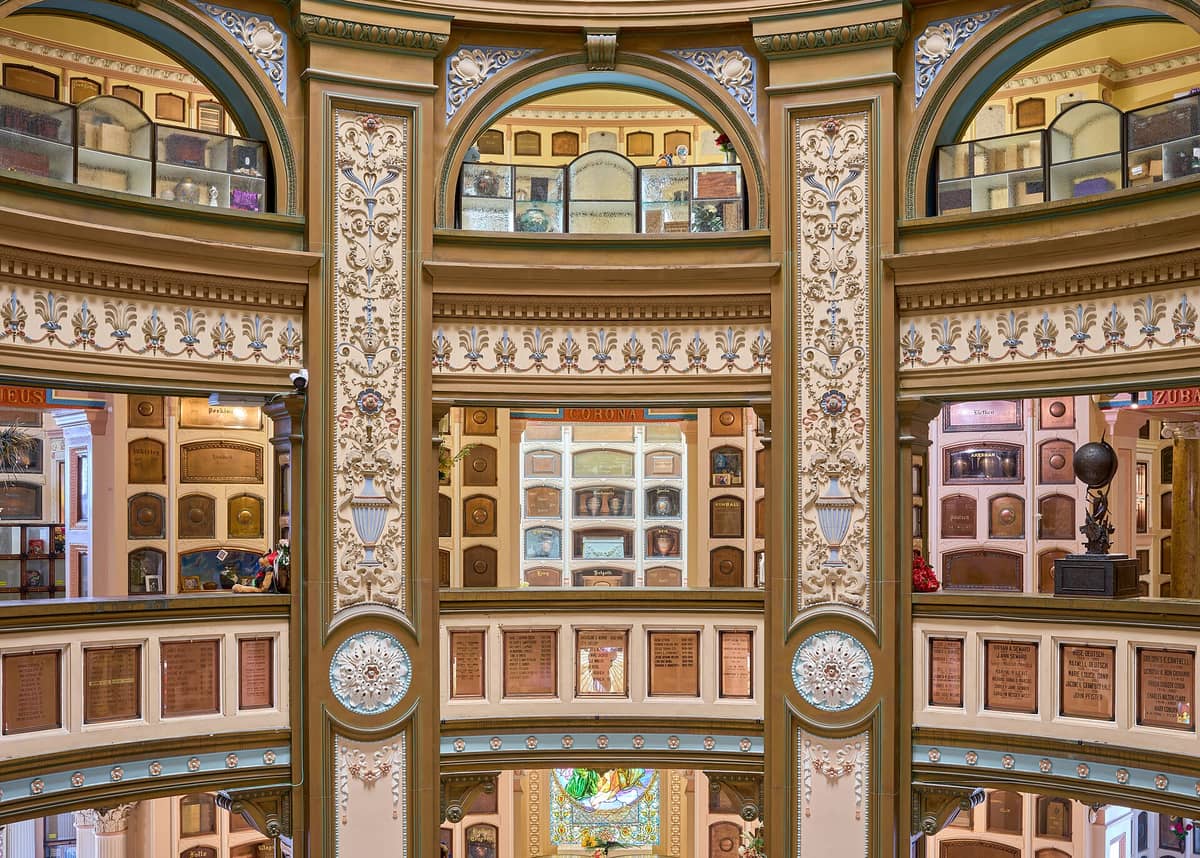
The San Francisco Columbarium is not a cemetery in any conventional sense. There are no headstones, no lawns, no outdoor grounds to wander. What you find instead is a four-story rotunda of cream-colored stone, designed by architect Bernard J. S. Cahill and completed in 1898, holding thousands of funerary niches stacked floor to ceiling inside a soaring copper-domed interior. The building functions as an active funeral home and place of interment, operated today as part of the Dignity Memorial network, and it remains San Francisco's only non-denominational public columbarium.
The structure sits at the end of Loraine Court, a short residential cul-de-sac in the Inner Richmond, and approaching it for the first time produces a mild double-take. You turn off Arguello Boulevard past modest houses and then the Columbarium appears, formal and imposing, flanked by a manicured circular forecourt. The contrast with its surroundings is striking. This is not signposted from the main road, and the lack of any fanfare is part of what makes the visit feel like a genuine discovery rather than a tick-box attraction.
💡 Local tip
The building is open to the public Monday through Friday 9:00 a.m. to 5:00 p.m., with weekend visiting hours commonly listed as Saturday through Sunday 10:00 a.m. to 3:00 p.m. Hours can vary; call ahead before making a special trip, especially on weekends or public holidays.
The Architecture and Interior
Cahill designed the building in a neo-classical style, and the exterior reads as restrained and official, a dignified civic gesture in terracotta and stone. But step through the front entrance and the interior opens into something far more atmospheric. The rotunda rises four stories, each gallery ringed by niches of different sizes, most sealed with glass panels behind which sit urns, photographs, flowers, small toys, letters, and personal keepsakes. The cumulative effect is of a vertical archive of individual lives.
Natural light enters through a series of stained glass windows, some original Victorian pieces, others more recent replacements, and on a bright San Francisco morning the light filters across the polished marble floors in amber and green tones. The dome above the central well focuses sound in unexpected ways; footsteps and low voices carry upward in a soft echo that discourages anything but quiet conversation.
The niche decorations are the real draw for most visitors. Some panels are spare, a plain urn and a name plate. Others are densely personal: a niche belonging to a former San Francisco drag performer is decorated with feather boas and photographs; another holds a baseball mitt and a worn copy of a batting average card. Taken together, these small displays form an unplanned folk-art exhibition on what people value and how they want to be remembered.
The building's history intersects with one of San Francisco's more unusual civic decisions. In 1900, the city banned burials within city limits and eventually ordered all cemeteries relocated, primarily to Colma, the small San Mateo County city south of San Francisco that became known for its ratio of the dead to the living. The Columbarium survived because it holds cremated remains in sealed niches rather than traditional grave plots, and it was eventually saved from demolition through preservation efforts. For more on how this shaped San Francisco's relationship with its past, the San Francisco architecture guide provides useful context on surviving Victorian-era structures across the city.
Tickets & tours
Hand-picked options from our booking partner. Prices are indicative; availability and final rates are confirmed when you complete your booking.
Sonoma and Napa Valley wine tour from San Francisco
From 127 €Instant confirmationFree cancellationGo City | San Francisco Explorer Pass
From 76 €Instant confirmationFree cancellationSan Francisco CityPASS
From 77 €Instant confirmationFree cancellationThe Flyer San Francisco - “Flying Theater experience”
From 12 €Instant confirmationFree cancellation
How the Experience Changes by Time of Day
Weekday mornings before noon offer the quietest conditions. The office staff are present but unobtrusive, and on most days you can have entire floors of the building to yourself. The light through the stained glass is at its best on sunny mornings between 9:00 and 11:00 a.m., when it falls directly through the east-facing windows. The temperature inside is consistently cool regardless of weather outside, so a layer is worth bringing even in warmer months.
Weekend afternoons, particularly Saturday, bring a modest increase in visitors, often including small groups doing informal tours. The building never feels crowded in the way that popular city attractions do, but the reflective quality of the space is best preserved when you're not sharing it with a group. If you're arriving on a Saturday, 10:00 a.m. at opening tends to be the most peaceful window before midday visitors arrive.
San Francisco's marine layer rarely penetrates the interior, but an overcast day outside does reduce the quality of light coming through the stained glass considerably. If photography is a priority, check the forecast and aim for a clear morning.
Getting There and Finding It
The Inner Richmond location means the Columbarium is not on most tourist circuits, which is precisely why it remains uncrowded. From the Geary and Arguello intersection, walk one block north on Arguello Boulevard, then turn left onto Anza Street and look for the Loraine Court sign on your right. The walk from the bus stop is under five minutes.
The 38 Geary bus runs frequently along Geary Boulevard, one of Muni's busiest corridors, and connects directly from downtown and Union Square. If you're coming from Golden Gate Park to the south, the 44 O'Shaughnessy provides a reasonable alternative. Street parking on Arguello and Anza is available but subject to San Francisco's two-hour limits on most blocks; read signs carefully.
ℹ️ Good to know
The Columbarium sits at the end of a cul-de-sac and is not visible from any main road. If you're navigating by smartphone, enter '1 Loraine Court' rather than searching for the building name, which some map apps route inconsistently.
Photography and What to Photograph
The interior is genuinely photogenic, and photography is permitted for personal use. The best compositions tend to involve the central rotunda shot from the ground floor looking up, with the stained glass windows and the circular gallery railings creating strong geometric lines. A wide-angle lens or the ultrawide setting on a smartphone captures the full height of the dome. Handheld low-light shooting is manageable, though a phone with good computational photography handles the mixed light sources better than a camera with a slow kit lens.
Individual niche photographs raise a question of etiquette. Most visitors treat the more personal displays with discretion, and photographing them closely without any reflective intent feels out of place in the context of the building. That said, the Columbarium is an active attraction partly because of these personal displays, and staff have not historically discouraged photography. Use judgment.
Broader Context: Where to Go Before or After
The Columbarium pairs naturally with the Inner Richmond and its surroundings. The Golden Gate Fortune Cookie Factory in nearby Chinatown makes for a contrasting afternoon if you're willing to take a bus. More logically, the Columbarium is a short drive or a fifteen-minute walk from the northern edge of Golden Gate Park, making it a practical add-on if you're visiting the de Young Museum or the Conservatory of Flowers on the same day.
If the Columbarium's quiet reflective quality appeals to you, Sutro Baths at Lands End offers a similarly atmospheric, off-the-main-drag experience with interesting historical layering, though it's entirely outdoor and requires a short hike. Visitors putting together a thoughtful first-time itinerary may also find the San Francisco hidden gems guide useful for building a day around less-visited sites like this one.
Who Should Not Bother
The San Francisco Columbarium is not for everyone, and that's not a criticism. Visitors whose primary interest is panoramic views, food markets, or waterfront energy will find nothing here that speaks to those interests. Children old enough to understand the context often find it genuinely interesting, but very young children may find it confusing or unsettling. Anyone with severe mobility limitations should call ahead before visiting, as no detailed public accessibility documentation exists online and the internal galleries involve staircases.
The building is also sometimes described, including by well-meaning guidebooks, in terms that oversell its spectacle. It is not grand in the way that a cathedral is grand. It is intimate, specific, and quietly surprising. Travelers who prefer experiences that feel measured in scale will respond to it; those who want maximum visual drama should plan their time elsewhere.
Insider Tips
- Ask the office staff about guided tours when you arrive; informal tours are sometimes available on weekdays and cover the historical background of the building's survival through San Francisco's cemetery-removal era in ways that significantly deepen the visit.
- The fourth-floor gallery is the least visited and often the quietest. It also offers the best overhead view of the central rotunda floor and the most unusual niche arrangements. Most casual visitors stop at the second or third floor.
- Bring a jacket regardless of the weather outside. The interior is maintained at a consistent cool temperature and the stone floors amplify the chill on foggy days.
- If you're interested in a specific person interred here, the staff can usually direct you to the correct niche location. A number of figures from San Francisco's civic and entertainment history are interred at the Columbarium, and the staff are generally knowledgeable about them.
- Street parking on Loraine Court itself is extremely limited. Park on Arguello Boulevard or Anza Street and walk the short distance rather than circling for a close spot.
Who Is San Francisco Columbarium For?
- Architecture and design enthusiasts interested in late Victorian neo-classical structures
- Travelers who appreciate slow, contemplative experiences rather than high-volume attractions
- Photography focused visitors who want interior light and geometry rather than outdoor scenery
- History-minded visitors curious about San Francisco's unusual relationship with its own burial traditions
- Anyone building a full day in the Inner Richmond or combining with a Golden Gate Park visit
Nearby Attractions
Combine your visit with:
- 16th Avenue Tiled Steps
The 16th Avenue Tiled Steps Project is a community-made mosaic staircase of 163 steps stretching through San Francisco's Golden Gate Heights neighborhood (a sub-area of the Inner Sunset), depicting a journey from the ocean floor to the night sky. It's free, photogenic, and connects to one of the city's best lesser-known hilltop viewpoints.
- Angel Island State Park
Angel Island State Park sits in the middle of San Francisco Bay, offering miles of hiking trails, layers of military and immigration history, and 360-degree views of the city skyline, Marin headlands, and beyond. Getting there requires a ferry, which is part of the appeal — the island feels removed from city life, even though San Francisco is visible the entire time.
- Asian Art Museum of San Francisco
One of the largest Asian art collections in the Western world, housed in a transformed Beaux-Arts landmark at Civic Center. From ancient Chinese bronzes to contemporary Southeast Asian installations, the museum rewards careful visitors who know what to look for.
- UC Berkeley Campus
The University of California, Berkeley sits on a hillside above San Francisco Bay, offering free access to striking Beaux-Arts architecture, landmark museums, and open green spaces. A short BART ride from San Francisco, it rewards curious visitors with history, intellectual energy, and some of the best campus scenery in the country.