UC Berkeley Campus: A Practical Guide to Visiting One of America's Great Universities
The University of California, Berkeley sits on a hillside above San Francisco Bay, offering free access to striking Beaux-Arts architecture, landmark museums, and open green spaces. A short BART ride from San Francisco, it rewards curious visitors with history, intellectual energy, and some of the best campus scenery in the country.
Quick Facts
- Location
- Berkeley, CA 94720 — East Bay, approx. 7 miles north of downtown Oakland
- Getting There
- BART to Downtown Berkeley Station; Sather Gate is a short walk east along Center Street or Allston Way
- Time Needed
- 2–4 hours for a walking tour of central campus; half a day if visiting museums
- Cost
- Campus grounds: free. Individual museums and events charge separate admission — check each venue
- Best for
- Architecture lovers, history enthusiasts, families, and anyone curious about California's public university tradition
- Official website
- www.berkeley.edu
What You're Actually Visiting
The University of California, Berkeley — commonly called UC Berkeley or simply Cal — is not a museum or a park. It is a working research university founded in 1868 as the founding campus of the University of California system. That distinction matters for visitors: this is a place of real academic life, not a preserved showpiece. On any given weekday, thousands of students move between Beaux-Arts stone buildings and modern research complexes, bicycles thread through Sproul Plaza, and the smell of eucalyptus drifts down from the wooded hills to the east.
The central campus covers roughly 178 acres of the total 1,232-acre Berkeley campus property. That central section — bounded by Oxford Street to the west and rising toward the hills — holds most of what visitors come to see: Sather Gate, the Campanile tower, the Greek Theatre, landmark plazas, and two notable museums (admission charged separately). The grounds are generally open at all hours, and walking through them costs nothing.
💡 Local tip
Getting there from San Francisco is straightforward: take BART from any downtown SF station on a Richmond-bound train and exit at Downtown Berkeley. The main campus entrance near Sather Gate is roughly a 10-minute walk east. Check BART's current fare tables before you go, as fares are distance-based.
The Architecture: Stone, Campaniles, and the California Ideal
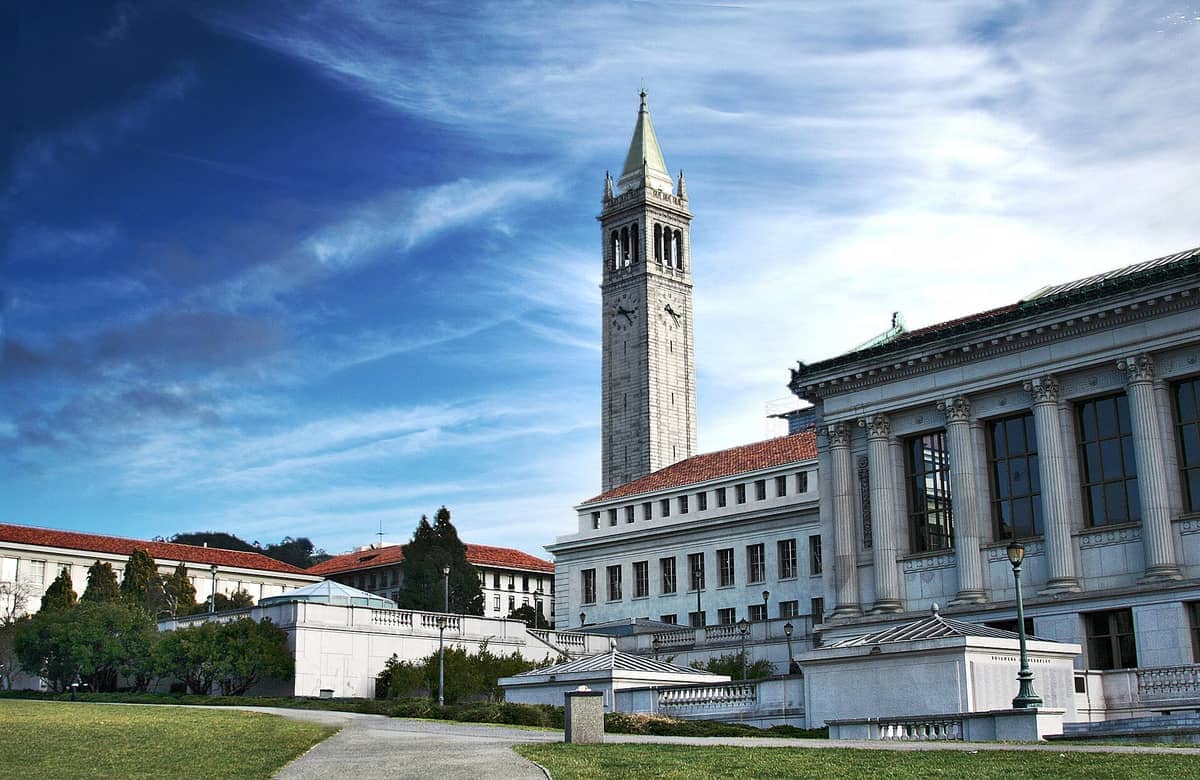
The core of the campus was designed in the early 20th century by architect John Galen Howard under a Beaux-Arts master plan. Walking through Sather Gate — a bronze-and-granite arch donated in 1910 — into the heart of campus, the visual logic becomes clear immediately: formal stone buildings arranged around open pathways, with Strawberry Creek running between them and the Berkeley Hills providing a green backdrop to the east.
The Sather Tower, known as the Campanile, is the campus's most recognizable structure. Standing 307 feet tall and modeled after the campanile in St. Mark's Square in Venice, it offers an observation deck with panoramic views across the Bay Area: San Francisco's skyline, the Golden Gate, the Bay Bridge, and on clear days, Mount Tamalpais to the north. The tower also houses a carillon of 61 bells, and the chimes can be heard across much of the campus at the quarter-hour. Verify current access and ticket prices for the observation deck directly with the university, as these can change.
For visitors who appreciate urban architecture in context, the campus connects naturally to a broader conversation about California's built heritage. The Hearst Mining Building, Doe Memorial Library, and Wheeler Hall are all worth pausing at, even from the outside. If you're already interested in Bay Area architectural history, UC Berkeley makes a natural companion stop to San Francisco's civic buildings — something covered in the San Francisco architecture guide.
Tickets & tours
Hand-picked options from our booking partner. Prices are indicative; availability and final rates are confirmed when you complete your booking.
Sonoma and Napa Valley wine tour from San Francisco
From 127 €Instant confirmationFree cancellationGo City | San Francisco Explorer Pass
From 76 €Instant confirmationFree cancellationMuir Woods and Sausalito guided tour with transportation
From 82 €Instant confirmationFree cancellationSan Francisco CityPASS
From 77 €Instant confirmationFree cancellation
Sproul Plaza and the Political History You're Standing On
Between Sather Gate and Telegraph Avenue lies Sproul Plaza, a wide open expanse of concrete and stone that functions as the campus's social and political nerve center. In the 1960s, this was the stage for the Free Speech Movement, a student-led protest that began in 1964 and became one of the catalysts for the broader campus activism that defined that decade in American life. Mario Savio's address from the steps of Sproul Hall in December 1964 is still widely quoted.
Today Sproul Plaza is where student organizations table, musicians busk, and the general noise of student life fills the air. On weekday mornings between 9 and 11am, it's dense with foot traffic and energy. Later in the afternoon it thins. On weekends during the academic year, it's quieter but not empty. During finals and university breaks, you'll find it near-deserted, which has its own appeal if you want to photograph the architecture unobstructed. The contrast between Sproul's activist history and its current role as an everyday transit space between the BART exit and the campus core is interesting to sit with.
The Museums: Worth the Trip on Their Own
UC Berkeley hosts several cultural institutions that would hold their own in any city. The most significant for general visitors are the Lawrence Hall of Science and the Berkeley Art Museum and Pacific Film Archive (BAMPFA). Each has its own admission structure and hours that should be confirmed before visiting.
BAMPFA, located just off the main campus on Center Street, houses a substantial collection of modern and contemporary art alongside a film archive and cinema program. The building itself — opened in 2016 and designed by Diller Scofidio + Renfro — is visually striking, with a facade of repurposed wood panels from the original brutalist building it replaced. The Lawrence Hall of Science, higher up the Berkeley Hills above campus, focuses on science education and is particularly strong for families with children: the views from its terrace over the Bay are exceptional and often less crowded than more famous viewpoints.
If you're building a full day around Bay Area museums, UC Berkeley's institutions pair well with San Francisco's major collections. See the best museums in San Francisco for context on what's worth your time on both sides of the bay.
How the Campus Changes Through the Day
The experience of UC Berkeley shifts considerably depending on when you arrive. On a weekday morning during the academic year, the campus is at full volume: the paths between the main gate, Dwinelle Hall, and Evans Hall carry dense foot traffic, vendors set up near Sather Gate, and the general air is purposeful and a little chaotic. This is the campus at its most alive, and also the hardest time to walk slowly and take things in.
Late afternoon on weekdays, roughly after 3pm, is often the best balance: foot traffic drops, the light is favorable for photography on the stone buildings, and the Campanile bells mark the hour with some ceremony. Strawberry Creek, which runs through the central campus between the Campanile and the Life Sciences building, is easiest to notice when things are quiet enough to hear it.
Visiting during semester breaks or in summer brings a noticeably different atmosphere. The campus empties significantly, many cafes and facilities reduce their hours, and the energy is closer to that of a public park than a university. This is worth knowing in advance: if part of what interests you is the experience of being inside a major research university, summer visits can feel a little hollow.
ℹ️ Good to know
The campus sits on a hillside: the terrain rises steadily from the BART-end entrance near Sather Gate toward the hills to the east. The incline is manageable for most people, but visitors with mobility considerations should plan routes in advance using UC Berkeley's accessibility resources, which are available through the university's disability and access services.
Telegraph Avenue and the Surrounding Neighborhood
Immediately south of Sproul Plaza, Telegraph Avenue runs toward downtown Berkeley and has long served as the commercial strip for the university community. Its reputation for counterculture dates back to the 1960s and 70s; while much has changed, the avenue still has an independent, eclectic character with used bookshops, record stores, coffee houses, and cheap restaurants sitting alongside newer businesses. Amoeba Music — which also has a San Francisco location — originally opened on Telegraph. It's a useful reminder that the area around UC Berkeley has its own distinct identity beyond the campus gates.
For visitors making a day of the East Bay, UC Berkeley fits naturally into a broader Berkeley outing. Those treating it as a side trip from San Francisco should budget at least an hour each way for transit. For planning purposes, the day trips from San Francisco guide covers Berkeley alongside other East Bay destinations.
Who Should Skip This, and Practical Limitations
UC Berkeley is not a manicured tourist site. There is no official visitor center at the main entrance, no guided audio tour app widely promoted, and the campus maps are functional rather than visitor-friendly. If you're hoping for the curated experience of a heritage site, this will feel like work.
Visitors who don't have a particular interest in architecture, academic history, or the museums on offer may find the campus interesting for about 45 minutes and then run out of clear purpose. It rewards the curious and penalizes the passive. Families with young children who aren't specifically targeting the Lawrence Hall of Science will likely find more immediate engagement at attractions designed for that audience.
⚠️ What to skip
San Francisco's Bay Area climate applies here too: morning fog is common, especially in summer. Berkeley sits slightly inland and tends to be clearer than the SF waterfront, but morning visits in June and July can still be overcast and cool. The Campanile views are dramatically better on clear days, typically from late September through November.
Insider Tips
- The Campanile carillon plays live concerts at certain times — typically noon on weekdays and weekend afternoons during the academic year. Check the university's official schedule and time your visit to hear the bells performed rather than just automated chimes.
- Strawberry Creek runs through the center of campus largely underground, but emerges into an open channel between the Valley Life Sciences Building and the Campanile. It's one of the quieter spots on campus and easy to miss if you stick to the main paths.
- The Lawrence Hall of Science is a separate uphill walk or short drive from the main campus and has its own parking area. Its terrace is one of the best unobstructed views of the Bay Area skyline and Bay Bridge on the east side of the bay — notably less crowded than Twin Peaks or Coit Tower across the water.
- If you're there during the academic year, Doe Memorial Library's public areas are open to visitors during library hours, and staff can often suggest particularly impressive spaces that are accessible without campus ID. The interior is one of the finest on campus and rarely mentioned in visitor literature.
- Parking near campus is expensive and limited, particularly on weekdays. BART from San Francisco is faster and cheaper than driving, especially if you factor in parking costs and traffic on the Bay Bridge.
Who Is UC Berkeley Campus For?
- Architecture and history enthusiasts who want to explore Beaux-Arts campus design outside a traditional museum context
- Families visiting with older children or teenagers interested in science, targeting the Lawrence Hall of Science
- Travelers on a budget who want a full half-day experience with no admission cost for the grounds
- San Francisco visitors looking for an East Bay day trip with cultural and intellectual depth
- Anyone interested in 1960s American political and social history and its physical geography
Nearby Attractions
Combine your visit with:
- 16th Avenue Tiled Steps
The 16th Avenue Tiled Steps Project is a community-made mosaic staircase of 163 steps stretching through San Francisco's Golden Gate Heights neighborhood (a sub-area of the Inner Sunset), depicting a journey from the ocean floor to the night sky. It's free, photogenic, and connects to one of the city's best lesser-known hilltop viewpoints.
- Angel Island State Park
Angel Island State Park sits in the middle of San Francisco Bay, offering miles of hiking trails, layers of military and immigration history, and 360-degree views of the city skyline, Marin headlands, and beyond. Getting there requires a ferry, which is part of the appeal — the island feels removed from city life, even though San Francisco is visible the entire time.
- Asian Art Museum of San Francisco
One of the largest Asian art collections in the Western world, housed in a transformed Beaux-Arts landmark at Civic Center. From ancient Chinese bronzes to contemporary Southeast Asian installations, the museum rewards careful visitors who know what to look for.
- Bernal Heights Park
Perched at 433 feet above sea level, Bernal Heights Park delivers sweeping 360-degree views of San Francisco, the Bay, and beyond — completely free. The 26.3-acre summit park draws locals, dog walkers, and sunrise seekers who want panoramas without the tourist pressure of Twin Peaks or Dolores Park.