16th Avenue Tiled Steps: San Francisco's Mosaic Staircase Worth the Climb
The 16th Avenue Tiled Steps Project is a community-made mosaic staircase of 163 steps stretching through San Francisco's Golden Gate Heights neighborhood (a sub-area of the Inner Sunset), depicting a journey from the ocean floor to the night sky. It's free, photogenic, and connects to one of the city's best lesser-known hilltop viewpoints.
Quick Facts
- Location
- Moraga St between 15th & 16th Ave, Golden Gate Heights (Inner Sunset), San Francisco, CA 94122
- Getting There
- N-Judah Muni Metro to 16th Ave & Judah, then walk uphill; Muni Bus 66 also stops nearby
- Time Needed
- 30–60 minutes for the steps alone; 90 minutes if continuing to Grand View Park at the top
- Cost
- Free — no admission fee or ticket required
- Best for
- Photography, architecture lovers, neighborhood explorers, and anyone combining a walk with a panoramic city view
- Official website
- www.16thavenuetiledsteps.com
What the 16th Avenue Tiled Steps Actually Are
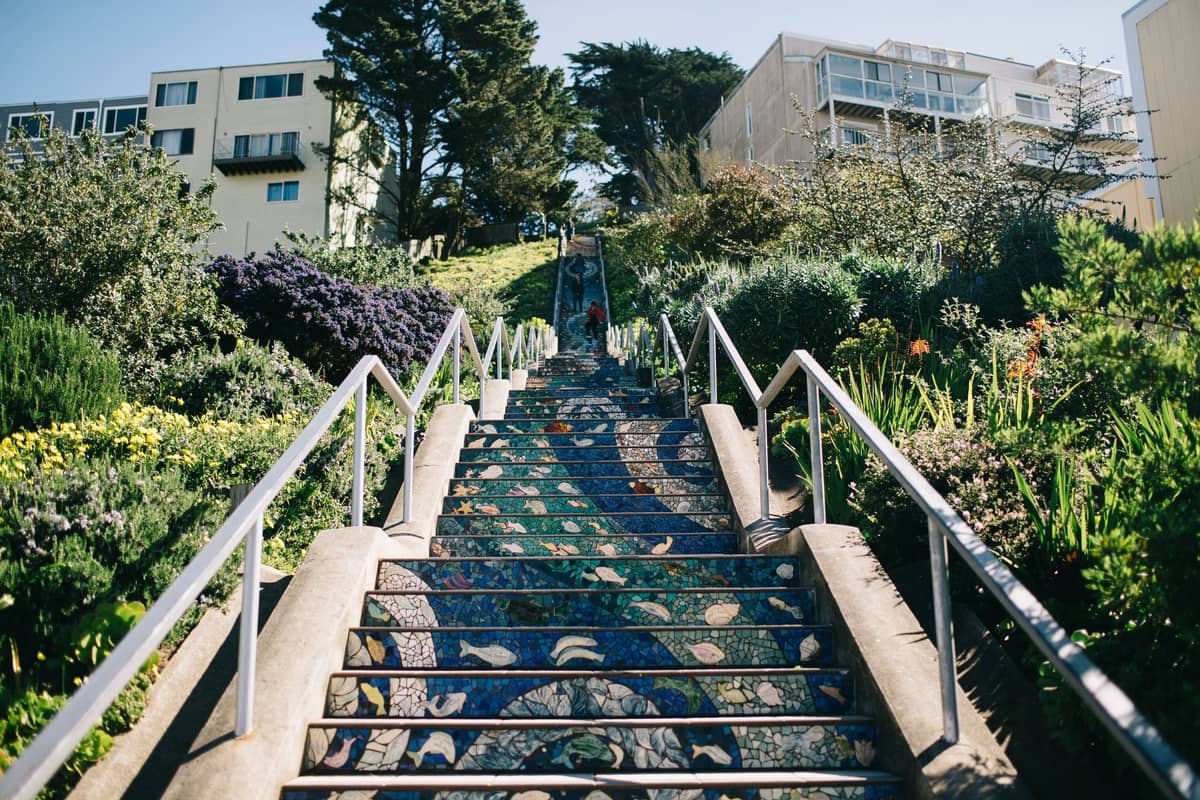
The 16th Avenue Tiled Steps Project is a public mosaic staircase of 163 steps rising steeply through a residential block in San Francisco's Golden Gate Heights neighborhood, part of the broader Inner Sunset area. Every riser is faced with hand-cut ceramic tile, and the design flows in an unbroken visual narrative from the bottom to the top: ocean waves and sea creatures at street level gradually give way to land, sky, a crescent moon, and finally a field of stars at the summit. The effect is closer to a vertical mural than a decorative touch.
The staircase was created by artists Aileen Barr and Colette Crutcher in collaboration with hundreds of neighborhood sponsors and volunteers as part of a grassroots project that began in 2003 and officially opened in August 2005. The project was self-funded through community donations and grants rather than a city commission, which partly explains why it feels so personal and local — this is a residential street that a neighborhood decided to transform.
ℹ️ Good to know
The steps are a public city stairway and are accessible at any hour. Most sources recommend visiting between 9:00 AM and 7:00 PM for safety and good light. There are no gates, guards, or admission booths.
The Experience: Climbing the Steps
You approach from the bottom of Moraga Street at 16th Avenue, where a small planted median and the first mosaic risers announce what is coming. The neighborhood is quiet and resolutely residential — narrow houses with steep garage doors, the occasional cat on a windowsill. There is no commercial strip nearby, no food cart, no ticket booth. The steps simply begin.
As you climb, the tile work is close enough to examine in detail. Sea creatures and kelp give way to shoreline imagery, then to land animals and trees, then to birds, clouds, and finally celestial bodies. The handrails on either side are themselves wrapped in smaller mosaic work with geometric and organic patterns. On a clear morning, the smell of marine air drifts up from the west, and the light falls at an angle that makes the tiles read almost three-dimensional.
The climb is steep. 163 steps on a San Francisco grade means you will be breathing harder by step 80. Most visitors pause two or three times on the way up, which is also when you realize how the view behind you is opening up. By the final landing, you can see rooftops stretching toward the Pacific, and on clear days, a thin line of ocean is visible beyond the Sunset grid.
Tickets & tours
Hand-picked options from our booking partner. Prices are indicative; availability and final rates are confirmed when you complete your booking.
Sonoma and Napa Valley wine tour from San Francisco
From 127 €Instant confirmationFree cancellationGo City | San Francisco Explorer Pass
From 76 €Instant confirmationFree cancellationMuir Woods and Sausalito guided tour with transportation
From 82 €Instant confirmationFree cancellationSan Francisco CityPASS
From 77 €Instant confirmationFree cancellation
How the Experience Changes by Time of Day
Morning visits, roughly between 9:00 and 11:00 AM, offer the best combination of light and solitude. The sun hits the east-facing tiles at a low angle, intensifying the blues and greens in the lower ocean section. Fog often lingers at this hour over the outer Sunset, which can add atmosphere or block the view from the top depending on the season. Locals walk dogs past the base of the steps and generally ignore tourists entirely.
Midday is the most crowded period, particularly on weekends. Groups queue informally on the lower steps for photographs, and the landing at the top can feel tight with people. If you visit midday in summer, be aware that June through August in San Francisco's western neighborhoods often brings persistent fog that can reduce the view from Grand View Park to near zero. September and October are significantly clearer and warmer.
Late afternoon, from around 3:00 PM on a clear day, is arguably the most photogenic window. The westward-facing view catches the sun lowering toward the ocean, and the upper tiles in the celestial section pick up warm orange tones. Weekday afternoons see noticeably smaller crowds than weekend mornings.
💡 Local tip
For photography, a wide-angle lens or a phone in portrait mode works better than zooming in on individual tiles. Stand at the very bottom of the staircase and shoot straight up the center to capture the full 'sea to stars' gradient in one frame.
Beyond the Steps: Grand View Park
The staircase does not end at the top landing. A short path continues uphill to Grand View Park, a small hilltop open space at roughly 670 feet elevation that offers one of the most expansive 360-degree views in San Francisco. On clear days you can see the Marin Headlands to the north, the downtown skyline to the east, the Pacific Ocean to the west, and the Santa Cruz Mountains to the south. This is one of the city's more underused viewpoints.
Grand View Park is particularly rewarding when combined with the steps visit, as the two together make for a natural 60-to-90-minute outing. If you are building a broader western neighborhoods itinerary, the area connects logically with Sutro Baths and Ocean Beach, both reachable within 15 minutes by bus.
Getting There: Practical Transit Directions
The most straightforward route is the N-Judah Muni Metro line, which runs along Judah Street through the Inner Sunset. Exit at 16th Avenue and Judah, then walk south and uphill along 16th Avenue for about half a mile until you reach Moraga Street; the uphill walk typically takes around 15 to 20 minutes. From downtown, the N-Judah runs frequently and the journey takes around 25 to 30 minutes.
Muni Bus 66 also serves the area and stops within a few blocks of the steps. For full route planning and current fares, use the SFMTA trip planner at sfmta.com. Rideshares work well here too; the address to enter is Moraga Street at 16th Avenue. There is some street parking in the surrounding blocks, but the Inner Sunset's residential streets are competitive. If you are pairing this with Golden Gate Bridge or the de Young Museum, both are reachable from here by transit in under 20 minutes.
⚠️ What to skip
There is no parking lot at or near the steps. Do not rely on street parking on weekends — the Inner Sunset's residential blocks fill up quickly, particularly on sunny days when the entire western neighborhoods see increased foot traffic.
Accessibility, Weather, and What to Bring
The 16th Avenue Tiled Steps are not accessible to visitors with mobility impairments. All 163 steps must be climbed on foot, and there is no ramp, elevator, or alternative route to the upper landing. The mosaic tiles can be slippery when wet, which matters in San Francisco's rainy season from November through March. If you visit after rain, wear shoes with grip and hold the handrail.
Bring layers regardless of season. The Inner Sunset sits at a higher elevation than the waterfront neighborhoods, and even on days when downtown is warm, wind at the top of the steps and at Grand View Park can be sharp. In summer, a light jacket or fleece is standard kit for any west-side neighborhood. Comfortable walking shoes are essential — heels or dress shoes are a poor choice on steep wet tile.
This part of San Francisco sits in what is colloquially called the "fog belt." The marine layer that rolls in off the Pacific makes summer mornings cool and grey in the outer avenues. For context on planning around fog and seasonal variation, the best time to visit San Francisco guide covers this in detail. The short version: September and October are statistically the clearest and warmest months for the western neighborhoods.
Who Should Reconsider
If you are traveling with a stroller, a wheelchair, or anyone who cannot manage steep stairs, this attraction is not suitable. There is no workaround. Similarly, visitors with only a few hours in San Francisco and a list of major landmarks may find the journey to the Inner Sunset too time-consuming relative to what the steps offer. The steps are beautiful, but they are a neighborhood-level experience, not a city-defining landmark on the scale of the Golden Gate Bridge or Alcatraz.
Visitors who primarily want scenic stair climbs in central neighborhoods might find the Filbert Steps in North Beach more conveniently located, with comparably rewarding views from Coit Tower. The 16th Avenue Tiled Steps reward travelers who enjoy exploring residential neighborhoods and are willing to go out of their way for something that most tourists skip entirely.
Insider Tips
- The lowest section of the steps, depicting ocean floor imagery, is often the most overlooked. Most visitors immediately look upward; spend a minute at the base examining the individual tile work before you start climbing.
- Weekday mornings between 9:00 and 10:30 AM are the quietest windows. Weekend afternoons between noon and 3:00 PM are the most congested, with visitors sometimes queuing on the lower steps for clear photographs.
- Combine the visit with Grand View Park at the top for a genuine panoramic payoff. The park is a 3-to-5-minute walk past the final landing and is often completely empty even when the steps themselves are busy.
- The tiles are the most vibrant on overcast days without direct glare. Bright midday sun creates harsh reflections on the glazed ceramic surface that can flatten the photography. A lightly cloudy sky acts as a natural diffuser.
- If you want to understand the full scope of San Francisco's stair-climbing culture, the city has dozens of public stairways. The 16th Avenue steps are among the most decorated, but they fit into a broader tradition of hillside walking that makes a good half-day micro-adventure when combined with other stair streets in the western neighborhoods.
Who Is 16th Avenue Tiled Steps For?
- Architecture and public art enthusiasts who appreciate the craft of community mosaic work
- Photographers looking for a structured, colorful subject that works in a range of lighting conditions
- Travelers building an Inner Sunset or western neighborhoods day with multiple stops
- Visitors who have already covered the main landmarks and want something that feels genuinely local
- Anyone pairing a viewpoint visit with a walk, since Grand View Park at the top is one of the city's less-crowded panoramic spots
Nearby Attractions
Combine your visit with:
- Angel Island State Park
Angel Island State Park sits in the middle of San Francisco Bay, offering miles of hiking trails, layers of military and immigration history, and 360-degree views of the city skyline, Marin headlands, and beyond. Getting there requires a ferry, which is part of the appeal — the island feels removed from city life, even though San Francisco is visible the entire time.
- Asian Art Museum of San Francisco
One of the largest Asian art collections in the Western world, housed in a transformed Beaux-Arts landmark at Civic Center. From ancient Chinese bronzes to contemporary Southeast Asian installations, the museum rewards careful visitors who know what to look for.
- UC Berkeley Campus
The University of California, Berkeley sits on a hillside above San Francisco Bay, offering free access to striking Beaux-Arts architecture, landmark museums, and open green spaces. A short BART ride from San Francisco, it rewards curious visitors with history, intellectual energy, and some of the best campus scenery in the country.
- Bernal Heights Park
Perched at 433 feet above sea level, Bernal Heights Park delivers sweeping 360-degree views of San Francisco, the Bay, and beyond — completely free. The 26.3-acre summit park draws locals, dog walkers, and sunrise seekers who want panoramas without the tourist pressure of Twin Peaks or Dolores Park.