Sutro Baths: San Francisco's Hauntingly Beautiful Coastal Ruins
Once the world's largest indoor swimming complex, the Sutro Baths today survive as concrete ruins on the edge of the Pacific. Free to visit at any hour, this National Recreation Area site combines Victorian-era history, dramatic coastal scenery, and an eerie, photogenic atmosphere unlike anything else in San Francisco.
Quick Facts
- Location
- Point Lobos Avenue at 48th Avenue, Lands End, San Francisco, CA (within Golden Gate National Recreation Area)
- Getting There
- Muni 38-Geary bus to Point Lobos Ave & 48th Ave, then a short walk down to the ruins
- Time Needed
- 45 minutes to 2 hours depending on how far you explore the Lands End trail
- Cost
- Free (no admission fee; generally visited during daylight hours)
- Best for
- History lovers, photographers, coastal walkers, and anyone who wants a dramatic view without the crowds
- Official website
- www.nps.gov/goga/planyourvisit/cliff-house-sutro-baths.htm
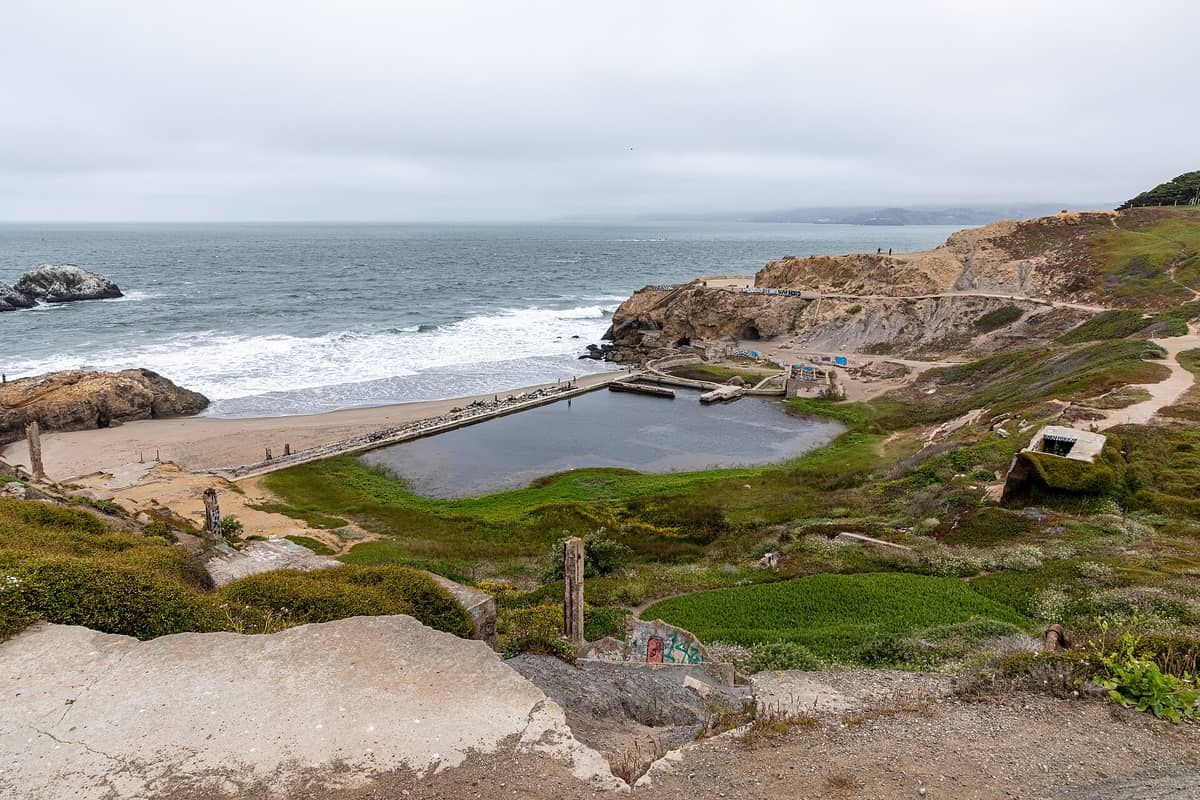
What the Sutro Baths Actually Are
The Sutro Baths ruins sit at the very edge of San Francisco, where the land meets the Pacific with very little ceremony. What remains today are low concrete walls, deep rectangular pools filled with tidal seawater, and the ghostly footprint of a structure that, in 1896, was the largest indoor swimming establishment in the world. The smell here is immediately distinctive: cold salt air mixed with the faint mineral tang of algae-covered stone. Seagulls wheel overhead. Waves crash against the rock shelf below. It is not a polished attraction.
Designed and built by Adolph Sutro, a Prussian-born engineer who became one of San Francisco's most influential civic figures, the baths opened officially on March 14, 1896. The original glass-and-iron structure enclosed seven swimming pools (six saltwater tanks of varying temperatures and one freshwater pool), accommodating up to 10,000 visitors at a time. Alongside the pools, Sutro installed museum galleries, a skating rink, and concert areas. It was part resort, part natural history museum, part civic spectacle, and it operated at the western edge of a city that was itself still defining what it wanted to be.
The complex never turned consistent profit and went through several transformations over the decades, including a conversion to an ice rink. In 1964, demolition was underway. On June 26, 1966, a fire destroyed most of what remained. The site was incorporated into Golden Gate National Recreation Area in 1973 and has been left, deliberately and correctly, as ruins.
ℹ️ Good to know
The ruins are part of the Sutro Historic District within Golden Gate National Recreation Area and are managed by the National Park Service. There is no entry fee, no reservation required, and the site is generally accessed during daylight hours, though trails can be slippery and poorly lit after dark.
The Experience at Different Times of Day
Arriving at the Sutro Baths early in the morning, before 9 a.m., is a genuinely different experience from arriving mid-afternoon. In the early hours, mist often sits low over the ruins, blurring the pool edges into the surrounding rock. The light is soft and gray, and if the marine layer is thick, the ocean beyond disappears entirely. The effect is disorienting in a way that photographs rarely capture. You hear the water before you see it: the low rhythmic surge of the tidal pools as waves push through the sea cave at the northwest corner of the ruins.
By late morning the fog typically begins to lift, and the site fills with more visitors, particularly on weekends. The ruins become easier to read architecturally once the light sharpens: you can trace the outlines of the original pool structures in the concrete, follow the channels that once connected the tidal inlet to the bathing tanks, and spot the rusted iron fittings still embedded in the walls. At this hour the surrounding hillside trail is also at its most accessible, with clear sightlines north toward the Marin Headlands.
Sunset visits have their own appeal, particularly in September and October when San Francisco's warmest, clearest days occur. The low western light turns the wet concrete a deep amber and illuminates the sea cave entrance dramatically. Plan to arrive at least an hour before sunset to explore the lower ruins before the light fails, as the path down from the parking area involves uneven steps and there is no artificial lighting at the site itself.
⚠️ What to skip
The rocks below the ruins are genuinely dangerous. Warning signs from the National Park Service are posted throughout the site, and visitors have been injured and killed by rogue waves in this area. Stay off the lower rocks, especially in winter or during high surf. The Pacific coastline here is not a beach: it is an exposed, rocky shelf with no warning system.
Tickets & tours
Hand-picked options from our booking partner. Prices are indicative; availability and final rates are confirmed when you complete your booking.
Sonoma and Napa Valley wine tour from San Francisco
From 127 €Instant confirmationFree cancellationGo City | San Francisco Explorer Pass
From 76 €Instant confirmationFree cancellationMuir Woods and Sausalito guided tour with transportation
From 82 €Instant confirmationFree cancellationSan Francisco CityPASS
From 77 €Instant confirmationFree cancellation
Navigating the Site: A Practical Walkthrough
Most visitors arrive via the parking lot at Merrie Way or Point Lobos Avenue, or by walking west along the Lands End trail from the direction of the Lands End Lookout visitor center. From the upper path, the ruins appear below you: a series of long rectangular depressions, the largest of which still holds standing water fed by the tidal surge. The descent takes you down a concrete stairway to the main ruins level.
The lower area is mostly open and walkable, though the surfaces are rough, frequently wet, and covered in places with algae. Wear shoes with grip. The most photographed spot is typically the northwest corner, where a short tunnel-like passageway opens onto a sea cave. The cave itself is accessible at low tide and offers a direct view of the Pacific framed by rock. At high tide or during heavy swell, do not enter.
From the ruins, a trail continues north and east along the Lands End coastline, connecting eventually to Eagle's Point and the views toward the Golden Gate Bridge. This extension adds roughly 30 to 45 minutes one-way to your visit and is worth considering if you have the time and footwear for it.
The Lands End Lookout visitor center, located nearby, contains exhibits about the history of the baths and the broader Sutro Historic District. It is staffed by National Park Service rangers who can answer questions about the site. For those interested in the wider coastal landscape, the full Lands End Trail extends several miles through cypress groves above the ruins, offering some of the most underrated views of the Golden Gate Bridge from the city side.
Getting Here Without a Car
The Muni 38-Geary bus runs from downtown San Francisco all the way to Point Lobos Avenue and 48th Avenue, putting you within a short flat walk of the ruins entrance. This is the most straightforward public transit option. The 38-Geary is a frequent route, making it practical for most visitors staying in central neighborhoods.
If you are combining this visit with other western San Francisco stops, note that Ocean Beach begins just south of the Sutro Baths site. The two can be paired in a single half-day without a car. Rideshare services (Uber and Lyft) are readily available throughout San Francisco and are a practical option if transit timing does not suit your itinerary.
Drivers should note that parking at Merrie Way fills quickly on sunny weekends. Arriving before 9 a.m. or after 4 p.m. on weekends significantly improves your chances of finding a spot without circling. Accessible parking spaces are available at the Merrie Way lot.
History, Architecture, and What Made This Place Significant
Adolph Sutro built the baths at a moment when San Francisco was both prospering and uncertain about its own cultural identity. He had already made his fortune through engineering and mining ventures, and the baths were partly philanthropic in intent: he priced admission deliberately low so that working-class families could access the facility. The original structure was an engineering achievement for its era, a massive glass and wrought-iron greenhouse covering three acres, with seawater pumped directly in from the ocean and heated to different temperatures across six saltwater tanks and one freshwater pool.
The architectural ambition of the original building is difficult to appreciate standing in the ruins, but the scale of the concrete footings that remain gives some sense of it. The longest pool ran over 300 feet. The complex included two galleries of Egyptian and Pacific artifacts, mechanical curiosities, and stuffed animals, which Sutro collected obsessively. Some of that collection ended up in what later became a separate museum, but much of it was lost when the building closed.
The baths sit within a broader area of San Francisco that rewards deeper exploration. The adjacent Lands End neighborhood is one of the least-developed stretches of the city's coastline, and the sense of remove from urban San Francisco is immediate and unusual. For those interested in the city's Victorian-era architectural heritage more broadly, the San Francisco architecture guide covers this period in detail.
Photography at the Sutro Baths
This is one of the more reliably photogenic locations in San Francisco, and it works in almost any light. On overcast days, the flat gray sky eliminates harsh shadows and allows the texture of the concrete and the color of the algae-covered pools to read clearly. On clear days, the contrast between the white foam of the Pacific, the dark rock, and the pale ruins is sharp and dramatic.
Wide-angle lenses suit the site well, particularly for capturing the full extent of the pool outlines from the upper viewpoint before descending. The sea cave at the northwest end rewards closer work: even a smartphone camera can produce compelling images inside the cave if the light is coming in from the ocean entrance at the right angle, typically in the afternoon.
💡 Local tip
For long-exposure shots of the tidal pools, the hour after sunrise on a weekday is ideal: you get soft directional light, minimal foot traffic, and the pools are still disturbed by overnight wave action, giving the water a silky, layered texture.
Who Will Get the Most Out of This Visit (and Who Might Not)
The Sutro Baths work well for visitors who are comfortable with an unstructured, exploratory experience. There are no guided tours on-site, no audio guides to rent, and no interpretive signage beyond a few NPS panels near the upper entrance. What you get is space, atmosphere, and the physical evidence of something that used to exist. If that sounds engaging, you will likely find the site absorbing.
Visitors expecting a polished museum experience will be disappointed. The ruins are not curated or staged: they are just ruins. Similarly, families with very young children or anyone with mobility limitations should factor in the uneven terrain, steep stairs, and absence of guardrails along the lower ruins area. The site is not stroller-accessible at the lower level. For families looking for a better-structured coastal experience nearby, Crissy Field offers flat, accessible paths along the bay with similar views of the Marin Headlands.
Visitors who come on clear afternoons in late summer or fall and combine the ruins with a walk along the Lands End trail tend to rate this among their most memorable San Francisco experiences. That combination of free access, historical depth, coastal drama, and relative quiet compared to the city's more crowded sites is genuinely unusual.
Insider Tips
- The sea cave at the northwest end of the ruins is accessible at low tide and offers a framed ocean view that most visitors walk past. Check tide tables before your visit: a tide below 1.5 feet gives the best access, while anything above 3 feet closes the cave entirely.
- The Lands End Lookout visitor center has free restrooms, which are the only facilities near the ruins. Use them before descending to the lower site, as there are none at ruin level.
- On summer mornings, the marine fog can be so thick that the ruins are completely socked in by 8 a.m. and fully clear by 11 a.m. If you want moody fog photography, arrive early. If you want views, wait for late morning.
- The upper trail just east of the ruins passes through a grove of Monterey cypress that creates an almost tunnel-like canopy. Most visitors head straight down to the pools and miss this stretch entirely. It takes 10 minutes and the contrast between the dense shade of the trees and the open coastal ruins is worth the short detour.
- On weekdays, the site sees a fraction of its weekend crowd. If your schedule allows, a Tuesday or Wednesday morning visit gives you the ruins largely to yourself, which meaningfully changes the experience.
Who Is Sutro Baths For?
- History enthusiasts interested in Gilded Age civic architecture and California's Victorian-era ambitions
- Photographers working in any light condition, from flat overcast to golden-hour coastal drama
- Walkers who want to connect the ruins to the broader Lands End Trail and Golden Gate views
- Travelers on a tight budget looking for a genuinely memorable experience at no cost
- Anyone who wants a break from the denser tourist corridors of Fisherman's Wharf and downtown San Francisco
Nearby Attractions
Other things to see while in Lands End:
- China Beach
Set between Baker Beach and Lands End in San Francisco's Sea Cliff neighborhood, China Beach is a small, free sandy cove within the Golden Gate National Recreation Area, managed in partnership by the National Park Service and the Golden Gate National Parks Conservancy.
- Lands End Coastal Trail
The Lands End Coastal Trail traces a rugged bluff above the Pacific in the Golden Gate National Recreation Area, following the former bed of a 19th-century railway. At roughly 3.4 miles round-trip, it delivers Golden Gate Bridge panoramas, views of shipwrecks at low tide, and a quieter side of San Francisco that most visitors never find.
- Legion of Honor
Perched above the Pacific in Lincoln Park, the California Palace of the Legion of Honor is a three-quarter-size replica of a Parisian neoclassical palace housing 4,000 years of art. The setting alone, with ocean fog rolling past the colonnade and a cast of Rodin's The Thinker standing sentinel in the courtyard, makes this one of the most visually striking museum visits in California.
- Ocean Beach
Ocean Beach is a 3.5-mile stretch of wild Pacific shoreline forming the western edge of San Francisco. Part of Golden Gate National Recreation Area, it is free to visit, open around the clock, and offers a dramatically different mood than the city's polished tourist corridors.