China Beach, San Francisco: The Sheltered Cove With a Layered History
Set between Baker Beach and Lands End in San Francisco's Sea Cliff neighborhood, China Beach is a small, free sandy cove within the Golden Gate National Recreation Area, managed in partnership by the National Park Service and the Golden Gate National Parks Conservancy.
Quick Facts
- Location
- 340 Sea Cliff Ave, San Francisco, CA 94121 (Sea Cliff neighborhood, between Baker Beach and Lands End)
- Getting There
- Muni bus routes serving the Richmond/Sea Cliff area; from there, walk down Sea Cliff Avenue to the beach entrance
- Time Needed
- 45 minutes to 2 hours depending on your pace and picnic plans
- Cost
- Free. No entrance fee as part of Golden Gate National Recreation Area
- Best for
- Quiet shoreline time, picnics, Golden Gate views, history seekers
- Official website
- www.nps.gov/goga/planyourvisit/chinabeach.htm
What China Beach Actually Is
China Beach is a small, protected cove on San Francisco's northwestern shoreline, sandwiched between the wide expanse of Baker Beach to the south and the rocky bluffs of Lands End to the north. It sits within the Golden Gate National Recreation Area and is managed in partnership by the National Park Service and the Golden Gate National Parks Conservancy. The beach is compact, perhaps 600 feet of sand, but that scale is part of its appeal: it feels genuinely secluded compared to the more frequented stretches of the San Francisco waterfront.
The cove's natural framing, steep bluffs on three sides and the mouth of the Golden Gate opening directly to the west, means you get unobstructed views toward the Marin Headlands without the foot traffic of the more famous overlooks. On a clear afternoon in September or October, when San Francisco hits its warmest and clearest weather, the light across the water is genuinely striking.
ℹ️ Good to know
China Beach is open daily from 6:00 AM until 7:00 PM or one hour after sunset. Hours can change due to maintenance or safety conditions, so confirm with the NPS or Golden Gate National Parks Conservancy before visiting: nps.gov/goga.
The History Behind the Name
The name China Beach is not incidental. From the Gold Rush era beginning in 1849, Chinese immigrant fishermen used this cove as a base, camping along the shore and working the waters of the Golden Gate. It was one of several sites around the bay where Chinese fishing communities established themselves during a period when institutional racism severely limited where they could live and work in the city.
In 1933, the City of San Francisco renamed the beach James D. Phelan Memorial Beach after a former San Francisco mayor and U.S. Senator, and in 1946 the State of California acquired the site as a state park. The renaming was not uncontroversial: Phelan had been a vocal advocate of Chinese exclusion laws and anti-Asian immigration policy. That context makes the 1974 restoration of the name particularly significant. When the area was folded into the newly created Golden Gate National Recreation Area, the National Park Service formally reinstated the name China Beach to honor the Chinese fishing communities whose presence here predated the park itself.
This naming history is worth understanding before you visit, not as a footnote but as a lens. The beach sits within a broader landscape that the Lands End area has preserved with unusual care for its layered past. A small monument near the beach acknowledges the Chinese fishermen. It is easy to walk past without noticing it; take a moment to find it near the access path.
Tickets & tours
Hand-picked options from our booking partner. Prices are indicative; availability and final rates are confirmed when you complete your booking.
Chinatown walking food tour
From 59 €Instant confirmationFree cancellationFood tour of Chinatown and North Beach
From 67 €Instant confirmationFree cancellationChinatown Food Tour
From 62 €Instant confirmationSan Francisco Chinatown food and history walking tour
From 56 €Instant confirmationFree cancellation
What the Visit Actually Feels Like
Getting to China Beach requires a short walk down Sea Cliff Avenue from the parking area. The path descends through a wooded slope, and there is a moment just before the sand opens up where the sound of the ocean arrives before the view does: a low, steady surge rather than the crashing break you hear at Ocean Beach. The cove's protected shape means the waves here are gentler, though the water temperature remains cold year-round, typically in the 50s Fahrenheit.
The beach itself is sandy rather than rocky, which is not a given on this section of the San Francisco coast. There are restroom facilities and a picnic area, both modest but functional. On a weekday morning, you may have the cove almost entirely to yourself. By weekend afternoons in September and October, it fills up with local families and dog walkers, though it never approaches the density of a popular urban beach. The cliff walls amplify sound in a peculiar way: you can hear conversations clearly across the sand, so it is not a place for complete solitude when other visitors are present.
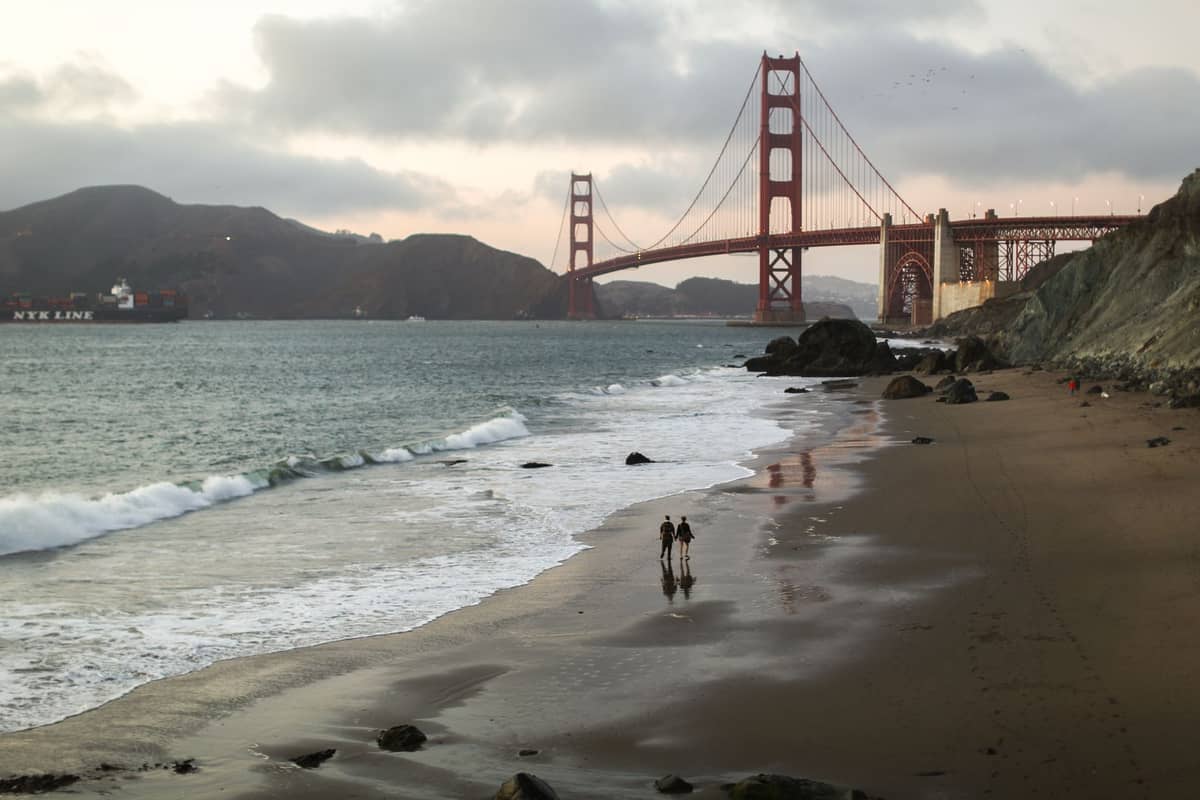
Looking west from the waterline, you have a clear sightline toward the Golden Gate strait. The bridge itself is not visible from the beach floor due to the cliff angles, but the headlands framing the gap are. At dusk, particularly in late summer and early fall, this view takes on a warm orange cast that draws photographers with tripods. Arriving 45 minutes before sunset gives you time to settle in before the light shifts.
How the Experience Changes By Time of Day
Early morning, before 9:00 AM, is when China Beach is at its quietest. The marine layer often sits thick over the water in summer, muting the light and the horizon into a uniform grey. This is actually a compelling time to visit if you respond to that particular quality of coastal fog, the kind that blurs the line between sea and sky. Bring a warm layer: even in July, morning temperatures at the waterline can sit in the low 50s Fahrenheit.
Midday in summer tends to keep the fog hovering. If you are visiting between June and August hoping for sunshine and warm sand, the meteorological reality of San Francisco's cool-summer Mediterranean climate will likely disappoint. September and October are the months when the marine layer burns off reliably and temperatures at the coast actually feel warm. These are the days when China Beach earns its status as one of the city's more pleasant swimming coves, though the water temperature itself stays cold regardless of season.
⚠️ What to skip
Swimming conditions at China Beach are generally calmer than at Ocean Beach, but ocean conditions can change rapidly. There is no lifeguard on duty. Check current surf and rip current conditions before entering the water, especially outside of summer months.
Getting There and Practical Details
The most direct address for navigation is 340 Sea Cliff Avenue, San Francisco, CA 94121. There is a small parking lot near the trailhead, which fills quickly on weekends. Arriving before 9:00 AM on weekends or visiting on a weekday significantly improves your chances of finding street or lot parking in the Sea Cliff neighborhood.
Muni bus service reaches the broader Sea Cliff and Richmond District area; from there, it is a walkable distance to the beach entrance. If you are building an itinerary for the day, China Beach pairs naturally with the Lands End Trail, which begins nearby and traverses the bluffs above the cove, offering the elevated views that the beach itself cannot provide.
The access path from the parking area to the beach involves stairs and a moderate descent. The terrain is not wheelchair accessible in the standard sense; the NPS acknowledges that Golden Gate coastal units often include steep paths that limit access. If mobility is a concern, contact the NPS directly before visiting to get current information on what is and is not accessible on the day of your visit.
Dogs are permitted on leash. The beach is part of federal land, so standard National Park rules apply: carry out your trash, do not disturb wildlife, and respect posted notices. Fires and camping are not permitted.
Photography and Sightlines
China Beach is not the place to photograph the Golden Gate Bridge itself. The bridge sits out of the direct sightline from the sand. What you can photograph effectively here is the raw geometry of the coastline: the bluffs, the channel mouth, and on clear days the Marin Headlands in the distance. A wide-angle lens captures the way the cove walls frame the water. Longer lenses pick out details on the far shore.
For the best light conditions, late afternoon in September and October delivers warm directional light on the western-facing cliffs. Morning in any season gives you the fog aesthetic if that is what you are after. Overcast days actually work well for seascape photography because the diffuse light eliminates harsh shadows on the sand.
Is China Beach Worth Your Time?
If you are visiting San Francisco for three days and working through the standard list of major attractions, China Beach is probably not your first priority. It does not have the commanding panorama of Baker Beach or the dramatic ruined architecture of the Sutro Baths. What it offers instead is scale and quiet: a small, well-maintained cove where the city recedes almost completely.
For visitors who want to understand the physical and historical texture of San Francisco's northwestern edge, China Beach is a genuinely worthwhile stop, particularly when combined with the Lands End Trail and a visit to the Legion of Honor museum a short drive away. Together these three form a half-day itinerary that covers natural landscape, coastal history, and fine art without any admission fees at the beach itself.
Travelers who should probably skip it: anyone whose primary goal is sunshine and warm swimming. San Francisco's coastal climate delivers cold water and frequent fog regardless of the season, and China Beach offers no particular advantages over any other local option on that front. Similarly, visitors with significant mobility limitations should check current access conditions with the NPS before making the trip, as the stairway descent to the sand is not easily bypassed.
Insider Tips
- The small monument honoring Chinese fishermen is easy to miss. It sits near the access path above the sand. Pause to read it before heading down to the beach.
- Weekday mornings before 9:00 AM are the most reliable time to find parking in the Sea Cliff neighborhood. Weekend afternoons, especially in September and October, fill the lot quickly.
- Bring more layers than you think you need. Even on days when the city itself is warm, the temperature at the waterline drops noticeably. A windproof outer layer is more useful here than sunscreen.
- If you time your visit for late September or October and arrive in the last hour before the posted closing time, the cove is typically empty and the afternoon light on the western cliffs is worth the effort.
- The Lands End Trail begins just above China Beach and traverses the bluffs northward toward the ruins of Sutro Baths. Combining both in a single outing gives you the ground-level beach experience and the elevated coastal view in one trip.
Who Is China Beach For?
- Travelers who want a quiet beach without a long drive out of the city
- History-minded visitors interested in Chinese immigrant history in San Francisco
- Photographers looking for coastal seascape compositions without crowds
- Locals and repeat visitors building a half-day Lands End itinerary
- Anyone seeking a free, low-key outdoor stop between the Golden Gate and the Richmond District
Nearby Attractions
Other things to see while in Lands End:
- Lands End Coastal Trail
The Lands End Coastal Trail traces a rugged bluff above the Pacific in the Golden Gate National Recreation Area, following the former bed of a 19th-century railway. At roughly 3.4 miles round-trip, it delivers Golden Gate Bridge panoramas, views of shipwrecks at low tide, and a quieter side of San Francisco that most visitors never find.
- Legion of Honor
Perched above the Pacific in Lincoln Park, the California Palace of the Legion of Honor is a three-quarter-size replica of a Parisian neoclassical palace housing 4,000 years of art. The setting alone, with ocean fog rolling past the colonnade and a cast of Rodin's The Thinker standing sentinel in the courtyard, makes this one of the most visually striking museum visits in California.
- Ocean Beach
Ocean Beach is a 3.5-mile stretch of wild Pacific shoreline forming the western edge of San Francisco. Part of Golden Gate National Recreation Area, it is free to visit, open around the clock, and offers a dramatically different mood than the city's polished tourist corridors.
- Sutro Baths
Once the world's largest indoor swimming complex, the Sutro Baths today survive as concrete ruins on the edge of the Pacific. Free to visit at any hour, this National Recreation Area site combines Victorian-era history, dramatic coastal scenery, and an eerie, photogenic atmosphere unlike anything else in San Francisco.