Asian Art Museum of San Francisco: What to Expect Before You Go
One of the largest Asian art collections in the Western world, housed in a transformed Beaux-Arts landmark at Civic Center. From ancient Chinese bronzes to contemporary Southeast Asian installations, the museum rewards careful visitors who know what to look for.
Quick Facts
- Location
- 200 Larkin Street, Civic Center, San Francisco, CA 94102
- Getting There
- BART or Muni Metro to Civic Center/UN Plaza Station, then a 3-minute walk
- Time Needed
- 2 to 3 hours for a focused visit; 4+ hours if exploring special exhibitions
- Cost
- Adults $20, Seniors (65+) $17, Students (ages 13–17 and college with ID) $14, Children 12 and under free. First Sunday of each month: general admission free
- Best for
- Art lovers, history enthusiasts, families with older children, rainy-day culture seekers
- Official website
- asianart.org
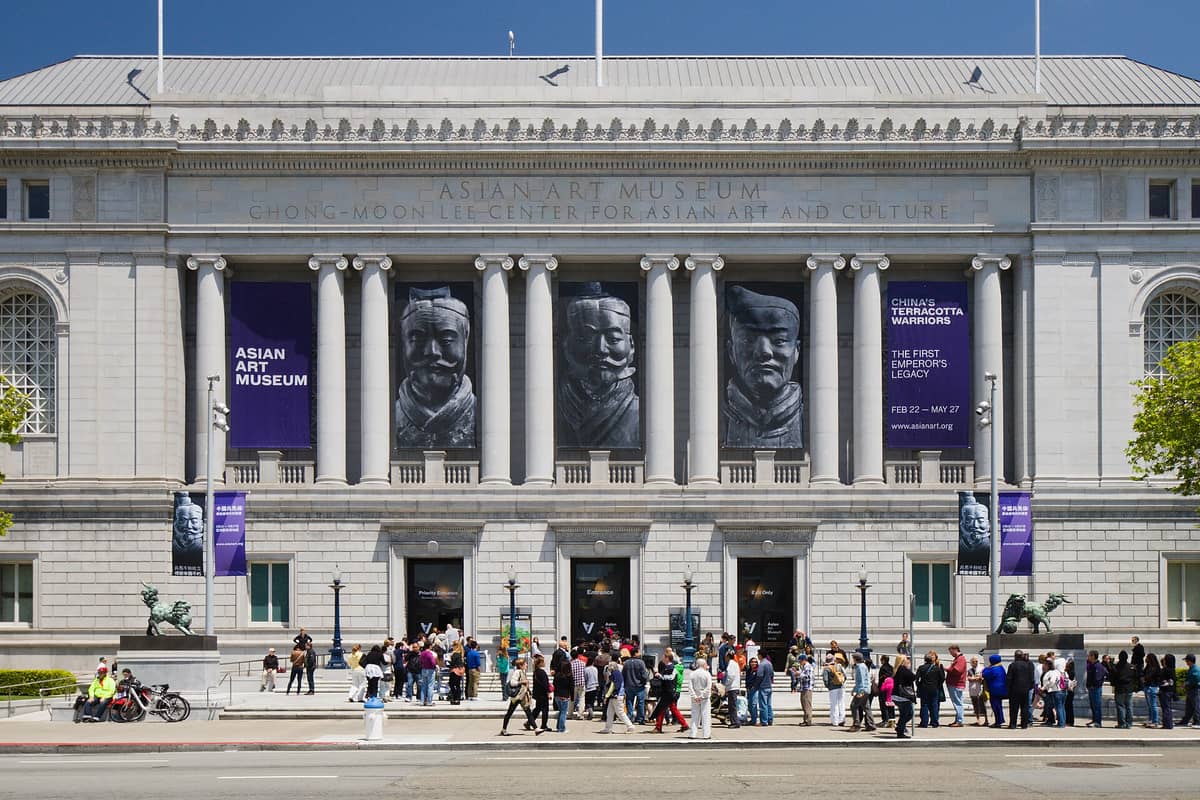
What the Asian Art Museum Actually Is
The Asian Art Museum of San Francisco, formally named the Asian Art Museum – Chong-Moon Lee Center for Asian Art and Culture, holds one of the most comprehensive collections of Asian art outside Asia itself. With over 18,000 artworks spanning roughly 6,000 years of history, the museum covers South Asia, Southeast Asia, the Himalayas, China, Korea, Japan, and West Asia under a single roof. That breadth is both its greatest strength and its most practical challenge for visitors: without some sense of what you want to see, it is easy to spend two hours on Chinese ceramics and never reach the Japanese sword gallery.
The museum was founded in 1966 as part of the de Young Museum in Golden Gate Park, largely built around a founding gift from Avery Brundage, the controversial American sports administrator who assembled an extraordinary private collection of Asian antiquities. It moved to its current Civic Center location in 2003, taking over the former main building of the San Francisco Public Library, a 1917 Beaux-Arts structure designed by George Kelham. Italian-Japanese architect Gae Aulenti oversaw the conversion, best known for a similar transformation of the Gare d'Orsay into the Musée d'Orsay in Paris.
💡 Local tip
Pick up the printed floor map at the entrance before you start. The gallery layout is not intuitive on a first visit, and the map marks highlighted works so you can anchor your route around the pieces most worth seeing.
The Building: Reading the Architecture Before You Enter
From Larkin Street, the museum's classical stone facade looks like exactly what it was: a civic institution built to project permanence and civic pride. The arched windows, granite steps, and rusticated base are standard Beaux-Arts vocabulary from the early twentieth century. What changed with the 2003 conversion is what you cannot see from outside: Aulenti removed the central stacks and reading rooms to create a sky-lit atrium, flooding the interior with diffused California light. The result is a building that reads as formal and weighty from the street but opens into something surprisingly airy once you step inside.
The Civic Center neighborhood surrounding the museum has a complicated character. The plaza outside is beautiful at a distance, flanked by City Hall's gilt dome to the south, but the immediate surroundings can feel uncomfortable at ground level, particularly in the early morning or evening. Arriving via the Civic Center BART station and walking directly to the museum entrance on Larkin takes under five minutes and is the most straightforward approach.
If you are combining the museum with nearby attractions, San Francisco City Hall is directly across Goodlett Place and worth a look from the outside or a quick interior visit, which is free. The rotunda is one of the finest examples of Beaux-Arts civic architecture in the United States.
Tickets & tours
Hand-picked options from our booking partner. Prices are indicative; availability and final rates are confirmed when you complete your booking.
Sonoma and Napa Valley wine tour from San Francisco
From 127 €Instant confirmationFree cancellationGo City | San Francisco Explorer Pass
From 76 €Instant confirmationFree cancellationMuir Woods and Sausalito guided tour with transportation
From 82 €Instant confirmationFree cancellationSan Francisco CityPASS
From 77 €Instant confirmationFree cancellation
Inside the Collection: How to Navigate 6,000 Years
The permanent collection is organized geographically and chronologically across three floors. The third floor is devoted to South and Southeast Asia and the Himalayas, with particularly strong holdings in Indian bronze sculpture and Himalayan thangkas. The second floor covers China, Korea, and Japan. If you have limited time, the second floor warrants the most attention: the Chinese collection is one of the finest in the Western hemisphere, including ritual bronzes from the Shang dynasty (roughly 1600 to 1046 BCE), Tang dynasty ceramics, and Song dynasty ink paintings.
The Korean galleries are smaller but worth slowing down for. Korean celadon ceramics from the Goryeo dynasty (918 to 1392 CE) represent some of the most technically accomplished pottery ever produced, and the museum holds excellent examples. The Japanese galleries include lacquerwork, screens, and the aforementioned arms and armor collection, which tends to draw visitors in quickly but can be rushed through at the expense of the quieter painting galleries nearby.
Special exhibitions are staged in the ground-floor galleries and typically rotate every three to four months. These often focus on a single artist, a specific period, or a contemporary cross-cultural theme, and they normally carry an additional charge on top of general admission (about $10; verify current prices). The quality varies. Some are landmark shows; others feel thin relative to the price. Check the exhibition listing on the museum's website before your visit to decide whether the surcharge is worth it on the day you go.
Time of Day: When to Go and What Changes
Weekday mornings between 10 am and noon are the quietest periods. School groups occasionally arrive mid-morning but tend to move through quickly and concentrate in specific galleries. By midday, particularly on weekends, the atrium and ground-floor special exhibition space can feel crowded, and the café has a line. If you are visiting on a First Sunday (when general admission is free), expect a noticeably larger crowd than normal. The free admission days are generous and worth taking advantage of if you live locally, but tourists on a tight schedule may find the tradeoff less favorable.
Thursday evenings, when the museum stays open until 8 pm, offer a different quality of visit. The galleries thin out after 5 pm, the light in the atrium shifts to something warmer and more atmospheric, and the overall pace slows. The Thursday extended hours are among the most underused openings in San Francisco's museum calendar, and they pair well with a dinner in the nearby Civic Center or Hayes Valley neighborhood afterward.
ℹ️ Good to know
Hours: Thursday 1 pm to 8 pm; Friday through Monday 10 am to 5 pm; closed Tuesday and Wednesday. Closed January 1, Thanksgiving Day, and December 25. Confirm current hours at asianart.org before your visit.
Practical Walkthrough: Getting There, Getting In, Getting Around
The Civic Center/UN Plaza BART station is served by multiple lines and is the most reliable way to arrive, particularly from the East Bay or SFO. From the station, exit toward Larkin Street and walk north past UN Plaza; the museum entrance is on your right. Muni Metro lines J, K, L, M, and N all stop at Civic Center as well. If you are driving, the city-operated garages at 355 McAllister Street and 376 Larkin Street are the nearest options, though parking costs in this part of the city add up quickly.
Admission is handled at a single desk near the main entrance on the ground floor. The museum uses timed-entry tickets for special exhibitions but not for the permanent collection. Buying tickets online in advance is possible and avoids the queue at the desk, which can be slow on busy weekends. The coat check is free and located just past the entrance, useful if you are carrying a bag.
Accessibility at the museum is reasonably good. The Larkin Street entrance is at street level, and elevators connect all three floors. The museum's ADA Coordinator can arrange assisted listening devices and, with at least two weeks' notice, ASL interpretation for tours and public programs. The contact number is +1-415-581-3598. The galleries themselves are spacious enough for wheelchair navigation, though some of the display cases in older sections are positioned lower than ideal for viewing from a seated position.
For context on how the Asian Art Museum fits into San Francisco's broader cultural landscape, the best museums in San Francisco guide covers the full range of options across the city, from the de Young to SFMOMA.
Photography, the Café, and the Museum Shop
Photography for personal use is permitted throughout the permanent collection galleries; flash and tripods are not allowed. The atrium is the most photographically rewarding interior space in the building, particularly in the early afternoon when diffused light comes through the skylight. Smartphone cameras handle the conditions well. For the display cases containing small objects (bronzes, ceramics, jewelry), getting close to the glass to reduce reflections significantly improves results.
The museum café, Taste, is on the ground floor and serves lunch and light snacks. It is a functional café rather than a destination in itself, and the prices reflect the museum setting. The museum shop, by contrast, is one of the better institutional shops in the city, stocking art books, textiles, and objects that connect to the collection rather than generic tourist merchandise.
Who This Museum Is For, and Who Might Want to Skip It
The Asian Art Museum rewards visitors who come with some curiosity about specific traditions or periods. The collection is deep enough that a passing interest in Japanese art, Himalayan Buddhism, or ancient Chinese ritual objects can easily sustain two to three hours of engaged looking. If you are traveling with children under ten, the permanent galleries can hold their attention for about an hour before the pace becomes difficult; the museum runs family-oriented programs on weekends that are worth checking in advance.
Visitors primarily interested in contemporary art may find the permanent collection too weighted toward historical objects. The special exhibitions sometimes address this, but the core identity of the museum is rooted in art history rather than the contemporary art world. Similarly, if your San Francisco visit is just one or two days and you are prioritizing outdoor experiences, the museum is best treated as a wet-weather option or an early-morning anchor before heading elsewhere.
If outdoor San Francisco is the priority, the Golden Gate Park guide covers the de Young Museum and California Academy of Sciences alongside the park's landscape attractions, which together make a full day.
⚠️ What to skip
The area around Civic Center can feel unsettled, particularly around UN Plaza. Keep an eye on belongings when walking from the BART station, and use the Larkin Street entrance rather than approaching from Market Street on foot late in the evening.
Insider Tips
- Thursday evenings after 5 pm offer some of the quietest gallery conditions of the week. The museum stays open until 8 pm on Thursdays, and most visitors arrive, complete the experience, and leave before late afternoon.
- The third-floor Himalayan galleries are consistently undervisited. The collection of gilt bronze Bodhisattva figures and silk thangka paintings is exceptional, and you will often have entire rooms to yourself while the Chinese galleries below fill up.
- For the best light in the atrium, arrive around 1 pm on a clear day. The skylight channels a column of diffused light that makes the central space look like a different room from how it feels on overcast mornings.
- First Sunday free admission covers general admission only. If there is a special exhibition running and you want to see it, you will still pay $10 rather than $15. Worth timing your visit around if you are a local or planning an extended stay.
- The museum hosts evening events, talks, and performances tied to current exhibitions. These are listed on the events calendar at asianart.org and often sell out quickly for popular shows. Check the calendar a few weeks ahead if your visit dates are flexible.
Who Is Asian Art Museum of San Francisco For?
- Art history enthusiasts with interest in Asian civilizations across multiple traditions
- Travelers seeking a full museum day sheltered from San Francisco's summer fog or winter rain
- Families with children aged 10 and older who can engage with object-based exhibits
- First-time San Francisco visitors wanting cultural depth beyond the waterfront attractions
- Budget travelers planning a First Sunday visit for free general admission
Nearby Attractions
Combine your visit with:
- 16th Avenue Tiled Steps
The 16th Avenue Tiled Steps Project is a community-made mosaic staircase of 163 steps stretching through San Francisco's Golden Gate Heights neighborhood (a sub-area of the Inner Sunset), depicting a journey from the ocean floor to the night sky. It's free, photogenic, and connects to one of the city's best lesser-known hilltop viewpoints.
- Angel Island State Park
Angel Island State Park sits in the middle of San Francisco Bay, offering miles of hiking trails, layers of military and immigration history, and 360-degree views of the city skyline, Marin headlands, and beyond. Getting there requires a ferry, which is part of the appeal — the island feels removed from city life, even though San Francisco is visible the entire time.
- UC Berkeley Campus
The University of California, Berkeley sits on a hillside above San Francisco Bay, offering free access to striking Beaux-Arts architecture, landmark museums, and open green spaces. A short BART ride from San Francisco, it rewards curious visitors with history, intellectual energy, and some of the best campus scenery in the country.
- Bernal Heights Park
Perched at 433 feet above sea level, Bernal Heights Park delivers sweeping 360-degree views of San Francisco, the Bay, and beyond — completely free. The 26.3-acre summit park draws locals, dog walkers, and sunrise seekers who want panoramas without the tourist pressure of Twin Peaks or Dolores Park.