Romano-Germanic Museum Cologne: Roman Cologne Brought to Life
The Romano-Germanic Museum (Römisch-Germanisches Museum) holds one of Europe's most significant collections of Roman archaeological finds. While its original home near the Cathedral undergoes renovation, the collection is displayed at the Belgian House on Cäcilienstraße — compact, accessible, and well suited to a focused visit by history-minded visitors.
Quick Facts
- Location
- Belgian House, Cäcilienstraße 46, 50667 Cologne (interim venue during renovation of original Roncalliplatz building)
- Getting There
- Neumarkt station (Trams 1, 3, 4, 7, 9, 16, 18) — approx. 2-minute walk
- Time Needed
- 1.5 to 2.5 hours
- Cost
- Adults €6.00 / Reduced €3.00. Accompanying persons with disability card (letter B) enter free.
- Best for
- History enthusiasts, Roman archaeology, families with older children, rainy day culture
- Official website
- www.roemisch-germanisches-museum.de
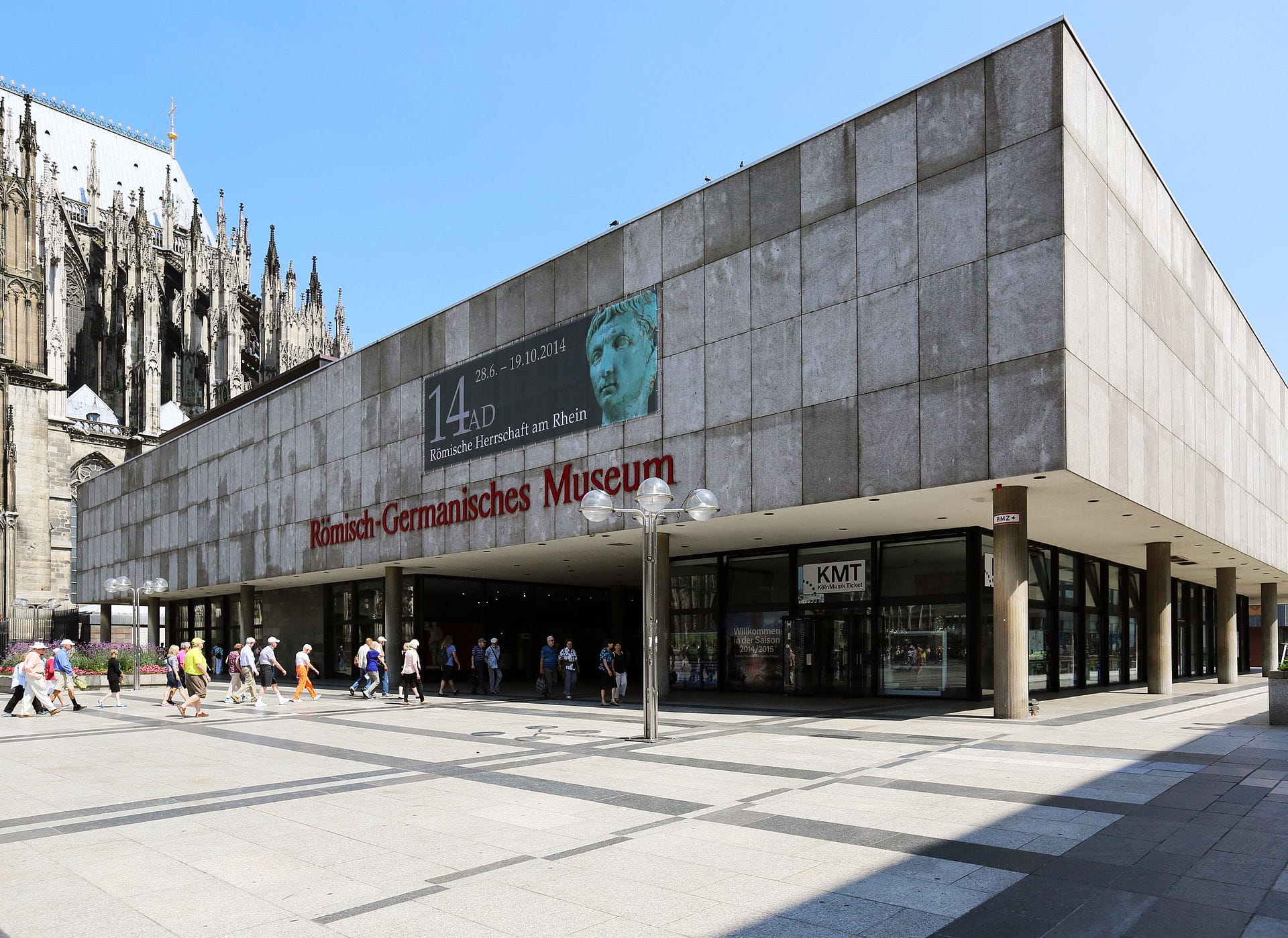
What the Romano-Germanic Museum Actually Is
The Romano-Germanic Museum (Römisch-Germanisches Museum) is Cologne's dedicated showcase for the city's ancient past, covering finds from prehistory through the Roman era and into the early Middle Ages. The collection exists because Cologne, known in antiquity as Colonia Claudia Ara Agrippinensium, was one of the most important Roman cities north of the Alps. It served as the capital of the Roman province of Germania Inferior, and excavations across the city have turned up an extraordinary density of objects: mosaic floors, carved tombstones, bronze figurines, amber jewelry, and some of the most refined Roman glassware found anywhere in the world.
The museum was originally opened in 1974 on the site of a large Roman mosaic discovered in 1941 during the construction of an air raid shelter near the Cathedral. That original building at Roncalliplatz is currently closed for extensive renovation. Until it reopens, the collection is shown at an interim exhibition space inside the Belgian House at Cäcilienstraße 46, roughly a ten-minute walk south of Cologne Cathedral.
ℹ️ Good to know
Renovation update: The original museum building at Roncalliplatz (next to Cologne Cathedral) is closed. The interim exhibition at Belgian House, Cäcilienstraße 46, is open Wednesday through Monday, 10:00–18:00 (on the first Thursday of each month open until 22:00, except public holidays). Closed Tuesdays, Christmas Eve, Christmas Day, New Year's Eve, and New Year's Day.
The Collection: What You'll Actually See
The headline piece of the permanent collection is normally the Dionysus Mosaic, a vast floor mosaic from the 3rd century AD depicting the god of wine surrounded by mythological scenes and intricate geometric borders. It covers approximately 70 square metres and was created using tens of thousands of stone and glass tesserae, and the sheer labour involved in its production signals how wealthy Roman Cologne had become by the late Imperial period. Important note: the Dionysus Mosaic sits in situ under the closed Roncalliplatz building and has not been transferred to the interim venue — it is not currently on display. The interim exhibition at Belgian House shows a curated selection of other objects from the collection while the main building is under renovation.
The glass collection is arguably the most internationally significant part of the museum's holdings. Cologne was a major production centre for Roman glass, and the pieces displayed here range from delicate perfume flasks with iridescent surfaces to a cage cup (diatretglas) of breathtaking intricacy: a double-walled vessel in which a decorative outer lattice was carved free from the inner wall, leaving it attached only by tiny glass bridges. Surviving examples of this technique number fewer than fifty worldwide. Seeing one in person reframes your understanding of what Roman craftspeople could achieve without modern tools.
Beyond glass and mosaics, the collection includes Roman funerary monuments and tombstones that once lined the roads leading out of Colonia, complete with inscriptions naming legionaries, merchants, and their families. There are everyday objects too: ceramic lamps, surgical instruments, writing tablets, children's toys, and coins. These mundane items do more than the grand monuments to make Roman daily life feel genuinely close.
Visitors with a broader interest in Cologne's ancient fabric will find this museum pairs well with the Cologne Cathedral, whose foundations sit directly on Roman and Frankish remains, and the NS Documentation Centre, which addresses a very different but equally layered chapter of the city's history.
Tickets & tours
Live prices and dates from our booking partner. If you book, we may earn a commission at no extra cost to you.
Cologne haunted places and ghost stories: interactive city game
From 8 €Instant confirmationFree cancellationFood Tour Cologne Sudstadt
From 44 €Instant confirmationFree cancellationCologne brewery tour including 3 Kolsch beer
From 28 €Instant confirmation2-hour afternoon cruise in Cologne at Christmastime
From 25 €Instant confirmationFree cancellation
The Interim Venue: What to Expect at Belgian House
The Belgian House is a substantial building that has hosted various cultural and administrative functions over the years. As an interim exhibition space it is functional rather than architecturally dramatic. The rooms are properly lit and labelled in German and English, but the experience is different from the original museum: there is no in-situ archaeology beneath your feet, no dramatic atrium, and the spatial storytelling that a purpose-built museum allows is necessarily compressed.
That said, the curators have made thoughtful choices about what to include. The most important objects are present, and the labels are clear. At quieter hours — weekday mornings, or the first hour after opening at 10:00 — the rooms are calm enough that you can study individual pieces without crowd pressure. Weekend afternoons bring more visitors, particularly school groups and families, which raises the ambient noise level but rarely creates bottlenecks the way peak hours at major art museums do.
💡 Local tip
Best visiting window: Wednesday or Thursday mornings, arriving at or shortly after 10:00. You'll have the glass cases largely to yourself, which makes a real difference when examining pieces as fine as the cage cup.
Getting There and Practical Navigation
The nearest public transport hub is Neumarkt, one of the busiest interchange points on the Cologne tram and light rail network. Trams 1, 3, 4, 7, 9, 16, and 18 all stop here, making it reachable from virtually any part of the city centre without a transfer. From the Neumarkt stop, the Belgian House is roughly a two-minute walk. The street is straightforward to navigate, and signage for the museum should be visible from the square.
If you're combining the museum with other stops in the historic centre, the Kolumba Art Museum is a short walk away, as is the Wallraf-Richartz Museum. The area around Neumarkt also connects naturally to a Cologne walking tour of the Altstadt.
Wheelchair access at the Belgian House is listed as limited by the museum. If accessibility is a specific concern, contact the museum directly before your visit to clarify current conditions. Accompanying persons with a disability card that includes the letter B are admitted free of charge.
Historical Context: Why Roman Cologne Matters
Founded as a Roman colony around 50 AD under Emperor Claudius, Cologne occupied a strategically critical position on the Rhine frontier. The Roman legionary fortress and its civilian settlement grew into one of the largest cities in the Roman Empire north of the Alps, with an estimated population of 20,000 to 30,000 at its peak. The Rhine served simultaneously as a trading artery and a military boundary, and Cologne controlled significant commercial traffic moving between the Mediterranean world and northern Europe.
This history is not merely academic for understanding Cologne today. The Roman street grid is partly preserved in the modern city's layout. The name itself derives from the Latin word colonia. Several of the city's celebrated Romanesque churches sit on Roman foundations. The Romano-Germanic Museum exists precisely because the density of finds from this period is unusually high, and the city has long considered its Roman heritage a defining element of its identity.
For visitors interested in the medieval chapter that followed, the Romanesque churches of Cologne represent the next layer of architectural history, with twelve major basilicas surviving in varying states of preservation across the city centre.
Photography, Accessibility, and Honest Caveats
Photography without flash is generally permitted in the permanent collection. The glass objects in particular reward close observation and photography: the iridescence that has developed on ancient glass surfaces over centuries is a product of slow chemical change in the burial environment, and it photographs well under the museum's diffuse lighting. Avoid using your camera's flash near any glass pieces regardless of policy, as it creates reflections and flattens the surface detail you're trying to capture.
One caveat: visitors expecting the full Romano-Germanic Museum experience — the in-situ Dionysus Mosaic set into the original floor, the dramatic architecture of the 1974 building, the view across Roncalliplatz toward the Cathedral — will not get that here, since the mosaic is not currently on display and remains in the closed original building. The interim exhibition is a good-faith reduction of a larger institution. It is worth visiting for the objects it does show, but it is not a substitute for what will eventually reopen at Roncalliplatz. If you are travelling specifically for the mosaic, monitor the official website for updates on the original building's reopening.
⚠️ What to skip
The original museum building at Roncalliplatz next to the Cathedral remains closed for renovation. Do not assume it is open. Always check the official website at roemisch-germanisches-museum.de before visiting, as reopening timelines are subject to change.
Combining the Visit: What Else Is Nearby
The Neumarkt area and the stretch toward the Altstadt offer a concentrated cluster of cultural stops. The Museum Schnütgen for medieval religious art shares the same street as the Belgian House and can reasonably be combined in a single afternoon. For a broader overview of what Cologne's museum landscape looks like, the best museums in Cologne guide lays out the full picture by category and neighbourhood.
The walk north from Neumarkt toward the Cathedral takes about ten minutes through the shopping streets of the city centre, passing the Wallraf-Richartz Museum on the way. The route south and west leads into the Belgisches Viertel, Cologne's gallery-dense quarter, if you want to extend the afternoon into contemporary art territory.
Insider Tips
- The Belgian House entrance is easy to miss if you approach from the wrong direction. Look for the museum signage at the main building entrance on Cäcilienstraße, not the side streets.
- The cage cup (diatretglas) is one of the rarest objects in the entire collection. It is worth reading the label before looking at the piece rather than after — understanding the technique completely changes how you read the object.
- If you visit on a public holiday that falls on a Tuesday, the museum is closed (Tuesdays are always the closing day, regardless of whether the holiday falls on that day). Plan accordingly, especially around Easter and Pentecost when Tuesday closures can catch visitors off guard.
- Admission is priced modestly at €6.00 for adults. If you plan to visit several of Cologne's municipal museums, check whether a combination ticket is available through the museen.koeln network, which can reduce overall cost.
- The Neumarkt tram hub can feel confusing during peak commuter hours. If you arrive by tram, exit at the Neumarkt stop and orient yourself using the large Kaufhof building as a landmark before heading south toward Cäcilienstraße.
Who Is Romano-Germanic Museum (Römisch-Germanisches Museum) For?
- History enthusiasts who want to understand what Cologne was before the Cathedral and the Kölsch
- Museum visitors with limited time who want a high-quality, manageable collection rather than a sprawling institution
- Families with older children (10+) who can engage with Roman daily life objects and stories
- Archaeology and classical studies travellers looking for world-class Roman glassware and mosaic work
- Rainy day visitors seeking a serious indoor cultural alternative in the city centre
Nearby Attractions
Other things to see while in Altstadt (Old Town):
- 4711 House (Dufthaus 4711 / Haus Mülhens)
The 4711 House on Glockengasse is the home of the 4711 Original Eau de Cologne, the famous citrus fragrance developed by Wilhelm Mülhens from 1792 (the earlier Farina fragrance from 1709 is generally considered the original 'eau de Cologne'). Part flagship store, part fragrance museum, and part architectural curiosity, it offers a compact but interesting stop in Cologne's Altstadt-Nord for anyone curious about the city's most famous exports.
- Cologne City Museum (Kölnisches Stadtmuseum)
The Kölnisches Stadtmuseum traces Cologne's extraordinary 2,000-year arc from Roman outpost to Rhine metropolis. Reopened in a striking new home on Minoritenstraße in March 2024, it offers an affordable and intellectually rewarding afternoon in the city's Altstadt.
- Cologne Cathedral (Kölner Dom)
Cologne Cathedral, officially the Hohe Domkirche Sankt Petrus, is Germany's most visited landmark and one of the great Gothic structures on earth. This guide covers tourist ticketing, tower access, the Treasury, and how to make the most of your time there.
- Cologne City Hall (Kölner Rathaus)
The Kölner Rathaus is Germany's oldest city hall, a layered architectural landmark in Cologne's Old Town that spans Gothic, Renaissance, and modern styles.
Planning a trip? Discover personalized activities with the Nomado app.