Kolumba Art Museum: Where Ruins, Sacred Art, and Architecture Converge
Kolumba, the Art Museum of the Archdiocese of Cologne, occupies one of the most extraordinary buildings in Germany. Designed by Swiss architect Peter Zumthor and opened in 2007, it rises above the ruins of a bombed Gothic church and a medieval chapel, presenting art across two millennia in a setting that is part museum, part meditation. If you care about architecture, ecclesiastical art, or simply spaces that make you think slowly, this is worth your time.
Quick Facts
- Location
- Kolumbastraße 4, 50667 Cologne (Altstadt-Nord)
- Getting There
- Dom/Hauptbahnhof or Appellhofplatz (5–10 min walk); Cologne Hauptbahnhof ~8 min on foot
- Time Needed
- 1.5 to 2.5 hours
- Cost
- Adults €8, Concessions €5, Under 18 free, Annual pass €30
- Best for
- Architecture enthusiasts, fans of sacred and medieval art, slow travelers who value atmosphere over volume
- Official website
- http://www.kolumba.de
What Kolumba Actually Is
The Kolumba Art Museum, officially the Kunstmuseum des Erzbistums Köln, is the art museum of the Archdiocese of Cologne. Its roots go back to 1853, making it one of the city's oldest museums, originally founded as the Archiepiscopal Diocesan Museum. But the building you visit today is something else entirely: a purpose-built structure by Swiss architect Peter Zumthor, inaugurated on 15 September 2007, that wraps itself around the excavated ruins of the late Gothic church of St. Kolumba. That church was destroyed in the Allied bombing raids of World War II. What remained on the site was a single, deliberately kept chapel, the 'Madonna of the Ruins,' completed by Gottfried Böhm in 1950 as a place of quiet mourning amid the rubble.
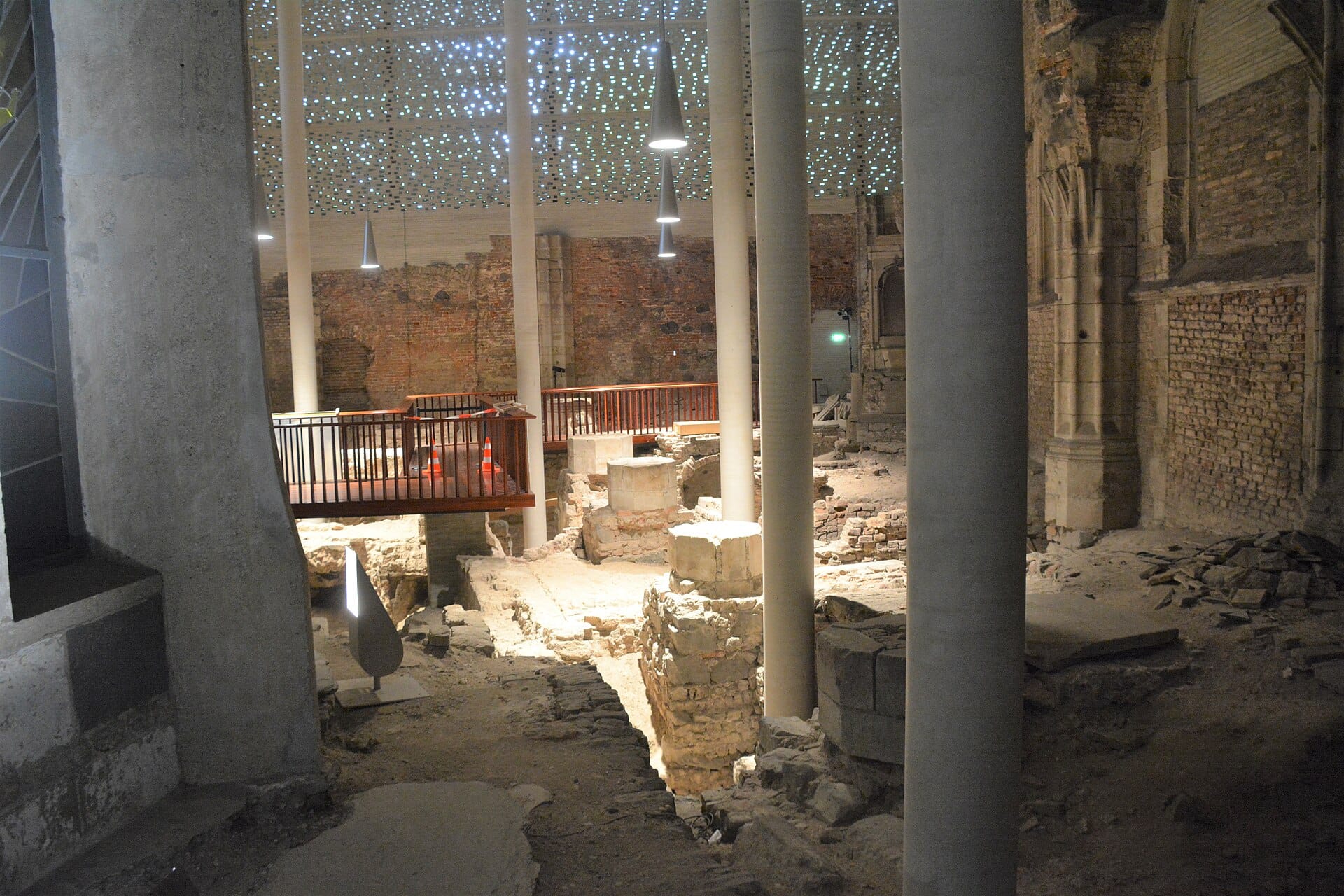
Zumthor's building doesn't erase that history. It incorporates it. You move through rooms that sit above Roman archaeological layers, medieval foundations, and the preserved chapel, all of it visible through the architecture itself. The museum was renamed 'Kolumba' in 2004, taking the name of the destroyed church and the street it stands on. The building covers approximately 1,600 square meters across 21 rooms, including an interior courtyard. For a city with a dense museum culture, Kolumba occupies an unusual position: it is neither encyclopedic nor commercial. It is precise, curated, and quiet.
ℹ️ Good to know
Kolumba changes its entire exhibition annually. The collection draws on art spanning two thousand years, but the specific works on display shift each autumn. If you visited before, it will look different now.
The Building: Peter Zumthor's Architecture as Experience
Kolumba is one of the few museums in the world where the architecture is itself a primary reason to visit, independent of whatever is currently on the walls. Zumthor, who won the Pritzker Prize in 2009, designed a building in grey-toned perforated brick that allows diffused natural light to enter the lower excavation halls. The texture of that brick is worth paying attention to: rough at close range, precise in pattern, almost textile-like from a distance. The exterior reads quietly on Kolumbastraße, which helps it avoid competing with the Cologne Cathedral a few minutes away.
Inside, the spatial sequence moves from dim archaeological ground levels upward through rooms of increasing austerity. Light enters from above in the upper galleries, flat and controlled, falling on artworks without drama. The temperature drops noticeably in the lower excavation areas. Sound changes too: the street noise from the Altstadt disappears almost entirely once you're inside. The effect is deliberate. Zumthor has described the building as a 'house of prayer and learning,' and the space behaves accordingly.
The preserved Böhm chapel sits within the building's footprint and can be entered during museum opening hours. It is a small, intact mid-century sacred space with a Madonna figure that survived the bombing, surrounded now by Zumthor's walls. Seeing it in context, with Roman-era archaeology visible below and contemporary art above, is the kind of layered experience that takes a few minutes to absorb.
💡 Local tip
Walk slowly through the lower excavation hall even if archaeological ruins are not usually your thing. The quality of light Zumthor achieves here, filtered through the perforated brick skin, is unlike anything else in Cologne.
Tickets & tours
Live prices and dates from our booking partner. If you book, we may earn a commission at no extra cost to you.
Discover Cologne's top street art quarter with a local
From 71 €Instant confirmationFree cancellationCologne haunted places and ghost stories: interactive city game
From 8 €Instant confirmationFree cancellationFood Tour Cologne Sudstadt
From 44 €Instant confirmationFree cancellationCologne brewery tour including 3 Kolsch beer
From 28 €Instant confirmation
The Collection: Sacred Art Across Two Millennia
The permanent collection spans from early Christian and Byzantine works through medieval ecclesiastical art, into the early modern period and then into the twentieth and twenty-first centuries. The Archdiocese of Cologne has accumulated significant holdings over centuries, including goldwork, ivory carvings, textile vestments, reliquaries, sculpture, and painted panels. What Kolumba curates from that collection each year is edited to a relatively small number of works, never overwhelming.
Contemporary and modern works are placed in conversation with older pieces rather than separated by period. You might find a medieval reliquary in the same room as a work by a living artist. This is a deliberate institutional stance: the museum is interested in continuity, in what sacred objects and contemporary art share across time, not in marking off historical epochs. Some visitors find this approach revelatory; others find it frustrating if they came specifically for medieval art or specifically for contemporary art. Knowing this in advance helps.
The collection's scope connects naturally to the broader landscape of Cologne's church-based heritage. The city's Museum Schnütgen specializes in Rhineland medieval sacred art with a more historically organized presentation, which makes the two museums genuinely complementary rather than repetitive. If ecclesiastical art across different curatorial approaches interests you, visiting both in the same trip is worthwhile.
How the Visit Feels at Different Times of Day
The museum opens at noon every day except Tuesday. Opening hour is reliably quiet, particularly on weekdays. The light in the upper galleries in early afternoon, when the sun is higher, is the most even and clear for looking at art. Photography without flash is generally permitted in the galleries, and the flat overhead light in those rooms makes conditions reasonable for handheld shots.
By mid-afternoon on weekends, small groups arrive and foot traffic increases, though Kolumba never reaches the crowding levels of larger Cologne institutions. The low number of rooms means even a moderate number of visitors can feel concentrated. If you want near-solitude, Wednesday or Thursday around opening time is the practical answer.
The lower excavation area, which receives natural light through the perforated brick rather than direct sunlight, looks roughly the same at any hour of the day. That is its own quality: a steady, ambient glow that changes with exterior cloud cover but slowly. On overcast days, which are common in Cologne from October through March, the effect is more muted and even more contemplative. On bright summer days, the filtered light becomes warmer and slightly more complex.
💡 Local tip
The museum runs Wednesday through Monday, noon to 5 pm. Arrive by 3 pm at the latest if you want unhurried time before closing. The final admission is shortly before 5 pm and the pace of the visit benefits from not feeling rushed.
Getting There and Practical Logistics
Kolumba sits at Kolumbastraße 4 in the Altstadt-Nord district, about eight minutes on foot from Cologne Hauptbahnhof. The walk takes you past the Cathedral and along the edge of the old town, which is a reasonable approach. From the Dom/Hauptbahnhof tram and U-Bahn stop, the walking time is similar. From Appellhofplatz, the walk is five to seven minutes from the west.
If you are building a day around the museum district near the Altstadt, Kolumba fits naturally into a walk that could also include the Cathedral, the Romano-Germanic Museum, and the area around Roncalliplatz. The tight geography means you can cover several significant sites without long transit gaps.
Parking is available at nearby garages at Brückenstraße and Glockengasse/Brückenstraße, but driving into central Cologne for a museum visit is generally not recommended; public transport connections are fast and direct from all parts of the city.
Accessibility is noted as limited for wheelchair users by city museum sources, and general disabled access is indicated on official fact sheets. The building's multiple levels and the archaeological areas may present practical difficulties. If mobility access is a concern, it is worth contacting the museum directly before visiting.
⚠️ What to skip
Kolumba is closed on Tuesdays. If your Cologne itinerary is short, check this before scheduling. The museum is also closed on certain public holidays; confirm current dates on the official website before visiting.
Context: Where Kolumba Fits in Cologne's Museum Landscape
Cologne has a concentrated and high-quality museum district. The Museum Ludwig is the city's major modern and contemporary art institution, with a large international collection and much higher visitor numbers. The Wallraf-Richartz Museum covers European painting from the medieval period through the nineteenth century. Against that backdrop, Kolumba occupies a specific and distinct position: smaller in scale, focused on the sacred across time, and defined by its architecture as much as its holdings.
It is not overhyped in the way that some single-architect buildings can be. Visitors who arrive expecting a conventional museum experience sometimes find it sparse. The collection is not comprehensive. Interpretation panels are minimal by design. The experience rewards visitors who are willing to slow down and look carefully, and it is less suited to those who prefer a high density of objects or detailed historical context provided at every turn.
For travelers working through the best museums in Cologne, Kolumba belongs in the top tier, but it is a specific kind of institution. Understanding that before you arrive will shape whether you leave thinking it was worth the two hours or wondering what the point was.
Who Should Skip It
Travelers with children under ten will likely find Kolumba unrewarding. The atmosphere is quiet and adult-oriented, the works are not explained in accessible formats for young visitors, and the building's pace does not accommodate short attention spans. There is nothing wrong with this; it is simply the nature of the institution.
Visitors looking for an overview of Cologne's history or a survey of the city's artistic development will be better served by the Romano-Germanic Museum or the Wallraf-Richartz. Kolumba does not attempt those things. If you have half a day for museums and want maximum coverage across periods and media, there are better options nearby for that goal.
Insider Tips
- The museum publishes a new exhibition catalogue each year when the annual display changes, usually in the autumn. If you visit shortly after the changeover, you may find staff particularly engaged with questions about new placements and intentions.
- The Böhm chapel inside the building, the 'Madonna of the Ruins,' is accessible during normal museum hours and is easy to miss if you follow the main exhibition route without looking for it. Ask at the entrance for its location within the current floor plan.
- Natural light quality is genuinely different depending on the season. Summer afternoons give a warmer tone in the lower excavation hall; overcast winter days produce the flattest, most evenly diffused light, which many find more suited to the architecture's character.
- There is no café inside Kolumba. If you plan to spend more than two hours, eat beforehand or plan for a break nearby. The area around Minoritenstraße and Neumarkt has several options within a five-minute walk.
- The annual exhibition typically changes in early to mid-autumn. If you are visiting around September or October, check the museum's website to confirm whether the new exhibition has opened; there is sometimes a brief closure period during the changeover.
Who Is Kolumba Art Museum For?
- Architecture enthusiasts who want to experience a major Peter Zumthor building in context
- Visitors with an interest in sacred art, ecclesiastical collections, or the intersection of medieval and contemporary work
- Travelers who prefer slow, contemplative museum experiences over high-density collections
- Photographers interested in architectural light and interior space
- Anyone curious about how Cologne's layered history, Roman, medieval, wartime destruction, and postwar reconstruction, is physically embedded in a single site
Nearby Attractions
Other things to see while in Altstadt (Old Town):
- 4711 House (Dufthaus 4711 / Haus Mülhens)
The 4711 House on Glockengasse is the home of the 4711 Original Eau de Cologne, the famous citrus fragrance developed by Wilhelm Mülhens from 1792 (the earlier Farina fragrance from 1709 is generally considered the original 'eau de Cologne'). Part flagship store, part fragrance museum, and part architectural curiosity, it offers a compact but interesting stop in Cologne's Altstadt-Nord for anyone curious about the city's most famous exports.
- Cologne City Museum (Kölnisches Stadtmuseum)
The Kölnisches Stadtmuseum traces Cologne's extraordinary 2,000-year arc from Roman outpost to Rhine metropolis. Reopened in a striking new home on Minoritenstraße in March 2024, it offers an affordable and intellectually rewarding afternoon in the city's Altstadt.
- Cologne Cathedral (Kölner Dom)
Cologne Cathedral, officially the Hohe Domkirche Sankt Petrus, is Germany's most visited landmark and one of the great Gothic structures on earth. This guide covers tourist ticketing, tower access, the Treasury, and how to make the most of your time there.
- Cologne City Hall (Kölner Rathaus)
The Kölner Rathaus is Germany's oldest city hall, a layered architectural landmark in Cologne's Old Town that spans Gothic, Renaissance, and modern styles.
Planning a trip? Discover personalized activities with the Nomado app.