Cologne City Hall (Kölner Rathaus): 900 Years of Civic History in the Heart of the Altstadt
The Kölner Rathaus is Germany's oldest city hall, a layered architectural landmark in Cologne's Old Town that spans Gothic, Renaissance, and modern styles.
Quick Facts
- Location
- Rathausplatz 2, 50667 Köln (Altstadt-Nord)
- Getting There
- Walkable from Dom/Hbf; check local transit for the nearest stop
- Time Needed
- 30–60 minutes for exterior and courtyard; longer for interior rooms
- Cost
- Free general entry; fees may apply for special tours or events
- Best for
- History enthusiasts, architecture lovers, Altstadt walkers
- Official website
- www.stadt-koeln.de/6/sehenswertes/rathaus
What Is the Kölner Rathaus?
The Historisches Rathaus Köln, known in English as Cologne City Hall, is the oldest city hall in Germany, with documented civic use stretching back over 900 years. The core of the building was completed between 1135 and 1152, and it has been continuously expanded, damaged, rebuilt, and restored across the centuries. It still functions as an active seat of city government, which sets it apart from the many historic buildings in Cologne that have been converted into museums or closed to the public entirely.
The building complex sits on Rathausplatz, wedged between the Rhine-facing Alter Markt square and the medieval street grid of Altstadt-Nord, roughly 300 meters southwest of Cologne Cathedral. This is not a grand isolated monument set in open parkland. It is a compact, layered structure pressed into the dense urban fabric of the Old Town, and that compression is part of what makes it interesting. You understand it gradually, moving around it rather than stepping back to take a single view.
ℹ️ Good to know
The current visitor entrance is on the Alter Markt side due to construction work. Check the official city website before visiting for updated access information.
Architecture Across Eight Centuries
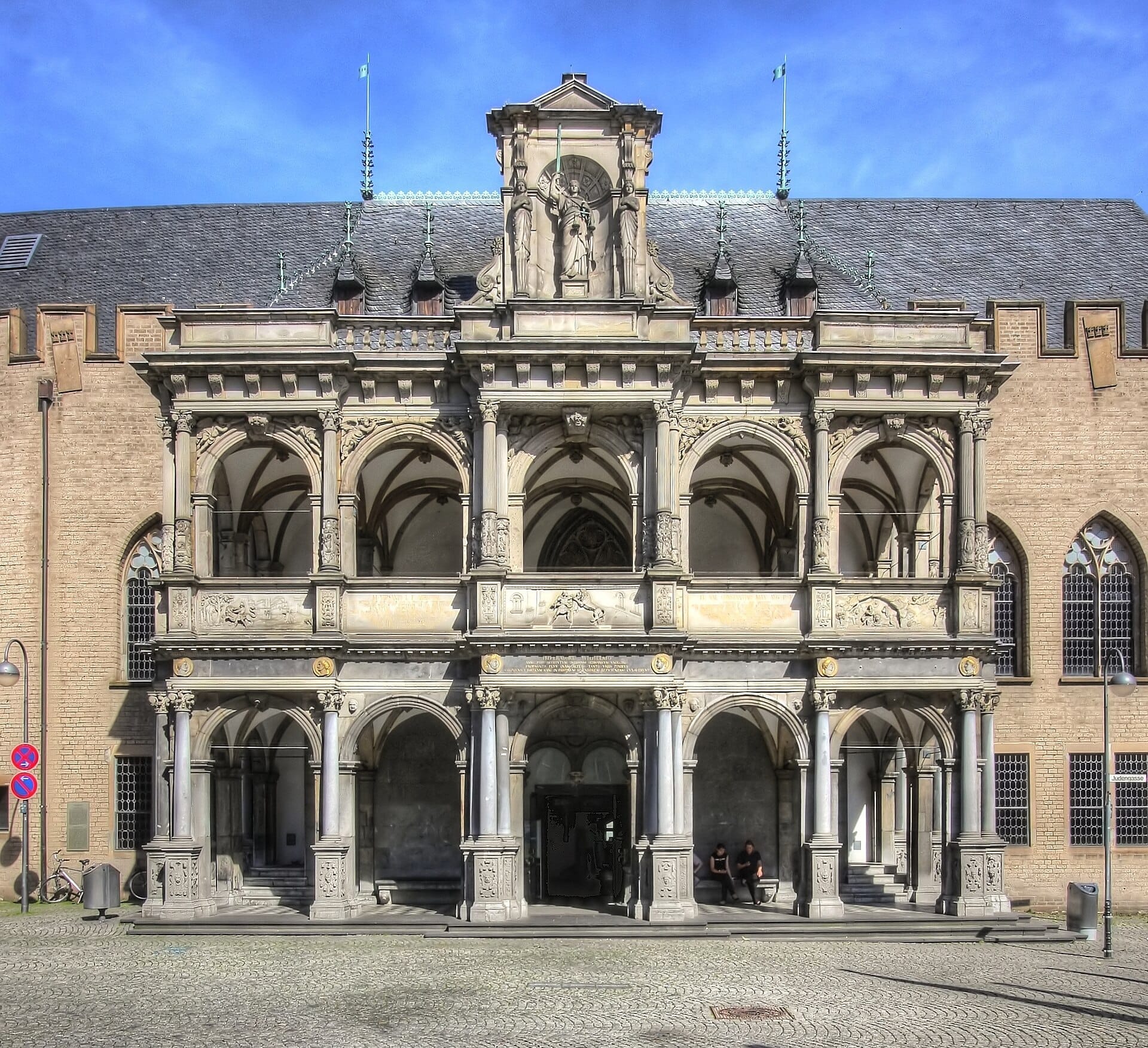
Few buildings in Germany carry as many distinct architectural periods in a single glance as the Kölner Rathaus. The oldest preserved part dates to the 14th century. Above it rises the Gothic tower, built in the 15th century, which was once the tallest structure in Cologne before the Cathedral's spires were completed. The tower is covered in over 100 carved stone sculptures of figures representing imperial, ecclesiastical, and civic authority, arranged across multiple tiers. Up close, the detail is remarkable; at midday when light hits the west face directly, the relief carving reads clearly even from the square below.
On the south side of the complex, the 16th-century loggia introduces a wholly different sensibility. Built in the Renaissance style at a time when Italian architectural ideas were spreading north through the Holy Roman Empire, the arcade of rounded arches and classical proportions feels almost incongruous next to the Gothic tower but is historically coherent: Cologne was a major trading city with strong European connections, and its civic architecture reflected those contacts. The loggia is an early Renaissance structure in the Rhineland.
A 20th-century courtyard fills the interior of the complex, a more utilitarian addition that nonetheless provides a sheltered transitional space between the historic sections. It is worth walking through slowly. The contrast between the medieval stonework and the plain postwar construction is itself a kind of document about what Cologne lost during the Second World War and how the city chose to rebuild.
Tickets & tours
Live prices and dates from our booking partner. If you book, we may earn a commission at no extra cost to you.
Escape Tour self-guided, interactive city challenge in Cologne
From 30 €Instant confirmationCologne haunted places and ghost stories: interactive city game
From 8 €Instant confirmationFree cancellationFood Tour Cologne Sudstadt
From 44 €Instant confirmationFree cancellationCologne brewery tour including 3 Kolsch beer
From 28 €Instant confirmation
The Experience of Visiting: Time of Day and Atmosphere
The City Hall is a working municipal building, not a tourist attraction in the conventional sense, and that distinction shapes the experience significantly. On weekday mornings, particularly between 9:00 and 11:00, the building hums with low-level bureaucratic activity. City employees move through the courtyards, residents arrive with paperwork, and the occasional wedding party assembles near the civil registry rooms. The Rathausplatz itself fills gradually with pedestrians cutting through from Hohe Straße toward the Rhine.
By early afternoon the crowd composition shifts toward tourists and school groups who have worked their way down from the Cathedral and are exploring the wider Altstadt. The Gothic tower photographs well in afternoon light from the north side of Rathausplatz, when the sun moves around to illuminate the sculpture-covered facade. Early morning, by contrast, tends to place the tower in shadow, though the quieter streets make for more considered exploration.
On Fridays, the building closes to visitors at noon, so any plans to enter the interior should be made on Monday through Thursday. Weekends and public holidays mean the building is closed entirely for general access. If your visit to Cologne falls on a weekend, you can still walk around the exterior, which is arguably where most of the architectural interest lies anyway.
💡 Local tip
Opening hours: Mon, Wed, Thu 08:00–16:00; Tue 08:00–18:00; Fri 08:00–12:00. Closed Saturdays, Sundays, and public holidays.
Historical and Cultural Significance
Cologne has been a center of civic and commercial power since its founding as a Roman colony, and the Rathaus represents the institutional continuity of that urban tradition across medieval, early modern, and modern periods. The site was the seat of the city council during Cologne's period as a Free Imperial City, when it governed itself independently within the Holy Roman Empire. That civic self-confidence is legible in the architecture: the Gothic tower was built to assert the city's status, and the Renaissance loggia reinforced that message in the idiom of a later era. For context on Cologne's broader architectural heritage, Cologne's twelve Romanesque churches provide a parallel story of civic and ecclesiastical investment in stone across the same centuries.
The building was heavily damaged during the Second World War bombing campaigns that destroyed much of Cologne's historic core. The postwar restoration and reconstruction preserved the Gothic tower and loggia while introducing the modern courtyard as a practical solution to the destroyed interior sections. This approach, preserving facades and significant structural elements while acknowledging the losses with plainer modern infill, is common across postwar German cities and represents a specific philosophy about heritage and honesty.
Beneath the Rathausplatz, archaeological excavations conducted during construction work uncovered the foundations of Cologne's medieval Jewish quarter, including a mikveh (ritual bath) and synagogue remains dating to the 12th century. These finds are significant and have been documented through public interpretation. The Jewish community of medieval Cologne was expelled in 1424; the excavated remains sit directly under the square where the city's civic institutions continued to function for centuries afterward.
Getting There and Navigating the Area
The simplest approach from Cologne's main train station is on foot. From the Dom/Hauptbahnhof exit, walk south along Unter Goldschmied or through the pedestrian shopping streets for roughly 10 minutes to reach Rathausplatz. Tram Line 5 stops at Rathaus, about a two-minute walk from the building entrance. The Hohenzollern Bridge and the Cathedral are both within easy walking distance, making the Rathaus a natural stop on any walking circuit of the Altstadt.
The surrounding streets of the Altstadt are compact and largely pedestrianized, which means the area is very walkable. Alter Markt to the north and Heumarkt to the south are both lively squares that anchor the neighborhood. If you are planning a half-day in this part of the city, the Cologne walking tour route connects the Rathaus with other key Old Town sites efficiently.
💡 Local tip
Photography: The Gothic tower is best captured from the northeast corner of Rathausplatz in the early afternoon. For the Renaissance loggia, step into the courtyard approach from Alter Markt. A wide-angle lens helps in the tight surrounding streets.
Context: What Surrounds the City Hall
The Rathaus sits in the densest part of Cologne's historic center, surrounded by attractions that range from major museums to neighborhood bars. The Wallraf-Richartz Museum is a short walk south and houses one of Germany's most important collections of medieval and early modern painting, a fitting pairing with a visit to the Rathaus for anyone interested in the city's artistic heritage.
The Romano-Germanic Museum is located just north near the Cathedral and covers Cologne's Roman origins with precision and depth. Visiting both on the same day gives a coherent arc from Roman Colonia to medieval civic institution. Equally close is Great St. Martin Church, whose massive Romanesque tower has defined the Altstadt skyline for nearly a thousand years and anchors the Rhine side of the neighborhood.
For a meal or a Kölsch before or after, Alter Markt has several traditional brewery restaurants within sight of the Rathaus. The area around Früh am Dom is a few minutes north and represents the classic Cologne beer hall experience.
Who Will Get the Most From This Visit
The Kölner Rathaus rewards visitors who bring some curiosity about civic history, architecture, or urban development. If you are interested in how a city governed itself over 900 years, or in the specific question of how medieval and Renaissance architectural styles coexist in a northern European context, this building offers genuine substance. The free entry and central location make it an easy add-on to any Altstadt walk.
Visitors expecting an interior museum experience or guided exhibition content may feel underwhelmed. There are no permanent displays aimed at tourists within the building, no multilingual interpretation panels lining the corridors, and the rooms that are accessible vary depending on administrative activity that day. The value here is architectural and historical, experienced through observation rather than curated presentation.
Travelers with very limited time in Cologne, say a single afternoon, might reasonably prioritize the Cathedral, the Rhine waterfront, or the museum quarter over a dedicated stop here. But for anyone spending two days or more in the city, the Rathaus earns its place as a short, substantive detour from the more obvious landmarks nearby.
Insider Tips
- The best exterior view of the Gothic tower requires approaching from the north side of Rathausplatz, not from Alter Markt. Most visitors come from the Alter Markt side and miss the tower's full elevation.
- If you visit on a Tuesday, you get the longest opening window (until 18:00), which gives you more flexibility to fit the Rathaus into an afternoon itinerary after the main tourist sites have peaked in crowd numbers.
- The archaeological remains of the medieval Jewish quarter, including a 12th-century mikveh, were discovered directly beneath Rathausplatz. These finds have been documented and interpreted as part of Cologne's heritage.
- Wedding ceremonies take place here on weekdays; if you arrive mid-morning on a Thursday you are likely to see a civil ceremony party in the courtyard, which is one of those unrepeatable slices of local life that no guidebook can schedule for you.
- The Renaissance loggia is one of the earliest examples of that architectural style in the entire Rhineland. If you are moving on to other German cities afterward, it provides a useful reference point for how Italian Renaissance ideas traveled north during the 16th century.
Who Is Cologne City Hall (Kölner Rathaus) For?
- Architecture enthusiasts interested in Gothic, Renaissance, and postwar building layered on a single site
- History-focused travelers who want to understand Cologne's civic identity beyond the Cathedral
- Visitors on a budget, since entry to the exterior and much of the accessible interior is free
- Altstadt walkers building a half-day or full-day circuit of the Old Town
- Travelers with a specific interest in medieval Jewish heritage in Germany
Nearby Attractions
Other things to see while in Altstadt (Old Town):
- 4711 House (Dufthaus 4711 / Haus Mülhens)
The 4711 House on Glockengasse is the home of the 4711 Original Eau de Cologne, the famous citrus fragrance developed by Wilhelm Mülhens from 1792 (the earlier Farina fragrance from 1709 is generally considered the original 'eau de Cologne'). Part flagship store, part fragrance museum, and part architectural curiosity, it offers a compact but interesting stop in Cologne's Altstadt-Nord for anyone curious about the city's most famous exports.
- Cologne City Museum (Kölnisches Stadtmuseum)
The Kölnisches Stadtmuseum traces Cologne's extraordinary 2,000-year arc from Roman outpost to Rhine metropolis. Reopened in a striking new home on Minoritenstraße in March 2024, it offers an affordable and intellectually rewarding afternoon in the city's Altstadt.
- Cologne Cathedral (Kölner Dom)
Cologne Cathedral, officially the Hohe Domkirche Sankt Petrus, is Germany's most visited landmark and one of the great Gothic structures on earth. This guide covers tourist ticketing, tower access, the Treasury, and how to make the most of your time there.
- Cologne Philharmonie
The Kölner Philharmonie is Cologne's premier concert venue, hosting around 400 performances a year beneath Heinrich-Böll-Platz. With seating for up to 2,000 and a column-free auditorium designed for acoustic precision, it draws world-class orchestras and soloists to the heart of the Altstadt.
Planning a trip? Discover personalized activities with the Nomado app.