Cologne City Museum (Kölnisches Stadtmuseum): The Full Story of a City in One Building
The Kölnisches Stadtmuseum traces Cologne's extraordinary 2,000-year arc from Roman outpost to Rhine metropolis. Reopened in a striking new home on Minoritenstraße in March 2024, it offers an affordable and intellectually rewarding afternoon in the city's Altstadt.
Quick Facts
- Location
- Minoritenstraße 13, 50667 Köln (Altstadt-Nord)
- Getting There
- U-Bahn 3, 4, 16, 18 to Appellhofplatz or Dom/Hbf; Bus 171 to Offenbachplatz
- Time Needed
- 1.5 to 2.5 hours
- Cost
- Adults €5, reduced €3; free for some qualifying groups and on KölnTag for Cologne residents
- Best for
- History lovers, first-time visitors wanting city context, rainy-day culture
- Official website
- www.koelnisches-stadtmuseum.de
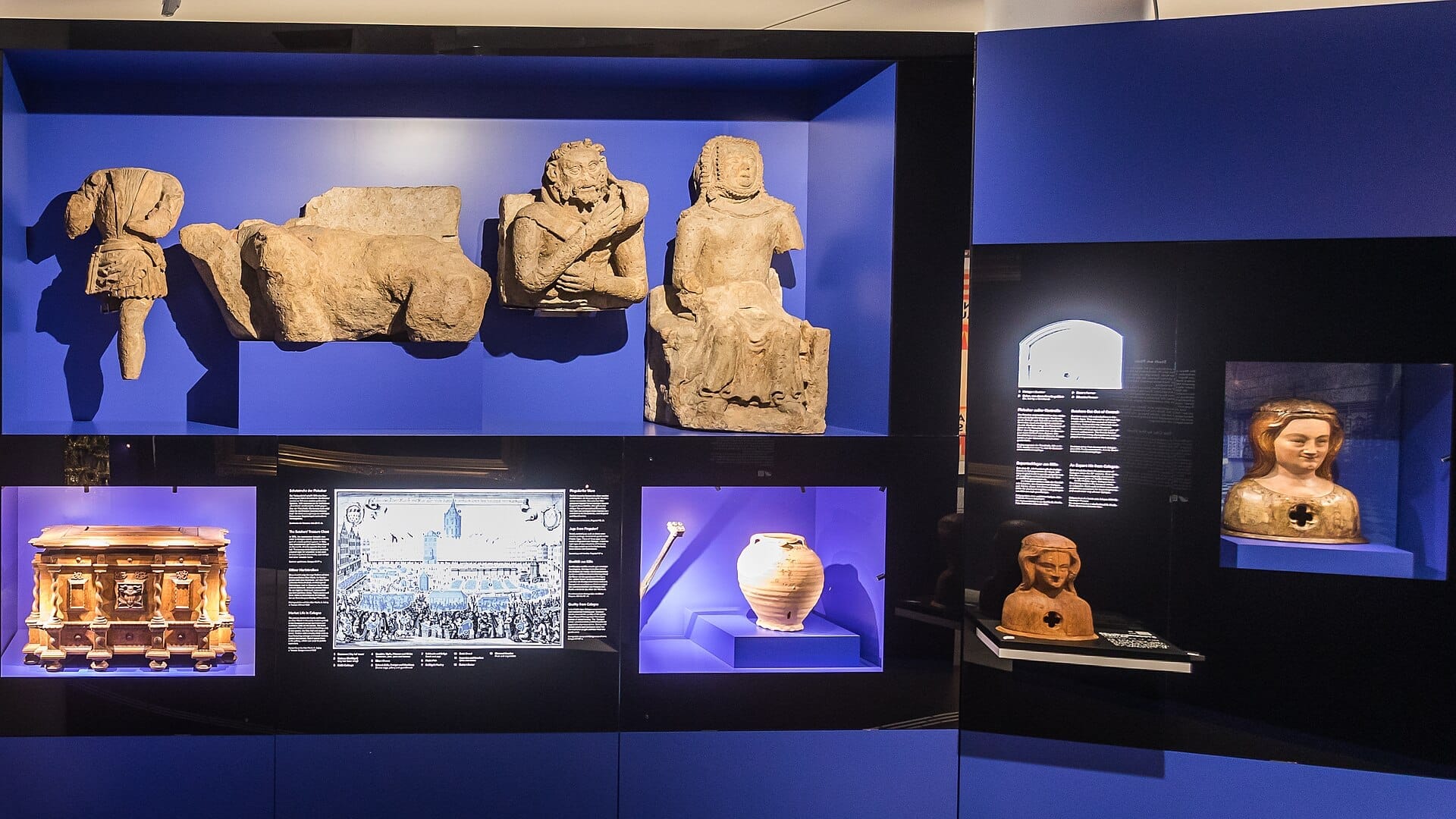
What Is the Cologne City Museum?
The Kölnisches Stadtmuseum is Cologne's principal municipal history museum, dedicated to telling the story of the city from its Roman foundations through the medieval Hanseatic period, the devastation of World War II, postwar reconstruction, and into the present. It is not a dry archive of dates and artifacts. The curators have deliberately built a museum that argues for Cologne's peculiarities: its stubborn local identity, its Carnival culture, its relationship with the Rhine, and the way ordinary residents have shaped the city as much as emperors and archbishops ever did.
After years in its older home at the Zeughaus, the museum relocated to the former Franz Sauer fashion house at Minoritenstraße 13 and reopened in March 2024. The building itself is a postwar commercial structure, and the renovation has been thoughtful: industrial bones have been kept visible where they add character, while display areas are well-lit and modern. It feels less like a traditional Wilhelmine institution and more like a city saying something new about itself.
ℹ️ Good to know
Opening hours: Tuesday to Sunday, 10:00–17:00. On the first Thursday of each month the museum stays open until 22:00 — a genuinely useful option for travelers with packed daytime schedules. Note: check the official website for any special closures during Cologne's Carnival season.
The New Home on Minoritenstraße: What the Building Tells You Before You Enter
Minoritenstraße 13 sits a short walk from both the Cathedral quarter and the courthouse district around Appellhofplatz. The street itself is quiet by Altstadt standards, which means you can stand outside and actually look at the facade without being jostled. The former fashion house has a clean, horizontal postwar profile that contrasts interestingly with the Gothic spires visible just a few hundred meters away. That contrast is, in a sense, the museum's central argument: Cologne is a city that absorbed catastrophe and rebuilt without erasing what came before.
The entrance on Minoritenstraße is straightforward and accessible. The museum explicitly accommodates visitors with physical disabilities and wheelchair users, and a significant portion of its programming is designed to be accessible to people with visual impairments as well. If accessibility is a concern, this is one of the better-equipped cultural venues in the Altstadt.
Tickets & tours
Live prices and dates from our booking partner. If you book, we may earn a commission at no extra cost to you.
Cologne haunted places and ghost stories: interactive city game
From 8 €Instant confirmationFree cancellationFood Tour Cologne Sudstadt
From 44 €Instant confirmationFree cancellationCologne brewery tour including 3 Kolsch beer
From 28 €Instant confirmation2-hour afternoon cruise in Cologne at Christmastime
From 25 €Instant confirmationFree cancellation
Inside the Collection: Two Thousand Years, One City
Cologne was founded as a Roman colony, Colonia Claudia Ara Agrippinensium, in 50 AD, and the museum traces that lineage with artifacts and context that complement rather than duplicate what you see at the Romano-Germanic Museum a few blocks away. Where the Romano-Germanic Museum focuses on the material culture of Roman Cologne in forensic detail, the Stadtmuseum is more interested in continuity: how Roman infrastructure, street patterns, and civic organization shaped the medieval city that grew over them.
The medieval sections cover the period when Cologne was one of the most powerful cities north of the Alps, a major node in the Hanseatic League's trading network, and home to one of Europe's earliest documented Jewish communities. The museum handles this history with appropriate weight, including chapters on persecution and expulsion that are neither glossed over nor sensationalized. For a broader picture of Cologne's Jewish heritage, the NS Documentation Centre nearby provides a sobering and essential companion visit.
The sections dealing with the 19th and 20th centuries are where the museum earns its local authority. The industrialization of the Rhine, the rise of Cologne as a commercial and printing hub, and the near-total destruction of the city center in World War II bombing raids are covered with maps, photographs, and personal objects that make the scale of loss concrete rather than abstract. Then the postwar story: the remarkable speed of reconstruction, the decisions about what to rebuild and what to leave as ruin, and the way Cologne's residents reassembled daily life. These galleries tend to hold visitors longer than the medieval rooms.
💡 Local tip
Arrive at opening time (10:00) on weekday mornings for the quietest experience. School groups typically arrive mid-morning, and the galleries around the medieval and WWII sections can get crowded by 11:30. The extended first-Thursday evening opening is ideal if you want the museum largely to yourself.
Carnival, Cologne Identity, and What the Museum Gets Right
One of the Stadtmuseum's most distinctive contributions is its treatment of Cologne Carnival, the Kölner Karneval, as a serious cultural and social institution rather than just a party. The museum traces Carnival's roots, its function as a period of social inversion and community bonding, and its evolution from street procession to the massive multi-day event it is today. If you are visiting around February or early March and want to understand what you are witnessing in the streets, the museum's Carnival galleries provide genuine context. Note, however, that the museum closes entirely during the peak Carnival days (12–17 February) each year. For deeper preparation, the Cologne Karneval guide covers the full event calendar and street experience.
The treatment of Kölsch identity throughout the museum is refreshingly self-aware. Cologne has a strong local dialect, a fiercely regional beer culture, and a tendency to define itself against the rest of Germany in ways that are half-serious and half-comic. The museum acknowledges this without turning it into kitsch, which is harder than it sounds given that most tourist shops on the Hohe Straße are selling exactly that kind of reductive Cologne branding.
Planning Your Visit: Practical Details
Admission is €5 for adults and €3 reduced, placing this firmly in the affordable bracket for a Cologne day. Several categories get free admission, including Cologne residents on KölnTag and certain qualifying groups. The ticket desk can confirm current free-admission categories on arrival.
Getting here is simple. From the Cathedral square, it is a ten-minute walk west along the pedestrian zone and then north toward Appellhofplatz. U-Bahn lines 3, 4, 16, and 18 stop at Appellhofplatz, which puts you almost at the door. If you are combining the museum with a visit to the Cologne Cathedral or the Romano-Germanic Museum, all three are walkable from the same transit stops. Budget at least 90 minutes inside the Stadtmuseum; two and a half hours is comfortable if you read the panels carefully.
The museum has a cloakroom for bags and coats, useful in winter when the Altstadt cold is sharp and a heavy jacket quickly becomes a burden. Photography policies for temporary exhibitions can vary, so check on arrival if you plan to document specific pieces. The permanent collection tends to be photographer-friendly.
⚠️ What to skip
The museum is closed on Mondays. If you are only in Cologne for a weekend, factor this in. Public holidays may also affect opening; the official website at koelnisches-stadtmuseum.de is the reliable source for up-to-date closure information.
How the Experience Changes by Time of Day
Morning visits, particularly on weekdays between 10:00 and 11:00, give you the quietest access to the permanent galleries. The light in the building is relatively even throughout the day given the interior orientation, so there is no particular photographic advantage to one time over another inside. On first-Thursday evenings, the atmosphere shifts noticeably. The reduced lighting in some sections, combined with a smaller crowd, makes the WWII-era galleries feel particularly immersive. The museum occasionally hosts events on these evenings, so checking the program in advance is worthwhile.
Weekend afternoons, especially on Saturdays between 13:00 and 15:00, are the busiest periods. Families with children are well represented; the museum has put effort into making parts of the collection engaging for younger visitors. If you are traveling with children, this is a reasonable choice for a cultural hour, though the Cologne with kids guide has additional options better suited to very young ages.
Who Should and Should Not Visit
The Kölnisches Stadtmuseum rewards visitors who arrive with at least some curiosity about urban history and the specific texture of German city life. First-time visitors to Cologne will find it enormously useful for understanding why the city looks and feels the way it does, particularly the coexistence of Roman-era fragments, medieval churches, postwar concrete, and contemporary design. History enthusiasts who have already read about Cologne's past will find enough new material and local perspective to make the visit worthwhile.
Travelers looking primarily for visual spectacle, immersive digital experiences, or blockbuster temporary exhibitions may find the Stadtmuseum more text-heavy and traditional than expected. The collection is strong but not sensational. It is a museum that rewards reading, not just looking. If your time in Cologne is limited to one or two days and you are prioritizing maximum variety, the Cathedral, the Chocolate Museum, and the Museum Ludwig offer more immediately striking experiences. But if you want to understand the city rather than just see it, the Stadtmuseum is genuinely useful in a way those attractions are not.
Insider Tips
- The first Thursday of each month the museum stays open until 22:00 with no price change. This is the best window to visit if you want space to think in the WWII and postwar galleries without school groups moving through.
- The museum may close or adjust its hours for Carnival. If your trip overlaps with Karneval season, build this into your schedule and check the official website for exact dates and opening times.
- Combine a visit with the Kolumba art museum, which is a five-minute walk away. The two institutions offer a complementary pair: Kolumba focuses on sacred art and spiritual continuity, the Stadtmuseum on civic and social history. Together they take about half a day.
- The €5 admission covers your visit for the day. If you want a break mid-visit, ask at the desk whether re-entry is permitted — many smaller German museums allow this with a stamped ticket.
- Audio guides and materials in English are available, but the quality of wall panel translations varies across galleries. The older medieval sections tend to have briefer English text than the modern-history rooms.
Who Is Cologne City Museum (Kölnisches Stadtmuseum) For?
- First-time visitors to Cologne who want historical context before exploring the Altstadt
- History and urban culture enthusiasts with a specific interest in German city development
- Travelers visiting during Karneval season who want to understand the festival's deeper roots (check opening hours in advance during February)
- Rainy-day or cold-weather seekers of a substantive, affordable indoor experience
- Visitors combining a cultural circuit with the Romano-Germanic Museum and Kolumba on the same afternoon
Nearby Attractions
Other things to see while in Altstadt (Old Town):
- 4711 House (Dufthaus 4711 / Haus Mülhens)
The 4711 House on Glockengasse is the home of the 4711 Original Eau de Cologne, the famous citrus fragrance developed by Wilhelm Mülhens from 1792 (the earlier Farina fragrance from 1709 is generally considered the original 'eau de Cologne'). Part flagship store, part fragrance museum, and part architectural curiosity, it offers a compact but interesting stop in Cologne's Altstadt-Nord for anyone curious about the city's most famous exports.
- Cologne Cathedral (Kölner Dom)
Cologne Cathedral, officially the Hohe Domkirche Sankt Petrus, is Germany's most visited landmark and one of the great Gothic structures on earth. This guide covers tourist ticketing, tower access, the Treasury, and how to make the most of your time there.
- Cologne City Hall (Kölner Rathaus)
The Kölner Rathaus is Germany's oldest city hall, a layered architectural landmark in Cologne's Old Town that spans Gothic, Renaissance, and modern styles.
- Cologne Philharmonie
The Kölner Philharmonie is Cologne's premier concert venue, hosting around 400 performances a year beneath Heinrich-Böll-Platz. With seating for up to 2,000 and a column-free auditorium designed for acoustic precision, it draws world-class orchestras and soloists to the heart of the Altstadt.
Planning a trip? Discover personalized activities with the Nomado app.