Hohenzollern Bridge (Hohenzollernbrücke): Cologne's Rhine Crossing
The Hohenzollernbrücke is Cologne's most-crossed bridge and one of Germany's busiest railway crossings. Open around the clock and free to walk, it offers some of the city's best views of the Cathedral and the Rhine, and carries hundreds of thousands of padlocks on its railings.
Quick Facts
- Location
- Altstadt-Nord, linking Cologne Central Station with Köln Messe/Deutz, Cologne
- Getting There
- Köln Hauptbahnhof (3-minute walk to bridge entrance); Köln Messe/Deutz on the east bank
- Time Needed
- 20–40 minutes for a leisurely crossing and look around
- Cost
- Free, 24 hours a day
- Best for
- Rhine views, Cathedral photography, architecture, evening walks
What Is the Hohenzollern Bridge?
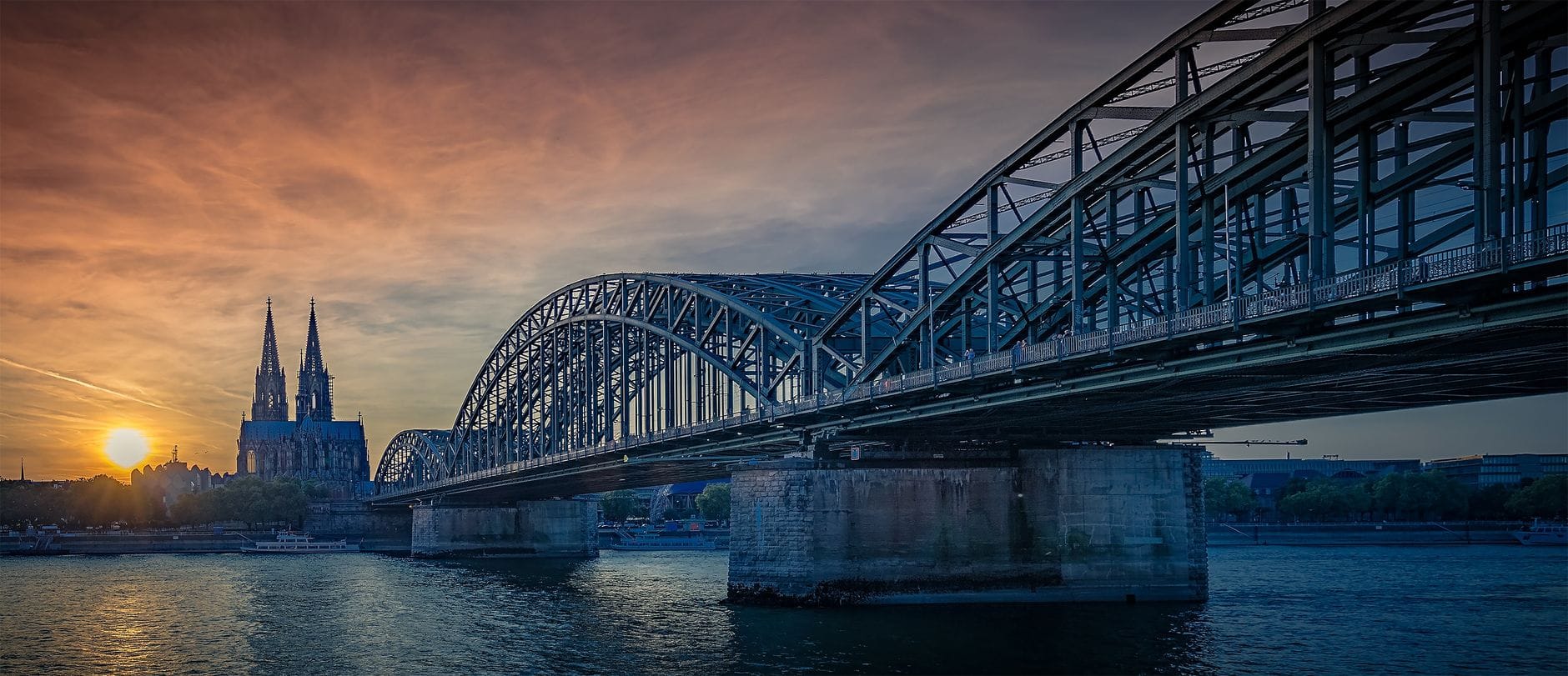
The Hohenzollernbrücke spans the Rhine at river kilometre 688.5, connecting Cologne's historic left bank, where the Cathedral and main station sit, to the Deutz district on the right bank. At roughly 409 metres long and just over 26 metres wide, it carries six railway tracks and a pedestrian walkway that runs alongside them. The bridge is open every day of the year, at every hour, at no cost.
What makes it extraordinary by any technical measure is its rail traffic: on the order of 1,200 to 1,500 train movements cross daily, making it one of the most intensively used railway bridges in Germany. Walk across on a weekday morning and you will feel the deck shudder as an ICE high-speed train passes within a few metres of you, separated only by a steel fence. That proximity to active rail is genuinely startling the first time.
For most visitors, though, the bridge is inseparable from the view it provides of the Cologne Cathedral. From the pedestrian walkway, the twin spires rise directly ahead as you cross from Deutz toward the old town, framed against the sky and reflected in the Rhine below. It is one of the defining visual compositions in the city, and one of the best reasons to walk this route rather than take the train.
💡 Local tip
For the classic Cathedral-and-bridge photograph, cross to the Deutz side and walk a few minutes south along the riverbank. From there you get the full sweep of the bridge with the Cathedral spires rising behind it, especially clean in the early morning light before tour groups arrive.
History: Built for an Empire, Rebuilt After Destruction
The original Hohenzollernbrücke was constructed between 1907 and 1911 and inaugurated on 22 May 1911 by Emperor Wilhelm II; its name refers to the Hohenzollern dynasty of German emperors. The design reflected the confidence of the Wilhelmine era: iron arches flanked at both approaches by four equestrian statues of Hohenzollern rulers (two on each bank), a structure meant to project imperial permanence over the Rhine.
That permanence did not survive the Second World War. In March 1945, retreating German forces demolished the bridge to slow the Allied advance. The Rhine crossing lay in ruins. Reconstruction began in the postwar years, with the pedestrian walkway returning to use in the late 1940s and full railway operation resuming in 1959. The current bridge is a steel arch structure that retained the historic proportions but was rebuilt largely from scratch. The equestrian statues were restored and reinstalled, giving the bridge its recognisable silhouette today.
That story of destruction and rebuilding is not incidental to understanding Cologne. The city lost roughly 90 percent of its historic centre to Allied bombing, and the bridge's reconstruction was part of a broader effort to reconnect a city that had been physically split by the war. Walking the Hohenzollernbrücke is, in a small way, walking across that history.
Tickets & tours
Live prices and dates from our booking partner. If you book, we may earn a commission at no extra cost to you.
Cologne private walking tour
From 241 €Instant confirmationFree cancellationCologne brewery tour
From 25 €Instant confirmationFree cancellationGuided Segway™ tour in Cologne
From 79 €Instant confirmationFree cancellationGuided walking tour to the highlights of Cologne
From 15 €Instant confirmationFree cancellation
The Love Locks: What You Will Actually See
The railings of the pedestrian walkway are covered, from end to end, with padlocks. Estimates put the number at several hundred thousand, accumulated over many years as couples began attaching locks engraved or written with their names and throwing the key into the Rhine. The locks are dense enough in places that you can barely see the original metalwork beneath them.
The practice began informally and has never been officially encouraged by city authorities, who have periodically discussed its structural and aesthetic implications. The weight of the locks is a legitimate engineering consideration. But removal efforts at other cities (notably Paris) have proved unpopular, and Cologne has so far left the locks in place. Whatever you make of the tradition, the sheer accumulated scale of them is striking, the colours of the locks catching sunlight in a way that turns the railing into something between folk art and public record.
If you are visiting with a partner and considering adding a lock, be aware that lock sellers sometimes operate near the bridge entrances, though this varies by season and day. The tradition itself is not going anywhere soon.
How the Bridge Changes by Time of Day
Early morning, roughly 7 to 9 AM, is when the bridge works best as an experience rather than a destination. The pedestrian walkway is relatively quiet, the Rhine catches the low light, and the Cathedral spires are sharp against whatever sky the day offers. The trains are running at full frequency, which means you get the rumble and vibration of passing rail traffic as a constant undercurrent, but without the shoulder-to-shoulder crowds of midday.
By midmorning on weekends and throughout summer afternoons, the walkway fills with tourists, particularly on the Cologne side where it connects directly to the riverfront promenade below the Cathedral. Progress slows as people stop for photographs. This is not a problem so much as something to factor in if you are crossing for a purpose rather than an experience.
Sunset and the hour after it are the most photographed window. The west-facing walkway glows as the sun drops toward the Altstadt skyline, and the Cathedral's floodlighting comes on at dusk, which changes the quality of the view entirely. In summer, people gather on the Deutz riverbank below the bridge to watch the light, and the bridge itself becomes part of that social atmosphere rather than just a crossing. In winter, fog sometimes settles on the Rhine and the lights of the old town blur into something moodier, which has its own appeal.
ℹ️ Good to know
The bridge is open and freely accessible at all hours. There are no gates, no entry points, and no ticket checks. You simply walk on from either bank.
Practical Walkthrough: Getting There and Crossing
From Cologne Central Station (Köln Hauptbahnhof), the bridge entrance is about a three-minute walk. Exit the station toward the Rhine, pass the Cathedral forecourt, and follow the riverside promenade north a short distance until the bridge ramp appears on your left. The pedestrian walkway runs on the south side of the bridge structure, separated from the rail tracks by fencing.
The crossing takes about 10 to 15 minutes at a leisurely pace. The surface is even and the walkway is wide enough for two people to pass comfortably in either direction. The noise level is significant: trains pass frequently at speed, and the steel structure amplifies both sound and vibration. If you are sensitive to noise or find crowds uncomfortable in enclosed-feeling spaces, note that the walkway, while open-air, does feel channelled between the bridge's steel arches.
On the Deutz side, you emerge near Köln Messe/Deutz station and the Cologne Triangle Panorama, a viewing platform in the triangular office tower that gives an aerial perspective back over the bridge and Cathedral. The combination of bridge crossing followed by the Triangle's rooftop view makes for a coherent two-hour loop from the old town.
Alternatively, staying on the left bank, the bridge sits within easy walking distance of the Cathedral, the Romano-Germanic Museum, and the Museum Ludwig. Most visitors combine the bridge with a broader walk through the Altstadt rather than treating it as a standalone stop.
Photography Notes and Accessibility
The best photography positions depend on what you want. For the Cathedral framed by the bridge arches, walk to the Deutz bank and position yourself on the riverside path looking west. For the bridge itself as a subject, the riverboat landing stages north of the Cathedral give a low-angle perspective with the arches overhead. For the love locks up close, any section of the walkway railing works, but the mid-bridge section tends to have the densest concentration and the widest variety.
Wide-angle lenses suit the bridge-and-Cathedral composition. In bright midday light, the contrast between the dark steel structure and a pale sky can be harsh; cloud cover or the warm tones of early morning and late afternoon produce better results without heavy post-processing.
On accessibility: the pedestrian walkway is step-free from the Cologne-side riverfront promenade up to the bridge deck itself, and the Deutz side similarly connects to the station level without stairs. However, for visitors using wheelchairs or pushchairs, it is worth verifying current access conditions at the station entrances, as infrastructure at major rail hubs can change with ongoing construction work.
⚠️ What to skip
The bridge can feel uncomfortably crowded during major city events, particularly Cologne Carnival and Christmas market weekends. If you are visiting during these periods, early morning or late evening crossings will be significantly more comfortable.
Who Should Skip It
The Hohenzollernbrücke is not an attraction that requires much enthusiasm to justify visiting, given that it is free and directly on the route between the main station and the Rhine. But if you are specifically hoping for a quiet or contemplative experience, the bridge can feel more like a commuter corridor than a destination, particularly at peak times. Anyone who finds heavy train noise unpleasant, or who has mobility concerns about the surface conditions in wet weather, should factor that in.
The lock tradition also divides opinion. If that kind of accumulated popular culture is not your thing, the bridge's main draw becomes the view and the engineering, which may be enough but may feel thin for a deliberate visit. In that case, the Cologne Triangle Panorama across the river offers a more structured experience of the same view.
Insider Tips
- The equestrian statues at the bridge entrances are often overlooked. There are four figures in total — two on each bank — depicting German emperors and Prussian kings from the Hohenzollern dynasty. Take a moment to look up at them before you step onto the walkway.
- Deutz riverbank on summer evenings becomes an informal gathering spot for locals with drinks, particularly the stretch just south of the bridge. It is a good place to sit and watch the bridge lit up without being on it.
- If you want the Cathedral-and-bridge shot without fighting for position, arrive before 8 AM on a weekday. The Deutz bank is nearly empty at that hour and the light from the east is behind you.
- The pedestrian walkway sits on the south side of the bridge. Westbound (toward the Cathedral), you will be on the downstream side of the Rhine, which gives the cleaner view of the old town skyline. Eastbound, you look upstream toward the southern Rhine bridges.
- On the Cologne side, the bridge ramp connects directly to the lower riverside promenade. You can descend to the water's edge immediately after crossing and join the Altstadt riverfront walk, which runs south past the chocolate museum and the crane houses in Rheinauhafen.
Who Is Hohenzollern Bridge (Hohenzollernbrücke) For?
- First-time visitors to Cologne who want the defining Cathedral view
- Couples following the padlock tradition
- Architecture and engineering enthusiasts interested in postwar reconstruction
- Photographers working the Rhine riverfront at dawn or dusk
- Walkers linking the Altstadt with Deutz on foot
Nearby Attractions
Other things to see while in Altstadt (Old Town):
- 4711 House (Dufthaus 4711 / Haus Mülhens)
The 4711 House on Glockengasse is the home of the 4711 Original Eau de Cologne, the famous citrus fragrance developed by Wilhelm Mülhens from 1792 (the earlier Farina fragrance from 1709 is generally considered the original 'eau de Cologne'). Part flagship store, part fragrance museum, and part architectural curiosity, it offers a compact but interesting stop in Cologne's Altstadt-Nord for anyone curious about the city's most famous exports.
- Cologne City Museum (Kölnisches Stadtmuseum)
The Kölnisches Stadtmuseum traces Cologne's extraordinary 2,000-year arc from Roman outpost to Rhine metropolis. Reopened in a striking new home on Minoritenstraße in March 2024, it offers an affordable and intellectually rewarding afternoon in the city's Altstadt.
- Cologne Cathedral (Kölner Dom)
Cologne Cathedral, officially the Hohe Domkirche Sankt Petrus, is Germany's most visited landmark and one of the great Gothic structures on earth. This guide covers tourist ticketing, tower access, the Treasury, and how to make the most of your time there.
- Cologne City Hall (Kölner Rathaus)
The Kölner Rathaus is Germany's oldest city hall, a layered architectural landmark in Cologne's Old Town that spans Gothic, Renaissance, and modern styles.
Planning a trip? Discover personalized activities with the Nomado app.