Museum Ludwig Cologne: What to Expect Inside One of Europe's Best Modern Art Museums
Museum Ludwig sits steps from Cologne Cathedral and houses one of the world's most significant collections of 20th and 21st century art, including a Picasso collection rivaled only by Barcelona and Paris, major Pop Art holdings, and important Russian avant-garde works. Whether you have two hours or a full day, this guide tells you exactly what to see, when to go, and what most visitors miss.
Quick Facts
- Location
- Bischofsgartenstraße 1, 50667 Köln (Altstadt-Nord), steps from Cologne Cathedral
- Getting There
- Dom/Hauptbahnhof (tram, bus, U-Bahn); Köln Hauptbahnhof (S-Bahn, regional rail) — 5-minute walk
- Time Needed
- 2–4 hours for a thorough visit; allow a full afternoon if special exhibitions are on
- Cost
- Adults €19.80 / Concessions €13.50 / Under 18 free — verify current pricing at museum-ludwig.de
- Best for
- Modern and contemporary art lovers, Picasso enthusiasts, Pop Art fans, rainy-day culture seekers
- Official website
- www.museum-ludwig.de
What Museum Ludwig Actually Is (and Why It Matters)
Museum Ludwig is not just another city art museum. It holds one of the three largest Picasso collections in the world, a Pop Art holding that rivals major American institutions, and a Russian avant-garde section that remains exceptional by any European standard. Located at Bischofsgartenstraße 1 on the edge of Cologne's Altstadt-Nord, the museum occupies an almost unfair geographic position: immediately adjacent to Cologne Cathedral, overlooking the Rhine, and a five-minute walk from the main railway station.
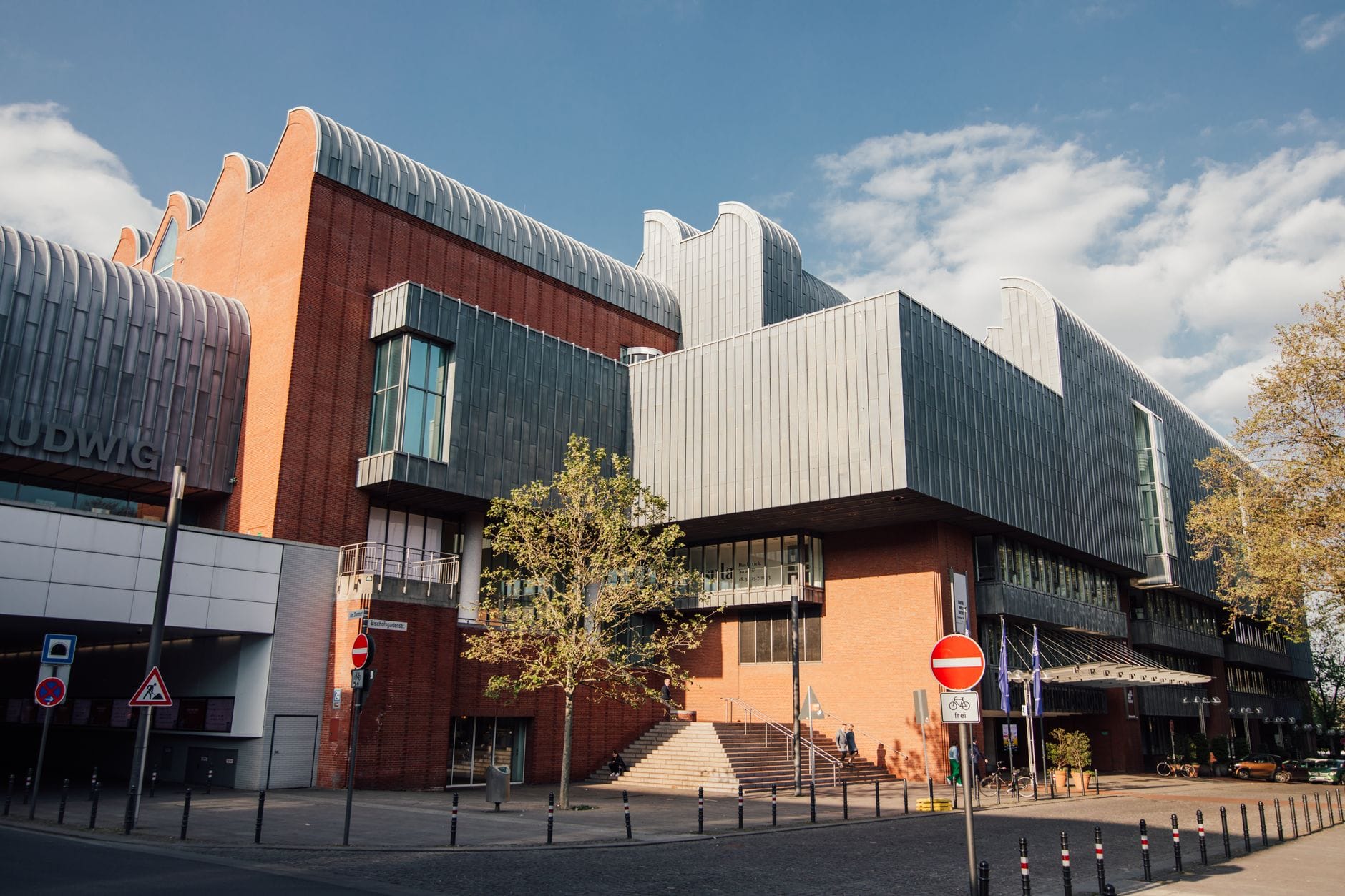
The collection was built on the foundation gift of Peter and Irene Ludwig, a Cologne-based couple who became two of the most consequential private art collectors of the 20th century. They donated their collection to the City of Cologne in 1976, and a decade later, architects Peter Busmann and Godfrid Haberer completed the dedicated building that opened in 1986. The sawtooth roof profile, visible from the riverside promenade, was designed to allow northern light into the upper galleries — a practical architectural decision that also makes the building recognizable from across the Rhine.
The museum covers around 8,000 square meters of exhibition space across multiple floors, split between permanent collection galleries and rooms dedicated to temporary special exhibitions. If you are working through a Cologne museum itinerary, Museum Ludwig belongs at the top of the list — not because it is obligatory, but because its specific strengths are genuinely hard to match elsewhere.
The Permanent Collection: Where to Focus Your Time
Picasso: The Anchor of the Collection
The Picasso galleries form the emotional and intellectual core of the permanent collection. The Ludwig gift included over 700 Picasso works, spanning paintings, drawings, sculptures, and ceramics. This was not simply wealthy collecting — Peter Ludwig made a deliberate effort to acquire Picasso's late work during a period when many critics dismissed it. Subsequent scholarship and auction prices vindicated that judgment. Walking through these rooms, you encounter Picasso across multiple decades and registers: the structural rigor of his Cubist period, the restless experimentation of his middle years, and the raw, almost confrontational energy of his final canvases.
Unlike the Musée Picasso in Paris or the Fundació Picasso in Barcelona, Museum Ludwig acquired its holdings through private purchase rather than the artist's estate, which means the selection reflects a particular collector's taste rather than a biographical survey. That gives the Cologne holdings a slightly different character: stronger in certain periods, deliberately concentrated rather than encyclopedic.
Pop Art: The American Rooms
The Pop Art collection is the other reason serious visitors travel specifically to Museum Ludwig. Andy Warhol, Roy Lichtenstein, Jasper Johns, Robert Rauschenberg, Claes Oldenburg: the museum holds major works by all of them, acquired by the Ludwigs during the 1960s and early 1970s when Pop Art was still contested rather than canonical. Warhol's large-scale works hang in rooms scaled appropriately for them, and Lichtenstein's comic-panel paintings read very differently at original size than in any reproduction.
These galleries tend to attract a younger demographic than the Picasso rooms, and the works generate consistent conversation and laughter — the art invites it. If you are visiting with older teenagers or anyone who finds traditional modern art cold or inaccessible, this section of the museum often changes that.
Russian Avant-Garde and German Expressionism
The Russian avant-garde holdings include works from the early Soviet period, a collecting area that became politically complicated in the Cold War era and that most Western museums largely neglected. Museum Ludwig did not, which means the collection has depth here that is unusual outside Russia. German Expressionism is also well represented, offering context for understanding how German art developed in the decades before and after the First World War.
💡 Local tip
On the first Thursday of each month, Museum Ludwig stays open until 22:00. Evening visits after 18:00 see significantly thinner crowds and a different atmospheric quality in the galleries, particularly in rooms with skylights as natural light fades. This is the single best time to visit if your schedule permits.
Tickets & tours
Live prices and dates from our booking partner. If you book, we may earn a commission at no extra cost to you.
Cologne haunted places and ghost stories: interactive city game
From 8 €Instant confirmationFree cancellationFood Tour Cologne Sudstadt
From 44 €Instant confirmationFree cancellationCologne brewery tour including 3 Kolsch beer
From 28 €Instant confirmation2-hour afternoon cruise in Cologne at Christmastime
From 25 €Instant confirmationFree cancellation
How the Experience Changes by Time of Day
Mornings from opening at 10:00 until around 11:30 are the quietest period on most days. The Picasso galleries in particular can feel almost private, which makes it easier to stand in front of individual works without the pressure of people moving behind you. The sawtooth skylights bring in clean northern light that illuminates canvases evenly — the effect is noticeably better on overcast days than on direct sun, which creates glare on certain glazed works.
Between noon and 15:00, especially on weekends, the museum fills considerably. School groups arrive in the upper floor galleries, and the main entrance area becomes congested during the lunch period. If you are visiting on a Saturday or Sunday and arrive after midday, expect to share the popular galleries with large numbers of people. This affects the experience in the Warhol rooms particularly, where the works are large and crowd-reading changes significantly.
Late afternoons from 16:00 onwards see crowds thin again on weekdays. The final hour before closing (17:00) is peaceful but leaves little time to move through the collection properly. On first-Thursday evenings, the museum takes on a different character entirely: the demographic skews younger, the lighting in certain galleries shifts to artificial, and the atmosphere becomes more social. Some visitors treat it as a cultural evening out rather than a concentrated study visit — both approaches work.
The Building Itself: Architecture Worth Noticing
The 1986 Busmann and Haberer building was controversial at the time of its construction, partly because it sits in the visual shadow of the Cologne Cathedral. The architects addressed this by keeping the roofline low and fragmenting the building's mass with the serrated skylight profile. From Heinrich-Böll-Platz, the museum reads as a horizontal counterpoint to the cathedral's vertical emphasis. The result is a building that does not compete with its neighbors but does have a coherent architectural logic of its own.
The ground-level connection between Museum Ludwig and the Romano-Germanic Museum and the Cologne Philharmonie creates a cultural campus effect at Heinrich-Böll-Platz that is worth understanding before you arrive. The square itself acts as a transition zone between the cathedral precinct and the Rhine promenade — crossing it, you move from 2,000-year-old Roman foundations to 20th-century art in about 90 seconds.
Inside, the gallery spaces vary considerably. The upper floors benefit from the skylight system and feel open and airy. Lower-level rooms housing photographs and works on paper are more conventionally lit and more enclosed. The transition between these different spatial registers is part of the building's character — it is not a uniform white cube.
Practical Walkthrough: Getting In and Getting Around
The main entrance is on Heinrich-Böll-Platz, the square that faces the cathedral's eastern facade. From Köln Hauptbahnhof, exit toward the cathedral, walk around the south side of the cathedral, and the museum entrance is directly ahead, roughly a five-minute walk. The Dom/Hauptbahnhof tram and bus stop is even closer — exit toward the Rhine and the museum is immediately visible.
Ticket purchase at the desk is straightforward; there is sometimes a short queue on weekend mornings. The cloakroom accepts bags, coats, and large backpacks, and photography without flash is permitted throughout the permanent collection. Some temporary exhibitions restrict photography — check signage at the entrance to each show. Audio guides are available and cover the permanent collection in reasonable depth, though the Picasso and Pop Art sections are dense enough that some visitors find a gallery plan sufficient.
The museum is fully wheelchair accessible, and wheelchairs are available from the ticket office at no extra charge. Guided tours for visitors with hearing impairments can be arranged through the ticket office in advance. The café on the ground floor is a practical stop mid-visit — it overlooks the Rhine and serves decent food and coffee, which is not always guaranteed at museum cafés.
ℹ️ Good to know
Museum Ludwig is closed on Mondays, except public holidays, and closes entirely on 24–26 December and 31 December–1 January. Opening hours: Tuesday–Thursday 10:00–18:00 and Friday–Sunday 10:00–20:00 (the permanent collection closes at 18:00 on Friday–Sunday); check the museum website for any special late openings linked to events.
When Museum Ludwig Disappoints
Museum Ludwig is not the right choice for every visitor. If you have no particular interest in 20th-century art movements, the experience can feel abstract and the admission price difficult to justify. The permanent collection is genuinely strong, but it rewards visitors who arrive with some frame of reference — even a basic familiarity with Cubism, Pop Art, or Soviet constructivism will make the rooms significantly more rewarding.
Visitors primarily interested in older European painting will find little here for them — the collection begins at the 20th century and does not extend backward. For medieval and Renaissance art, Wallraf-Richartz Museum is the better choice and is located only a short walk away in the same neighborhood.
Special exhibitions vary significantly in quality and relevance. Some are internationally important; others feel niche or academic. Check the museum's website before visiting to see what is currently showing, since the temporary exhibition space is substantial and admission covers both permanent and special exhibitions.
⚠️ What to skip
Ticket prices and exhibition schedules change regularly. Always verify current admission fees and opening hours at museum-ludwig.de before your visit. Prices listed in this guide reflect the most recently published figures but may not reflect current rates.
Situating the Museum in the Altstadt
Museum Ludwig occupies the northern edge of Cologne's Altstadt, the historic core of the city along the Rhine. The Cologne Cathedral is the immediate neighbor to the west. The Hohenzollern Bridge and the Rhine promenade are a two-minute walk to the east. This concentration of landmarks means that Museum Ludwig is easy to combine with a broader Altstadt visit — though the museum alone warrants a dedicated half-day if you intend to engage with the collection seriously.
If you are planning a full day in the area, the Cologne walking tour routes that begin at the cathedral naturally pass Museum Ludwig, making it simple to fold in a visit without backtracking. The Chocolate Museum is a 15-minute walk south along the Rhine promenade, which gives families with children a logical second stop that contrasts well with the contemporary art upstairs.
Insider Tips
- Evening openings linked to events (such as KölnTag or major special exhibitions) are one of the best-kept practical secrets about Museum Ludwig. Crowd levels often drop sharply after 18:30 on these nights, and the gallery experience improves considerably; the café typically stays open later as well—check current details on the museum website.
- The museum's rooftop terrace, when accessible, offers an unusual angle on the cathedral's eastern end and the Rhine. Not all visitors realize it exists — ask at the information desk whether it is currently open.
- Under-18s enter free, which makes Museum Ludwig one of the better free options in the city for families with younger children — provided the children have some tolerance for contemporary art. The Pop Art galleries, with their bold colors and comic-book aesthetics, tend to hold attention better than the more austere painting rooms.
- The museum's permanent collection catalogue is available in the shop and is a serious publication rather than a glossy souvenir. It covers the Picasso and Pop Art holdings in scholarly depth and is worth buying if you want to continue engaging with what you have seen.
- If you arrive on foot from the main station, approach from the north side of the cathedral rather than the south. This route keeps you on the pedestrian zone, avoids the tram tracks, and deposits you directly at the museum entrance without crossing any streets.
Who Is Museum Ludwig For?
- Art lovers with a specific interest in Picasso, Pop Art, or Russian avant-garde who want to see major works in depth rather than survey collections
- Travelers on a rainy or cold day in Cologne who want a full-afternoon indoor experience that rewards slow, attentive looking
- Families with teenagers who respond well to the visual language of Pop Art and contemporary photography
- Visitors combining a broader Altstadt day with the cathedral and riverside promenade — the museum's location makes it an easy addition without extra transit
- Anyone visiting Cologne for more than two days who wants to go beyond the standard sightseeing circuit and engage with the city's cultural infrastructure
Nearby Attractions
Other things to see while in Altstadt (Old Town):
- 4711 House (Dufthaus 4711 / Haus Mülhens)
The 4711 House on Glockengasse is the home of the 4711 Original Eau de Cologne, the famous citrus fragrance developed by Wilhelm Mülhens from 1792 (the earlier Farina fragrance from 1709 is generally considered the original 'eau de Cologne'). Part flagship store, part fragrance museum, and part architectural curiosity, it offers a compact but interesting stop in Cologne's Altstadt-Nord for anyone curious about the city's most famous exports.
- Cologne City Museum (Kölnisches Stadtmuseum)
The Kölnisches Stadtmuseum traces Cologne's extraordinary 2,000-year arc from Roman outpost to Rhine metropolis. Reopened in a striking new home on Minoritenstraße in March 2024, it offers an affordable and intellectually rewarding afternoon in the city's Altstadt.
- Cologne Cathedral (Kölner Dom)
Cologne Cathedral, officially the Hohe Domkirche Sankt Petrus, is Germany's most visited landmark and one of the great Gothic structures on earth. This guide covers tourist ticketing, tower access, the Treasury, and how to make the most of your time there.
- Cologne City Hall (Kölner Rathaus)
The Kölner Rathaus is Germany's oldest city hall, a layered architectural landmark in Cologne's Old Town that spans Gothic, Renaissance, and modern styles.
Planning a trip? Discover personalized activities with the Nomado app.