Cologne's Chocolate Museum: The Complete Visitor Guide
The Schokoladenmuseum Köln (Imhoff Chocolate Museum) traces chocolate from ancient Mesoamerica to modern factory production, all inside a striking building on the Rhine. It draws roughly 650,000–700,000 visitors a year, so knowing when to go and what to skip makes a real difference.
Quick Facts
- Location
- Am Schokoladenmuseum 1a, 50678 Köln, Rheinauhafen peninsula
- Getting There
- Tram to Heumarkt or Ubierring; Bus stop Schokoladenmuseum or Severinstraße
- Time Needed
- 1.5–2 hours for the exhibition; allow extra time on weekends when production lines slow down
- Cost
- Adults from €17.50 (weekday) to €19 (weekend/holiday); children from €10; under-6s free. Prices vary — verify before visiting.
- Best for
- Families with children, curious food lovers, rainy-day culture, history of trade and globalization
- Official website
- www.schokoladenmuseum.de
What the Schokoladenmuseum Actually Is
The Schokoladenmuseum Köln, formally the Imhoff Chocolate Museum, opened on 31 October 1993. Hans Imhoff, then managing director of Cologne-based chocolate manufacturer Stollwerck, founded the institution with the aim of documenting chocolate's full arc: from the cacao groves of pre-Columbian Mesoamerica to the automated production lines of modern confectionery factories. It sits on the Rheinauhafen peninsula in Altstadt-Süd, a finger of land that juts into the Rhine, giving the building a distinctive profile visible from the river.
In terms of scope, few museums in the world dedicate this much floor space to a single food product. The permanent exhibition covers the cultural and ritual significance of cacao among the Maya and Aztec peoples, the commodity's arrival in Europe via Spanish colonial trade routes in the 16th century, and the industrialization that made chocolate affordable to ordinary Europeans in the 19th century. This is not a brand experience or a candy shop dressed up as a museum. The historical sections are serious, dense with artifacts, and genuinely informative.
💡 Local tip
Admission is cheaper on weekdays. Adults pay €17.50 Monday through Friday versus €19 on weekends and public holidays. If you have schedule flexibility, a Tuesday or Wednesday morning visit saves money and noticeably reduces crowd density.
The Building and Its Rhine Setting
The museum's architecture deliberately references its location. The building extends over the water on a raised platform, and its lower levels are visible from the Rhine promenade. On sunny days the reflection of the structure in the river makes for a strong photograph, especially in the late afternoon when the light comes from the west. The surrounding Rheinauhafen district has transformed significantly since the museum opened: the crane houses (Kranhäuser) nearby, with their distinctive upside-down L shape, now define the skyline of the area, and the entire waterfront has developed into one of the more architecturally coherent stretches of the city's riverside.
The walk from the city centre to the museum is worth making on foot. Coming from the Hohenzollern Bridge area, it takes roughly 20–25 minutes along the Rhine promenade, passing the old town waterfront before reaching the Rheinauhafen. This is a pleasant approach in good weather and gives useful spatial context for how the museum sits within the broader riverfront.
Tickets & tours
Live prices and dates from our booking partner. If you book, we may earn a commission at no extra cost to you.
The Exhibition Floor by Floor
The permanent exhibition is organized chronologically across multiple levels. The lower floors focus on origins: the cultivation of Theobroma cacao in Central America, its preparation as a bitter ceremonial drink by the Maya, and the Aztec practice of using cacao beans as currency. The replica artifacts and interpretive displays here are detailed enough to hold the attention of adults, not just children.
The middle section of the museum covers the European chapter: how Spanish explorers brought cacao back to Seville in the 1500s, how it was sweetened and transformed for European palates, and how chocolate houses became social institutions in 17th and 18th century London and Amsterdam before the drink reached wider populations. This section references actual trading documents and historical recipes, and the connection to Cologne's own confectionery industry, including Stollwerck's role in German chocolate history, gives the local context real weight.
The upper floors move into modern production. Here you can watch a working production line demonstrate the process from roasted cacao bean to finished bar. The machinery runs on a schedule, so if you arrive just as production has stopped for the day (it ends approximately 30 minutes before closing), you miss a significant part of the experience. Arriving by early afternoon gives you the best chance of seeing the line in full operation.
⚠️ What to skip
The production line closes approximately 30 minutes before the museum's official closing time, and last admission is 1 hour before closing. Plan your arrival accordingly, especially for late visits.
The Chocolate Fountain: The Thing Everyone Remembers
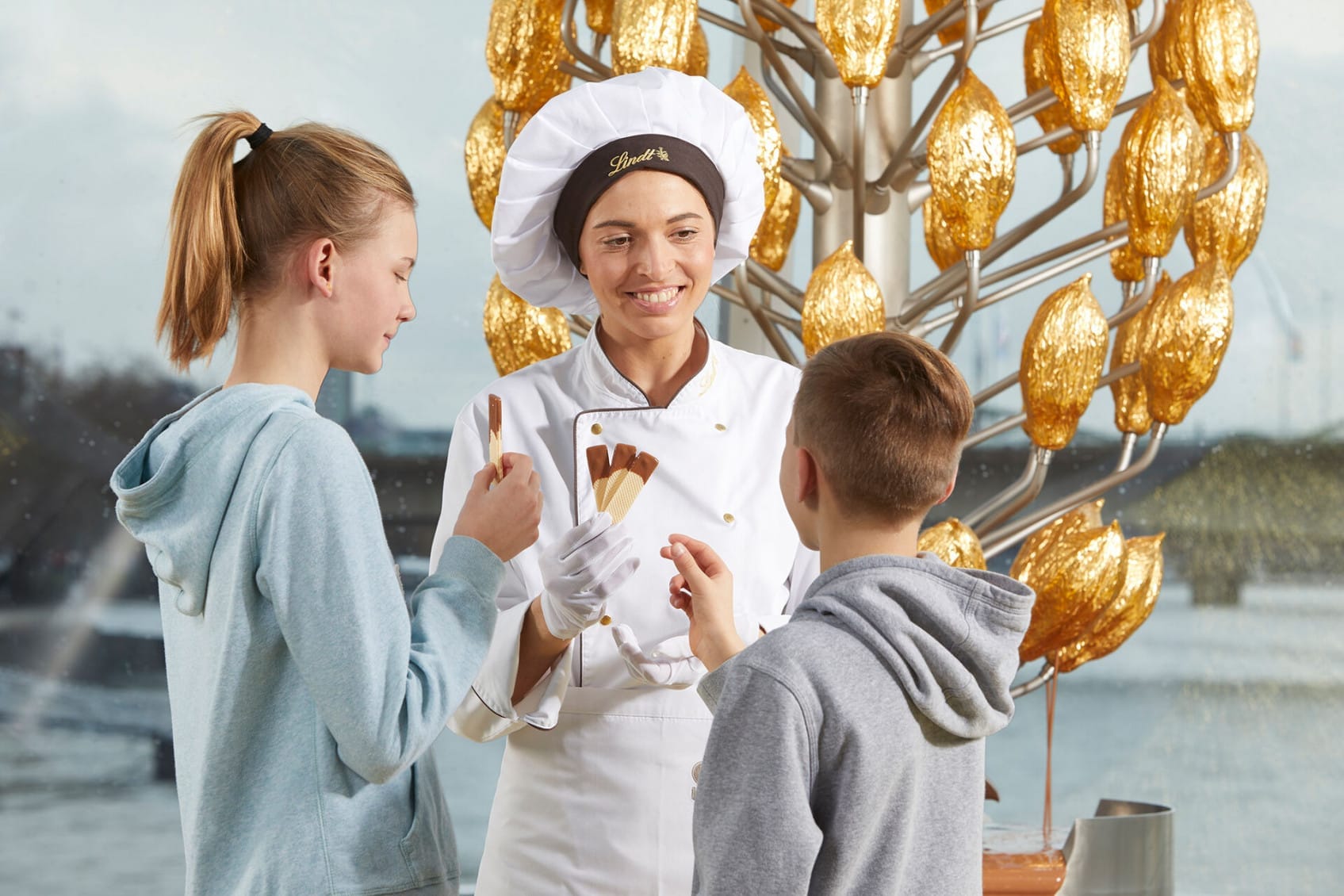
The three-metre-high chocolate fountain is the visual centrepiece of the museum and the image most visitors photograph within five minutes of entering. Liquid couverture chocolate cascades continuously over a tiered gold structure. Staff members dip wafers into the chocolate and hand them to visitors, which is the one genuine free sample included with admission.
The fountain is theatrical and genuinely impressive in person, more so than photographs suggest, partly because of the warm cocoa aroma that concentrates in that section of the building. It is also, predictably, the most crowded spot in the museum at almost any hour. On weekend mornings, school groups and family parties cluster around it densely. If you want a photograph without twenty other people in the frame, visit on a weekday morning before 11:00 or in the final hour before closing on a quiet day.
Crowds, Timing, and the Honest Reality
The Schokoladenmuseum draws roughly 650,000–700,000 visitors a year and is consistently one of Germany's most visited private museums. That figure means crowds are a genuine operational reality, not an occasional inconvenience. Weekend afternoons in summer and during school holidays are particularly packed, with queues forming at the entrance and congestion inside the production floor sections.
The museum is closed on Mondays from January through March and in November, so check the calendar carefully if you are visiting in winter. It is also closed on 24 and 25 December, with reduced hours on certain other holiday dates including New Year's Eve and New Year's Day. Always check the official website for current hours before planning your trip.
The museum is an excellent option for a rainy day in Cologne, when outdoor alternatives lose their appeal. If you are building a multi-day itinerary, pairing the museum visit with a walk through the Rheinauhafen district and the nearby old town works well as a single afternoon. The Kranhäuser are a five-minute walk and worth a look from the outside.
ℹ️ Good to know
Weekday mornings between 10:00 and 12:00 are the quietest window. Families with younger children tend to arrive mid-morning; solo visitors and couples who prefer a calmer pace should aim for opening time on a Tuesday, Wednesday, or Thursday.
Practical Information for Your Visit
The museum is fully accessible for wheelchair users and visitors with mobility needs. The building was designed with level access across the main exhibition floors, and the address is well-served by public transport. Trams stop at Heumarkt; bus stops named Schokoladenmuseum are within a short walk, and the Schoko-Express tourist train connects directly from the cathedral. If you are driving, paid parking is available in the Rheinauhafen facilities adjacent to the museum.
The on-site shop is large and well-stocked, with a wide range of chocolate products available for purchase. Prices are noticeably higher than supermarket equivalents, but the selection of specialty items including single-origin bars, cocoa products, and museum-branded confectionery is genuinely broader than what you find in regular retail. Budget some time at the exit if you intend to buy gifts: it can get congested on busy days and the shop itself is worth browsing slowly.
If you are coordinating a broader day of sightseeing, the museum pairs logically with the Wallraf-Richartz Museum to the north, or with a walk along the Rhine toward the Cologne Cathedral. Both are reachable on foot within 20–30 minutes from the Rheinauhafen. For practical guidance on structuring a day in the city, the Cologne walking tour guide covers logical routes between the main sights.
Who Should Skip It (and Who Should Not)
Visitors who prioritize fine art, contemporary architecture, or Cologne's Roman history will find other institutions more rewarding. The museum's subject is specific and the experience is heavily weighted toward families and food history enthusiasts. Adults travelling without children who have limited time in the city and need to choose between this and the Museum Ludwig, the Romano-Germanic Museum, or the Kolumba Art Museum should probably prioritize those depending on their interests.
That said, anyone with a genuine interest in the history of global trade, colonialism, or food culture will find the early sections of the exhibition substantive rather than superficial. The story of how cacao moved from ritual drink to mass-market commodity touches on genuinely significant historical forces. For context on Cologne's broader museum landscape, the best museums in Cologne guide helps set realistic expectations across the city's main institutions.
Insider Tips
- Arrive at opening time on a Tuesday or Wednesday for the most relaxed experience. The first hour after 10:00 is consistently the quietest, with short queues at the fountain and clear sightlines on the production floor.
- The chocolate fountain wafer sample is included in your ticket, but additional tasting workshops and praline-making sessions cost extra and require advance booking. Check the official website for current workshop schedules before your visit.
- The museum's riverside terrace offers a direct view across the Rhine toward Deutz. In good weather, spending ten minutes here before or after the exhibition is worthwhile, especially in late afternoon light.
- If you are visiting with children under 10, the lower historical floors (Maya and Aztec sections) hold attention less reliably than the production line and fountain. Consider starting at the top floor and working downward to keep energy levels engaged before the more text-heavy sections.
- The museum shop sells a number of items not widely available in Cologne's retail stores. If you are looking for chocolate gifts to take home, buying here after your visit is more efficient than hunting through the Altstadt shops.
Who Is Chocolate Museum (Schokoladenmuseum) For?
- Families with children aged 5 and older
- Food history and cultural history enthusiasts
- Rainy-day visitors looking for a full half-day activity indoors
- Travellers interested in the global history of commodity trade
- Groups that include visitors with mobility needs, given full accessibility
Nearby Attractions
Other things to see while in Rheinauhafen:
- Crane Houses (Kranhäuser)
The Kranhäuser are three L-shaped residential and office towers rising 62 metres above the Rheinauhafen harbour district, their cantilevered upper floors mimicking the silhouette of the old port cranes that once operated here. Free to visit as an outdoor landmark, they're the centrepiece of one of Cologne's most dramatic waterfront regeneration projects.
Planning a trip? Discover personalized activities with the Nomado app.