Crane Houses (Kranhäuser): Cologne's Bold Statement on the Rhine
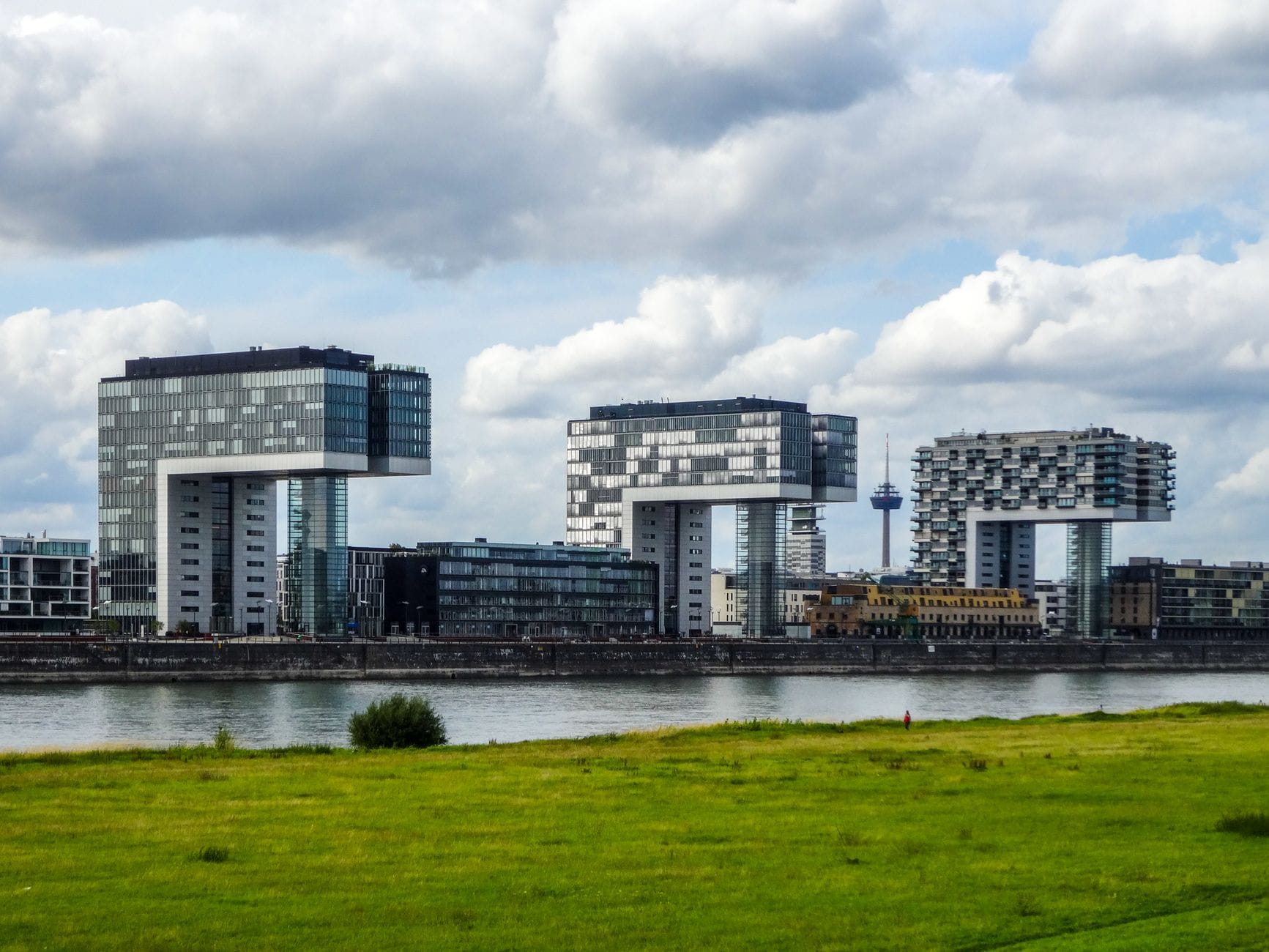
The Kranhäuser are three L-shaped residential and office towers rising 62 metres above the Rheinauhafen harbour district, their cantilevered upper floors mimicking the silhouette of the old port cranes that once operated here. Free to visit as an outdoor landmark, they're the centrepiece of one of Cologne's most dramatic waterfront regeneration projects.
Quick Facts
- Location
- Im Zollhafen, 50678 Köln (Rheinauhafen district)
- Getting There
- Tram 15 or 16 to Ubierring; Bus 133 to Rheinauhafen
- Time Needed
- 30–60 minutes to walk the waterfront and appreciate the architecture
- Cost
- Free (outdoor landmark; no admission fee)
- Best for
- Architecture enthusiasts, photographers, evening riverside walks
- Official website
- www.cologne-tourism.com/arts-culture/sights/detail/crane-houses
What Are the Kranhäuser?
The Crane Houses, known in German as the Kranhäuser, are three high-rise towers that define the southern tip of Cologne's Rheinauhafen waterfront. Completed between 2006 and 2010, each building stands roughly 61.6 to 61.9 metres tall, 70.20 metres long, and 33.75 metres wide. What makes them immediately recognisable is the structural cantilevered top section: the upper floors extend horizontally over the water on one end, replicating the profile of the massive hydraulic portal cranes that once loaded and unloaded cargo here. It's not a decorative gesture. It's a structural feat, and it shows.
The Rheinauhafen district itself is a former inner-city harbour that fell into industrial decline across the latter half of the 20th century. Its transformation into a mixed-use waterfront quarter is one of the larger urban regeneration projects in western Germany, and the Kranhäuser are its visual anchor. If you're already planning to explore the area, the Rheinauhafen neighbourhood has significantly more to offer beyond just the towers themselves.
💡 Local tip
The Kranhäuser are private buildings: two towers are office complexes and one contains luxury residential apartments. You cannot enter or tour the interiors. The experience is entirely about the exterior and the waterfront promenade around them.
The Architecture Up Close
Standing at the base of any of the three towers, the scale becomes immediately apparent in a way that photos don't prepare you for. The façades are clad in dark metal and glass panels that shift colour throughout the day, reading as near-black under overcast skies and catching sharp silver light in the afternoon sun. The underside of the cantilevered upper section looms overhead like an overhang, and on windy days the Rhine air funnels through the gap between the elevated section and the ground floors with noticeable force.
The three towers are positioned along the harbour basin in sequence, giving the promenade a rhythmic quality as you walk south from the city centre. They are not identical: subtle differences in fenestration and the angle of the cantilever distinguish them on close inspection, though at a glance the family resemblance is strong. The design was conceived by the architectural firm Bothe Richter Teherani (BRT Architekten), with architect Alfons Linster also involved through an earlier urban development competition, and the buildings have since become a standard reference point in discussions of post-industrial waterfront redevelopment in Europe.
For architecture enthusiasts, the Kranhäuser pair well with a broader exploration of Cologne's architectural contrasts. The city contains some of Europe's most significant Romanesque churches, and the Romanesque churches of Cologne sit within a few kilometres of the Rheinauhafen, making for a rewarding half-day that spans a thousand years of building history.
Tickets & tours
Live prices and dates from our booking partner. If you book, we may earn a commission at no extra cost to you.
Cologne haunted places and ghost stories: interactive city game
From 8 €Instant confirmationFree cancellationFood Tour Cologne Sudstadt
From 44 €Instant confirmationFree cancellationCologne brewery tour including 3 Kolsch beer
From 28 €Instant confirmation2-hour afternoon cruise in Cologne at Christmastime
From 25 €Instant confirmationFree cancellation
How It Changes by Time of Day
Morning visits, particularly on weekdays, are quiet. The promenade is used by joggers and cyclists commuting along the Rhine path, and the towers catch low eastern light on their glass panels from the opposite bank. The water in the harbour basin is calm at this hour, and the reflections of the buildings are sharp and almost perfectly inverted. It's the best time for photography if you want clean lines and minimal crowd interference.
Midday brings more foot traffic, particularly in summer, when office workers from the Rheinauhafen buildings use the promenade for lunch breaks and the café terraces along the waterfront fill up. The towers look their most monumental under direct overhead light, the shadows minimal and the scale impossible to ignore.
Sunset is when the Kranhäuser genuinely earn their reputation. As the sun drops toward the western bank, it lights the Rhine from behind the old town and catches the southern-facing glass panels of the towers in full. The sky over the river turns amber and the dark metal cladding absorbs the colour differently than the glass, creating a layered effect that lasts for about 20 minutes. This is the hour the promenade fills with people walking deliberately slowly and holding cameras at various angles. If you want the shot without other visitors in frame, arrive 30 minutes before sunset and find your position early.
💡 Local tip
For the best photography angle, walk to the far southern end of the Rheinauhafen promenade and look back north toward the towers with the Rhine to your right. This gives you all three buildings in frame with the river in the foreground.
The Historical Context: From Working Port to City Showpiece
The Rheinauhafen was constructed in the late 19th century as an inland port to handle Rhine river trade, and it functioned as a working harbour for most of the 20th century. The original crane infrastructure, massive steel portal cranes capable of lifting heavy cargo between barges and warehouse floors, gave the harbour its industrial character. As river freight declined in favour of road and rail transport, the harbour’s facilities became outdated and plans for conversion to leisure and mixed-use development were set in motion from the mid-1970s onward.
The redevelopment plan that produced the Kranhäuser was conceived as a way to reconnect this stretch of Rhine riverfront with the city. Rather than demolishing all industrial memory, the design brief explicitly called for references to the crane silhouette in whatever new buildings rose on the site. The result is an unusual architectural gesture: buildings that quote their industrial predecessors not in materials or colour but in overall form. Whether that constitutes meaningful historical continuity or sophisticated branding is a question worth turning over as you walk the promenade.
The Rheinauhafen also contains the Chocolate Museum, which sits at the northern end of the harbour peninsula and draws considerable visitor traffic year-round. The two attractions are roughly 15 minutes apart on foot along the promenade.
Getting There and Moving Around
The most practical public transport option is tram lines 15 or 16 to the Ubierring stop, from which the Kranhäuser are a short walk south along the riverbank. Bus line 133 also serves the Rheinauhafen more directly. From Cologne Central Station (Köln Hauptbahnhof), the walk along the Rhine promenade takes around 25 to 30 minutes and passes the Hohenzollern Bridge and the old town waterfront, which makes it a pleasant route if weather allows.
The Rheinauhafen is well-served by cycling infrastructure and the Rhine riverside cycle path runs directly past the Kranhäuser. If you're using a rental bike or have brought your own, the route from the central Rhine promenade to the towers is flat and clearly marked. Parking is available at Parkhaus Rheinauhafen, Harry-Blum-Platz 2, for visitors arriving by car.
The promenade itself is at street level and accessible without steps, making it generally suitable for pushchairs and wheelchair users. The waterfront surface is paved and well-maintained. If you're combining this with a Rhine cruise, some boat services stop near the Rheinauhafen; the Rhine river cruise guide outlines the main departure points and routes.
What to Combine It With
The Kranhäuser work well as part of a longer south-bank walk. Starting from the Hohenzollern Bridge and moving south through the old town waterfront, then continuing into the Rheinauhafen, covers some of Cologne's most visually varied riverfront in a single route of about 2.5 to 3 kilometres. You pass the Altstadt waterfront cafés, the entrance to the Chocolate Museum, the marina, and finally the towers themselves at the southern tip of the peninsula.
For a focused architectural half-day, combine the Kranhäuser with the Cologne City Hall and the area around the old town, where the layering of medieval, 19th-century, and postwar reconstruction architecture is most visible. If views are a priority, the Cologne Triangle panorama on the opposite bank of the Rhine offers a direct elevated view toward the Rheinauhafen from across the river.
ℹ️ Good to know
The Rheinauhafen has a reasonable selection of restaurants and cafés along the promenade, several with outdoor seating facing the harbour basin. Prices are on the higher side compared to the old town, which reflects the newer development and the clientele of the adjacent office buildings.
Who Might Want to Skip This
The Kranhäuser are an outdoor architectural landmark with no interior access. Visitors hoping to go inside, take a lift to an observation deck, or have an interactive experience will find nothing of that kind here. In poor weather, particularly heavy rain or low grey fog that obscures the upper floors, the visit loses most of its visual impact and the promenade becomes an unpleasant place to linger. The buildings are also primarily of interest to those who engage with architecture on some level: travellers focused entirely on museums, history, or food may find the detour to the Rheinauhafen a poor use of limited time unless they combine it with the Chocolate Museum.
Children generally find the towers visually striking for about five minutes before the lack of interactive elements becomes apparent. Families with young children will get more from the visit if they build in time at the waterfront playground nearby or plan the Chocolate Museum as the main event with the Kranhäuser as a walking-past bonus.
Insider Tips
- Walk to the end of the southernmost Kranhaus pier and look back north along the full row of three towers: this is the angle most commonly used in architectural photography of the site, and it's more dramatic in person than in images.
- The marina basin between the towers and the main promenade reflects the buildings on still mornings. Arrive before 9am on a calm weekday for near-perfect reflections with nobody in the shot.
- The metal cladding on the towers changes character dramatically depending on the season. In winter, under flat grey skies, it reads nearly black and severe. In summer evening light it picks up warm amber tones that contradict the industrial aesthetic.
- There are benches along the promenade facing the harbour basin at the base of the towers. Sitting here for 15 minutes rather than walking straight past gives your eyes time to process the scale and the structural logic of the cantilever.
- If you want to understand how the towers relate to the surrounding city skyline, the observation deck of the Cologne Triangle across the Rhine gives you a wide elevated view that places the Kranhäuser in context with the cathedral, old town, and the full arc of the riverfront.
Who Is Crane Houses (Kranhäuser) For?
- Architecture and design enthusiasts wanting to see a successful example of post-industrial waterfront redevelopment
- Photographers targeting dramatic Rhine riverfront compositions, especially at golden hour
- Visitors combining a longer south-bank Rhine walk with multiple stops along the waterfront
- Travellers with limited time who want a free and visually impressive stop that can be done in under an hour
- Couples looking for a scenic evening walk along a quieter stretch of the Rhine away from the old town crowds
Nearby Attractions
Other things to see while in Rheinauhafen:
- Chocolate Museum (Schokoladenmuseum)
The Schokoladenmuseum Köln (Imhoff Chocolate Museum) traces chocolate from ancient Mesoamerica to modern factory production, all inside a striking building on the Rhine. It draws roughly 650,000–700,000 visitors a year, so knowing when to go and what to skip makes a real difference.
Planning a trip? Discover personalized activities with the Nomado app.